A tambola ticket book is a numbered set of tickets that you print once, cut apart and hand out, with no two tickets alike. This page gives you three free books as PDFs: 6 tickets, 60 tickets and 600 tickets, each in US Letter and A4. Every ticket is a valid 3 by 9 tambola ticket, and every group of six is a strip that uses each number from 1 to 90 exactly once. If you also call the game with a number caller, you have everything for an evening of tambola, which is also called housie or 90-ball bingo.
In short: download the book that matches your crowd, print it, cut along the boxes and give each player a numbered ticket. A book of 6 suits a family, a book of 60 suits a kitty party or a classroom, and a book of 600 suits a society event, a wedding or a fundraiser. Need your own names, colors or pictures instead? The tambola ticket generator makes custom tickets, and this page opens the same card maker below.
Download your free tambola ticket book
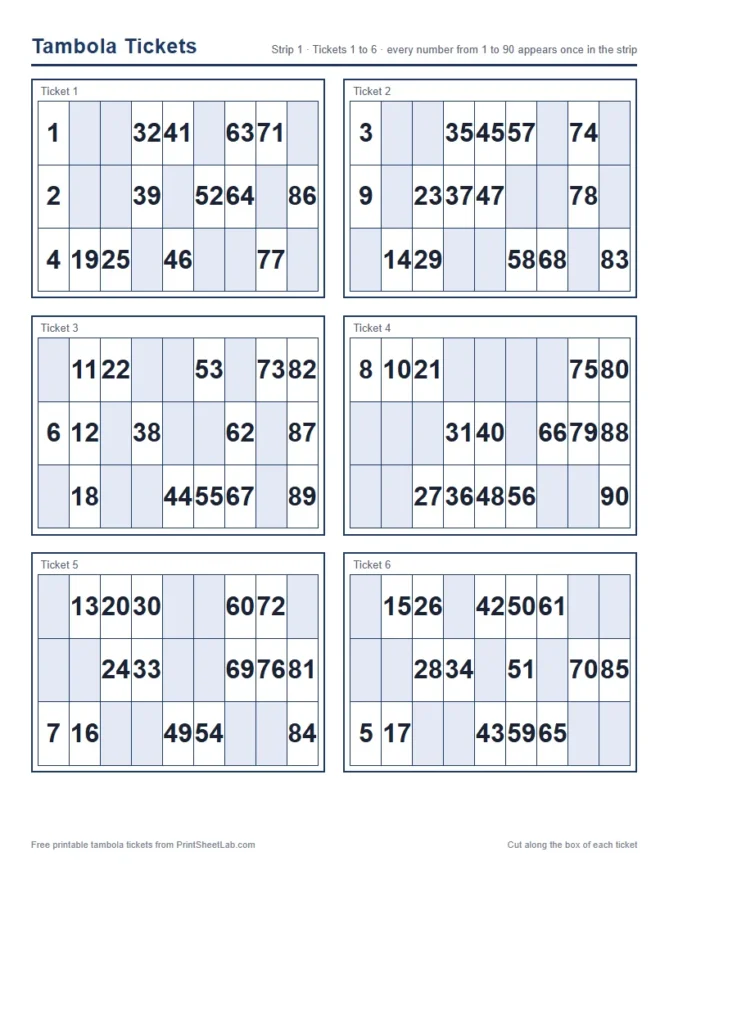
Pick a size and a paper format for your tambola ticket book. Each file is a single PDF with one strip of six tickets on every page, each ticket numbered, so a book of 600 has 100 pages and a book of 60 has 10. The files are small enough to email or share in a group chat: the 6-ticket book is 43 KB, the 60-ticket book about 75 KB and the 600-ticket book about 401 KB.
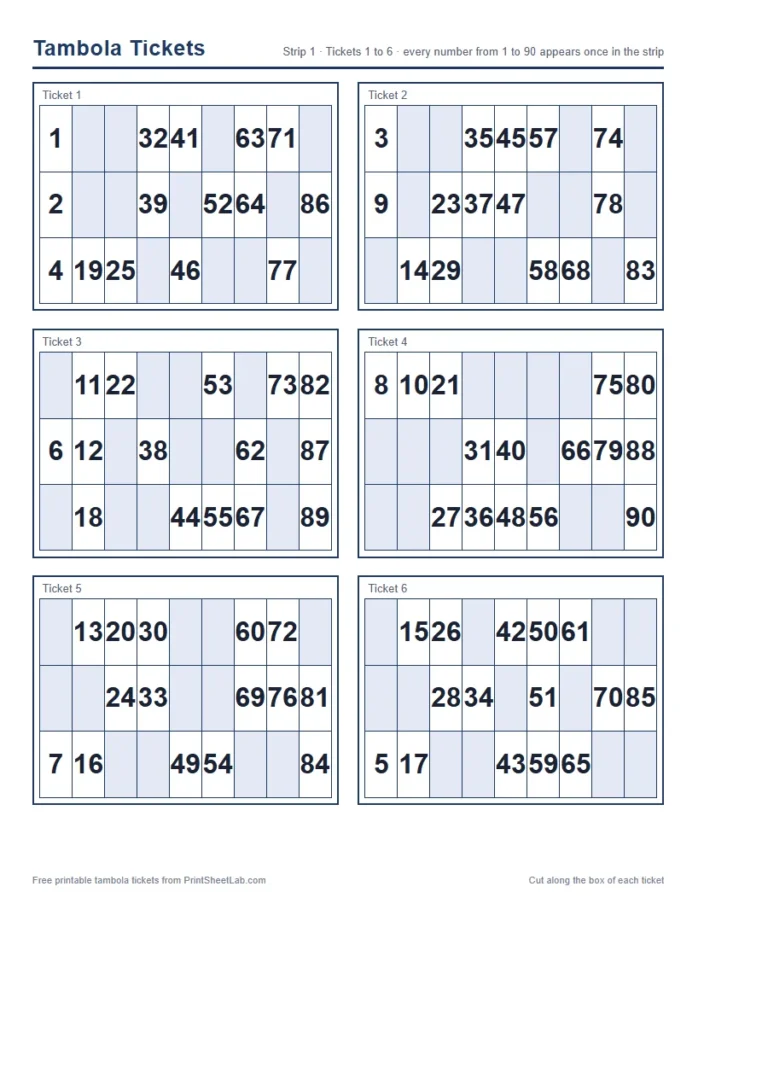
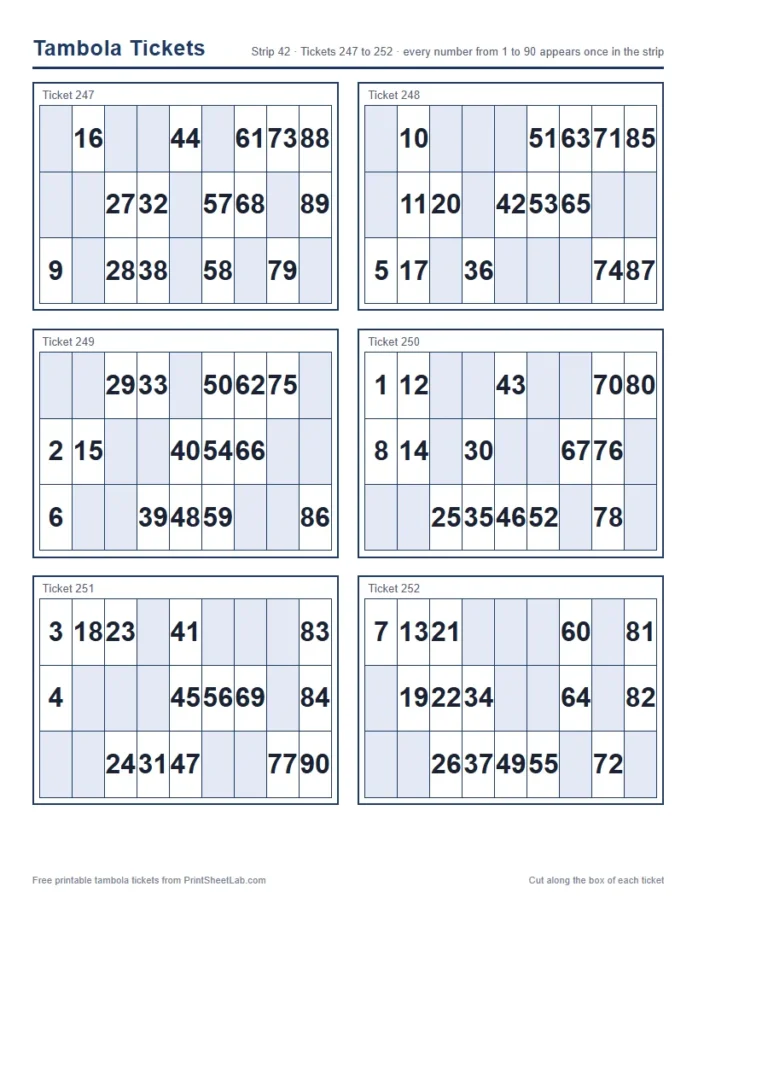
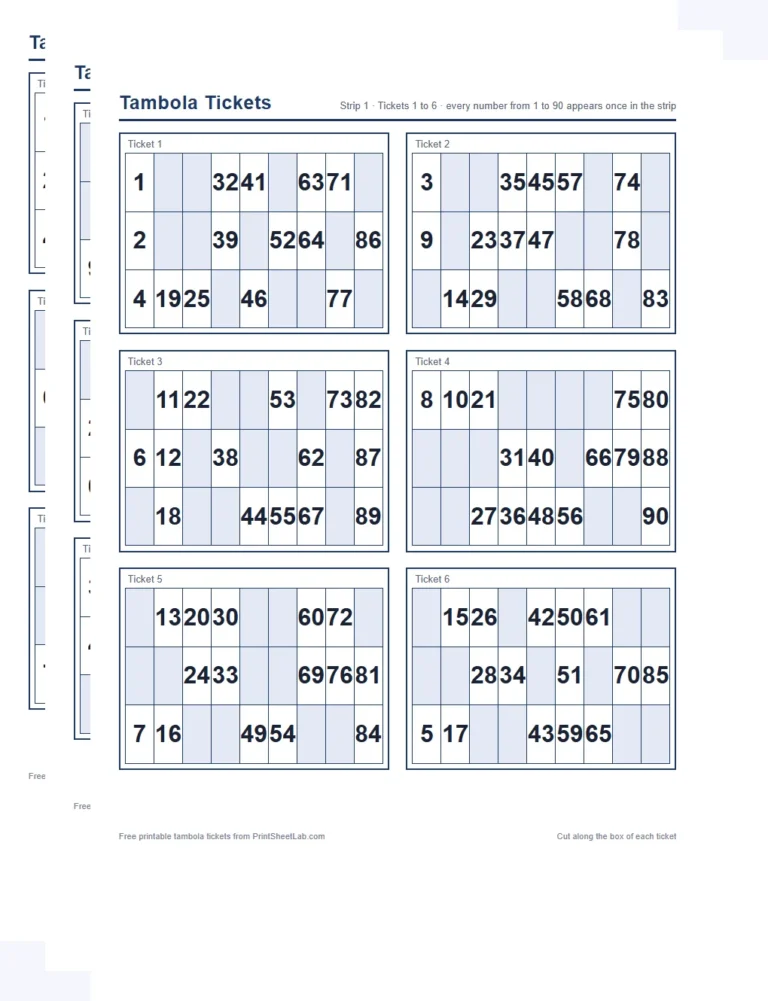
The tickets in the tambola ticket book are the same in the Letter and A4 versions, so you can mix a Letter print from one person with an A4 print from another without losing the numbering. The books are the same for everyone who downloads them, which is fine for a single game. If two groups play at the same time and compare notes, use the generator below for one of them so that they do not hold identical tickets.
What is in a housie ticket book and a tambola ticket book
A housie ticket book, or tambola ticket book, is what players in India, the United Kingdom and many other places mean when they ask for a book of tickets. The word “book” comes from the printed pads that organizers once bought and tore off, and the name stuck for the PDF version.
A good tambola ticket book has two properties that casual printouts often lack: every ticket is legal, and the tickets are grouped into strips so that a game stays fair. The British 90-ball game is played with the same ticket layout, which is why you will also hear the cards called 90-ball bingo tickets.
The rules every ticket in the tambola ticket book follows
| Rule | What it means | How the book checks it |
|---|---|---|
| Grid | 3 rows and 9 columns, 27 squares | Every ticket is printed as a 3 by 9 table |
| Numbers per ticket | Exactly 15 numbers, the other 12 squares are blank | Counted for all 600 tickets |
| Numbers per row | Exactly 5 numbers in every row | Counted for all 1,800 rows |
| Column ranges | 1 to 9 in the first column, 10 to 19 in the second, and so on up to 80 to 90 in the ninth | Every number sits in its own column |
| Column order | Numbers in a column rise from top to bottom | Checked on every column |
| Numbers per column | At least one and at most three numbers in each column of a ticket | Checked on every ticket |
| Strip | Six tickets that together contain each number from 1 to 90 once | Checked on all 100 strips |
| No duplicates | No two tickets in the book are the same | All 600 tickets compared |
These are the rules that make a ticket a tambola ticket, and the tambola ticket book follows all of them. A card that breaks one of them, for example by holding six numbers in one row, plays differently and can cause arguments, so the book was checked by a program rather than by eye. Every one of the 100 strips and 600 tickets passed every check in the table.
Tambola ticket strips: why six tickets in the tambola ticket book belong together
Tambola ticket strips are the reason a tambola ticket book is more than a pile of tickets. A strip has six tickets, each with 15 numbers, so the strip holds 90 numbers, which is exactly the numbers 1 to 90 once each. Because of that, if one person held a whole strip, every number the caller drew would be on one of their six tickets. Nothing is missing and nothing repeats.
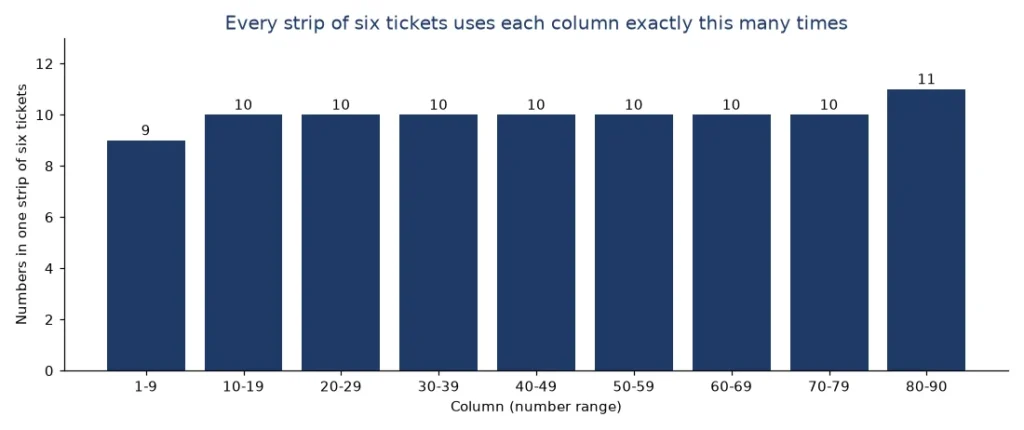
The column counts follow from the number ranges. The first column covers only 1 to 9, so one strip holds 9 numbers there; the last column covers 80 to 90, so it holds 11; the seven middle columns hold 10 each. Nine plus seven tens plus eleven is 90. Each ticket must also keep 15 numbers in total, so the builder has to share those column counts out among six tickets without giving any ticket more than three in a column or fewer than one. The chart shows the count per column.
How we built the strips
The program builds each strip in three steps. First it decides how many numbers each ticket gets in each column, so that every column adds up to its total and every ticket reaches 15. Second, for every ticket, it chooses which of the three rows each number goes in, so that each row holds exactly five.
Third, it shuffles the numbers of each column among the six tickets that need them, sorts them from top to bottom, and writes them into the rows chosen in step two. If the first two steps cannot be satisfied it starts again. The result was checked against the rules above before it was added to the book.
Which tambola ticket book size do you need: the tambola book of 60 tickets or another?
The right tambola ticket book depends on how many people play and how you want to hand tickets out. A rule of thumb that works for most parties is one ticket per person for a short game, and two or three tickets per person for a long game with small prizes. The table gives sizes and a typical use for each book.
| Book | Strips | Pages | Good for | Typical setup |
|---|---|---|---|---|
| 6 tickets | 1 | 1 | Families and small groups of up to 6 players | One ticket per person, or two each for 3 players |
| 60 tickets | 10 | 10 | Kitty parties, classrooms, office teams and friends | One ticket each for up to 60 people, or three each for 20 |
| 600 tickets | 100 | 100 | Wedding receptions, community and society events, school fundraisers | Sell or hand out tickets by number, and keep a register |
The tambola book of 60 tickets is the one most hosts need, because most kitty parties and classroom games have between 15 and 40 players. If you have fewer than 60 players, print only the pages you need. You do not have to use full strips, but using full strips has one benefit: when you give out whole strips, you know every number has an owner.
Handing out tickets fairly
Fairness matters most when there are prizes. A player who holds a whole strip of six tickets can mark every number called, so they have six chances for each dividend, while a player with one ticket has one. If everyone holds the same number of tickets, the game is fair. The simplest rule is to give each player the same number of tickets, from different strips, and write the ticket numbers on a sign-in sheet so you can check a claim by looking up the number. The numbers printed above each ticket make that easy.
How a game works with the tambola ticket book
The host draws numbers from 1 to 90 at random and calls them out, and players mark the numbers on their tickets. The usual prizes, called dividends, are Early Five (the first player to mark any five numbers), Top Line, Middle Line, Bottom Line, Four Corners (the first and last number of the top and bottom rows) and Full House (all 15 numbers). The tambola dividends guide explains each prize and how to split a prize pool, and how to play tambola covers hosting step by step.
You need a way to draw the numbers. The free tambola number caller calls each number once, in random order, with the traditional nickname if you like, and has a box to check a winning ticket against the numbers called. For the nicknames, see housie number calls and bingo calls and nicknames.
How long a game lasts with this tambola ticket book
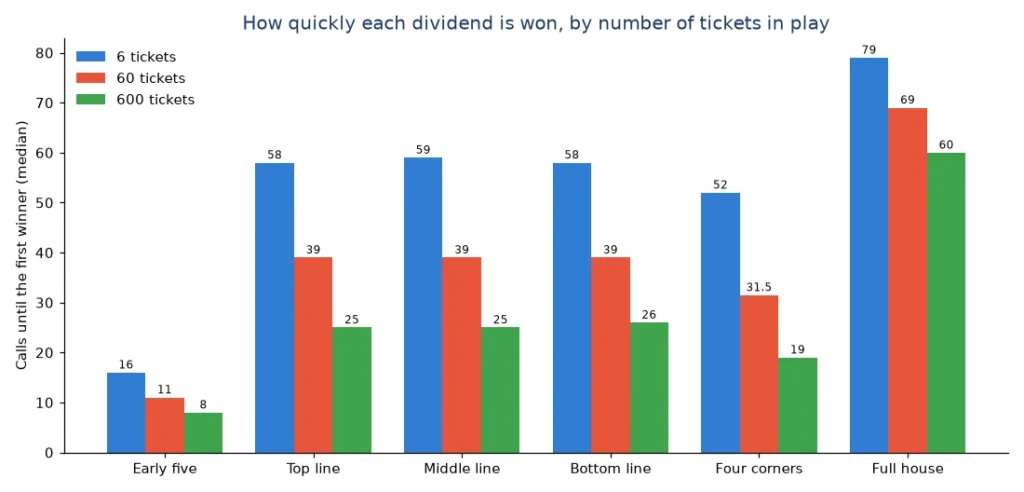
We simulated games on the real tickets in this tambola ticket book. Each game draws the 90 numbers in random order and records the call on which the first ticket in play wins each dividend. Each result below is the median of 2,000 games, with the middle half of games in brackets. Six tickets means strip 1 only, 60 tickets means the first 10 strips and 600 tickets means the whole book. Four Corners uses the first and last number of the top and bottom rows of a ticket.
| Dividend | Calls with 6 tickets | Calls with 60 tickets | Calls with 600 tickets |
|---|---|---|---|
| Early Five | 16 (14 to 19) | 11 (9 to 12) | 8 (7 to 8) |
| Top Line | 58 (50 to 66) | 39 (33 to 44) | 25 (22 to 30) |
| Middle Line | 59 (51 to 66) | 39 (33 to 44) | 25 (22 to 29) |
| Bottom Line | 58 (50 to 65) | 39 (32 to 45) | 26 (22 to 30) |
| Four Corners | 52 (43 to 61) | 31.5 (26 to 38) | 19 (16 to 23) |
| Full House | 79 (75 to 81) | 69 (66 to 72) | 60 (57 to 63) |
The pattern is easy to read. With only six tickets in play, a line needs around 58 calls and the full house about 79, so a family game of one strip is long and the late numbers matter. With 60 tickets the lines come after about 39 calls and the full house after about 69. With all 600 tickets in play the first line appears around call 25 and the full house around call 60. If you want faster games, give out more tickets, and if you want a longer evening, give out fewer.
Plan the length of the evening with the same figures. At a call every eight seconds, a full house with 60 tickets in play arrives after roughly nine minutes of calling, and the whole session of six dividends fits inside a quarter of an hour of calling plus the time for claims and prizes. Slow the calls down for children or seniors.
Tambola ticket book PDF: what is in each file
Each tambola ticket book PDF is a plain document with no password, no watermark and no sign-up. A page holds one strip, so the first page has tickets 1 to 6, the second page has tickets 7 to 12, and so on up to tickets 595 to 600 on page 100. The ticket number is printed in small type above each ticket, and the strip number and ticket range are printed in the page header, so a lost ticket is easy to replace and a claim is easy to check.
Open the tambola ticket book PDF in any viewer and choose the pages to print. Because the document is vector text rather than a picture, the numbers stay sharp at any size and the file stays small. If your printer adds a margin, the tickets still fit, because the layout leaves room at the edges of the page for the usual unprintable area.
A free tambola ticket book for every kind of event
The same free tambola ticket book works for very different crowds. These are the setups hosts use most often, with the book size that fits each one.
Tambola ticket book for a kitty party
A kitty party usually has between 12 and 40 guests, so the book of 60 is the right choice. Print the ten pages, cut them into 60 tickets and give each guest one or two. Choose a different prize for each dividend, from Early Five to Full House, and keep the game short enough to fit between lunch and the next round of chai. If your group likes themes, the free tambola ticket book gives you the plain numbered tickets and a themed set from the generator gives you the pictures.
Tambola ticket book for a classroom
Teachers can use a tambola ticket book for number practice. A class of 30 needs 30 tickets, which is five pages of the 60-ticket book. Children listen for the number, find it in the right column and learn that the first column holds the numbers below ten and the last column holds the eighties. For younger classes, laminate the tickets once and reuse them with counters, then wipe them clean for the next lesson. The same tambola ticket book serves a different class every week.
Tambola ticket book for weddings, societies and fundraisers
For a large crowd, the 600-ticket tambola ticket book lets you sell or give out tickets by number and keep a register of who holds which one. Numbers are printed on every ticket, so you can check a claim by looking up the ticket, and the strips make sure that the numbers you call all belong to somebody. A fundraiser can sell tickets at a fixed price and give out prizes donated by local shops. Check local rules on games of chance and prizes before you sell tickets, because they differ from place to place.
Printing and cutting tips
- Pick the right paper. Use the Letter files in the United States and Canada and the A4 files almost everywhere else. Print at 100% size, not “fit to page”, so the tickets stay the same size.
- Print black and white if you like. The tickets use dark numbers on light cells and look fine on a monochrome printer. Blank squares are shaded so they are easy to tell from numbers.
- Use thicker paper for events. Card stock survives a long evening and many handlings. For classroom games, laminate a set and use dry-erase markers or counters, then wipe the tickets clean.
- Cut along the boxes. Six tickets fit on a page in two columns and three rows. A paper cutter is faster than scissors for 100 pages.
- Keep strips together until you hand them out. That makes it easy to share tickets from different strips and to find a ticket by its number.
- Print a spare set. Have a few tickets ready for late arrivals, and keep a master copy of the pages for checking claims.
Make your own tambola tickets instead of the standard tambola ticket book
A tambola ticket book is the fastest way to start. If you want a themed or personal set, use the card maker that opens on this page. It builds classic 3 by 9 tickets, prints up to 100 different tickets in a PDF, and lets you add a title, names, a logo and colors, so you can have a kitty party set or a school fundraiser set with your name on it.
For illustrated tickets with pictures in each square and prizes printed on the page, see the 25 ready-made sets on the theme tambola page, or the festival pages such as kitty party tambola. Hosts who want to play online with friends will find tickets that mark themselves on the tambola party games page, and anyone who plays the 90-ball game as bingo can use the 90-ball bingo cards page.
The guides cover the rest of the evening. Kitty party tambola themes gives twelve months of ideas, corporate tambola shows how to run a team event, and tambola vs bingo vs housie explains how the three games differ.
Frequently asked questions
10 quick answers
What is a tambola ticket book?
A tambola ticket book is a numbered set of tambola tickets, usually printed in strips of six, that a host cuts apart and hands out to players. This page offers free books of 6, 60 and 600 tickets as PDFs.
What is a housie ticket book?
Housie is another name for tambola, so a housie ticket book is the same thing: a set of 3 by 9 tickets numbered 1 to 90 that are cut up and distributed for a game of housie.
How many tickets are in a strip?
Six. The six tickets of a strip hold all the numbers from 1 to 90 once each, with 15 numbers on every ticket.
Are the tickets in the tambola ticket book valid?
Yes. Every ticket has 15 numbers, 5 in each row, numbers in the right column ranges and in rising order, and every strip uses each number from 1 to 90 once. All 600 tickets are different.
How do I get a tambola ticket book PDF with tambola tickets 1 to 600?
Download the 600-ticket tambola ticket book PDF on this page. It has 100 pages with six numbered tickets on each page, numbered from 1 to 600.
Can I print just some of the pages?
Yes. Choose a page range in the print dialog. If you print only a few pages, print them in full strips so each page has six tickets with every number once.
Which paper size should I use?
Use Letter in the United States and Canada and A4 elsewhere. The tickets are the same in both files.
How do I check a winning ticket?
Ask the player for the ticket number, read the numbers on the ticket and compare them with the numbers called. The tambola number caller has a check box that does it for you.
Can I get custom or themed tickets?
Yes. Use the tambola ticket generator or the card maker on this page for names, colors and a logo, or the theme tambola page for illustrated tickets.
Is the free tambola ticket book really free?
Yes. The books are free to download and print for any home, school, office or community use, and you do not need an account.