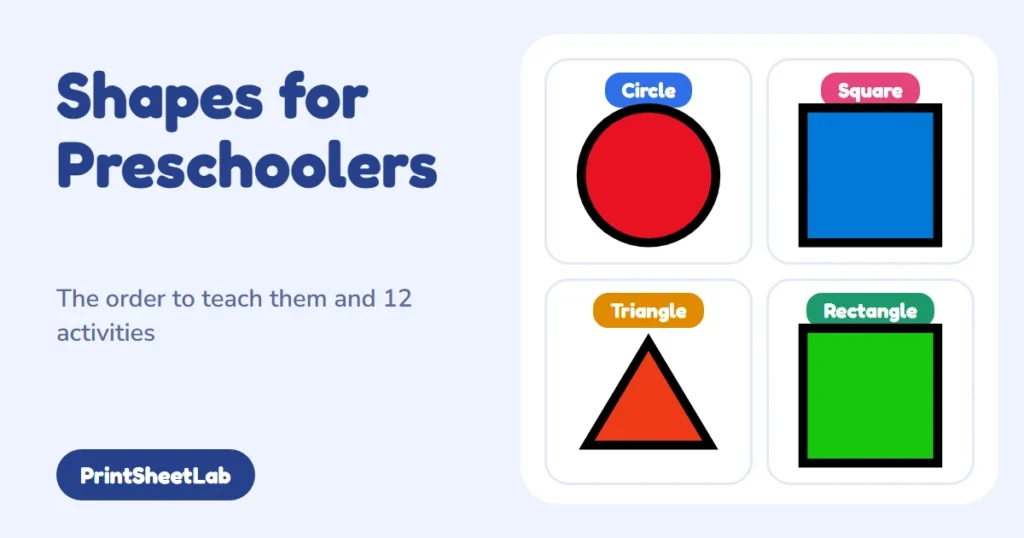
The best shapes for preschoolers to learn first are the circle, then the square and triangle, followed by the rectangle, oval and diamond. Most children can name the first four by the end of the preschool years, and teaching shapes to preschoolers works best through touching, building and sorting before any pencil is involved. This guide gives the order, a plan by age, twelve activities with materials, and the mistakes that confuse children.
Which shapes should preschoolers learn first?
Start with the circle. It has no corners and no straight sides, so a child does not have to count anything to recognize it. Balls, plates, wheels and clocks give you plenty of real examples in any home. After the circle, move to the square and the triangle, because both show up in blocks, crackers and roofs, and both have clear corners a child can point to.
Next come the rectangle, oval and diamond. These are the shapes that look like shapes children already know, which is why they are best taught as comparisons: a rectangle is like a square that has been stretched, and an oval is like a squashed circle. Save the star, heart, pentagon, hexagon and octagon for later, once the first six are solid.
There is no official order for shapes for preschoolers, and no law of child development says it must be this one. The sequence above for teaching shapes to preschoolers simply follows how many teachers and parents reduce confusion: one new idea at a time, and each new shape compared with one the child already knows.
Why shapes for preschoolers matter beyond the names
Learning shapes for preschoolers is not really about memorizing a list of names. Shapes are the child’s first taste of geometry, and they train three habits that later help with reading and math: looking closely, comparing, and describing what you see. A child who notices that a window and a cracker both have four corners is already doing the kind of observing that supports early geometry.
Shapes also build vocabulary. Words such as side, corner, round, flat, long, short, above and next to all arrive naturally while you work with shapes for preschoolers. Those words show up again in Kindergarten math, in directions on worksheets, and in everyday conversation about where things are.
Finally, shapes are a low-pressure win. They are concrete, they are everywhere, and a child can succeed within a few minutes. That early confidence makes the harder preschool skills, such as letters and counting, feel more approachable.
What shapes should preschoolers know by age?
Parents often ask what shapes should preschoolers know, and the honest answer is that the range is wide. The table below gives a practical teaching target rather than a deadline. Children move at different speeds, and a child who is a few months behind on naming shapes is rarely a cause for concern. If you are worried about overall development, the CDC milestone checklists are the place to start, and your pediatrician can help with the rest.
| Age | Shapes to focus on | What success looks like |
|---|---|---|
| 2 to 3 years | Circle, square | Matches identical shapes and sorts round things from non-round things |
| 3 to 4 years | Circle, square, triangle, rectangle | Names most of them and finds them around the house |
| 4 to 5 years | Adds oval, diamond, star, heart | Describes a shape by its sides and corners, even in a simple way |
| 5 to 6 years | Adds pentagon, hexagon, octagon; 3D shapes | Names shapes in any size or direction and builds new shapes from smaller ones |
One CDC milestone connects directly to this. By age 3, the CDC lists that most children draw a circle when you show them how. That lines up neatly with the circle-first order, because a child who can already draw a circle has practiced the same shape with their hand and their eyes.
Teaching shapes to preschoolers: a five-step routine
Teaching shapes to preschoolers goes faster when each shape follows the same short routine, and the shapes for preschoolers below all use it. Use it for every new shape, and keep each session to five or ten minutes. Short and frequent beats long and rare.
- Feel it. Hand over a real object or a cut-out shape and let the child trace the edge with a finger. Count corners together out loud.
- Name it. Say the name clearly, three times, in different sentences: “This is a triangle. A triangle has three corners. Can you find another triangle?”
- Find it. Go on a short hunt around the room or the park for that shape.
- Make it. Build the shape with sticks, play dough, blocks or your own bodies.
- Sort it. Mix it with shapes already learned and ask the child to sort them into groups.
Notice that drawing is the last step, not the first. Putting a pencil in a three-year-old’s hand and asking for a triangle usually ends in frustration, because drawing a triangle is a harder skill than recognizing one.
The properties of each shape in plain words
Children do not need the word “vertex” yet, but they do need to notice that shapes for preschoolers have parts. The Common Core calls for kindergartners to describe shapes by the number of sides and corners, so it helps to build that habit early with simple language. Counting is the bridge between a shape name and a shape idea.
| Shape | Sides | Corners | Kid-friendly clue |
|---|---|---|---|
| Circle | 0 straight sides | 0 | Round, rolls, no corners |
| Oval | 0 straight sides | 0 | Like an egg, a stretched circle |
| Triangle | 3 | 3 | Pointy like a tent or a slice of pizza |
| Square | 4, all the same length | 4 | Like a window pane or a cracker |
| Rectangle | 4, two long and two short | 4 | Like a door or a book |
| Diamond (rhombus) | 4, all the same length | 4 | A square standing on its corner |
| Pentagon | 5 | 5 | Like a home plate in baseball |
| Hexagon | 6 | 6 | Like a honeycomb cell |
| Octagon | 8 | 8 | Like a stop sign |
A quick note on the diamond: in math class the word is rhombus, and a square is technically a special kind of rhombus too. For preschoolers, “diamond” is the word on the worksheet and the playground, so use it, and introduce rhombus later.
Twelve shape activities for preschoolers
The best shape activities for preschoolers use real materials and take under fifteen minutes. The table below pairs each activity with what you need and the skill it builds. Pick two or three shape activities for preschoolers a week rather than trying them all at once.
| # | Activity | Materials | Builds |
|---|---|---|---|
| 1 | Shape hunt | Paper bag or clipboard | Spotting shapes in the real world |
| 2 | Play dough shapes | Play dough, cookie cutters | Hand strength and shape names |
| 3 | Stick and clay shapes | Craft sticks, clay balls | Sides and corners |
| 4 | Shape sorting | Buttons, blocks, paper cut-outs | Classifying by shape, not color |
| 5 | Painter’s tape shapes | Tape on the floor | Walking around the edge of a shape |
| 6 | Shape snacks | Crackers, cheese, sandwich cuts | Naming shapes at a snack table |
| 7 | Shape stamping | Sponges, washable paint | Seeing the same shape in different sizes |
| 8 | Shape bingo | Printed boards, counters | Fast recognition |
| 9 | Tracing | Fat crayons, tracing sheets | Pencil control |
| 10 | Cut and paste | Kid scissors, glue stick | Cutting and matching |
| 11 | Shape pictures | Cut-out shapes, paper | Combining shapes into a house or robot |
| 12 | Mystery bag | Cloth bag, solid shapes | Naming by touch alone |
Of these shape activities for preschoolers, numbers 5 and 12 work especially well for children who learn through movement. Walking the tape triangle, counting corners with their feet, gives the number three a physical meaning. The mystery bag removes sight entirely, so the child has to rely on edges and corners, which is exactly the thinking you want them to build.
Shape activities for preschoolers at the table: tracing, cutting, building
Once a child has met a shape with their hands and body, paper-based work consolidates it, and shapes for preschoolers on paper are the natural next step. Printable shape activities for preschoolers are most useful when they come after the hands-on steps, not instead of them. A tracing sheet asks the child to follow a dotted outline, which trains the eye to notice the shape and the hand to follow it.
The CDC lists that by age 4, most children hold a crayon or pencil between the fingers and thumb rather than in a fist. If your child still grips with a whole fist, tracing may feel tiring. Offer thick chunky crayons, shorter pieces of chalk, and vertical surfaces such as an easel to give the shoulder and wrist some help. For tracing shapes for preschoolers, our guide to fine motor skills activities at home has simple exercises for this.
Cutting shapes out and pasting them into a picture is the other classic paper activity, and our preschool cutting practice pages make a gentle start. It combines shape recognition with scissor control and gluing, and it quietly practices the standard that asks children to put simple shapes together to make larger shapes. A triangle on top of a square makes a house. Two triangles with their full sides touching can make a rectangle, which is the exact example the standards use.
Which grade standards cover shapes?
Learning shapes for preschoolers feeds straight into Kindergarten geometry. The Common Core State Standards for Kindergarten, listed at thecorestandards.org, include three clusters worth knowing. K.G.A.1 asks children to describe objects using shape names and position words such as above, below, beside, in front of, behind and next to. K.G.A.2 asks them to correctly name shapes regardless of orientation or overall size. K.G.A.3 asks them to tell flat (two-dimensional) from solid (three-dimensional) shapes.
The second cluster, K.G.B, asks children to compare shapes using informal language about sides and corners, to build shapes from sticks and clay balls or draw them, and to compose simple shapes into larger shapes. Notice how closely this matches the preschool routine above: feel, name, find, make, sort. You are already rehearsing the Kindergarten work.
| Standard | What the child does | Preschool preview |
|---|---|---|
| K.G.A.1 | Describes objects with shape names and position words | “The circle is next to the square” |
| K.G.A.2 | Names shapes in any size or orientation | Rotate a triangle and ask if it is still a triangle |
| K.G.A.3 | Tells flat shapes from solid shapes | Mystery bag with balls and blocks |
| K.G.B.4 | Compares shapes by sides and corners | Count the corners together |
| K.G.B.5 | Builds and draws shapes | Stick and clay shapes, tracing |
| K.G.B.6 | Combines shapes into bigger shapes | Shape pictures |
Common mistakes that confuse young children
Most confusion about shapes for preschoolers comes from how we show them, not from the child. The patterns below appear again and again in preschool rooms, and they are easy to fix once you spot them.
| Mistake | Why it confuses | Better approach |
|---|---|---|
| Only showing a triangle with a flat bottom | The child decides a tilted triangle is not a triangle | Rotate shapes and show long, skinny and wide triangles |
| Calling every four-sided shape a square | Rectangles and diamonds never get names | Say “a rectangle is a long square-like shape” and compare |
| Teaching five shapes in one sitting | Names blur together | One new shape per week, review old ones |
| Asking for drawing before recognition | Frustration and avoidance | Use trace-and-build first |
| Using only flat pictures | Children think a ball is “a circle” | Bring solid objects too and say “sphere” later |
| Marking answers wrong without explaining | The child learns nothing from the error | Count sides together to check |
Orientation deserves special attention. Many children first learn the triangle as the shape that points up and decide a triangle pointing down is something different. The Kindergarten standard asks children to name shapes regardless of orientation, so rotate everything from the start.
A simple four-week plan
If you want a path for teaching shapes to preschoolers, this plan assumes about ten minutes a day, four or five days a week. Adjust the speed to your child, and repeat a week if you need to.
- Week 1, circle and oval: shape hunt, play dough circles, round versus not round sorting.
- Week 2, square and rectangle: stick shapes, painter’s tape squares, count the four corners, sort squares from rectangles.
- Week 3, triangle and diamond: tent building, roof pictures, rotate triangles, compare a diamond with a square.
- Week 4, review and combine: mystery bag, shape bingo, cut and paste a picture built only from shapes.
At the end of week four, ask your child to find three shapes in the room, name them, and say how many corners each has. You are not testing; you are listening for how they describe things.
Putting shapes for preschoolers into daily life
You do not need a special lesson time. Name shapes while you cook, walk, tidy and shop: “Let’s cut the sandwich into triangles,” or “Can you find the rectangle on the cereal box?” Ten small moments a day add up to far more practice than one long worksheet session.
For teaching shapes to preschoolers, keep a simple routine: one new shape per week, one hands-on activity, one short paper activity, and one review of old shapes. Praise effort and careful looking, not speed. When your child makes a mistake, count the sides together instead of just correcting, so they learn how to check their own thinking. That habit matters more than any single shape name.
Free shapes printables on PrintSheetLab
- Preschool shape worksheets for first matching, coloring and finding shapes.
- Shapes worksheets with a wider mix of shapes for older preschoolers and kindergartners.
- Shape tracing worksheets to practice following outlines before drawing.
- Cutting worksheets that combine shape recognition with scissor practice.
- Pre-nursery activities for the youngest learners who are not ready for formal shape work yet.
- What a preschooler should know to see where shapes sit among the other skills.
- Fine motor skills activities at home to build the hand strength tracing needs.
Sources
Standards wording comes from the Kindergarten Geometry pages of the Common Core State Standards Initiative. Milestone statements about drawing a circle and holding a crayon come from the CDC’s 3-year and 4-year milestone checklists. The teaching order and activity ideas reflect common early-childhood teaching practice; children vary, so treat the ages as guidelines.
Frequently asked questions
7 quick answers
What shapes should preschoolers know?
Most preschoolers should be working on the circle, square, triangle and rectangle, then adding the oval, diamond, star and heart. There is no required list, and children vary a lot. Aim for recognition in real life rather than memorized names on a flashcard.
At what age do children learn shapes?
Many children can match simple shapes around age 2 or 3 and name several by age 4. The CDC notes that by 3 years most children draw a circle when shown how. Drawing a triangle usually comes later, often around age 5.
Should I teach shapes before or after colors?
Either is fine. Shapes and colors can be taught together, but give each its own short session. If a child is mixing the two up, ask first about the color, then about the shape, so the questions stay separate.
How do I teach a child who confuses squares and rectangles?
Count the sides together and compare their lengths. Lay a craft stick along each side of a square to show all four match. Then do the same with a rectangle, where two sticks are shorter, so the difference becomes something the child can see and touch.
Are worksheets good for teaching shapes?
Worksheets on shapes for preschoolers help once a child has handled real shapes. Use them for tracing, matching and cutting practice, and keep them short. A single page after a hands-on activity is usually enough for a preschooler.
What is the difference between 2D and 3D shapes for preschoolers?
Flat shapes such as circles and squares are two-dimensional. Solid shapes such as balls, boxes and cans are three-dimensional. Kindergarten standards expect children to tell them apart, so start with the mystery bag and ask “is it flat or solid?”
My child is four and cannot name shapes. Should I worry?
Not automatically. Naming shapes is one small piece of development, and children learn at different speeds. Try more hands-on play with shapes for preschoolers for a few weeks. If you also notice delays in speech, play or movement, mention it to your pediatrician, who can point you to an evaluation if needed.