The best times tables tricks turn a fact your child does not know into one they already do: double a known fact, add one more lot, or take one lot away from ten lots. Learn the tables in a sensible order, use one trick per table, and practice for about ten minutes a day, and the 2 to 12 times tables stop being 144 facts to memorize and become a small set of patterns.
Why times tables tricks work: 78 facts, not 144
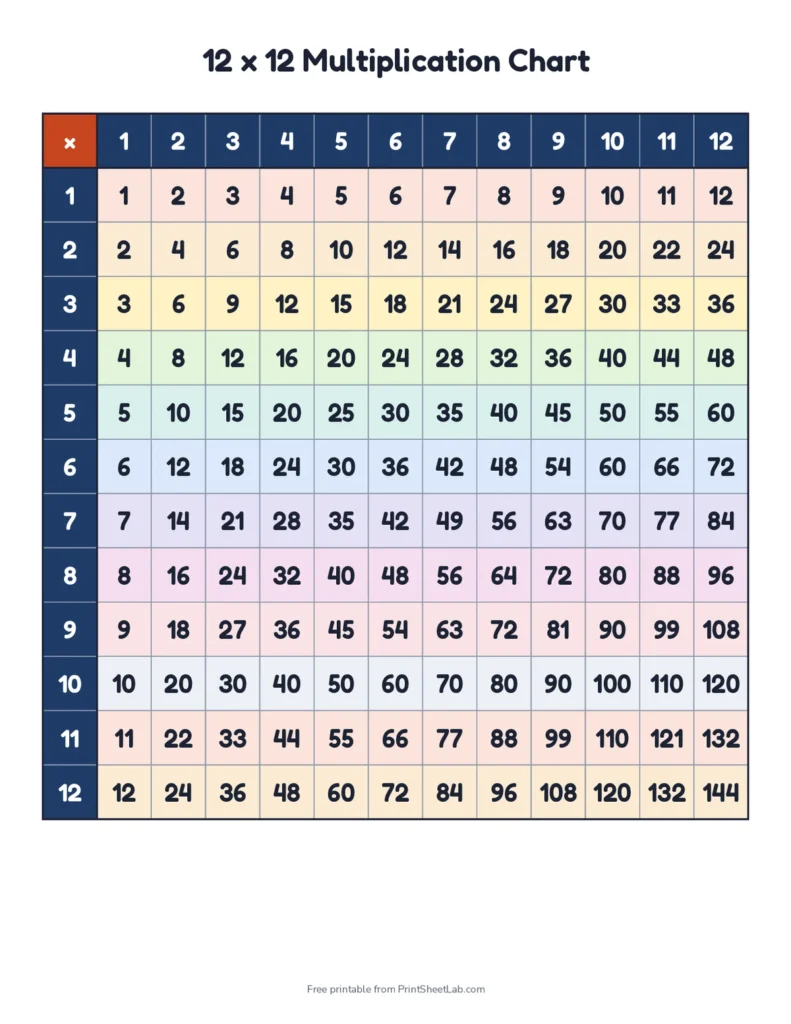
A 12 by 12 grid has 144 answers, but 7 × 3 and 3 × 7 are the same fact. Once a child understands this turnaround rule (the commutative property), there are only 78 different facts from 1 × 1 to 12 × 12. Turn a 3 by 7 array of counters on its side to show why.
Most good times tables tricks rely on one more idea: a new fact can be built from an old one. If you know 5 × 7 = 35, then 6 × 7 is just one more 7, so 35 + 7 = 42. This is called deriving a fact, and it is why learning order matters.
The best order to learn the times tables
This order puts the tables with the clearest patterns first, so the trick for each later table leans on facts your child already knows. The numbers below count the different facts (pairs) that are new at each stage.

- 10s, 2s and 5s: 33 new facts. The patterns are easy to see and build confidence fast.
- 11s and 1s: 17 new facts, most of them almost free.
- 4s and 9s: 13 new facts, using doubling and “ten lots minus one lot”.
- 3s and 6s: 9 new facts. The 6s are double the 3s.
- 8s and 12s: only 5 new facts: 7 × 8, 8 × 8, 8 × 12, 7 × 12 and 12 × 12.
- 7s last: every 7s fact is already known from another table except 7 × 7 = 49.
After stage one a child knows 33 of the 78 facts, and after stage two they know 50. That is why the 7 times table, which children often fear most, ends up being one new fact.
Times tables tricks for every table from 2 to 12
Teach one trick per table, and let your child say the thinking out loud. Each of these tricks is a way to reach an answer quickly while the fact is still new; with practice the answer simply comes from memory.
2 times table: double it
Two lots of a number is that number doubled: 2 × 8 = 8 + 8 = 16. Children who know their doubles from addition already know most of the 2s. Every answer is even.
3 times table: double, then one more lot
3 × 8 is two lots of 8 plus one more lot: 16 + 8 = 24. A handy check: the digits of every answer up to 3 × 12 add up to 3, 6 or 9 (for 24, 2 + 4 = 6). It does not give you the answer, but it catches a wrong one.
4 times table: double, double
Double the number, then double again: 4 × 7 is 7 → 14 → 28. For 4 × 9, double 9 to get 18, then double 18 to get 36.
5 times table: half of ten lots
Answers end in 0 or 5. Find ten lots and halve it: 5 × 8 is half of 80, which is 40. For an odd number it still works: 5 × 7 is half of 70, which is 35.
6 times table: five lots and one more
Use the 5s you already know and add one more lot: 6 × 7 = 35 + 7 = 42. Or double the 3s: 3 × 8 = 24, so 6 × 8 = 48. A pattern children enjoy: 6 times an even number ends in that same digit (6 × 2 = 12, 6 × 4 = 24, 6 × 6 = 36, 6 × 8 = 48).
7 times table: lean on the others
By the time you reach the 7s, 7 × 2, 7 × 3 and every other fact except one has been learned in another table. The new fact is the square 7 × 7 = 49. For a slippery one like 7 × 8, derive it: 7 × 7 = 49, plus one more 7 is 56. Some children like the rhyme “5, 6, 7, 8”: 56 = 7 × 8.
8 times table: double three times
8 × 6 is 6 → 12 → 24 → 48. Also notice the ones digits of the 8s: 8, 16, 24, 32, 40 go down by two each time (8, 6, 4, 2, 0), and then the pattern repeats with 48, 56, 64, 72, 80.
9 times table trick: ten lots minus one lot
9 × 7 is ten 7s take away one 7: 70 − 7 = 63. From 9 × 1 to 9 × 10, the tens digit goes up by one while the ones digit goes down by one (09, 18, 27, 36, 45, 54, 63, 72, 81, 90), and the digits always add up to 9. Of all the tricks for the 9s, “ten lots minus one lot” is the one that keeps working: 9 × 12 = 120 − 12 = 108.
The 9 times table trick with your fingers
The best-known 9 times table trick uses ten fingers. Hold both hands in front of you with the fingers spread and number them 1 to 10 from the left. To multiply 9 by a number from 1 to 10, fold down that finger. The fingers to the left of the folded finger are the tens, and the fingers to the right are the ones. This table shows how it works for every answer:
| 9 × | Finger trick | Fingers to the left (tens) | Fingers to the right (ones) | Reads as | Answer |
|---|---|---|---|---|---|
| 1 | Fold down finger 1 | 0 | 9 | 09 | 9 |
| 2 | Fold down finger 2 | 1 | 8 | 18 | 18 |
| 3 | Fold down finger 3 | 2 | 7 | 27 | 27 |
| 4 | Fold down finger 4 | 3 | 6 | 36 | 36 |
| 5 | Fold down finger 5 | 4 | 5 | 45 | 45 |
| 6 | Fold down finger 6 | 5 | 4 | 54 | 54 |
| 7 | Fold down finger 7 | 6 | 3 | 63 | 63 |
| 8 | Fold down finger 8 | 7 | 2 | 72 | 72 |
| 9 | Fold down finger 9 | 8 | 1 | 81 | 81 |
| 10 | Fold down finger 10 | 9 | 0 | 90 | 90 |
For 9 × 4, fold down the fourth finger: 3 fingers stand to the left and 6 to the right, so the answer is 36. The 9 times table trick works because the tens digit is always one less than the number you multiply by, and the two digits always add up to 9. It only covers 9 × 1 to 9 × 10, so use “ten lots minus one lot” for 9 × 11 and 9 × 12.
10 times table: every digit moves one place
10 × 7 = 70. Explain it as the digits moving one place to the left, with a zero holding the ones place. “Just add a zero” breaks later with decimals (10 × 0.5 is 5, not 0.50).
11 times table: repeat the digit, then learn three
Up to 11 × 9, write the digit twice: 11 × 6 = 66. Then there are only three to learn: 11 × 10 = 110, 11 × 11 = 121 and 11 × 12 = 132. Use ten lots plus one lot: 11 × 12 = 120 + 12 = 132.
12 times table: ten lots plus two lots
12 × 7 is 10 × 7 plus 2 × 7: 70 + 14 = 84. For 12 × 8: 80 + 16 = 96. The same split works for 12 × 12: 120 + 24 = 144.
Worked examples for the hard facts
The facts children miss most are usually in the middle of the chart. Here is the thinking to model aloud, so your child hears which known fact you start from.
- 6 × 8: “I know 5 × 8 = 40. One more 8 makes 48.”
- 7 × 6: “Turn it round: 6 × 7. Five 7s are 35, one more 7 is 42.”
- 8 × 7: “Double 7 is 14, double 14 is 28, double 28 is 56.”
- 9 × 8: “Ten 8s are 80. Take away one 8: 72.”
- 12 × 6: “Ten 6s are 60 and two 6s are 12, so 72.”
- 8 × 8: “It is a square number, so I learned it by heart: 64.”
Notice that 9 × 8 and 12 × 6 are both 72. Answers that appear twice on the multiplication chart show children that the facts are connected.
Square numbers: the anchors
Square numbers are a number multiplied by itself: 1, 4, 9, 16, 25, 36, 49, 64, 81, 100, 121, 144. They sit on the diagonal of the multiplication chart, and many times tables tricks start from them. Knowing 6 × 6 = 36 gives 6 × 7 (one more 6 is 42) and 6 × 5 (one fewer 6 is 30).
The easy way to learn times tables: new facts each week
The easy way to learn times tables is to know exactly how much is new each week. We counted the different facts (using the turnaround rule) that each week of the plan below adds, given that earlier tables are already known. This table shows the result:
| Week | Table taught | New facts this week | Facts known so far | Share of the 78 |
|---|---|---|---|---|
| 1 | 10s and 2s | 23 | 23 | 29% |
| 2 | 5s | 10 | 33 | 42% |
| 3 | Review and the turnaround rule | 0 | 33 | 42% |
| 4 | 11s and 1s | 17 | 50 | 64% |
| 5 | 4s | 7 | 57 | 73% |
| 6 | 9s | 6 | 63 | 81% |
| 7 | 3s | 5 | 68 | 87% |
| 8 | 6s | 4 | 72 | 92% |
| 9 | 8s | 3 | 75 | 96% |
| 10 | 12s | 2 | 77 | 99% |
| 11 | 7s and square numbers | 1 | 78 | 100% |
| 12 | All tables mixed | 0 | 78 | 100% |
The weeks with the most new facts are the first two, with 23 and 10, so the plan front-loads the easy patterns. From week 5 on, each week adds only a handful of facts, and the last table, the 7s, adds just one. The early rush is the reason children feel quick progress at first, and the long tail is the reason the late weeks are really about speed and mixing the tables.
A child practicing 10 minutes a day for all 12 weeks spends 840 minutes, or 14 hours, which works out at about 11 minutes per new fact. Use these numbers as a guide to how to learn times tables at a pace that does not overload your child.
A 12-week plan for learning the times tables
This plan suits a child who already understands multiplication as equal groups. Spend about ten minutes a day on that week’s times tables tricks, and repeat a week whenever the facts are still slow.
| Week | Focus | Times tables tricks to use |
|---|---|---|
| 1 | 10s and 2s | Digits move one place; doubling |
| 2 | 5s | Half of ten lots; the clock face |
| 3 | Review 2s, 5s, 10s mixed; the turnaround rule | Arrays turned on their side |
| 4 | 11s and 1s | Repeat the digit; learn 11 × 10, 11 × 11, 11 × 12 |
| 5 | 4s | Double, double |
| 6 | 9s | Ten lots minus one lot; digits add to 9 |
| 7 | 3s | Double plus one more lot |
| 8 | 6s | Five lots plus one lot; double the 3s |
| 9 | 8s | Double three times |
| 10 | 12s | Ten lots plus two lots |
| 11 | 7s and square numbers | 7 × 7 = 49 and its neighbors |
| 12 | All tables mixed | Find the slow facts and make flash cards for them |
Multiplication tricks for kids: the same ideas beyond 12
Good multiplication tricks do not stop at 12 × 12. The ideas children learn for the tables (double, halve, ten lots plus or minus a few lots) work on much larger numbers, and that is what makes multiplication tricks for kids worth teaching early. We checked every example in this table with a calculator:
| Trick | Example | Thinking aloud |
|---|---|---|
| Ten lots minus one lot (9s) | 9 × 34 | 10 × 34 = 340, minus 34 = 306 |
| Half of ten lots (5s) | 5 × 48 | 10 × 48 = 480, half is 240 |
| Double, double (4s) | 4 × 36 | 36 → 72 → 144 |
| Ten lots plus two lots (12s) | 12 × 15 | 150 + 30 = 180 |
| A quarter of 100 lots (25s) | 25 × 16 | 100 × 16 = 1,600, a quarter is 400 |
| Add the digits (11s) | 11 × 34 | 3, then 3 + 4 = 7, then 4: 374 |
| Add the digits and carry (11s) | 11 × 67 | 6, then 6 + 7 = 13 (write 3, carry 1), then 7: 737 |
Ask your child to say the thinking aloud for each one, as in the third column. These multiplication tricks make mental math faster in Grade 4 and 5, when children multiply two- and three-digit numbers, and they use exactly the facts from the tables above, so each fact your child knows makes one more trick available.
What age should children learn their times tables?
In England, the National Curriculum for mathematics sets the 2, 5 and 10 times tables in Year 2 (age 6 to 7), the 3, 4 and 8 times tables in Year 3, and all tables up to 12 × 12 in Year 4 (age 8 to 9). Year 4 students in state schools also take the multiplication tables check: 25 on-screen questions with 6 seconds to answer each one.
In the United States, Common Core standard 3.OA.C.7 says that by the end of Grade 3 children should know from memory all products of two one-digit numbers, which means every fact up to 9 × 9; many schools teach the 10s alongside them. The 11s and 12s are not in that standard, but many US schools and families add them in Grade 4 because they are useful for measurements and money.
Common mistakes and how to fix them
Most problems come from using times tables tricks too early (before the idea of equal groups is secure) or for too long (instead of moving on to recall).
- Counting up every time. Chanting 3, 6, 9, 12 to reach 3 × 8 works but is slow. Ask “Which fact do you already know that is close?” and model deriving it.
- Mixing up neighbors. 6 × 8 = 48 and 7 × 8 = 56 are often swapped. Practice them as a pair and check with the trick: five 8s are 40, one more 8 is 48.
- Using a trick without understanding it. If a child cannot explain why 4 × 7 is double 2 × 7, go back to arrays or counters for a few minutes.
- Learning a table only in order. Reciting 1 × 7 to 10 × 7 is not the same as knowing 8 × 7 on its own. Always finish with mixed questions.
- Stopping too soon. A table that feels known today fades without review. Keep one mixed round a week going.
- Too much time pressure too early. Speed comes from knowing the facts well, so start untimed and add a timer only once the tricks are reliable.
How to learn times tables with worksheets and games
Short daily practice works better than one long session a week, and it is the simplest answer to how to learn times tables for good. A simple ten-minute routine:
- 2 minutes of talk: recap the times tables tricks for today’s table and work through two facts out loud.
- 5 minutes of play: a round of the matching game, such as the 4 times table game or the 7 times table game. Every table from 2 to 12 has its own game.
- 3 minutes on paper: a short sheet from our times tables worksheets.
Once two or three tables feel secure, mix them in the mixed times tables game to find the facts that still need work. Turn those into a small set with the flash card maker, and practice them for a minute before bed.
Older children can move on to multiplication worksheets with larger numbers. Or print a multiplication chart and ask your child to color each pattern: the even rows, the 5s ending in 0 or 5, the diagonal of square numbers and the 9s whose digits add to 9. Patterns children find themselves stick far better.
From times tables to division
Every multiplication fact gives two division facts: 6 × 7 = 42, so 42 ÷ 6 = 7 and 42 ÷ 7 = 6. Once a table is solid, practice its division facts with the division facts game, then move on to long division worksheets. The same times tables tricks work backwards: to find 72 ÷ 8, ask “ten 8s are 80, take away one 8 is 72, so the answer is 9”.
Sources
Year group expectations and the multiplication tables check details come from the National Curriculum in England: mathematics programmes of study and the multiplication tables check administration guidance on GOV.UK. The US Grade 3 expectation is Common Core standard 3.OA.C.7. The fact counts (78 different facts, and the new facts at each stage) were counted by PrintSheetLab.
Frequently asked questions
8 quick answers
What are the easiest times tables tricks to start with?
Start with the 10s (the digits move one place), the 2s (double the number) and the 5s (half of ten lots). Those three tables cover 33 of the 78 different facts up to 12 × 12.
Which times tables tricks help with the hardest tables?
Children often find the 7s, 8s and 12s hardest. Learn them last: double three times for the 8s, ten lots plus two lots for the 12s, and the 7s then have one new fact, 7 × 7 = 49.
Do times tables tricks replace memorizing the facts?
No. These tricks are a bridge: they let a child work out a fact quickly while it is new. With regular practice the answer comes straight from memory, which is the goal by around age 9.
How long does it take to learn the tables with times tables tricks?
It varies a lot from child to child. Working at one table a week with about ten minutes a day, our suggested plan covers the 2 to 12 tables in around 12 weeks, with extra weeks for any table that is still slow.
How many times tables facts are there?
From 1 × 1 to 12 × 12 there are 144 facts, but only 78 are different once you use the turnaround rule (7 × 3 is the same as 3 × 7).
What is the 9 times table trick?
Hold up ten fingers, number them 1 to 10 and fold down the finger for the number you multiply by. The fingers to the left are the tens and the fingers to the right are the ones, so folding finger 4 gives 3 and 6, which is 36.
Do multiplication tricks work for bigger numbers?
Yes. Ten lots minus one lot gives 9 × 34 = 340 − 34 = 306, and half of ten lots gives 5 × 48 = 240. The same ideas used for the tables work on larger numbers.
What is the easy way to learn times tables?
Learn the tables in the order 10s, 2s and 5s, then 11s, 4s and 9s, then 3s and 6s, then 8s and 12s and 7s last. That order leaves just one new fact for the 7s.