Here is how to teach a child to tell time: break it into small steps and teach them in a fixed order, the hour hand alone, then o’clock, half past, quarter past and quarter to, counting in fives, and finally any minute. Each step needs only a few days of short practice with a clock your child can move. Below you will find each step with the words to use, worked examples, a six-week plan and the mistakes to watch for.
Before you start: what your child needs to know
Check these four building blocks first. Gaps here cause most of the confusion later.
- Counting to 60, and ideally counting in fives to 60.
- Reading the numbers 1 to 12 in and out of order.
- Halves and quarters as ideas: half a sandwich, a quarter of a pizza. These make “half past” and “quarter past” make sense.
- Daily routine words such as morning, afternoon, before and after.
If counting in fives is shaky, spend a week on it first with the skip counting by 5s game. It is the skill that unlocks every time after half past.
How to teach a child to tell time in 6 steps
The steps below follow the same order as the English National Curriculum and the US Common Core standards. Use a printable clock with hands your child can turn. Children learn far more from moving the hands themselves than from looking at pictures.
Step 1: Meet the clock
Talk about the parts: the numbers 1 to 12, the short hand that shows the hour and the long hand that shows the minutes. Show that both hands always move the same way, clockwise. Let your child turn the long hand all the way round once and watch the short hand move from one number to the next: that is one hour.
Step 2: O’clock
Start with times where the long hand points straight up at 12. Say “The long hand is on 12, so it is something o’clock. The short hand tells us which o’clock.” Link each time to your child’s day: 7 o’clock for breakfast, 3 o’clock for pickup, 7 o’clock again for bed.
Step 3: Half past
When the long hand points to 6, it has gone halfway round, so it is half past. Point out that the short hand is now halfway between two numbers. This is where many children go wrong: at half past 3 the short hand is between 3 and 4, but the time is still “3 and something” until the short hand reaches 4.
Step 4: Quarter past and quarter to
Fold a paper plate into quarters. Long hand on 3: quarter past. Long hand on 9: quarter to the next hour. “Quarter to” is the trickiest phrase because you say the hour the short hand is about to reach: at quarter to 4 (3:45), the short hand is nearly at 4.
Step 5: Counting in fives
For the long hand, each number is worth five minutes: 1 is 5 minutes, 2 is 10, 3 is 15, and 6 is 30. Count in fives round the clock together, pointing at each number, until your child can say how many minutes any number stands for. Knowing the 5 times table helps here, so the 5 times table game is useful practice.

Step 6: Past and to, digital time and single minutes
Now teach that the right half of the clock (from 12 round to 6) is “past” and the left half (from 6 back round to 12) is “to”. Twenty past 4 is 4:20; twenty to 5 is 4:40. Write the digital form next to every time you read so your child connects the two. Finally, count on in ones from the last five-minute mark to read any minute.
The past-and-to picture in the diagram above is the key to reading times beyond the quarter hours. Color the two halves on your printable clock in two colors and it becomes obvious which word to use.
Telling time for kids: where the hands really are
Telling time for kids gets easier once they see why the short hand sits between numbers. The long hand turns 6 degrees every minute, and the short hand turns 0.5 degrees every minute, which is 30 degrees from one number to the next in an hour. This table shows the angle of both hands, measured clockwise from 12, for some of the times in this guide:
| Time | Short hand (degrees from 12) | Long hand (degrees from 12) | Where the short hand sits |
|---|---|---|---|
| 3:00 | 90° | 0° | on the number |
| 3:15 | 97.5° | 90° | 25% of the way from 3 to 4 |
| 3:30 | 105° | 180° | 50% of the way from 3 to 4 |
| 3:45 | 112.5° | 270° | 75% of the way from 3 to 4 |
| 4:00 | 120° | 0° | on the number |
| 7:30 | 225° | 180° | 50% of the way from 7 to 8 |
| 11:55 | 357.5° | 330° | 92% of the way from 11 to 12 |
At 3:30 the short hand has moved halfway from 3 toward 4, and at 3:45 it has moved three quarters of the way. That is exactly why the short hand is “nearly at 4” at quarter to 4, a phrase worth saying aloud when you teach a child to tell time.
The two hands also meet 11 times in 12 hours, not 12: the first time is at about 1:05:27, then every 65 and 5/11 minutes. So half the surprises come from the short hand creeping on while the long hand goes round, and showing the movement on a clock with turning hands clears them up.
Worked examples: reading the clock with the thinking shown
Model the thinking aloud, starting with the short hand and then the long hand. This is how to teach a child to tell time so it makes sense rather than being guessed.
- 7:30: “The short hand is between 7 and 8, so it is still 7 something. The long hand is on 6, halfway round: half past 7.”
- 4:20: “The short hand is just past 4. The long hand is on 4: 5, 10, 15, 20. Twenty past 4, or 4:20.”
- 2:45: “The short hand is nearly at 3. The long hand is on 9, which is quarter to. Quarter to 3, or 2:45.”
- 11:55: “The long hand is on 11, one number before 12, so it is 5 minutes to. The short hand is nearly at 12: 5 to 12, or 11:55.”
- 6:38: “The short hand is past 6. The long hand is 3 marks after the 7: 35, then 36, 37, 38. It is 6:38, or 22 minutes to 7.”
How to tell time for kids: five questions to ask every time
When you are working out how to teach a child to tell time and your child still hesitates, give them the same five questions in the same order. The routine works for every time in this guide:
- Which hand is short? It shows the hour. Name the last number it passed.
- Where is the long hand? If it is on 12, say o’clock. If it is on 6, say half past.
- Is the long hand on the right side or the left side? Right is “past”, left is “to”.
- Count in fives from 12 (or back from 12) to the number the long hand is pointing at.
- Say the time and write it in digital form, such as 4:20.
Put the five questions on a card beside the practice clock. After a few weeks of this routine your child will ask the questions silently and simply know the time, which is the aim at any age.
At what age do children learn to tell the time?
In England, the National Curriculum for mathematics expects Year 1 students (age 5 to 6) to tell the time to the hour and half past, and Year 2 students to tell and write the time to five minutes, including quarter past and quarter to. In Year 3 children read analog clocks with Roman numerals, use 12-hour and 24-hour clocks, and read time with increasing accuracy to the nearest minute.
In the US, the Common Core standards follow a similar path: hours and half hours in Grade 1 (1.MD.B.3), the nearest five minutes with a.m. and p.m. in Grade 2 (2.MD.C.7), and the nearest minute plus time intervals in Grade 3 (3.MD.A.1). So a child who is 8 or 9 is usually expected to read any time. Every child is different, and a few extra weeks on one step is normal. Knowing these stages helps you decide how to teach a child to tell time at a pace that matches their class.
Teaching digital clocks alongside analog ones
Digital clocks look easier, but they hide how time moves. Teach them alongside the analog clock rather than instead of it. The number before the colon is the hour and the two digits after it are the minutes past that hour.
Show how each digital time matches a clock face: 4:05 is five past 4, 4:15 is quarter past 4, 4:30 is half past 4 and 4:45 is quarter to 5. The last one surprises children, because the digital clock still shows 4. Explain that 45 minutes have passed, so there are 15 minutes to go until 5.
How to teach a child to tell time when they find it hard
If your child keeps getting stuck, make the task smaller rather than repeating the same explanation.
- Use the short hand only. Cover the long hand and ask “About what time is it?” Answers like “just after 3” or “nearly 4” build the idea that the short hand moves slowly between numbers.
- Label the minutes. Stick small notes with 5, 10, 15 and so on outside each number of the printable clock, then remove them one by one.
- Anchor times to routines. A child who knows that lunch is at half past 12 has a real picture to compare with.
- Go back one step. Trouble with “to” times usually means counting in fives is not yet secure.

Learn to tell time in stages: how many different times are there?
Many parents wonder why it takes weeks to learn to tell time when it is only a clock, and the answer shapes how to teach a child to tell time. The reason is the number of different times a clock can show. This table counts them for each level of this guide on a 12-hour clock:
| Level | Different times on a 12-hour clock | How it is counted |
|---|---|---|
| O’clock | 12 | 12 hours x 1 |
| Half past added | 24 | 12 hours x 2 |
| Quarters added | 48 | 12 hours x 4 |
| Every 5 minutes | 144 | 12 hours x 12 |
| Any minute | 720 | 12 hours x 60 |
A child who masters o’clock times has learned 12 of 720 possible times, which is less than 2%. Half past brings the total to 24, and quarter hours to 48, so by the end of week 3 of our plan your child can read 48 times, or about 7% of the clock. Counting in fives multiplies the number of times to 144, and the last step reaches all 720.
So it is normal for the early weeks to feel slow: each stage adds more times than the stage before, but each step uses the same skill. When you ask how long it takes to learn to tell time, the answer is that the six stages need about 420 minutes in total, from 10 minutes a day for 6 weeks, which is seven hours of practice.
A six-week plan
If you are still unsure how to teach a child to tell time week by week, this plan uses about ten minutes a day. Move on only when the current step feels easy.
| Week | Focus | Daily activity |
|---|---|---|
| 1 | The clock and o’clock | Set the practice clock to each hour; read real clocks at meals and bedtime |
| 2 | Half past | Fold a paper plate in half; mix o’clock and half past questions |
| 3 | Quarter past and quarter to | Fold the plate into quarters; play the telling time game |
| 4 | Counting in fives | Write 5, 10, 15… on sticky notes round a clock; skip count together |
| 5 | Five-minute times, past and to | Read the time on the practice clock, then write it in digital form |
| 6 | Any minute | Count on in ones from the last five; read the kitchen clock at odd times |
Common mistakes and how to fix them
Knowing the usual mix-ups is half of how to teach a child to tell time well, because you can spot them early.
- Mixing up the hands. Say “short hand, hour; long hand, long word, minutes”. Some families color the hands differently on the printable clock.
- Reading the wrong hour at half past or quarter to. Ask “Which number has the short hand passed?” The hour is the last number it passed.
- Reading the number as minutes (saying “3 minutes past” when the long hand is on 3). Go back to counting in fives round the clock.
- Counting “to” minutes the wrong way. For “to” times, count back from 12: long hand on 10 is 10 minutes to, because 11 and 12 are two fives away.
- Drawing both hands the same length. When your child draws hands on worksheets, check the short hand really is shorter.
Games and activities for teaching kids to tell time
Games are the part of how to teach a child to tell time that children ask for again. Keep each one short and finish while your child still wants more.
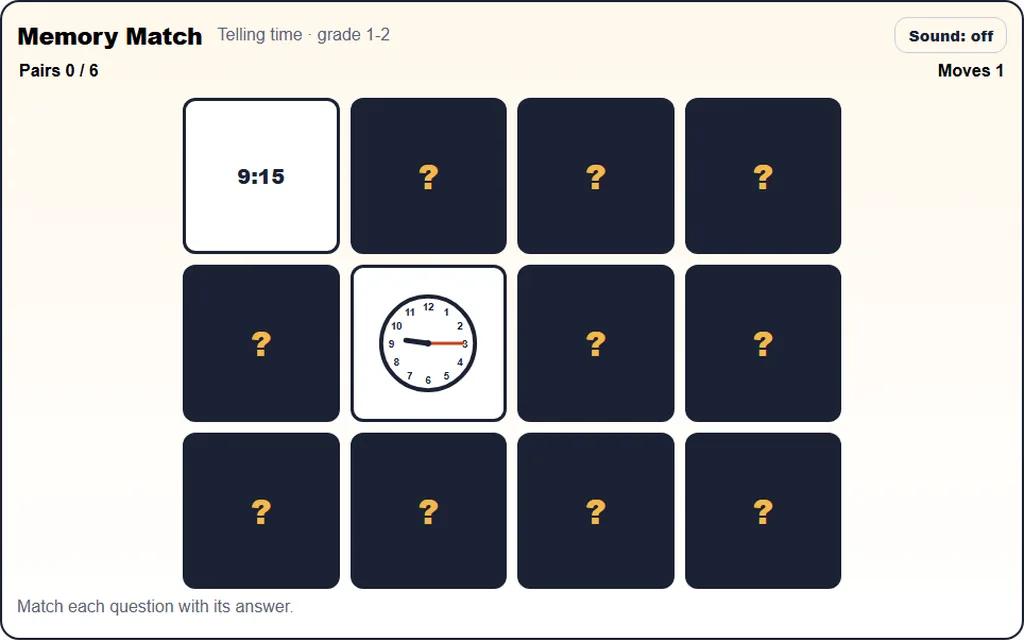
- The telling time game. Our free telling time game shows an analog clock and asks for the matching digital time.
- Worksheets by level. Start with hour and half-hour worksheets, then five-minute worksheets and time to the minute. All our telling time worksheets have answer keys.
- Clock of the day. Each time something happens (lunch, bath, bedtime), ask your child to read the clock.
- Beat the timer. “Can you clean up before the long hand reaches 6?”
- Set the clock. Say a time and let your child set it on the printable clock; then swap roles.
Time words to teach
Using the same words every time is a simple part of how to teach a child to tell time: children copy the phrases they hear, so be consistent.
- hour hand, minute hand, clockwise
- o’clock, half past, quarter past, quarter to
- minutes past and minutes to
- a.m. (from midnight to noon) and p.m. (from noon to midnight)
- earlier, later, before, after
What comes next
Once your child reads any minute, the last part of how to teach a child to tell time is using it in real life.
- Elapsed time: “It is 3:15 and the movie is 2 hours long. When does it end?” Count on in hours on a number line. Our elapsed time worksheets cover this step.
- 24-hour time: add 12 to afternoon hours, so 3 p.m. is 15:00. Useful for train times and digital devices.
- Calendars: days, weeks and months. Our calendar and time worksheet links clocks and dates.
Sources
Year group expectations come from the National Curriculum in England: mathematics programmes of study (Years 1 to 3, measurement). US grade expectations come from the Common Core standards for Grade 1, Grade 2 and Grade 3 measurement and data.
Frequently asked questions
8 quick answers
What age should you start teaching a child to tell time?
Many children are ready at 5 or 6, once they can count to 60 and read the numbers 1 to 12. The English National Curriculum starts o’clock and half past in Year 1, and Common Core starts hours and half hours in Grade 1.
Should you start with analog or digital clocks?
Start with analog hours and half hours, because the clock face shows how time moves round. Write the digital time next to each analog time as you go so the two grow together.
Why is quarter to so hard for children?
Because the hour you say is the next hour, even though the short hand has not reached it yet. Practice it on a clock with movable hands and always ask which number the short hand is heading toward.
How long does it take to teach a child to tell time?
It varies. With about ten minutes a day, many children move from o’clock to five-minute times in around six weeks, but some need longer on quarter to or on counting in fives.
How do you use a printable clock to teach a child to tell time?
Print the clock on card, cut out the hands and fix them with a brass fastener. Say a time and let your child set it, then let them set a time for you to read. Start with o’clock only and add half past once that is easy.
How to teach a child to tell time at home without it feeling like a lesson?
Little and often: read real clocks during the day, move the hands on a practice clock, and play short telling time games. Ask your child to explain which hand they read first.
How many times does a child need to learn to tell time?
A 12-hour clock shows 720 different times, but a child learns them in stages: 12 o’clock times, then 24 with half past, 48 with quarters, 144 at five-minute steps and 720 at any minute.
What is the easiest way for kids to start telling time?
Start with a clock with hands your child can move, learn the short hand first, and practice o’clock times for a few days before adding half past. Five short questions on a card make a routine your child can repeat, and that routine is the simplest way to teach it at home.