Wide ruled vs college ruled paper comes down to the space between the lines. Wide ruled paper has lines 11/32 inch (about 8.7 mm) apart, while college ruled paper has lines 9/32 inch (about 7.1 mm) apart. So wide ruled is bigger and gives younger children and larger handwriting more room, and college ruled fits more lines on a page for older students and adults.
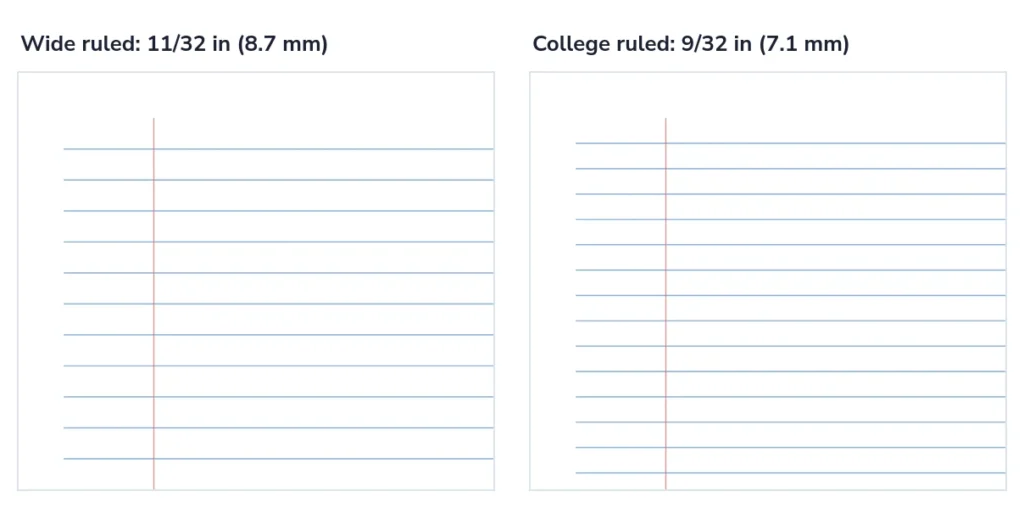
Wide ruled vs college ruled at a glance
| Wide ruled | College ruled | Narrow ruled | |
|---|---|---|---|
| Line spacing | 11/32 in (8.73 mm) | 9/32 in (7.14 mm) | 1/4 in (6.35 mm) |
| Other names | Legal ruled | Medium ruled | None common |
| Lines on a US Letter page with 1/2 inch margins | 29 | 35 | 40 |
| Which is bigger | Biggest spacing | Medium | Smallest |
| Usually used by | Elementary school, larger handwriting | Middle school, high school, college, adults | Very small handwriting, dense notes |
The line counts come from our printable paper maker with half-inch margins all round. Store-bought notebooks leave a larger margin at the top, so they usually have a few lines fewer. Both rulings usually have a vertical margin line about 1¼ inches (32 mm) from the left edge.
How the line spacings convert to millimeters
One inch is exactly 25.4 mm, so the conversions are simple multiplication:
- Wide ruled: 11/32 × 25.4 = 8.73 mm (0.344 in).
- College ruled: 9/32 × 25.4 = 7.14 mm (0.281 in).
- Narrow ruled: 8/32 (1/4) × 25.4 = 6.35 mm (0.25 in).
The gap between wide and college ruled is only 2/32 (1/16) inch, or about 1.6 mm per line. It sounds tiny, but over a page it adds up: in the same height, college ruled fits about 22% more lines than wide ruled (11 ÷ 9 = 1.22).

Wide ruled vs college ruled, drawn to the same scale next to the UK 8 mm feint and the two narrow rulings.
College ruled vs wide ruled: how many lines fit on a page?
The glance table above counts lines on US Letter with half-inch margins. Because the margin and the paper size both change the answer, we calculated the number of whole lines that fit for the five common rulings on US Letter and A4, with half-inch and one-inch margins all round (a ruling’s lines are counted from edge to edge of the usable height):
| Ruling | Spacing | Letter, 1/2 in margins | Letter, 1 in margins | A4, 1/2 in margins | A4, 1 in margins |
|---|---|---|---|---|---|
| Wide ruled (11/32 in) | 8.73 mm | 29 | 26 | 31 | 28 |
| 8 mm feint | 8.00 mm | 31 | 28 | 33 | 30 |
| College ruled (9/32 in) | 7.14 mm | 35 | 32 | 38 | 34 |
| Narrow ruled (1/4 in) | 6.35 mm | 40 | 36 | 42 | 38 |
| 6 mm narrow feint | 6.00 mm | 42 | 38 | 45 | 41 |
On the same US Letter page with one-inch margins, college ruled gives 32 lines and wide ruled gives 26, a difference of 6 lines, so the comparison of college ruled vs wide ruled barely changes with the margin. A4 adds two to three lines for most rulings. The 8 mm feint ruling lands between the two US sizes at 31 lines on Letter with half-inch margins, which is why it is a popular compromise. Shop notebooks, which leave a wide top margin, give a few lines fewer than any of these numbers.
Which is bigger wide ruled or college ruled?
Wide ruled is bigger: each line gives you 8.7 mm of height instead of 7.1 mm. College ruled lines are closer together, so the writing is smaller and more of it fits on a page. If you are comparing wide ruled vs college ruled for a young child, the extra 1.6 mm per line matters much more than it looks, because children’s tall letters (b, d, h, k, l) need room to stand without touching the line above.
Pen width: how much of the gap does the ink use?
Thick pens are one more reason to choose the wider ruling, so we worked out how much of the gap between two lines a stroke takes up. The table also shows the height of the midline on primary paper, which sits halfway between the lines and marks where the small letters should stop:
| Ruling | Line gap | Half the gap (midline height) | Fine gel pen (0.5 mm) uses | Ballpoint (0.8 mm) uses | Felt tip (1.5 mm) uses | Marker (3.0 mm) uses |
|---|---|---|---|---|---|---|
| Wide ruled | 8.73 mm | 4.37 mm | 6% | 9% | 17% | 34% |
| College ruled | 7.14 mm | 3.57 mm | 7% | 11% | 21% | 42% |
| Narrow ruled | 6.35 mm | 3.17 mm | 8% | 13% | 24% | 47% |
A 3 mm marker stroke fills 34% of the wide ruled gap but 42% of the college ruled gap, and 47% of a narrow ruled gap, so it covers almost half the space. For a fine gel pen the difference is small, at 6% and 7%. The midline on wide ruled paper is 4.37 mm high, against 3.57 mm on college ruled, which is why a child who is still sizing small letters has an easier time on the wide spacing.
If you write with a ballpoint or gel pen every day and your handwriting is average, college ruled is fine. If you use felt tips, markers or a brush pen, choose wide ruled paper.
Is wide ruled or college ruled better?
When you compare wide ruled vs college ruled, neither is better in general; the right one is the one your handwriting fits. A quick test takes two minutes:
- Write the same sentence on each ruling. Use one with tall and hanging letters, such as “The lazy dog jumped over big yellow logs.”
- If tall letters touch or cross the line above, choose the wider spacing.
- If your writing looks lost between the lines, with lots of white space above it, choose the narrower one.
- Wide ruled is better for: children in about grades 2 to 5, large handwriting, writing with thick pens or markers, and readers with low vision.
- College ruled is better for: long notes, lectures, journals, and anyone with average or small handwriting who wants more writing per page.
Which ruling suits each grade?
The switch to college ruled usually happens somewhere in middle school. This is the typical path in US schools. Schools and teachers differ, so treat it as a guide and follow your supply list when there is one.
| Stage | Usual paper | Why |
|---|---|---|
| Pre-K and kindergarten | Primary handwriting paper with a dashed midline | Children are still learning letter sizes |
| Grades 1 to 2 | Primary paper, then story paper | Midline still helps; space for a picture |
| Grades 2 to 5 | Wide ruled | Room for large, still-developing handwriting |
| Grades 6 to 8 | Wide or college ruled, by school | The switch usually happens here |
| Grades 9 to 12, college, adults | College ruled | Longer notes, smaller handwriting |
For the early stages, print handwriting paper with a midline or story paper with a drawing box. Children learning joined-up (cursive) writing can practice with our cursive writing worksheets.
Signs a child is ready to move down a size
- Letters touch or cross the line above: the spacing is too narrow. Stay on wide ruled, or go back to paper with a midline.
- Letters sit neatly with space above them: they are ready to try the next size down.
- Tall letters are much taller than short ones: a midline still helps.
Pros and cons of each ruling
Here is how the two compare in everyday use.
| Wide ruled | College ruled | |
|---|---|---|
| Pros | Easier for beginners and large handwriting; works with thick pens and markers; easier to read back and mark | More writing per page; neater for small handwriting; the usual choice from high school on |
| Cons | Fewer lines, so long notes use more pages | Cramped for large or developing handwriting; tall letters collide with thick pens |
| Best for | Grades 2 to 5, spelling tests, low vision | Lecture notes, essays, journals |
Worked example: a 500-word essay
Say a student fits about 10 words on a wide ruled line. On college ruled their writing usually shrinks to fit the smaller gap, so assume about 12 words a line (10 × 11 ÷ 9 ≈ 12). Using the page counts from the table above:
- Wide ruled: 29 lines × 10 words ≈ 290 words a page, so a 500-word essay fills about 1¾ pages.
- College ruled: 35 lines × 12 words ≈ 420 words a page, so the same essay fits on about 1¼ pages.
This is an illustration, not a rule: real handwriting varies, and some writers do not shrink their letters at all. It shows why the ruling that suits a student’s handwriting matters more than squeezing words onto fewer pages.
How many pages does an essay take?
The 500-word example above can be extended to longer pieces. Using the same assumptions (29 lines at 10 words each on wide ruled paper, 35 lines at 12 words each on college ruled), this table shows the pages for four common lengths:
| Essay length | Pages on wide ruled paper | Pages on college ruled | Pages saved |
|---|---|---|---|
| 500 words | 1.7 | 1.2 | 0.5 |
| 1,000 words | 3.4 | 2.4 | 1.1 |
| 2,000 words | 6.9 | 4.8 | 2.1 |
| 5,000 words | 17.2 | 11.9 | 5.3 |
A 1,000-word essay takes about 3.4 pages on wide ruled paper and 2.4 on college ruled, so college ruled saves about one page in every three or four. For a semester of notes, that is why a 70-sheet notebook of college ruled paper lasts roughly a third longer than the same notebook in wide ruled. The assumptions are an illustration: if your handwriting does not shrink on narrower lines, the saving is smaller. Test your own handwriting on both before buying a pile of notebooks.
Wide ruled or college ruled for middle school and high school?
Many middle school and most high school supply lists ask for college ruled paper, because students write more and their handwriting is smaller. Some middle schools still ask for wide ruled in grades 6 and 7, so check the list before buying a pile of notebooks. If a teacher asks for one type, use it: teachers often choose it to match binders, folders or classroom routines.
Math, notes and journals: what works best
- Math: many students prefer graph paper, because the squares keep digits and decimal points lined up. Between the two lined options, college ruled fits more steps of working, while wide ruled leaves more room for fractions and exponents.
- Lecture notes: college ruled, or a Cornell notes template that splits the page into cues, notes and summary.
- Journals and bullet journals: college ruled for writing, or dot grid paper if you mix writing with lists and sketches.
Narrow ruled, “standard” and Gregg ruled paper
Narrow ruled (1/4 inch, 6.35 mm) fits the most lines and suits very small handwriting. It fits about 37% more lines than wide ruled in the same space (11 ÷ 8 = 1.375). There is no official “standard ruled” size; packs labeled standard are usually wide or college ruled, so check the spacing printed on the pack. Gregg ruled paper, used for shorthand, has three lines to the inch and a line down the center.
UK, A4 and metric rulings
Outside North America, lined paper is described in millimeters and nobody says “wide ruled vs college ruled”. The common rulings are:
| Ruling | Spacing | Where it is used | Nearest US ruling |
|---|---|---|---|
| Feint ruled (often “8 mm feint and margin”) | 8 mm | UK and many A4 pads; the most common adult ruling | Between college (7.14 mm) and wide (8.73 mm) |
| Narrow feint | 6 mm | UK and A4 pads for small handwriting | Just under US narrow (6.35 mm) |
| Seyès (French ruling) | 8 mm, with three light lines 2 mm apart | French school exercise books | Close to wide ruled, plus guide lines |
| Single ruled | 8 mm | Indian school notebooks | Between college and wide |
“Feint” simply means the lines are printed faintly, usually in pale blue, so they guide the writing without competing with it.
Printing on A4 instead of US Letter
US Letter is 8.5 × 11 inches (216 × 279 mm); A4 is 210 × 297 mm. A4 is about 18 mm taller, so the same ruling gives about two more wide ruled lines or two to three more college ruled lines per page. The spacing itself does not change: 9/32 inch is 7.14 mm on any paper size.
How to print wide ruled or college ruled paper
The wide ruled vs college ruled choice is a single setting in our paper maker:
- Open the printable paper maker and choose Lined, or start from our ready-made lined paper page.
- Pick Wide ruled or College ruled from the spacing list, and US Letter or A4 to match your printer paper.
- Turn on the red margin line if you want the familiar notebook look.
- Download the PDF and print at 100% (“Actual size”).
- Check the result with a ruler: measure across 10 gaps. Wide ruled should be about 87 mm (3 7/16 in); college ruled about 71 mm (2 13/16 in).
Common mistakes when choosing lined paper
- Printing with “Fit to page” on. The printer shrinks the page and the spacing shrinks with it, so wide ruled can end up close to college ruled.
- Moving a child to college ruled too early. Cramped letters get messier, not neater. Switch when the handwriting test says so, not because of age alone.
- Ignoring the pen. Thick markers and felt tips need wide spacing even for adults.
- Buying before the list arrives. The wide ruled vs college ruled choice is often set by the teacher, so wait for the supply list.
Sources
Line spacings, margin position and the UK, French and Indian rulings follow the Ruled paper article on Wikipedia and its cited sources. US Letter and A4 dimensions follow the Paper size article. All conversions use 1 inch = 25.4 mm exactly.
Frequently asked questions
8 quick answers
What is the difference in wide ruled vs college ruled paper?
The line spacing. Wide ruled lines are 11/32 inch (8.7 mm) apart and college ruled lines are 9/32 inch (7.1 mm) apart, so college ruled has more lines per page. The paper size is usually the same.
Which is bigger, wide ruled or college ruled?
Wide ruled has the bigger spacing between lines, by 1/16 inch (about 1.6 mm). College ruled lines are closer together.
Do they use wide ruled or college ruled in middle school?
Many middle schools ask for college ruled, but some ask for wide ruled in grades 6 and 7. The school supply list is the best guide.
Wide ruled vs college ruled: which is better for high school?
College ruled is the usual choice in high school because students take longer notes and write smaller. Wide ruled is still fine for students with large handwriting, or when a teacher asks for it.
Is 8 mm lined paper wide ruled or college ruled?
Neither exactly. 8 mm sits between college ruled (7.14 mm) and wide ruled (8.73 mm). It is a good choice if wide ruled feels too big and college ruled a little cramped.
Can I print college ruled paper on A4?
Yes. Choose A4 in the paper maker and the lines keep the same 9/32 inch spacing; you get two or three more lines because A4 is slightly taller than US Letter.
How many lines are on a page of college ruled paper?
About 35 on US Letter with half-inch margins, 32 with one-inch margins, and 38 on A4 with half-inch margins. Wide ruled gives 29, 26 and 31 lines on the same pages.
How many pages does a 1,000-word essay take on wide ruled paper?
About 3.4 pages on wide ruled paper, against about 2.4 on college ruled, if you write 10 words a line on wide ruled and 12 on college ruled.