How to play tambola in one sentence: every player gets a ticket with 15 numbers, a host calls the numbers 1 to 90 in random order, and the first player to strike off each prize pattern (Early Five, a line, Four Corners, Full House) shouts and wins it. Tambola is also called housie, and in the UK the same game is 90-ball bingo. This guide explains the ticket, the calling, every classic prize, the disputes that spoil games and how to host on paper or on phones.
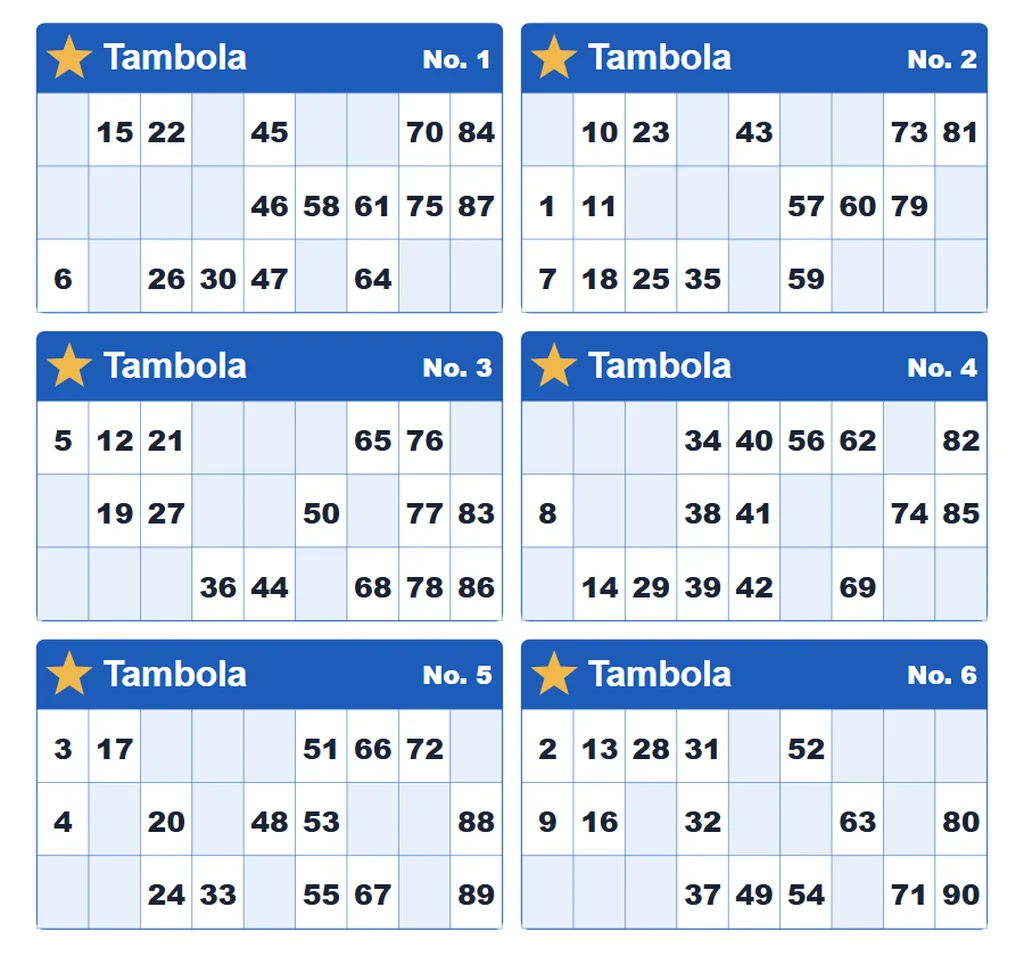
Tambola rules: how to play tambola in 30 seconds
- Each player has a ticket of 15 numbers in 3 rows of 5.
- The host calls 1 to 90 in random order; players strike off any number on their ticket.
- The first player to complete a prize pattern claims it before the next number is called.
- The host checks the claim against the caller sheet; a wrong claim is a “bogey” (a false claim).
- The game ends with the Full House, all 15 numbers.
Tambola game rules: the complete list
Most groups need nothing more than the 30-second summary, but written tambola game rules stop arguments, especially at paid or competitive games. Here is a complete set that you can print and read out:
- The game uses the numbers 1 to 90, and each number is called once.
- Each ticket has 15 numbers in 3 rows. Only numbers the host has called count.
- Players mark their own tickets. The host’s caller sheet is the only record of what has been called.
- A prize is claimed by shouting before the next number is called. A claim after the next call is late.
- The host checks every claim aloud against the caller sheet before paying the prize.
- A false claim is a bogey: the ticket is out of that prize only, not out of the game.
- Each prize is won once. If two correct claims arrive on the same call, the prize is split or decided by the tie-breaker you announced.
- The game ends at the Full House, or after the Second House if you play one.
These tambola game rules suit a living room as much as a hall. For children, keep rules 4 and 6 gentle, as in the gentler family version of the dispute table below.
What you need to play tambola
- Tickets, one per player, or two for keen players. Print free ones with our tambola ticket generator, which also gives you a caller sheet, a prize list and a rules page.
- A way to call numbers: numbered tokens in a bag, a shuffled set of 90 slips, or the free online tambola host screen, which calls the numbers for you.
- A caller sheet with 1 to 90, so the host can tick every call and check claims.
- Pens or dabbers for every player, and prizes. Six or seven small prizes beat one big one, because more people stay interested until the end.
How a tambola ticket works
Before you learn how to play tambola, look closely at one ticket. It is a grid of 3 rows and 9 columns. Each row holds exactly 5 numbers and 4 blank boxes, so every ticket has 15 numbers. The columns are arranged by tens:
| Column | 1 | 2 | 3 | 4 | 5 | 6 | 7 | 8 | 9 |
|---|---|---|---|---|---|---|---|---|---|
| Numbers | 1-9 | 10-19 | 20-29 | 30-39 | 40-49 | 50-59 | 60-69 | 70-79 | 80-90 |
Every column has at least one number, and numbers run from smallest at the top to largest at the bottom. That makes a call quick to find: 47 can only sit in the fifth column. The first column has only nine numbers and the last has eleven, because 90 joins the 80s.
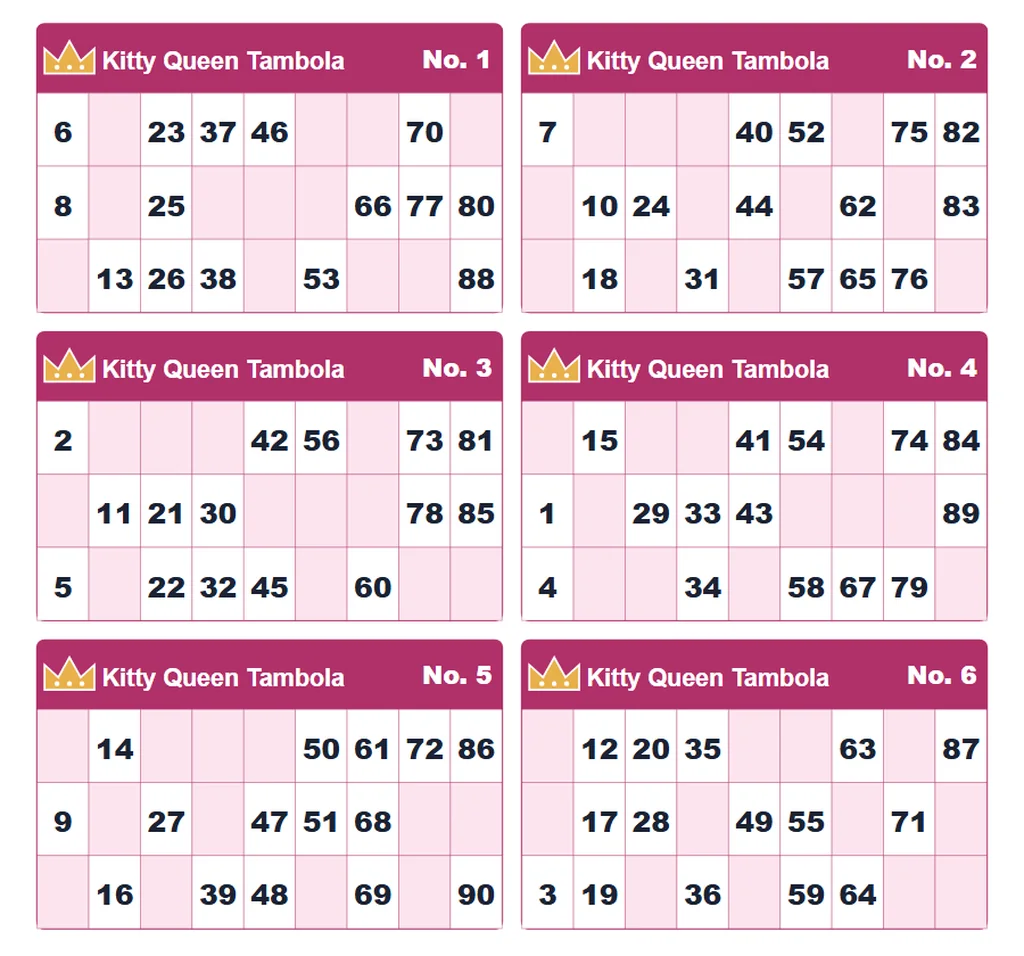
Tickets come in strips of six. In a proper strip every number from 1 to 90 appears exactly once, so each call helps exactly one ticket in the strip. Our generator builds real strips, so no two tickets in a game repeat each other.

The chart shows the game at a glance: one real ticket, its column ranges and the numbers that win each classic prize.
How to play tambola, step by step
Here is how to play tambola from the first ticket to the Full House, in the order a host runs it.
- Hand out tickets and write each ticket number next to the player’s name. Announce the prizes before the first call.
- The host calls a number clearly, digit by digit and then as a whole: “Four and seven, forty-seven.”
- Players strike it off if it is on their ticket. Nothing happens if it is not.
- Claim straight away. When your ticket completes a prize, shout “Tambola!”, “Housie!” or the prize name before the next number is called.
- The host checks the claim against the caller sheet. A correct claim wins, and play carries on for the prizes still open.
- The game ends when the Full House is won. Some groups carry on for a Second House.
The classic tambola prizes (dividends)
Knowing the tambola prizes is half of how to play tambola well. Prizes are called dividends at many Indian games, and housie rules use the same patterns. Every one is won by the first correct claim:
- Early Five (Jaldi Five): the first ticket with any five numbers struck off.
- Top Line, Middle Line and Bottom Line: all five numbers in that row.
- Four Corners: the first and last numbers of the top row and of the bottom row. They are not always in the corner boxes, because a row can start with a blank.
- Full House: all 15 numbers. This is the biggest prize.
Popular extra prizes
- Breakfast, Lunch and Dinner: every number in columns 1 to 3, 4 to 6 or 7 to 9.
- Pyramid: in one common version, one number from the top row, two from the middle row and three from the bottom row. Versions differ, so show the exact pattern first.
- Second House: the second ticket to complete all 15 numbers.
- Themed names: the kitty party tambola and Diwali tambola packs rename the classics and print a matching prize list.
In UK halls the same tickets are played for One Line, Two Lines and the Full House. If you are learning how to play tambola with British friends, agree which set of prizes you are using.
When are the prizes usually won?
This depends mostly on how many tickets are in play. We simulated 1,500 games for each row of this table, with tickets built in strips of six to the rules above. The figures are the median call on which each prize was first won. It is the part that most rule sheets skip.
| Tickets in play | Early Five | First line (any row) | Four Corners | Full House |
|---|---|---|---|---|
| 6 | call 17 | call 47 | call 52 | call 78 |
| 12 | call 14 | call 42 | call 45 | call 76 |
| 24 | call 12 | call 37 | call 39 | call 73 |
| 48 | call 11 | call 33 | call 34 | call 70 |
| 96 | call 10 | call 29 | call 28 | call 67 |
So in a family game with 12 to 24 tickets, expect the Early Five within the first 15 calls and the Full House somewhere in the 70s. At one number every 10 seconds, 75 calls take about 12 and a half minutes. More tickets mean faster prizes, so a big party can play two or three games in an hour.
Tambola dividends: how to split the prize money
If players pay to join, as at many charity and kitty events, the prize pool is split into dividends before the game starts. The Full House is the biggest dividend because it takes the longest to win. This table applies the split from the budget example above to four common pools. Use any currency, since the shares are percentages:
| Prize (dividend) | Share of the pool | Pool of 500 | Pool of 1000 | Pool of 2000 | Pool of 5000 |
|---|---|---|---|---|---|
| Early Five (Jaldi Five) | 10% | 50 | 100 | 200 | 500 |
| Top Line | 12% | 60 | 120 | 240 | 600 |
| Middle Line | 12% | 60 | 120 | 240 | 600 |
| Bottom Line | 12% | 60 | 120 | 240 | 600 |
| Four Corners | 14% | 70 | 140 | 280 | 700 |
| Full House | 40% | 200 | 400 | 800 | 2000 |
| Total | 100% | 500 | 1000 | 2000 | 5000 |
With a pool of 1,000, for example, the Early Five pays 100, each line pays 120, Four Corners pays 140 and the Full House pays 400. Everyone can check the sums, which helps a paid event run without suspicion. Write the tambola dividends on a card beside the caller sheet, and read them out with the rules before the first number. If you add Breakfast, Lunch, Dinner or a Second House, take their share from the Full House, and keep the Full House at 30% or more.
A worked example of checking a claim
Take the sample ticket in the chart above. Its top row is 12, 31, 58, 61 and 81. A player shouts “Top Line!” just after 58 is called. The host reads the numbers back, one at a time, and finds each one ticked on the caller sheet: 12, 31, 58, 61, 81. All five were called, and the claim came before the next call, so the Top Line is won.
Now suppose the same player had claimed Four Corners. The corners of this ticket are 12 and 81 in the top row and 5 and 77 in the bottom row, not the blank corner boxes. If 5 has not been called yet, the claim is a bogey (a wrong claim, explained below). Reading numbers aloud, rather than glancing at a ticket, keeps every check fair and quick.
Claims, ties and bogeys: settling disputes
Knowing how to play tambola also means knowing what happens when a claim goes wrong. Most arguments at a tambola table come from four situations. Agree the rule for each before the first call:
| Situation | Usual rule | Gentler family version |
|---|---|---|
| Late claim (after the next number) | The prize is lost for that ticket | Allow it if nobody else has claimed |
| Two correct claims on the same call | Split the prize | Tie-breaker: highest number on the winning pattern wins |
| Wrong claim (a bogey) | That ticket is out of that prize | A laugh and a warning |
| Number misheard | The caller sheet decides | Repeat the last three calls on request |
Whatever you choose, read the rules out before the first number, not after the first argument. The generator’s rules page is written for exactly that.
How to host tambola smoothly
Teaching guests how to play tambola takes a minute. Running a smooth game takes a little planning:
- Tick every call on the caller sheet. Without it you cannot check claims.
- Keep a steady pace. About one number every 8 to 10 seconds suits most adult groups. Slow down for children.
- Say numbers the same way every time, digits first: “one, six, sixteen”. It avoids the 16 and 60 mix-up.
- Announce each prize as it is won, and remind everyone which prizes are still open.
- Add a few classic calls for fun: “Kelly’s eye, number one”, “Legs eleven”, “Two fat ladies, 88” and “Top of the shop, 90”. A full list of rhymes has its own guide.
How many tambola tickets to print
| Players | Tickets | Why |
|---|---|---|
| Up to 6 | 1 strip of 6 | Every number helps exactly one player, so nobody sits out a call. |
| 7 to 12 | 2 strips (12) | One ticket each, with spares for keen players. |
| 13 to 30 | 3 to 5 strips | One ticket each; allow two for players who ask. |
| 30 or more | One strip per six players, plus 10% spare | Latecomers can still join. |
A suggested prize split for a budget of 100 (rupees, pounds or dirhams): Early Five 10, each line 12, Four Corners 14 and Full House 40. The Full House stays the prize worth waiting for.
Hosting tambola online with family
For relatives in other cities, or when nobody has a printer, host on phones. On our online tambola page, press Create game, choose the number of tickets and the time between numbers (6 to 20 seconds), and share one link on WhatsApp. Each guest types the ticket number you give them, and their e-ticket marks itself as numbers are called. Guests who have never played can follow along, because they only need to watch their ticket.
When someone claims, type their ticket number into Check a claim to see which prizes it has completed and on which call. Calls can be read aloud in English or Hindi. Automatic calls cannot be paused, because every phone follows the same clock, so pick a slower speed if your group likes to chat. You can also download the same tickets as a PDF, so paper and phone players can join one game.
How to play housie: what is the same and what is different?
If you already know how to play housie, you know how to play tambola, because the ticket and the calling are the same. The names change by country, and so do the usual prizes. This table compares the main versions:
| Game | Ticket | Numbers called | Usual prizes |
|---|---|---|---|
| Tambola (India) | 3 rows by 9 columns, 15 numbers | 1 to 90 | Early Five, lines, Four Corners, Full House |
| Housie | Same 3 by 9 ticket | 1 to 90 | Usually a line (or two) and a Full House |
| 90-ball bingo (UK) | Same 3 by 9 ticket, in strips of six | 1 to 90 | One line, two lines, Full House |
| 75-ball bingo (US) | 5 by 5 card with a free center square | 1 to 75 | Lines, Four Corners, Full House (blackout) |
The housie rules are therefore the tambola rules with a shorter prize list in many halls. Most groups simply pick the prizes they enjoy: a family game of housie often has just a line and a Full House, while a kitty party adds Early Five and Four Corners. Housie rules vary between clubs, so ask what is being played before you buy a ticket.
Tambola, housie and bingo: what is the difference?
Tambola and housie are the same game. It is tambola or housie in India, housie in Australia and 90-ball bingo in the UK and Ireland, all with the same 3-row ticket. American bingo is different: 75 numbers on a 5 by 5 card with B-I-N-G-O columns. Print UK tickets from our 90-ball bingo cards page, make American cards with the bingo card generator, or read how to play bingo online with friends.
Tambola for children and seniors
The rules stay the same for every age. What changes when you teach children or older relatives is the pace, the ticket size and the number of prizes:
- Children: print 3 large tickets per page, call every 15 to 20 seconds and play for only three prizes (Early Five, one line and Full House). Pair the youngest players with an adult.
- Seniors: large tickets, a steady pace and a printed caller sheet on the table so players can check calls themselves. Calls read aloud on a phone help anyone who finds the caller hard to hear.
- Mixed groups: give each child a named prize, such as a “Lucky Seven” award for the first 7 struck off, so everyone has a chance to win something.
Common mistakes to avoid
- No caller sheet. A called-number list on a phone screen is easy to lose; paper is safer.
- Prizes announced late. If nobody knew Four Corners was a prize, nobody claims it.
- Tickets that are not real tambola tickets. Home-made grids with random numbers break the column rule and can repeat numbers. Use strips from a proper generator.
- Calling too fast. If players keep asking “what was that?”, slow down.
Sources
Our explanation of how to play tambola is checked against these sources. The ticket layout, strips of six and the UK prizes (one line, two lines, full house) follow the Wikipedia article on British 90-ball bingo, which also notes that the game is called tambola in India. The example calls come from the list of British bingo nicknames. The prize timings are from our own simulation of 1,500 games per ticket count.
Frequently asked questions
8 quick answers
How many numbers are called in tambola?
Up to 90, from 1 to 90, in random order. The game usually ends sooner, when someone wins the Full House, typically somewhere in the 70s with 12 to 48 tickets in play.
What is the easiest way to learn how to play tambola?
Play one short game with three prizes only: Early Five, one line and Full House. Once everyone knows how to strike off numbers and claim, add Four Corners and the other lines.
Can two people win the same tambola prize?
Yes, if both claims are correct on the same call. The usual rule is to split the prize; family games often use a quick tie-breaker instead.
How long does a game of tambola take?
With one number every 10 seconds and the Full House won around call 70 to 78, a game takes about 12 to 13 minutes, plus time for checking claims.
How to play tambola at a kitty party?
Use themed tickets, play for Early Five, three lines, Four Corners and Full House, and keep the prizes small. The kitty party tambola pack prints tickets, a caller sheet and a themed prize list in one go.
Is tambola the same as housie and bingo?
Tambola and housie are the same game, and it is 90-ball bingo in the UK. American 75-ball bingo uses a different 5 by 5 card.
What are tambola dividends?
Tambola dividends are the prizes, or the shares of the prize pool, for each pattern: Early Five, the three lines, Four Corners and the Full House. A common split is 10%, 12% each for the lines, 14% and 40%.
What are the basic housie rules?
Each player has a 3 by 9 ticket with 15 numbers, the host calls numbers from 1 to 90, and the first player to complete a prize pattern and claim it before the next call wins that prize. The game ends at the Full House.