Addition strategies are the mental shortcuts that let children add without counting every object: counting on, number bonds to 10, making ten, doubles, near doubles, adding 9 by adding 10, and splitting into tens and ones. Later strategies build on earlier ones, so the order you teach them matters. Below you will find each strategy with the thinking shown, a six-week plan, grade guidance and practice ideas.
Why addition strategies beat counting
Counting on fingers is a perfectly good start for 3 + 2. It gets slow and unreliable at 8 + 7, and it cannot cope with 47 + 38. These shortcuts turn a hard fact into an easy one the child already knows: 8 + 7 becomes 7 + 7 + 1, or 8 + 2 + 5. This is also how confident adults add in their heads.
Addition strategies are not the opposite of memorizing. A child who works out 6 + 7 as “double 6 and one more” a few dozen times will soon just know that it is 13. The strategy is the bridge to instant recall.
The 7 addition strategies for kids, in teaching order
Teach one of these addition strategies at a time with objects first (blocks, counters, fingers), then pictures, then numbers only.
1. The counting on strategy: start from the bigger number
For 2 + 7, start at 7 and count on two: “8, 9”. Two ideas make this work. First, you can add in either order, so start with the bigger number. Second, do not count the starting number again. Practice with the addition within 10 game.
2. Number bonds to 10
The pairs that make 10 (1 + 9, 2 + 8, 3 + 7, 4 + 6 and 5 + 5) are the foundation for the addition strategies that follow. Ten fingers show them well: hold up 3 and the folded fingers show 7. A ten frame does the same on paper. Drill them with the number bonds to 10 game until they are instant.
3. The making ten strategy
To add two numbers that cross ten, split the smaller number to fill the bigger one up to ten. For 8 + 5: 8 needs 2 more to make 10, so split 5 into 2 and 3. 8 + 2 = 10, then 10 + 3 = 13.

Making ten turns many “hard” facts within 20 into easy ones, which is why it is widely taught in Grade 1. The addition within 20 game is full of make-ten facts.
4. The doubles strategy
Doubles (6 + 6, 7 + 7) are easy to remember because children see them everywhere: an egg box holds 6 + 6, a spider has 4 + 4 legs, and two hands have 5 + 5 fingers. Once they are instant, they unlock near doubles. Try the doubles facts game.
5. Near doubles
6 + 7 is a double plus one: 6 + 6 = 12, and one more is 13. It also works as a double minus one: 7 + 7 = 14, one fewer is 13. Children need to spot that the two numbers are next to each other, so point it out each time: “7 is one more than 6, so…”
6. Adding 9 and 8 by adding 10
Adding 10 is easy once place value makes sense, so adding 9 becomes “add 10, take 1”: 9 + 6 = 6 + 10 − 1 = 15. Adding 8 is “add 10, take 2”: 8 + 7 = 7 + 10 − 2 = 15. Show it on a number line: one jump of ten forward, one small hop back.
7. Tens and ones for two-digit numbers
For 34 + 25, add the tens (30 + 20 = 50) and the ones (4 + 5 = 9) to get 59. When the ones make more than ten, as in 47 + 38, the tens give 70 and the ones give 15, so the total is 85. That extra ten is the idea behind regrouping (“carrying”), so this strategy makes the written method make sense. Practice with base ten blocks and the two-digit addition game.
How many basic facts does each strategy cover?
There are 45 basic addition facts when both numbers are from 1 to 9 and the smaller number is written first (1 + 1 up to 9 + 9; the order does not matter because 3 + 8 = 8 + 3). Facts with a 0 are easy, so they are left out. Going down this list from the top and stopping at the first idea that fits, here is how many of the 45 facts each strategy handles:
| First strategy that fits | Facts covered (of 45) | Examples |
|---|---|---|
| Doubles | 9 | 1 + 1, 2 + 2, 3 + 3, 4 + 4 |
| Near doubles | 8 | 1 + 2, 2 + 3, 3 + 4, 4 + 5 |
| Number bonds to 10 | 4 | 1 + 9, 2 + 8, 3 + 7, 4 + 6 |
| Add 9 (add 10, take 1) | 6 | 2 + 9, 3 + 9, 4 + 9, 5 + 9 |
| Count on 1 | 6 | 1 + 3, 1 + 4, 1 + 5, 1 + 6 |
| Making ten | 6 | 3 + 8, 4 + 7, 4 + 8, 5 + 7 |
| Count on from the bigger number | 6 | 2 + 4, 2 + 5, 2 + 6, 2 + 7 |
Doubles and near doubles account for 17 of the 45 facts, and with number bonds to 10 the total is 21, almost half of all the facts. Making ten, the best known of these shortcuts, is the first idea for only 6 facts, since the doubles, the bonds and the “add 9” trick already deal with the other facts.
Plain counting on is needed for just 6 facts, and these are all small sums such as 2 + 4 and 3 + 6. So a child who knows doubles, bonds to 10 and the make-ten idea is only a few facts short of knowing them all, and a few weeks of practice with the addition within 20 game can close the gap.
Worked examples with the thinking shown
Model the thinking out loud, then ask your child to explain theirs. Several addition strategies can work for one fact; the best one is the one your child can do quickly and correctly.
- 3 + 8: “Start with the bigger number: 8, then 9, 10, 11. It’s 11.”
- 7 + 6: “7 needs 3 to make 10. Split 6 into 3 and 3. 10 and 3 more is 13.”
- 8 + 9: “They’re next to each other. Double 8 is 16, one more is 17.”
- 9 + 5: “Add 10 to 5 to get 15, then take 1 away: 14.”
- 38 + 7: “38 needs 2 to reach 40. Split 7 into 2 and 5. 40 and 5 is 45.”
- 46 + 27: “Tens: 40 and 20 is 60. Ones: 6 and 7 is 13. 60 and 13 is 73.”
- 29 + 16: “29 is nearly 30. 30 + 16 = 46, and I added one too many, so 45.”
Notice how 38 + 7 uses the same make-ten idea as 8 + 7. The ideas children learn with small numbers carry straight over to bigger ones.
Mental addition with two-digit numbers
Mental addition with two-digit numbers is where the strategies pay off, because the same ideas work on bigger numbers. Children usually meet three methods. Splitting works on tens and ones separately. Jumping keeps the first number whole and adds the second in two hops. Rounding up turns the second number into a multiple of ten and corrects at the end. This table shows all three on four sums:
| Sum | Split into tens and ones | Jump from the first number | Round up, then adjust |
|---|---|---|---|
| 38 + 47 | 30 + 40 = 70, 8 + 7 = 15, 70 + 15 = 85 | 38 + 40 = 78, then + 7 = 85 | 38 + 50 = 88, then − 3 = 85 |
| 56 + 27 | 50 + 20 = 70, 6 + 7 = 13, 70 + 13 = 83 | 56 + 20 = 76, then + 7 = 83 | 56 + 30 = 86, then − 3 = 83 |
| 64 + 29 | 60 + 20 = 80, 4 + 9 = 13, 80 + 13 = 93 | 64 + 20 = 84, then + 9 = 93 | 64 + 30 = 94, then − 1 = 93 |
| 45 + 36 | 40 + 30 = 70, 5 + 6 = 11, 70 + 11 = 81 | 45 + 30 = 75, then + 6 = 81 | 45 + 40 = 85, then − 4 = 81 |
No method wins every time. Splitting is easiest to write down, jumping is easiest on a number line, and rounding up is quickest when the second number ends in 8 or 9, as in 64 + 29. A child who has two methods can solve each sum twice and check the answers against each other.
How to introduce a new strategy in three steps
New addition strategies stick best when children meet them with things they can touch, then with drawings, and only then with digits. Here is how that looks for making ten with 9 + 6.
- Objects: put 9 counters in a ten frame and 6 beside it. Ask “How many more fill the frame?” Move 1 across, and the child sees 10 and 5, which is 15.
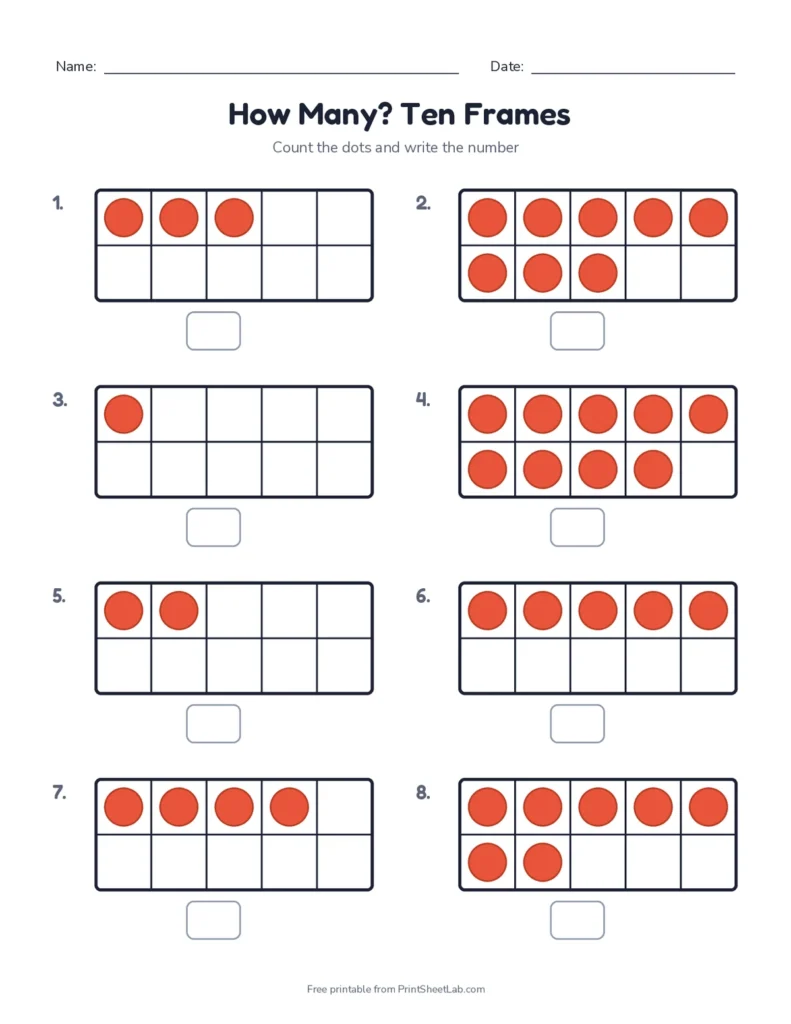
- Pictures: draw two ten frames and shade the dots, or use a printable ten frame. The child circles the dot that moves.
- Numbers: write 9 + 6 = 9 + 1 + 5 = 10 + 5 = 15, and ask the child to say each step.
Spend a day or two on each step. If a child gets stuck with numbers alone, go back to the counters for a few minutes rather than explaining again.
Which strategy for which fact? Quick mental addition choices
| Fact | Quickest strategy | Thinking |
|---|---|---|
| 5 + 2 | Count on from the bigger number | 5, then 6, 7 |
| 7 + 3 | Number bond to 10 | 7 and 3 make 10 |
| 8 + 6 | Make ten | 8 + 2 + 4 = 14 |
| 7 + 7 | Double | 14 |
| 7 + 8 | Near double | 7 + 7 + 1 = 15 |
| 9 + 5 | Add 10, take 1 | 15 − 1 = 14 |
| 46 + 27 | Tens and ones | 60 + 13 = 73 |
Which grade learns which strategies?
In the US Common Core standards, kindergarten children find the number that makes 10 with any number from 1 to 9 (K.OA.A.4). Standard 1.OA.C.6 asks Grade 1 children to add and subtract within 20 using strategies such as counting on, making ten and known sums like 6 + 6 + 1, and to be fluent within 10. By the end of Grade 2 (2.OA.B.2), children should know from memory all sums of two one-digit numbers.
In England, the National Curriculum for mathematics asks Year 1 pupils (age 5 to 6) to represent and use number bonds and related subtraction facts within 20. In Year 2 (age 6 to 7) they recall and use addition and subtraction facts to 20 fluently, and derive and use related facts up to 100.
A six-week teaching plan
Ten minutes a day is plenty. Move on only when the current strategy feels easy, and repeat a week if it does not.
| Week | Focus | Daily activity |
|---|---|---|
| 1 | Counting on | Roll two dice; say the bigger number and count on the smaller |
| 2 | Number bonds to 10 | Ten frame and fingers; the number bonds game |
| 3 | Making ten | Two ten frames with counters; fill the first frame, then add the rest |
| 4 | Doubles and near doubles | Doubles game; find doubles around the house |
| 5 | Adding 9 and 8 | Number line jumps: forward 10, back 1 or 2 |
| 6 | Mixed facts within 20 | Worksheet plus “which strategy did you use?” |
Two-digit addition with tens and ones usually comes later, once facts within 20 are secure, often in Grade 2 or Year 2.
Which stage is your child at?
- Counting all: for 4 + 3, counts out four fingers, then three, then counts all seven. Next step: counting on.
- Counting on: starts at 4 and counts “5, 6, 7”. Next step: number bonds and doubles.
- Using known facts: “I know 4 + 4 is 8, so 4 + 3 is 7.” Next step: making ten and strategies for two-digit addition.
- Instant recall: just knows 4 + 3 = 7. Keep it fresh with short, mixed practice.
Watching how a child solves three or four facts tells you more than a test score, and shows which strategy to teach next.
Common mistakes and how to fix them
- Counting the starting number again (4 + 3: “4, 5, 6” = 6). Say the first number, tap your head, then count the next ones on fingers.
- Splitting the wrong number when making ten. Split the smaller number to top up the bigger one, and check with two ten frames.
- Not seeing near doubles. Ask “Are these numbers next door to each other?” before every fact for a week.
- Forgetting to take one away after adding 10 for a 9. Always show the hop back on a number line until it is automatic.
- Adding digits in the wrong columns in two-digit sums. Say the value (“forty plus twenty”) rather than the digit (“four plus two”).
- Rushing to speed. Timed drills before a strategy is secure can push children back to finger counting. Build accuracy first.
Games and worksheets for extra practice
Match each game to the strategy you are working on: number bonds with the number bonds to 10 game, doubles with the doubles facts game, and mixed facts with the addition within 20 game. For quiet practice, our addition worksheets go from single digits to regrouping. Ask “Which strategy did you use?” next to two or three answers on each sheet.
A hundreds chart is the best tool for two-digit addition: moving down a row adds ten, and moving right adds one. Once addition feels solid, the same addition strategies work backwards for subtraction worksheets: 13 − 5 is “5 and what make 13?”
Screen-free ideas for home:
- Dice doubles: roll one die and double it; roll two and add them with the fastest strategy.
- Make ten snap: deal cards 1 to 9 and snap when two cards make 10.
- Shopping sums: add two whole-pound or whole-dollar prices at the shop.
- Domino totals: add the dots on each domino, then sort them by total.
Sources
Grade expectations come from the Common Core State Standards for Mathematics (Grade 1 Operations and Algebraic Thinking, including 1.OA.C.6, plus K.OA.A.4 and 2.OA.B.2) and the National Curriculum in England: mathematics programmes of study for Years 1 and 2.
Frequently asked questions
7 quick answers
What are the main addition strategies for first grade?
Counting on, number bonds to 10, making ten, doubles and near doubles. Common Core standard 1.OA.C.6 names counting on, making ten and easier known sums as strategies for adding within 20.
What is the make-ten strategy?
Split one number so the other reaches 10, then add what is left. For 9 + 4, take 1 from the 4 to make 10, then add the remaining 3 to get 13.
Is it bad for children to count on their fingers?
No. Fingers are a great first tool, especially for number bonds to 10. The aim is to move beyond counting one by one for bigger numbers by using addition strategies built on facts the child already knows.
How do addition strategies help with subtraction?
Every addition fact has matching subtraction facts: if 8 + 5 = 13, then 13 − 5 = 8 and 13 − 8 = 5. Children who can make ten can also subtract by counting up to ten and beyond.
How long does it take to learn addition facts within 20?
It varies from child to child. Common Core expects fluency within 10 in Grade 1 and all sums of two one-digit numbers from memory by the end of Grade 2, so most children work on these facts over about two school years.
Which addition strategy should I teach first?
Start with counting on from the bigger number, because it builds on counting that children already do. Then teach number bonds to 10, since the make-ten and add-9 ideas both depend on them.
What is the best strategy for mental addition?
There is no single best one. For facts within 20, making ten and doubles cover most cases. For two-digit mental addition, splitting into tens and ones is the easiest to learn and rounding up is the quickest when a number ends in 8 or 9.