What are sight words? They are the very common words that children learn to read instantly, without stopping to sound them out, such as the, said, was and you. A small set of them makes up a large share of the words in early reading books, so knowing them on sight lets a child spend their effort on the new and harder words in a sentence.
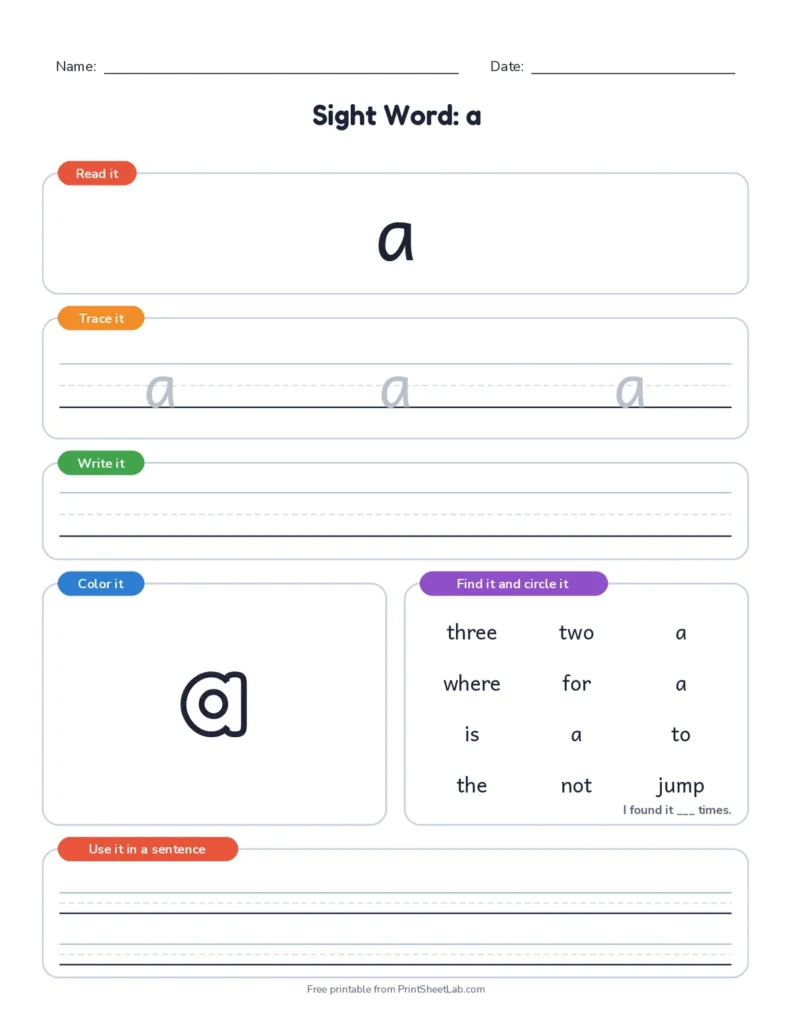
This guide answers “what are sight words?” in plain terms, shows how they differ from high-frequency and decodable words, sets out the Dolch and Fry lists with real examples, and covers how to teach sight words in a phonics-friendly way, in five minutes a day, with free worksheets and games from PrintSheetLab.
What are sight words? The short answer
Teachers use the term in two ways, and the difference matters for how you teach.
- Everyday meaning: a list of common words children practice until they can read them in under a second, such as the Dolch or Fry lists.
- Research meaning: any word a reader recognizes instantly. For a fluent adult, almost every familiar word is a sight word. Reading researcher Linnea Ehri calls the process that stores words this way orthographic mapping: the reader links the letters to the sounds they have already learned, and the word is then remembered.
So when a parent asks “what are sight words?”, the practical answer is “the common words on your child’s list”, and the longer answer is “any word your child has read often enough, sound by sound, to know it at a glance”.
How sight words, high frequency words and decodable words differ
These three labels overlap, which is why lists can look confusing.
| Term | What it means | Examples |
|---|---|---|
| High-frequency words | The words that appear most often in text, whatever their spelling | the, and, of, to, in, it, was |
| Decodable words | Words that follow the letter-sound patterns a child has already been taught | and, can, in, it, up, jump, not, red |
| Irregular or “tricky” words | Common words with a spelling that does not match the usual patterns, or one not taught yet | said, was, of, one, two, could, their |
| Sight words (list sense) | A teaching list that mixes all of the above | The Dolch and Fry lists |
Look at the Dolch pre-primer list and you will find and, can, jump and help next to said, one and two. Most words on sight word lists can be sounded out with basic phonics. Only some of them need their tricky part taught directly.
Common exception words: the term used in England
In England, early reading is taught through systematic synthetic phonics, and the national curriculum does not use the term “sight words”. Instead it uses common exception words: common words with unusual letter-sound correspondences. In Year 1, students should be taught to read them, “noting unusual correspondences between spelling and sound”.
The curriculum’s Year 1 examples include the, a, do, to, today, of, said, says, are, were, was, is, his, has, I, you, your, they, be, he, me, she, we, no, go, so, by, my, here, there, where, love, come, some, one, once, ask, friend, school, put, push, pull, full, house and our, with the note that the choice varies by phonics program. The Department for Education’s reading framework adds that schools also call these “tricky words”, and that reading words “at a glance” does not mean memorizing whole words.
Many phonics programs also treat some words as tricky only for now. She, me and we look odd before children learn that e can say its name, and become decodable later.
What are sight words on the Dolch and Fry lists?
Most sight word lists in schools come from one of two sources.
- Dolch: Edward Dolch published his basic sight vocabulary in 1936 and in his 1948 book Problems in Reading. It has 220 “service words” (no nouns), in five levels, plus a separate list of 95 nouns. It was drawn from children’s books of the time, which is why the nouns include kitty and Santa Claus.
- Fry: Edward Fry’s Instant Words are 1,000 words ranked by frequency, usually taught in groups of 100. In his 1980 article Fry wrote that about half of all written material is made up of the first 100 words and their common variants.

Dolch sight words at each level: the chart shows the word count and six real examples from every list.
Dolch sight words by level, with examples
| Dolch level | Words | Examples | Usual stage | Worksheets |
|---|---|---|---|---|
| Pre-primer | 40 | a, and, the, said, you, see | Preschool, early kindergarten | Pre-primer |
| Primer | 52 | all, are, was, they, what, with | Kindergarten | Primer |
| First grade | 41 | after, could, of, once, were, when | Grade 1 | First grade |
| Second grade | 46 | always, because, does, their, which, would | Grade 2 | Second grade |
| Third grade | 41 | about, done, laugh, myself, only, together | Grade 3 | Third grade |
If a school letter mentions the sight words on your child’s list, it almost always means one of these levels. The stage column is a guideline. Schools differ, and steady progress matters more than hitting a number by a particular birthday. Our sight word worksheets follow these five Dolch levels.
Sight words by age: a stage-by-stage guide
The honest answer to “which sight words should my child know?” depends more on what they have learned in phonics than on their birthday. Use these stages as a rough map.
- Ages 3 to 4 (preschool, Nursery): no formal lists. Share books, play rhyming and sound games, and point out a few words children see every day, like their name and the. Our alphabet worksheets and letter tracing worksheets build the letter knowledge that comes first.
- Ages 4 to 5 (kindergarten, Reception): once a child knows some letter sounds, add a handful of pre-primer words at a time. Many kindergartens work through the pre-primer and primer lists during the year.
- Ages 6 to 7 (grade 1, Year 1 and Year 2): first grade Dolch words or the Year 1 common exception words. Children should now decode most regular words, so sight word practice focuses on the irregular ones.
- Ages 7 to 9 (grades 2 and 3): the second and third grade lists, plus spelling. Move from reading the words to writing them correctly in sentences with our spelling worksheets.
How to teach sight words: a phonics-first method
This routine follows the approach in England’s reading framework and Ehri’s research: decode what can be decoded, and teach only the unusual part as the tricky bit.
- Say the word and use it in a sentence. “Said. Mom said it was time for bed.”
- Count the sounds. Said has three: /s/ /e/ /d/. Hold up a finger for each.
- Match letters to sounds. Write the word and point: s says /s/, d says /d/, as expected.
- Mark the tricky part. Underline ai, which says /e/ here. That is the only part to remember.
- Write it from memory. Cover the word, write it, then check.
- Read it in a sentence within the same session, and again the next day.
Worked examples: finding the tricky part
| Word | Sounds | Regular parts | Tricky part |
|---|---|---|---|
| said | s-e-d | s, d | ai says /e/ |
| was | w-o-z | w | a says /o/, s says /z/ |
| of | o-v | none | o says /u/, f says /v/ |
| they | th-ay | th | ey says /ay/ |
| could | c-oo-d | c, d | oul says /oo/ |
| jump | j-u-m-p | all four | none: just decode it |
Ask “what are sight words made of?” and the table gives the answer: mostly regular letters with one tricky bit. The last row is the point: words like jump, and and help sit on sight word lists, but a child who knows basic phonics can simply read them.
Is every word on a sight words list really tricky?
A sight words list can make every word look like something to memorize. To test that, we compared the 40 Dolch pre-primer words with the Year 1 common exception word examples quoted earlier in this guide. This table shows which words appear on both lists:
| Dolch pre-primer words (40) | How many | Words |
|---|---|---|
| On the Year 1 common exception word examples | 15 | a, come, go, here, I, is, me, my, one, said, the, to, we, where, you |
| Not on that list | 25 | and, away, big, blue, can, down, find, for, funny, help, in, it, jump, little, look, make, not, play, red, run, see, three, two, up, yellow |
Only 15 of the 40 words (38%) are on the exception list, and the other 25 follow regular patterns that phonics teaches. Some of them, such as blue, play and see, need a vowel team before a child can read them, so they are not decodable on day one. But none of them has to be memorized as an unbreakable whole word. That is why the list is best taught with the phonics-first routine, and why the pre-primer list is a gentle place to start.
Sight words for kindergarten: how many new words a week?
When planning sight words for kindergarten, parents often ask how long the lists take. If you teach 3, 4 or 5 new words a week, as in the routine below, this table counts the weeks needed to cover each part of the Dolch lists (the 95 nouns are extra):
| Dolch words learned so far | Total words | Weeks at 3 new words a week | At 4 a week | At 5 a week |
|---|---|---|---|---|
| Pre-primer | 40 | 14 | 10 | 8 |
| Pre-primer + primer (kindergarten) | 92 | 31 | 23 | 19 |
| Everything up to first grade | 133 | 45 | 34 | 27 |
| Everything up to second grade | 179 | 60 | 45 | 36 |
| Everything up to third grade | 220 | 74 | 55 | 44 |
Pre-primer and primer together are 92 words, which at 4 a week takes 23 weeks, comfortably inside a 36-week school year. With 3 a week it takes 31 weeks, still inside the year. That is why most kindergarten sight words programs keep to a few words a week, and why more than 5 a week is rarely needed. By the end of third grade the whole 220-word list is about 44 to 74 weeks of work, so there is no need to rush any single level.
High frequency words: why the first 100 do so much of the work
High frequency words matter because a small group of them covers a large share of everything a child reads. As noted above, Fry reported that about half of all written material is made of the first 100 words and their common variants.
At 3, 4 or 5 new words a week, those 100 words take 34, 25 or 20 weeks, which means a child who practices a few words every day can cover half of ordinary text in under one school year. After that, each new word adds less, which is why the first 100 are worth teaching carefully and the rest can follow the child’s own reading.
A five-minute daily sight word routine
- 1 minute: quick review of five known words, shown one at a time.
- 2 minutes: the week’s new words, using the six steps above. Introduce three to five new words a week.
- 2 minutes: read a sentence or short book page containing the words, or play one game.
Short daily practice works better than one long weekly session. Keep a “known” pile and a “learning” pile, and move words back if they slip.
Example: one week with five new words
Say your child’s new words are said, was, they, of and went. On Monday, introduce said and was with the six steps. On Tuesday, add they and of. On Wednesday, notice that went is fully decodable: sound it out and move it straight to the known pile. On Thursday, read a short book page and hunt for all five. On Friday, dictate one sentence, such as “They said it was one of the best”, and check the spelling together.
Sight word games and printables
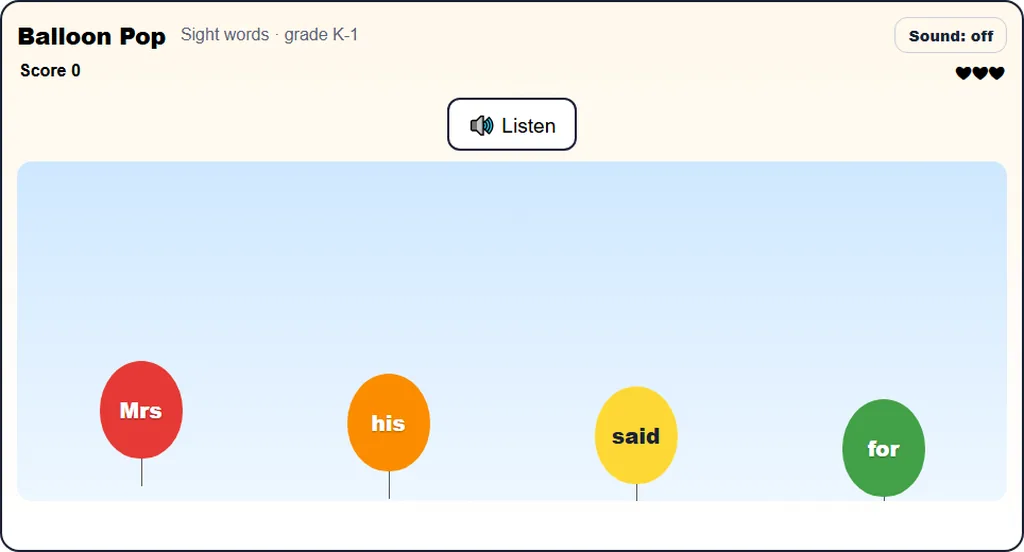
- Listen and find: in the sight words game the word is read aloud and children pick it out from look-alikes, which trains careful looking at every letter.
- Type it: the sight words typing game adds spelling practice for older children.
- Flash cards: make cards for the words that keep slipping with the flash card maker, and mark the tricky part in a second color.
- Bingo: paste your list into the bingo card generator and play with the whole family or class.
- Word hunt: choose a word of the day and count how often it appears in a bedtime story or on a cereal box.
- Build it: make the word with magnetic letters, say each sound as you place the letter, then mix and rebuild.
- Word families: once and is known, try hand, band, sand with our word family worksheets.
Common sight word mistakes and myths
- Memorizing word shapes. Drawing boxes round a word’s outline, or asking children to guess from the first letter, teaches the wrong habit. Look at every letter.
- Too many new words at once. Twenty cards a week overwhelms most beginners. Three to five is plenty.
- Treating regular words as tricky. If a word can be decoded with the sounds taught so far, decode it.
- Flash cards only. Cards help speed, but children also need the words in sentences and in their own writing.
- Racing through the lists. Finishing a level matters less than keeping the words known a week later.
How to tell a sight word is really known
- The child reads it in about a second, both on a card and in a sentence.
- They spell it correctly in their own writing.
- They still know it a week later without review.
If words are not sticking, cut the number of new words to two or three a week, go back to the sound-by-sound steps, and try writing words in sand or shaving cream. If progress stays very slow over several months, talk to your child’s teacher; early reading support makes a real difference.
Sources
- Department for Education, English programmes of study: key stages 1 and 2 (Year 1 word reading and English Appendix 1: Spelling).
- Department for Education, The reading framework (July 2023).
- Ehri, L. C. (2014), Orthographic mapping in the acquisition of sight word reading, spelling memory, and vocabulary learning, Scientific Studies of Reading 18(1).
- Dolch, E. W. (1936), “A basic sight vocabulary”, The Elementary School Journal 36(6); and Problems in Reading (1948).
- Fry, E. (1980), “The new instant word list”, The Reading Teacher 34(3).
Frequently asked questions
8 quick answers
What are sight words in simple terms?
Sight words are common words a child can read straight away, without sounding them out, such as the, said, you and was. Most can be partly sounded out; children learn the tricky part so the whole word becomes instant.
What are sight words called in the UK?
The English national curriculum calls irregular common words “common exception words”, and many schools and phonics programs call them “tricky words”. The more general term is high-frequency words.
What are sight words to teach first?
Start with very common words from the Dolch pre-primer list, such as the, a, and, I, to, is, it, you and said, once your child knows some letter sounds.
What are sight words a kindergartner should know, and how many?
Usually words from the Dolch pre-primer and primer lists (92 words together) or the first 100 Fry words. There is no single standard, and expectations vary by school and by phonics program.
What are sight words on the Fry list?
The Fry list is Edward Fry’s 1,000 Instant Words, ranked by how often they appear. The first 100 include the, of, and, a, to, in, is, you, that and it, and most schools teach them in groups of 100 or smaller sets.
Are sight words the same as phonics?
No. Phonics teaches how letters represent sounds so children can decode any word. Sight word practice builds instant recognition of common words. The best teaching uses phonics to learn sight words, not memorization of shapes.
How many weeks does it take to learn the Dolch lists?
At 4 new words a week, the 92 pre-primer and primer words take 23 weeks, and all 220 words take 55 weeks. At 3 a week the 92 words take 31 weeks, which fits inside a 36-week school year.
How many Dolch pre-primer words are tricky?
In our comparison, 15 of the 40 pre-primer words are on the Year 1 common exception word examples, such as the, said, you and one. The other 25 follow regular spelling patterns that phonics teaches.