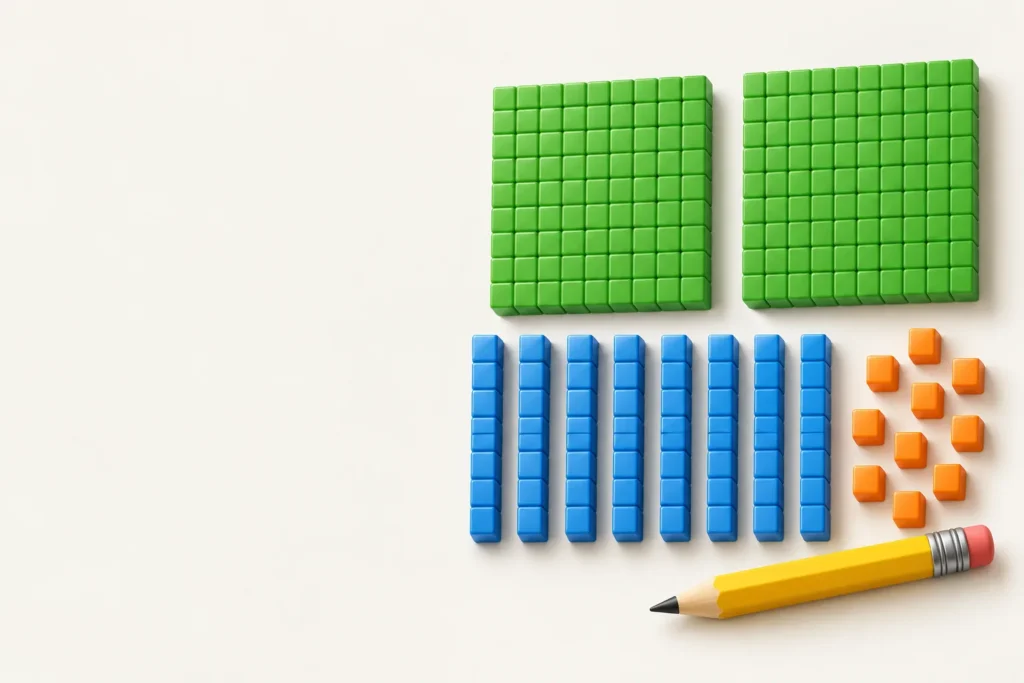
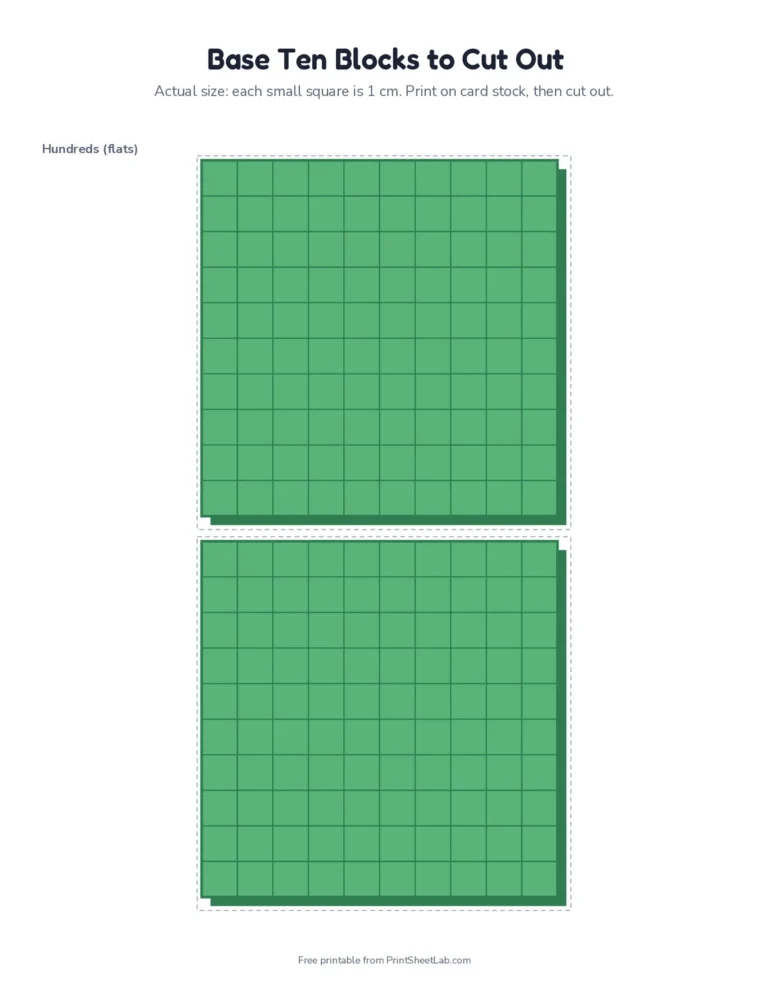
Base ten blocks (also called place value blocks or base 10 blocks) show numbers as real shapes: a small cube is one, a rod of ten cubes is ten, and a flat square of ten rods is one hundred. They make place value something children can see and touch. Use the maker above to print free base ten blocks to cut out (at the actual 1 cm size of plastic blocks), a colorful place value mat, and base ten blocks worksheets with answer keys, or build numbers with the virtual base ten blocks below.
In short: base ten blocks show 1 as a small cube, 10 as a rod and 100 as a flat. This page has a free base ten blocks printable at true 1 cm size, place value mats, base 10 blocks worksheets with answer keys, and virtual blocks that show regrouping on screen.
Virtual base ten blocks
Press + and − to add hundreds, tens and ones to the mat and watch the number and its expanded form update. Put more than 9 ones on the mat and the Trade 10 ones for 1 ten button lights up. That trade is exactly what “carrying” (regrouping) means in addition. Break a ten into 10 ones shows “borrowing” in subtraction. Then play Build a number: make the target number with the fewest blocks.
Ready-to-print base ten blocks (PDF)
Every sheet below is a ready base ten blocks printable: download the PDF straight away, or choose Customize to change the numbers, the answer format or the block size first.

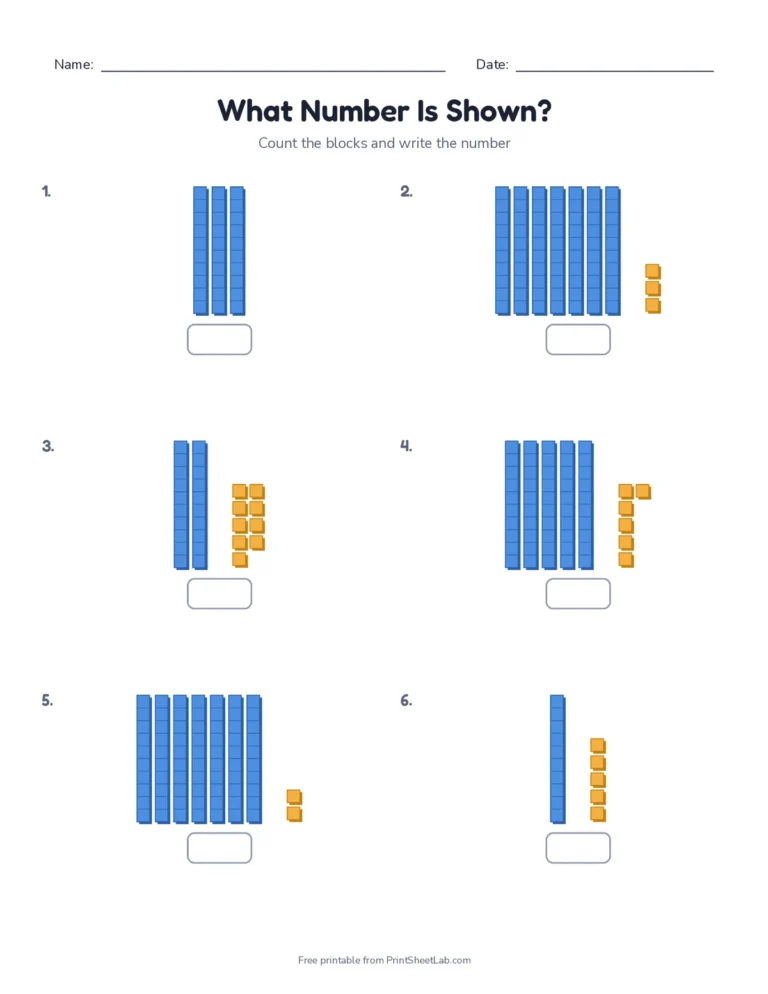
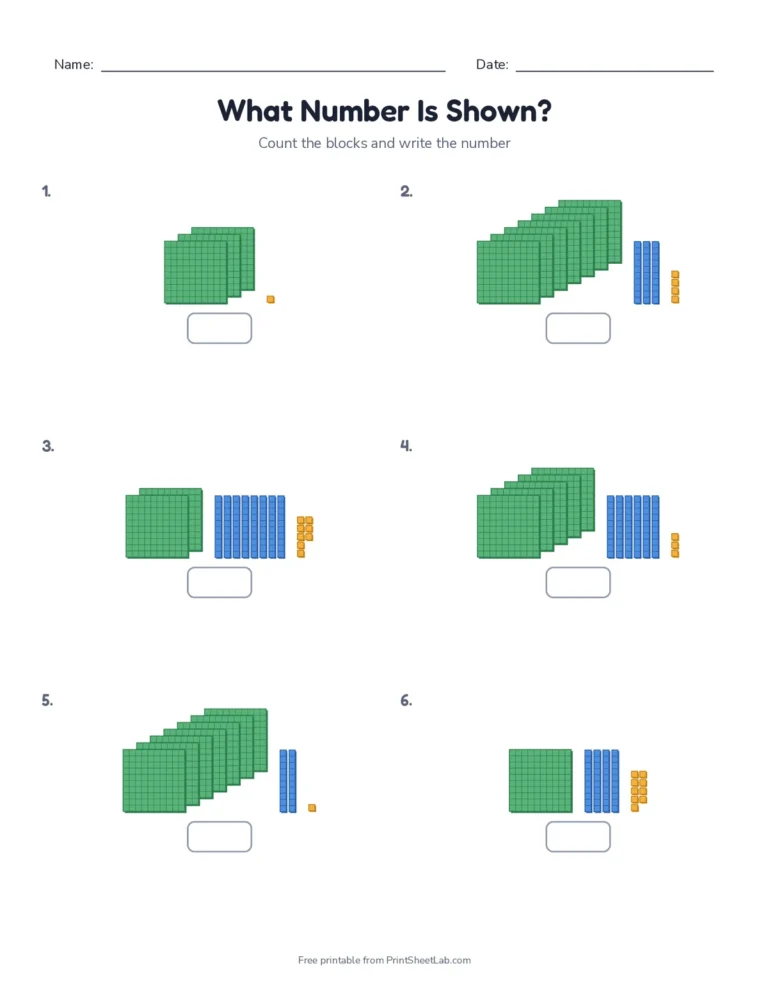

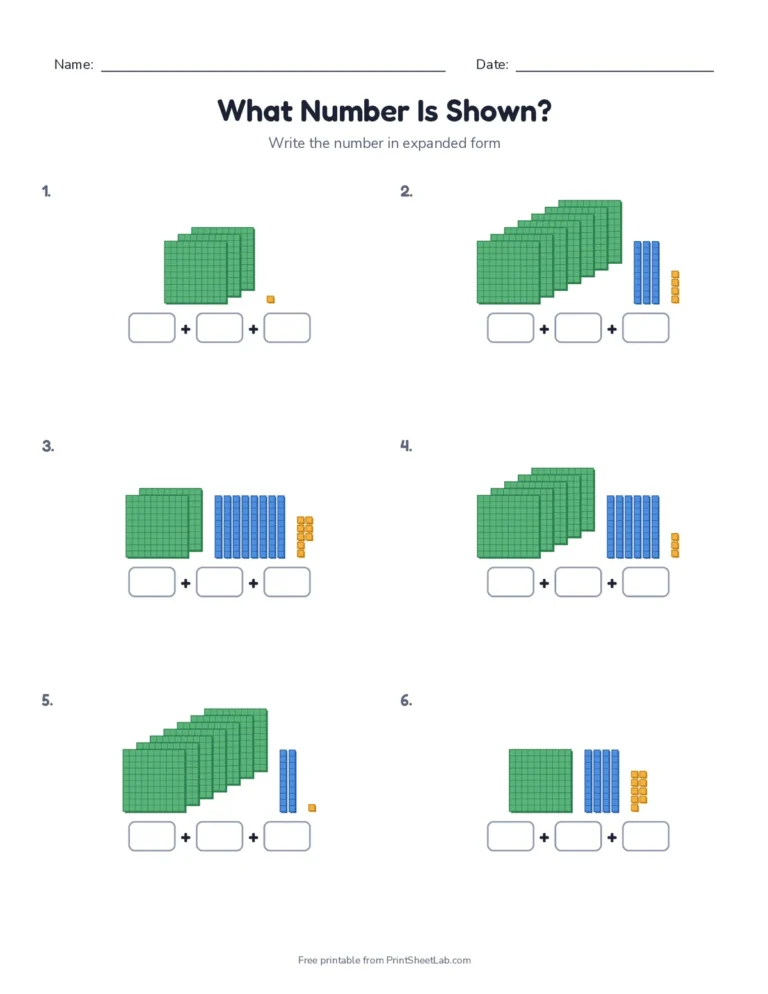
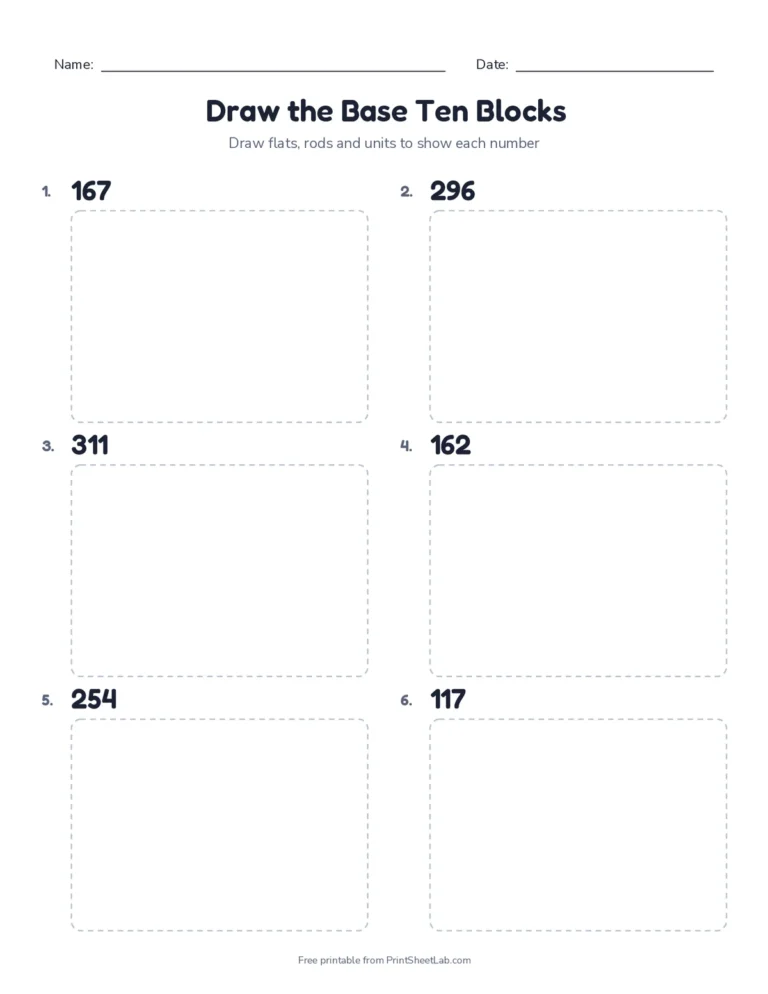
What each base ten block means
| Block | Also called | Value | Made of |
|---|---|---|---|
| Unit | Cube, one | 1 | A single small cube |
| Rod | Long, ten | 10 | 10 units in a row |
| Flat | Square, hundred | 100 | 10 rods side by side (100 units) |
| Cube | Big cube, thousand | 1,000 | 10 flats stacked up |
Every block is exactly ten times the one before it, which is the whole idea of our base ten number system: each place in a number is worth ten times the place to its right.
How to read a number from base ten blocks
- Count the flats for the hundreds digit. Three flats means 3 hundreds, or 300.
- Count the rods for the tens digit. Four rods means 4 tens, or 40.
- Count the units for the ones digit. Seven units means 7.
- Put the digits together: 3 hundreds, 4 tens and 7 ones is 347. In expanded form it is 300 + 40 + 7.
- Watch for zeros. If there are no rods, the tens digit is 0: 3 flats and 7 units make 307, not 37.
Base 10 blocks worksheets
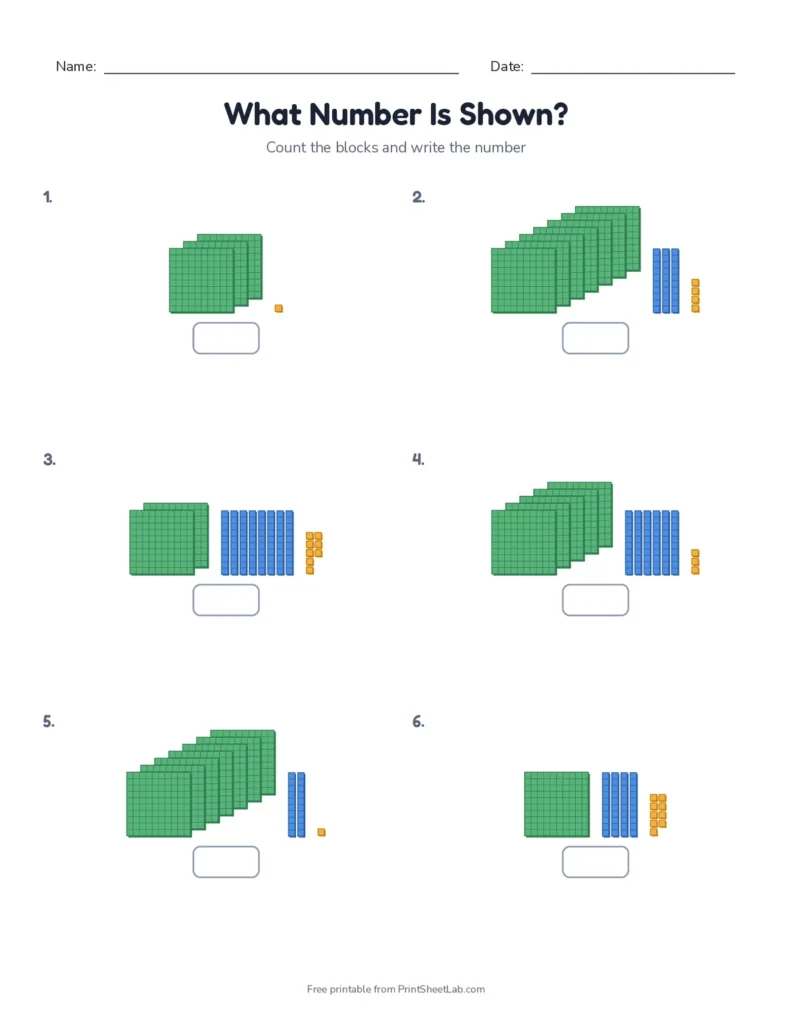
- What number is shown? Pictures of flats, rods and units to count. Choose the answer format: write the number, fill in a hundreds-tens-ones table, or write the expanded form (300 + 40 + 7).
- Draw the blocks: read a number and draw it with squares for hundreds, lines for tens and dots for ones. The answer key shows the blocks.
- Three levels: 2-digit numbers to 99 (grade 1), 100 to 399 (grade 2) and all 3-digit numbers to 999 (grades 2 and 3), matching the grade 2 place value standards in the Common Core. Numbers with a zero digit appear now and then, because they are the trickiest.
Place value mat
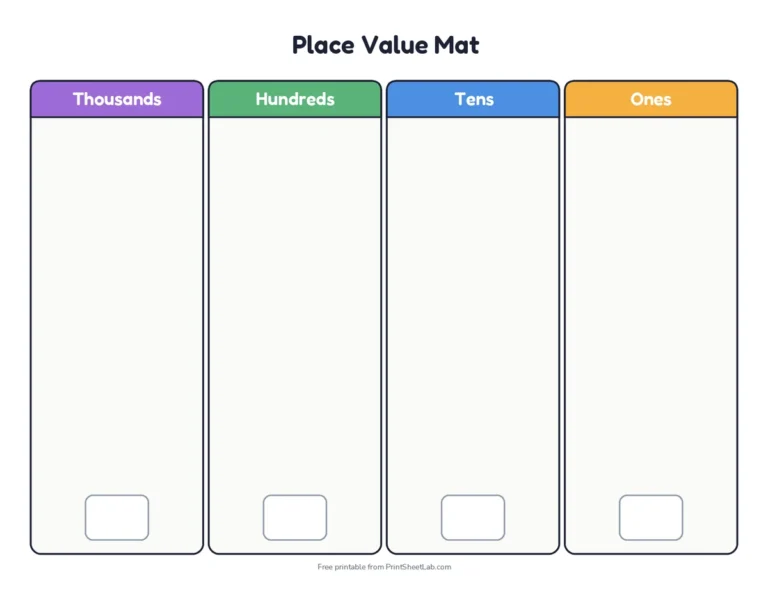
A place value mat is a board with a column for each place: hundreds, tens and ones (and thousands if you like). Children put blocks in the right column to build a number, then write the digit for each column in the boxes at the bottom. It keeps blocks organized and makes the link between the blocks and the written number very clear. Printed in landscape and laminated, or tucked inside a clear plastic pocket, the mat can be wiped clean with a dry-erase pen and used all year.
Activities with the blocks
- Show it three ways: build 45 as 4 tens and 5 ones, then as 3 tens and 15 ones, then as 45 ones. All three are the same number.
- Addition with regrouping: build both numbers, push them together, and trade every 10 ones for a ten.
- Subtraction with regrouping: build the bigger number. If there are not enough ones to take away, break a ten into 10 ones first.
- Race to 100: roll a die and add that many units; trade for a rod whenever you can. First to trade up to a flat wins.
- Compare numbers: build two numbers and compare the hundreds first, then the tens, then the ones.
Frequently asked questions
8 quick answers
What are base ten blocks?
They are hands-on math manipulatives that show place value. A unit cube is 1, a rod is 10, a flat is 100 and a large cube is 1,000. Children use them to build, compare, add and subtract numbers.
Are the printable base ten blocks the same size as plastic ones?
Yes. Choose “Actual size (1 cm)” and each small square prints 1 centimeter wide, the same as standard plastic sets. Print at 100% (actual size) with scaling turned off.
What is the difference between a rod and a flat?
A rod is a row of 10 units and is worth 10. A flat is a square of 10 rods (100 units) and is worth 100.
How do you show 305 with the blocks?
Use 3 flats for the 3 hundreds, no rods because the tens digit is 0, and 5 units for the 5 ones.
How do base ten blocks help with regrouping?
When you have 10 or more units, you can trade 10 of them for one rod. That trade is regrouping (carrying) in addition. In subtraction you do the reverse and break a rod into 10 units (borrowing).
What grade uses base ten blocks?
They are used from kindergarten, where children see teen numbers as ten and some ones, through grade 2 and 3 for 3-digit place value, addition and subtraction with regrouping, and even later for decimals.
What is expanded form?
Expanded form writes a number as the sum of the value of each digit. 347 in expanded form is 300 + 40 + 7. The blocks show each part of the sum as its own group.
Are these base ten printables free?
Yes. The cut-out blocks, the mats and every worksheet cost nothing, need no account and print on Letter or A4 paper, as many copies as your class needs.
More place value practice
- Place value chart for any number, including decimals.
- Place value worksheets for every grade.
- Addition worksheets and subtraction worksheets with regrouping.
- Hundreds chart to see tens and ones patterns.
- Ten frames for numbers to 20.
- 2nd grade math worksheets, the big place value year.