The most fun ways to practise times tables are short games with a reason to answer fast: card games like Snap, dice races, clapping rhythms, bingo, relay races and quick online rounds. Ten minutes of play a day, aimed at one table at a time, builds the same recall as a worksheet without the groans.
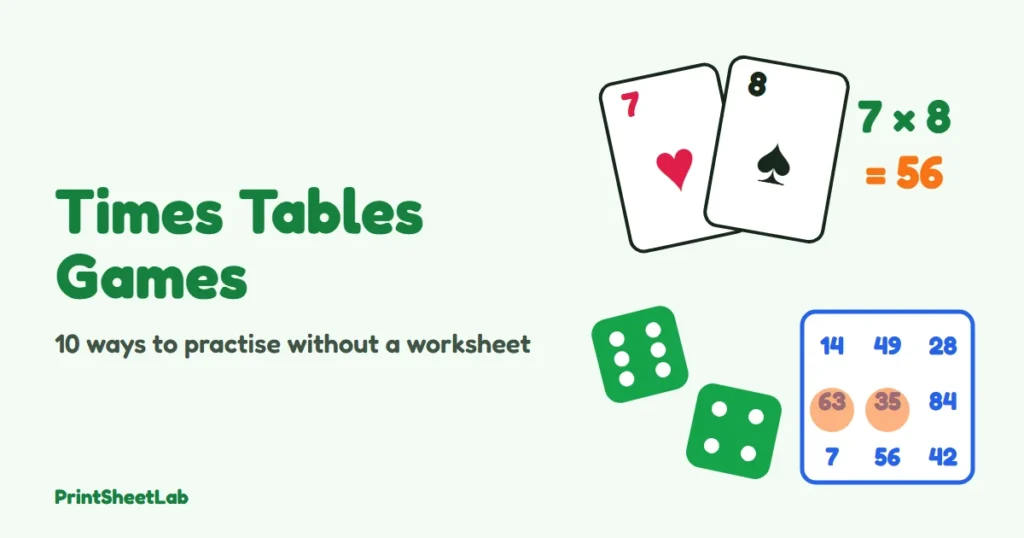
Below are 10 games that use things you already have at home or in class: a pack of cards, two dice, a printed chart, your hands. Each game lists the kit, the tables and the ages it suits. For quick screen practice, start with our mixed times tables game, which mixes facts from 2 to 12.
This guide is about practice, not memory tricks. If your child still needs a way to work out 7 × 8, start with our times tables tricks for every table. Tricks are fun ways to learn times tables; games make them stick.
Fun ways to practise times tables: quick picker
| Game | You need | Best tables | Ages | Time |
|---|---|---|---|---|
| 1. Product Snap | Pack of cards | One table, 2 to 10 | 7 to 9 | 5 min |
| 2. Biggest Product | Pack of cards | Mixed, up to 10 × 10 (12 × 12 with picture cards) | 8 to 11 | 10 min |
| 3. Dice Four in a Row | 2 dice, counters, a drawn board | 1 to 6 | 6 to 9 | 10 min |
| 4. Pat, Clap, Say | Hands | 2, 5, 10, then 3 and 4 | 5 to 7 | 3 min |
| 5. Buzz | A group in a circle | Any one table | 7 to 11 | 5 min |
| 6. Times tables bingo | Bingo cards, pens | One table or mixed | 7 to 10 | 10 min |
| 7. Answer relay race | Answer cards, space to run | Any | 7 to 11 | 10 min |
| 8. Chart Battleships | 2 printed multiplication charts | Up to 12 × 12 | 8 to 11 | 15 min |
| 9. Flash card pairs | Homemade flash cards | One table | 6 to 9 | 5 min |
| 10. Online times table games | A device | Each table, then mixed | 7 to 11 | 5 min |

Times table card games
Card games are among the quickest fun ways to practise times tables, and a normal pack is the cheapest maths kit there is. Take out the jacks, queens and kings and count the ace as 1, which leaves 40 cards from 1 to 10. Card multiplication games work because every flip is a brand-new question.
1. Product Snap
Kit: pack of cards, 2 players. Tables: one table at a time. Ages: 7 to 9.
Put one “table card” face up in the middle, for example a 6. Deal the rest into two face-down piles. Both players turn over their top card at the same time. The first to say the product of their own card and the table card, such as “6 × 4 is 24”, wins both cards. When the piles run out, the player with more cards wins. To make it harder, change the table card every round.
2. Biggest Product
Kit: pack of cards, 2 to 4 players. Tables: mixed, up to 10 × 10. Ages: 8 to 11.
Each player turns over two cards and says the product out loud. The biggest correct product wins all the cards on the table. A wrong answer loses that round, so children check each other. For tie-breaks, each tied player turns over two more cards. For 12 × 12 practice, put the jacks back as 11 and queens as 12.
These times table card games suit car journeys and waiting rooms, and card multiplication needs no writing at all.
Multiplication dice games with two ordinary dice
3. Dice Four in a Row
Kit: two ordinary dice, counters or coins, paper. Tables: 1 to 6. Ages: 6 to 9.
Draw a 5 × 5 grid and fill it with products from two dice, such as 4, 6, 8, 12, 15, 18, 20, 24, 30 and 36. Players take turns rolling both dice and multiplying. If the product is on the board, cover it with a counter. The first player with four counters in a row (across, down or diagonally) wins.
Two dice can only make 18 different products. 6 and 12 are the most likely, with 4 ways each out of 36, while 25 and 36 need a double. Put 6 and 12 on the board more than once. Swap to 10-sided dice to practise tables up to 10.
Multiplication dice games like this one also teach that 3 × 4 and 4 × 3 land on the same square, which halves the number of facts to learn.
Clapping and counting: fun ways to learn times tables with no kit
4. Pat, Clap, Say
Kit: your hands. Tables: 2, 5 and 10 first, then 3 and 4. Ages: 5 to 7.
Keep a steady beat: pat your knees, clap your hands, then say the next multiple out loud. For the 3 times table: pat, clap, “three”; pat, clap, “six”; pat, clap, “nine”. Go up to 12 lots, then try backwards from 36. This is skip counting with a rhythm, and our skip counting guide for kids has more chants to use first.
5. Buzz
Kit: 3 or more players in a circle. Tables: any one table. Ages: 7 to 11.
Choose a table, say 4. Count round the circle from 1. Anyone whose number is a multiple of 4 says “buzz” instead of the number. Say the number by mistake, or pause too long, and you sit out a round. After 48 (12 × 4) start again with a new table. Buzz is one of the best games for a long car trip.
Bingo and relay races for a group
6. Times tables bingo
Kit: 3 × 3 grids and pens. Tables: one table or mixed. Ages: 7 to 10.
For the 7 times table, each player writes any nine of the 12 products (7, 14, 21, 28, 35, 42, 49, 56, 63, 70, 77, 84) in a 3 × 3 grid. The caller reads a question such as “seven nines” and players cross out 63 if they have it. First to cross out a full line shouts “bingo” and reads back the questions. For a class, make cards in seconds with our bingo card generator by typing the products in as your list.
7. Answer relay race
Kit: answer cards, two teams, a hall or garden. Tables: any. Ages: 7 to 11.
Spread the answer cards face up at the far end of the space. The caller reads a question, the first runner from each team races to grab the right answer card and runs back to tag the next player. A wrong card goes back with no point. Most cards after 5 minutes wins. It is one of the most active games here, and it builds speed under gentle pressure.
Games with printable charts and flash cards
8. Chart Battleships
Kit: two copies of a 12 × 12 printable multiplication chart, pencils, a book as a screen. Tables: up to 12 × 12. Ages: 8 to 11.
Each player secretly shades three ships on their own chart: one of 4 squares, one of 3 and one of 2, in straight lines. Take turns calling a square as a fact, for example “7 × 8”. The shot only counts if the caller also says the product, 56. The other player answers “hit” or “miss”, and the caller marks their second chart to keep track. First to sink all three ships wins.
9. Flash card pairs
Kit: 24 small cards. Tables: one table. Ages: 6 to 9.
Make 12 question cards (6 × 1 to 6 × 12) and 12 answer cards, or print a set from our flash card maker. Shuffle and lay them face down. Turn over two cards: if a question matches its answer, keep the pair and go again. This is one of the gentlest games for younger children, who say each fact many times without noticing.
Online times table games
10. Five-minute online rounds
Kit: a phone, tablet or computer. Tables: each table, then mixed. Ages: 7 to 11.
Online games give instant feedback and a score to beat, which makes them one of the easiest ways to practise alone. Play one table at a time, for example the 7 times table game or the 8 times table game, then the mixed game once each table is secure. Our free online math games guide lists more games by grade.
Keep screen rounds short and part of a plan. The American Academy of Pediatrics suggests families agree a family media use plan, and a 5-minute maths game fits easily into one.
Which fun ways to practise times tables suit each age?
Match the game to where your child is in the curriculum. In England, the national curriculum expects the 2, 5 and 10 times tables in Year 2, the 3, 4 and 8 in Year 3, and all tables up to 12 × 12 in Year 4. In the US, the Common Core standard 3.OA.C.7 says that by the end of Grade 3 children should know from memory all products of two one-digit numbers.
| Stage | Tables to focus on | Fun ways to practise times tables at this stage |
|---|---|---|
| Ages 5 to 7 (Year 1 to 2, K to Grade 1) | 2, 5, 10 as counting | Pat, Clap, Say; flash card pairs |
| Ages 7 to 8 (Year 3, Grade 2 to 3) | 3, 4, 8, then 6 | Product Snap, Dice Four in a Row, bingo |
| Ages 8 to 9 (Year 4, Grade 3 to 4) | 6, 7, 9, 11, 12 and mixed | Biggest Product, Buzz, relay race, online rounds |
| Ages 9 to 11 (Year 5 to 6, Grade 4 to 5) | Mixed facts and division | Chart Battleships, Biggest Product with 12 × 12 |
Children vary, so treat these ages as a guide. If a game feels hard, drop back one table.
A 10-minute weekly plan
Little and often works better than one long session. Here is one of the simplest ways to organise a school week, focusing on one table for the whole week.
| Day | Game | Minutes |
|---|---|---|
| Monday | Pat, Clap, Say forwards and backwards, then flash card pairs | 3 + 7 |
| Tuesday | Product Snap with this week’s table card | 10 |
| Wednesday | Online round for this week’s table, twice | 10 |
| Thursday | Times tables bingo or Buzz with the family | 10 |
| Friday | Mixed online game and Biggest Product with all tables learned so far | 5 + 5 |

Games are fun, but a short written check still helps. Our times tables worksheets make a short check, and the multiplication worksheets take the facts into bigger numbers.
Practising for the multiplication tables check
In England, the multiplication tables check is statutory for Year 4 pupils in state-funded schools. It has 25 on-screen questions covering tables up to 12, and the administration guidance gives pupils 6 seconds to answer each one, with the check taken in June.
Six seconds means recall, not working out. The fun ways to practise times tables that build that speed best are Product Snap, the relay race and short online rounds, because each one rewards a fast, correct answer.
Common mistakes when practising times tables with games
Even the most fun ways to practise times tables can backfire if the game is too hard or goes on too long.
| Mistake | What happens | Better approach |
|---|---|---|
| Mixing all tables too early | Children guess and lose confidence | One table a week, then mix in old ones |
| Only counting up from 1 | Fine for 2 × 3, very slow for 7 × 8 | Ask facts out of order and backwards |
| Games that go on too long | Attention drops, mistakes rise | Stop at 10 minutes while it is still fun |
| Only speed games | Anxious children freeze | Start slow (bingo, pairs), add speed later |
| Ignoring division | Facts stay one-way | Ask “what times 6 is 42?” in every game |
When multiplication is secure, the division facts game turns the same facts around.
Related guides and printables
- Times tables tricks and the best order to learn them
- Skip counting for kids, with songs and chants
- Free online math games for kids by grade
- Free multiplication chart to print
- All learning games for kids
Sources
Year-by-year expectations: national curriculum in England: mathematics programmes of study and Common Core Grade 3 Operations and Algebraic Thinking. Check details: GOV.UK multiplication tables check. Screen time: HealthyChildren.org (American Academy of Pediatrics). Game rules on this page are our own.
Frequently asked questions
7 quick answers
What are fun ways to practise times tables at home?
Card games like Product Snap, multiplication dice games like Four in a Row, clapping rhythms, bingo and short online games all work at home with no worksheet and very little kit.
What are fun ways to learn times tables for a child who hates them?
Keep sessions to about 10 minutes, start with a table they nearly know, choose a slow game such as flash card pairs before any speed game, and stop while it is still fun.
Which times tables should children learn first?
Most children start with the 2, 5 and 10 times tables, then 3, 4 and 8, then 6, 7, 9, 11 and 12. This matches the year-by-year order in the national curriculum in England.
Which fun ways to practise times tables help with the multiplication tables check?
Speed games help most: Product Snap, the answer relay race and short online rounds, because the check gives only 6 seconds per question.
How long should kids practise times tables each day?
Five to ten minutes a day is plenty for most children. Short, regular practice works better than one long session at the weekend.
Are online games good fun ways to practise times tables?
Yes, for short rounds. They give instant feedback and a score to beat. Mix them with card, dice and talking games so practice is not all on a screen.
What age should a child know all their times tables?
In England, children are expected to know tables up to 12 × 12 by the end of Year 4 (age 8 to 9). Common Core expects all products of two one-digit numbers by the end of Grade 3.