Skip counting for kids means counting forwards (or backwards) by the same number each time, such as 2, 4, 6, 8 or 5, 10, 15, 20, instead of counting in ones. Start with 10s, 5s and 2s at around age 5 to 7, using objects, a hundreds chart, a number line and short chants, then move on to 3s, 4s and the other tables as your child gets ready for multiplication.
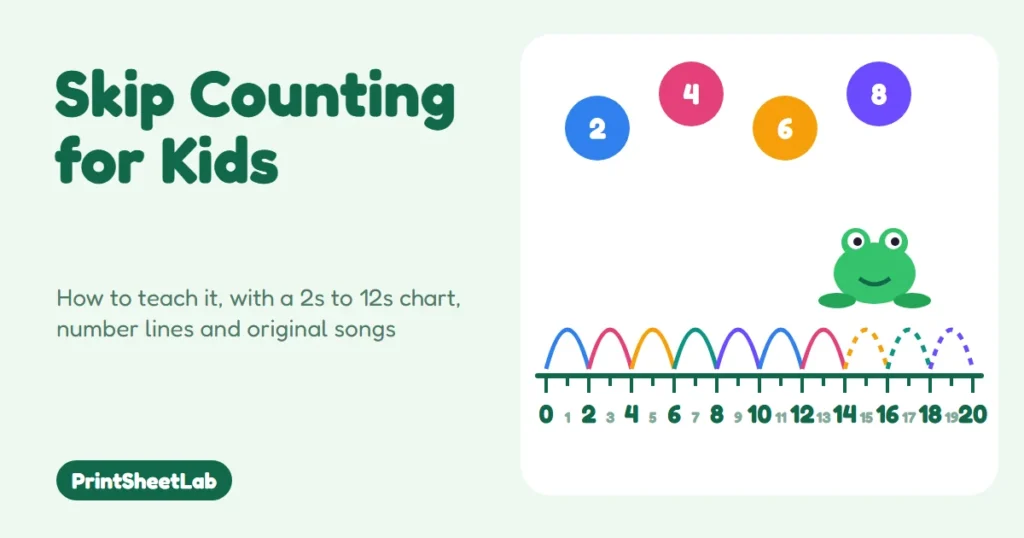
What is skip counting for kids?
When a child counts socks in pairs, they say “2, 4, 6, 8” rather than “1, 2, 3, 4, 5, 6, 7, 8”. Each number they say is the total so far, and the gap between the numbers never changes. That fixed jump is what makes skip counting for kids different from ordinary counting.
Skip counting is the bridge between counting and multiplication. Five jumps of 2 land on 10, which is the same fact as 5 × 2 = 10. A child who can count in 5s to 35 already knows that seven 5s make 35, even before they have heard the words “times table”.
It also pays off in everyday math: telling the time (minutes go up in 5s), counting money (10p, 20p, 30p or 10, 20, 30 cents), adding tens mentally and spotting odd and even numbers.
Ages and grades: when children are ready to start
There is no fixed start date for skip counting for kids. Most are ready when they can count objects to 20 reliably and say the numbers to 100 with a little help, often around age 5 or 6. The table combines the national curriculum in England with the US Common Core to show roughly where each count fits.
| Stage | Typical age | What children skip count by | Official reference |
|---|---|---|---|
| Year 1 / Kindergarten to Grade 1 | 5 to 6 | 2s, 5s and 10s, using objects | England Year 1: count in multiples of 2s, 5s and 10s |
| Year 2 / Grade 2 | 6 to 7 | 2s, 3s and 5s from 0; 10s from any number, forwards and backwards; 5s, 10s and 100s to 1,000 | England Year 2; Common Core 2.NBT.A.2 |
| Year 3 / Grade 3 | 7 to 8 | 4s, 8s, 50s and 100s | England Year 3 |
| Year 4 / Grade 3 to 4 | 8 to 9 | 6s, 7s, 9s, 25s and 1,000s | England Year 4; Common Core 3.OA.C.7 (all one-digit products by the end of Grade 3) |

Schools in India, Pakistan and the Gulf may call it “counting in 2s” or “number patterns”; the same order works at home.
A skip counting chart from 2s to 12s
This skip counting chart lists every sequence from 2 to 12, each taken to the twelfth jump, with one pattern that makes it easier to remember. Cover a column with a strip of paper and ask your child to say what is hidden.
| Count by | Sequence (12 jumps) | Pattern to notice |
|---|---|---|
| 2s | 2, 4, 6, 8, 10, 12, 14, 16, 18, 20, 22, 24 | Even numbers; ones digits go 2, 4, 6, 8, 0 |
| 3s | 3, 6, 9, 12, 15, 18, 21, 24, 27, 30, 33, 36 | Makes diagonals on a hundreds chart |
| 4s | 4, 8, 12, 16, 20, 24, 28, 32, 36, 40, 44, 48 | Double the 2s; ones digits go 4, 8, 2, 6, 0 |
| 5s | 5, 10, 15, 20, 25, 30, 35, 40, 45, 50, 55, 60 | Ends in 5 or 0; think of fingers on hands |
| 6s | 6, 12, 18, 24, 30, 36, 42, 48, 54, 60, 66, 72 | Double the 3s; ones digits go 6, 2, 8, 4, 0 |
| 7s | 7, 14, 21, 28, 35, 42, 49, 56, 63, 70, 77, 84 | No short digit pattern; days in weeks |
| 8s | 8, 16, 24, 32, 40, 48, 56, 64, 72, 80, 88, 96 | Double the 4s; ones digits go 8, 6, 4, 2, 0 |
| 9s | 9, 18, 27, 36, 45, 54, 63, 72, 81, 90, 99, 108 | Tens digit up 1, ones digit down 1 (to 90) |
| 10s | 10, 20, 30, 40, 50, 60, 70, 80, 90, 100, 110, 120 | Ends in 0; the tens digit goes up by 1 |
| 11s | 11, 22, 33, 44, 55, 66, 77, 88, 99, 110, 121, 132 | Repeated digits up to 99 |
| 12s | 12, 24, 36, 48, 60, 72, 84, 96, 108, 120, 132, 144 | Ten lots plus two lots |

Show only the row you are working on.
How many jumps does each count need to reach 100?
A skip counting chart for 2s to 12s stops at the twelfth jump, but many children ask how far each count goes. This table shows how many jumps of each size stay within 100, the last number reached and how many of the numbers on a hundreds chart you land on:
| Count by | Jumps that stay within 100 | Last number reached | Numbers on a hundreds chart landed on | Left over to reach 100 |
|---|---|---|---|---|
| 2 | 50 | 100 | 50 numbers (50%) | 0 |
| 3 | 33 | 99 | 33 numbers (33%) | 1 |
| 4 | 25 | 100 | 25 numbers (25%) | 0 |
| 5 | 20 | 100 | 20 numbers (20%) | 0 |
| 6 | 16 | 96 | 16 numbers (16%) | 4 |
| 7 | 14 | 98 | 14 numbers (14%) | 2 |
| 8 | 12 | 96 | 12 numbers (12%) | 4 |
| 9 | 11 | 99 | 11 numbers (11%) | 1 |
| 10 | 10 | 100 | 10 numbers (10%) | 0 |
| 11 | 9 | 99 | 9 numbers (9%) | 1 |
| 12 | 8 | 96 | 8 numbers (8%) | 4 |
Counting by 2s lands on 50 of the 100 numbers, counting by 5s on 20 and counting by 10s on only 10, so a hundreds chart colored in 2s is half full while 10s make a single column. Counts that do not divide 100 exactly leave a gap: 3s end at 99 with 1 left over, 7s end at 98 and 9s end at 99.
The gaps show why 3s, 7s and 9s feel harder on a hundreds chart than 2s, 5s and 10s, which all land exactly on 100. Use this table to choose which patterns to colour first: start with the counts that give a neat finish.
6 steps from real objects to numbers alone
These steps move from real objects to pictures to numbers alone. Spend a few days on each step, and go back one whenever your child starts guessing.
1. Make real groups
Put 20 pieces of pasta into piles of 2, or 30 buttons into piles of 5. Count the piles together, touching each one: “5, 10, 15, 20, 25, 30”. Then check by counting in ones: both ways give the same total.
2. Whisper and shout
Count in ones, but whisper the numbers in between and shout the ones you land on: “one, TWO, three, FOUR”. After a few rounds, drop the whispers completely. This works especially well for 2s and 5s.
3. Color a hundreds chart
Give your child a printable hundreds chart and ask them to color every number they land on. The 10s make one column, the 5s two columns, the 2s five columns, and the 3s slanting diagonals. Ask “what do you notice?” before explaining.
4. Jump along a number line
Number lines for skip counting show the size of each jump, which a hundreds chart does not. Draw arcs from 0 to 3, 3 to 6 and so on along a number line to 100, and say each landing number. Then ask: “How many jumps did it take to reach 18?” (six jumps). For home-made lines with no numbers, print blank number lines and let your child label them.
5. Chant with a beat
Clap, stamp or bounce a ball on each number. Rhythm helps children hold a long sequence in their head. You will find six short chants below.
6. Count backwards and from other numbers
Once 0, 10, 20 is easy, start from 30 and count back, or count in 10s from 7: “7, 17, 27, 37”. This turns a memorized rhyme into real understanding, and it is what the Year 2 curriculum asks for with 10s.
Keep skip counting for kids short and frequent: five minutes in the car or at bath time beats one long sitting at the table.
Skip counting songs and chants (original, free to use)
Rhythm is the secret weapon of skip counting for kids. We wrote these chants for PrintSheetLab, so print them, sing them or change the words. Clap once on every number.
Pairs of socks (2s)
2, 4, 6, 8,
socks in pairs are looking great!
10, 12, 14, 16,
every pair is nice and clean.
18, 20, that’s the view,
counting pairs the way we do!
Triangle climb (3s)
3, 6, 9,
triangles all in a line,
12, 15, 18,
keep on climbing, don’t be late,
21, 24, 27, 30,
three more each time, now we’re thirty!
High five (5s)
5, 10, 15, 20,
high fives, high fives, give me plenty!
25, 30, 35, 40,
wave your hands and keep it sporty,
45, 50, clap and cheer,
fifty’s halfway, a hundred’s near!
Bug legs (6s)
6, 12, 18, 24,
insects have six legs, count some more!
30, 36, 42, 48,
double the threes and keep it straight,
54, 60, count them all,
ten insects, sixty legs in all!
Marching tens (10s)
10, 20, 30, 40,
stamp your feet and march in order,
50, 60, 70, 80,
swing your arms and don’t be lazy,
90, 100, stand up straight,
ten big steps and we’re there, great!
Back to zero (10s backwards)
100, 90, 80, 70,
rocket’s ready, count down slowly,
60, 50, 40, 30,
20, 10, zero, lift off!
Skip counting by 6 (and the other tricky ones)
Skip counting by 6 is one of the most searched counts, because it comes after the easy 2s, 5s and 10s. The sequence to 72 is 6, 12, 18, 24, 30, 36, 42, 48, 54, 60, 66, 72.
- Double the 3s. Each 6s number is twice the 3s number in the same position: 3 → 6, 9 → 18, 15 → 30.
- Watch the last digit. The ones digits go 6, 2, 8, 4, 0 and then repeat, so every answer is even.
- Use 30 as a checkpoint. Five 6s make 30, so 36 is one more 6 and 24 is one fewer.
4s and 8s: say the 2s and keep every second number to get the 4s (4, 8, 12, 16), then keep every second 4s number to get the 8s (8, 16, 24, 32). 9s: up to 90, the tens digit goes up by one while the ones digit goes down by one (18, 27, 36, 45). 7s: there is no neat digit pattern, so use a calendar: the 7th, 14th, 21st and 28th of any month always fall on the same day of the week, one week apart.
Number lines for skip counting: when do two counts land together?
Draw two skip counts on the same number line in different colors and the arcs meet at some numbers. This is the idea behind common multiples. We worked out where each pair of counts first meets, and how often it happens up to 100:
| Two counts | First number both land on | Numbers they share (up to 100) | How many up to 100 |
|---|---|---|---|
| 2 and 3 | 6 | 6, 12, 18, 24, … | 16 |
| 2 and 5 | 10 | 10, 20, 30, 40, … | 10 |
| 3 and 4 | 12 | 12, 24, 36, 48, … | 8 |
| 3 and 5 | 15 | 15, 30, 45, 60, … | 6 |
| 4 and 6 | 12 | 12, 24, 36, 48, … | 8 |
| 5 and 10 | 10 | 10, 20, 30, 40, … | 10 |
| 4 and 8 | 8 | 8, 16, 24, 32, … | 12 |
| 6 and 9 | 18 | 18, 36, 54, 72, … | 5 |
Counting in 2s and 3s on one number line, the arcs meet every 6 (6, 12, 18, 24), which is 16 times up to 100. Counts in 3s and 5s meet only at 15, 30, 45, 60, 75 and 90.
When one count divides the other, as with 5s and 10s or 4s and 8s, the bigger count lands only on numbers the smaller one also reaches. Ask children to predict where the arcs will meet before drawing them: it turns number lines for skip counting into a first lesson on common multiples, which they will meet again with fractions in Grade 4 and 5.
Everyday games that need no equipment
The best practice happens away from the table, with things you already have.
| Activity | Count by | How to play |
|---|---|---|
| Sock sort | 2s | Pair the laundry and count the pairs: 2, 4, 6… |
| Hand prints | 5s and 10s | Trace everyone’s hands; count fingers by 5s, then by 10s for pairs of hands |
| Coin jar | 2s, 5s and 10s | Line up 10p or 10-cent coins (or ₹2, ₹5 and ₹10 coins) and count the total |
| Clock minutes | 5s | Point to each number on an analog clock: 5, 10, 15… up to 60 minutes |
| Chalk hopscotch | any | Chalk a line of squares labeled 0, 3, 6, 9 and jump while saying each number |
For screen time, the skip counting by 5 game asks children to find the next number in a pattern, and the full learning games collection has times tables games for when they are ready.
Common mistakes in skip counting for kids
Most slips come from rushing ahead. Watch for these five.
- Reciting without meaning. A child who chants 5, 10, 15 perfectly may still count a pile of 5p coins in ones. Keep coming back to real groups.
- Losing the count after 100. Children often say “95, 100, 200”. Practice the crossing: 90, 95, 100, 105, 110.
- Adding the wrong jump in the middle. In 3s, “12, 15, 17” is common. Check a doubtful jump by counting on in ones on the number line.
- Always starting at zero. Counting in 10s from 4 (4, 14, 24) shows whether a child understands tens.
- Moving on too fast. Secure 2s, 5s and 10s first; the 7s can wait until Grade 3 or Year 4.
From skip counting to times tables
Skip counting for kids leads straight into the times tables. Once a count feels easy, link it to multiplication. Ask “what is the fourth number when we count in 5s?” (20), then write it as 4 × 5 = 20. Build the same fact as 4 rows of 5 counters so your child sees the array. Our equal groups and arrays worksheets practice exactly this step.
Next, try the tricks in our times tables tricks guide, which uses the same doubling ideas (the 4s are double the 2s, the 6s are double the 3s). Skip counting in 10s from any number also powers mental addition: to add 36 + 30, count on three tens, 46, 56, 66. Our guide to addition strategies shows more ways to add like this.
Printable skip counting practice on PrintSheetLab
Every resource below is free to print. Use them in this order for smooth progress with skip counting for kids:
- Hundreds chart: color the patterns for 2s, 5s and 10s.
- Skip counting worksheets: fill in missing numbers in 2s, 5s, 10s and 100s.
- Number line: draw jumps and count how many it takes to reach a target.
- Multiplication chart: each row is a skip counting sequence, ready for the times tables.
- Times tables worksheets: the natural next step once counting is quick.
Sources
Year-by-year expectations come from the National Curriculum in England: mathematics programmes of study. US grade references (1.NBT.A.1, 2.NBT.A.2, 2.OA.C.3 and 3.OA.C.7) come from the Common Core State Standards for Mathematics (CCSSO). For a free problem-solving follow-up, try the Skip Counting problem from NRICH (University of Cambridge), where children find routes counting in 3s.
Frequently asked questions
8 quick answers
What is the best age for skip counting for kids?
Most children start at around 5 or 6, once they can count objects to 20. Begin with 10s, 5s and 2s using real objects; 3s and 4s usually follow at 6 to 8, and 6s, 7s and 9s at 8 to 9.
Which numbers should children skip count by first?
Start with 10s, then 5s, then 2s. These have the clearest patterns: 10s end in 0, 5s end in 5 or 0, and 2s are the even numbers. Move to 3s and 4s only when these three are quick.
How do you skip count by 6?
Add 6 each time: 6, 12, 18, 24, 30, 36, 42, 48, 54, 60. Each number is double the matching 3s number, and the ones digits repeat 6, 2, 8, 4, 0.
How do number lines help with skip counting for kids?
A number line shows every jump as the same length, so children see that skip counting is repeated adding. Counting the jumps to reach a number (six jumps of 3 reach 18) also prepares them for multiplication and division.
Is skip counting the same as multiplication?
Not quite. Skip counting finds multiples by adding the same number again and again; multiplication names the result directly. The seventh number when you count in 5s is 35, and 7 × 5 = 35.
How can I make skip counting for kids fun at home?
Turn it into movement and play: count socks in pairs, clap chants, chalk a hopscotch line in 3s, toss a ball and say the next number, or color patterns on a hundreds chart. Five minutes a day is enough.
How many jumps of 5 reach 100?
Twenty jumps of 5 reach 100, and counting by 2s needs 50 jumps. Counts that divide 100 exactly (2s, 4s, 5s and 10s) land on 100, while 3s end at 99.
When do the 2s and 3s skip counts meet?
They meet at every multiple of 6: 6, 12, 18, 24 and so on, 16 times up to 100.