The best Diwali activities for kids mix something to make, something to play and something to learn: painting a diya, filling a rice rangoli, a round of picture bingo and the story of Rama and Sita. Below are 21 ideas for home and the classroom, with materials, steps and the ages each one suits, plus a five-day school plan and free printables. Diwali (Lakshmi Puja) falls on Sunday 8 November 2026, so most schools will celebrate in the week before.
Diwali activities for kids at a glance
Use this table to choose Diwali activities for kids by age, time and how much mess you can face. Each idea is explained step by step further down.
| Activity | Best ages | Time | Mess |
|---|---|---|---|
| Paint a clay diya | 3 and up | 20 min plus drying | Medium |
| Rice rangoli on a paper plate | 4 and up | 30 min | Medium |
| Paper lantern (kandil) | 4 and up, with help | 15 min | Low |
| Salt dough diyas | 4 and up | 30 min plus drying | Medium |
| Pass the diya | 3 and up | 10 min | None |
| Sweet shop math | 5 to 8 | 20 min | None |
| Story sequencing | 5 to 9 | 20 min | None |
| Rangoli symmetry | 8 and up | 25 min | Low |
| Coconut ladoo | 5 and up, with an adult | 25 min | Medium |
Easy Diwali crafts for kids
Crafts are the Diwali activities for kids that families remember longest, because the diyas, lanterns and torans stay on display for the whole festival. Cover the table with newspaper, put on old T-shirts and set out wet wipes before you start.
1. Paint your own diya
You need: plain clay diyas, acrylic or poster paint, cotton swabs, sequins and white glue. Paint the whole diya in one base color and leave it to dry. Then add dots, stripes and petals with a cotton swab, and glue sequins around the rim. For under-5s, a cotton swab is easier to control than a brush. Put an LED tea light inside instead of a flame for little ones.
2. Rice rangoli on a paper plate
You need: uncooked rice, food coloring, zip bags, glue and paper plates. Shake a cup of rice with a few drops of coloring in a zip bag, then spread it on a tray to dry. Draw a flower, star or diya on the plate in pencil. Spread glue on one section at a time, sprinkle one color, then tip the extra back into its bag.
Traditional rangoli uses materials such as rice flour, colored sand and flower petals, and the design has many regional names: kolam in Tamil Nadu, alpana in Bengal and muggu in Andhra Pradesh. Ask children what their own family calls it.
3. Paper lanterns (kandils)
Fold a sheet of colored letter-size or A4 paper in half lengthways. Cut slits from the fold, stopping about 1 inch (2 cm) from the open edge. Unfold, roll it into a tube, glue or staple the short edges and add a paper strip as a handle. Children as young as 4 can make them if an adult draws the cutting lines first.
4. Toran door hanging
Cut mango-leaf shapes from green paper and marigold circles from yellow and orange paper, or scrunch tissue paper into balls for a 3D marigold. Glue them in a repeating pattern along a ribbon and hang it over a door. It doubles as pattern practice.
5. Salt dough diyas
No clay diyas in the shops near you? Mix 1 cup of all-purpose flour, half a cup of salt and about half a cup of water into a soft dough. Roll a ball, press a thumb into the middle and pinch a spout at one side. Leave the diyas to air-dry for a day or two, then paint them like the clay ones.
6. Diwali greeting cards
Fold card, draw a diya or a rangoli pattern and write “Happy Diwali” or “Shubh Deepavali”. Older children can add a short message inside about what the festival means to them. The Diwali activity pack includes a ready-to-color quarter-fold card.
Diwali games for kids
These games need little or no kit and work for a class, a family gathering or a party.
7. Diwali tambola (housie)
Tambola is the Indian name for 90-ball bingo, and it is a Diwali-party classic. Use tickets with Diwali pictures for young children and numbers for families. Our Diwali tambola page prints tickets and runs the caller online.
8. Diwali quiz in teams
Why do we light diyas? What is Dhanteras? Play the online Diwali quiz on a phone or TV in teams, or print it for class. For a longer quiz night, use our 60 Diwali quiz questions with answers, split into six rounds.
9. Pass the diya
Children sit in a circle and pass a decorated, unlit diya while music plays. When the music stops, the child holding it names a Diwali word or shares a family tradition. Anyone who gets stuck can ask a friend for help, so nobody is out.
10. Rangoli relay
Draw one chalk rangoli outline per team on the playground or on large paper. Each runner carries one spoonful of colored rice to the outline, adds it and runs back. The neatest finished rangoli earns bonus points.
11. Diwali picture bingo
Picture bingo with diyas, lanterns, sweets, rangoli, fireworks and marigolds works for ages 4 and up, before children can read. Print cards from the Diwali activity pack or use the picture bingo for kids page.
12. Diwali charades
Act out lighting a diya, drawing a rangoli, eating a ladoo, hanging a lantern or Hanuman flying. The team that guesses first scores. Our charades for kids page adds a timer and scores for the board.
13. Lantern hunt
Hide the paper lanterns made in activity 3 around the room or yard, each with a letter on the back. Children find them all and rearrange the letters to spell DIWALI or DEEPAVALI.
Math, reading and writing through Diwali
These activities link the festival to the curriculum, so they suit a school week as well as a rainy afternoon at home.
14. Sweet shop math
Set up a pretend mithai shop with price labels (ladoo 5, barfi 10, jalebi 8) in rupees, pounds or dollars, whichever your children use. They “buy” sweets with toy coins and work out the change. Grade 1 and 2 children add two prices; older children work out the cost of a box of six.
15. Diya counting and patterns
Younger children count paper diyas into groups of five, make color patterns (red, yellow, red, yellow) and practice number bonds: “There are 10 diyas; 6 are lit. How many are not?”
16. Rangoli symmetry
Give children squared paper with a vertical and a horizontal mirror line. They color a pattern in one quarter, then reflect it into the other three. It is a real rangoli skill and a good test of reflective symmetry for ages 8 and up.
17. Retell the story of Rama and Sita
Tell the story of Rama, Sita, Lakshmana and Hanuman returning to Ayodhya after 14 years in exile and the defeat of the demon king Ravana, when people lit lamps to welcome them. Children put four pictures in order (the exile, Sita taken, the battle, the return home) and retell it in their own words.
18. Diwali writing prompts
- “My favorite part of Diwali is…”
- “Describe the sounds, smells and colors of Diwali night.”
- “Write a thank-you letter to someone who made Diwali special.”
- “You are a diya on a windowsill. What do you see all night?”
19. How different families celebrate
Diwali is celebrated by Hindus, by Sikhs as Bandi Chhor Divas (remembering the release of Guru Hargobind from prison) and by Jains, for whom it marks the nirvana of Mahavira. Newar Buddhists in Nepal celebrate it too. Ask children to share what their family does, then make a class chart of traditions.
20. Word search and word scramble
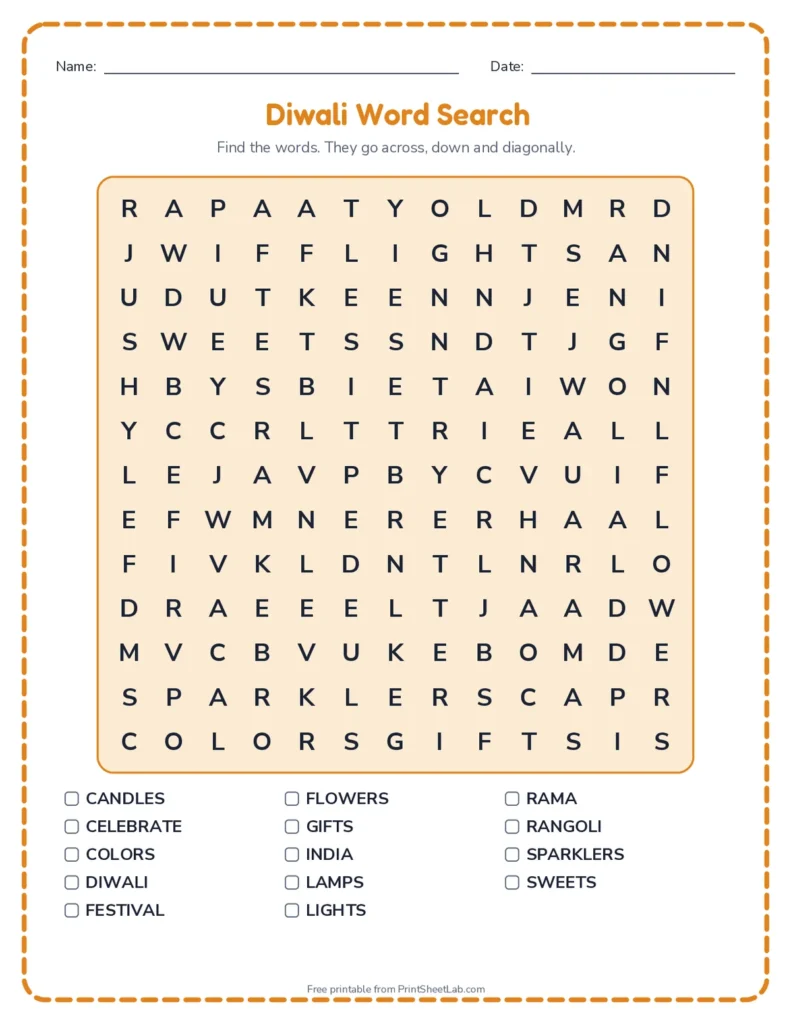
Diya, rangoli, lantern, mithai, marigold, Lakshmi: a Diwali word search builds vocabulary without feeling like work. The Diwali activity pack makes one at three levels, or type your own list into the word search maker.
Diwali games indoor: six that fit a small room
Diwali often falls in cold or wet weather, and many families celebrate in an apartment or a classroom, so it helps to know which Diwali games indoor need the least space. This table compares six games from the list above by players, time, space and kit:
| Game | Players | Time | Space | You need |
|---|---|---|---|---|
| Pass the diya | 6 to 30 | 10 min | A circle of chairs or a rug | An unlit decorated diya and music |
| Diwali charades | 6 to 30 | 15 min | Space for one actor | Slips of paper |
| Diwali picture bingo | 2 to 40 | 10 to 15 min | Seats only | Printed cards and counters |
| Diwali quiz in teams | 6 to 40 | 20 min | Seats only | A phone, a TV or printed questions |
| Diwali tambola | 4 to 50 | 20 to 30 min | Seats only | One ticket per player and a caller |
| Lantern hunt | 4 to 20 | 15 min | One room | Six to nine paper lanterns with letters |
Four of the six need nothing but chairs, so they work in any room. Only the lantern hunt and charades need to move around, and both can be played in one corner. For a party with more than 30 guests, choose the games where everybody plays at once, such as bingo, the quiz and tambola, because Diwali activities for kids that give one child a turn at a time leave the others waiting.
Sweet shop math: a price list and answer key
Sweet shop math is one of the Diwali activities for school that needs only paper and coins. Make a price list like this one, give each child a purse of toy coins and let them take turns as shopkeeper and customer:
| Sweet | Price (coins) |
|---|---|
| Ladoo | 5 |
| Jalebi | 8 |
| Barfi | 10 |
| Gulab jamun | 12 |
| Kaju katli | 15 |
With these prices, the baskets in this table make good starter questions. The change column is the answer key, so a classroom helper can check the work:
| Shopping basket | Total cost | Child pays | Change |
|---|---|---|---|
| 2 ladoo | 10 | 20 | 10 |
| 1 jalebi and 1 barfi | 18 | 20 | 2 |
| 3 barfi | 30 | 50 | 20 |
| 1 gulab jamun and 1 kaju katli | 27 | 30 | 3 |
| 4 jalebi | 32 | 50 | 18 |
| 1 box of 6 ladoo | 30 | 50 | 20 |
Children in grades 1 and 2 can do the first three baskets, while older children can invent baskets with a given budget, such as “Choose three different sweets that cost exactly 30 coins” (there are 2 ways: ladoo, barfi and kaju katli or jalebi, barfi and gulab jamun). Use pounds, dollars or rupees to suit the class, and see our pages on making change and adding and subtracting money for printable practice.
Rangoli symmetry: from one quarter to the full pattern
Rangoli symmetry gives children a real pattern to count. When a pattern in one quarter is reflected in a vertical and a horizontal mirror line, every square in the quarter appears four times in the full pattern, as long as none of the squares touches a mirror line. This table shows what that means for three grid sizes:
| Quarter grid | Full pattern | Squares in the full pattern | Colored squares in the quarter | Colored squares in the full pattern |
|---|---|---|---|---|
| 3 × 3 | 6 × 6 | 36 | 4 | 16 |
| 3 × 3 | 6 × 6 | 36 | 6 | 24 |
| 4 × 4 | 8 × 8 | 64 | 4 | 16 |
| 4 × 4 | 8 × 8 | 64 | 6 | 24 |
| 5 × 5 | 10 × 10 | 100 | 4 | 16 |
| 5 × 5 | 10 × 10 | 100 | 6 | 24 |
A child who colors 6 squares in a 4 × 4 quarter should therefore find 24 colored squares in the 8 × 8 pattern, out of 64. Ask them to count both and say why the second number is four times the first. The fraction of the pattern that is colored stays the same, which is 6 out of 16 or 24 out of 64, both equal to 3 out of 8. That connects the symmetry activity to equivalent fractions for older children, and to multiplication facts for younger ones. Few activities connect art and math as neatly as this one.
Diwali activities for kids by age
Match activities to hand skills and attention span rather than to school year alone.
| Age | Best activities | Adult help |
|---|---|---|
| 2 to 4 | Painting diyas with cotton swabs, sorting colors, pass the diya, picture bingo | Close help all the time |
| 5 to 7 | Paper lanterns, rice rangoli, diya counting, story sequencing, charades | Cutting and glue |
| 8 to 10 | Toran, salt dough diyas, sweet shop math, rangoli symmetry, word search | Setting up only |
| 11 and up | Diwali tambola, a festival report, researching Diwali around the world, making ladoo | Checking in |
The five days of Diwali, explained for kids
Knowing the five days helps you time Diwali activities for kids across the whole festival, not just the main night.
- Dhanteras: families clean the house and often buy something new in metal.
- Choti Diwali (Naraka Chaturdashi): Lord Krishna defeats the demon Narakasura; the first lamps are lit.
- Lakshmi Puja: the main night, with diyas, rangoli, prayers to Goddess Lakshmi and sweets.
- Govardhan Puja: Krishna lifts Govardhan hill to shelter people from the rain.
- Bhai Dooj: brothers and sisters celebrate their bond.
Traditions differ by region: in Bengal, for example, Goddess Kali is worshipped on Diwali night. Local calendars can place the smaller days a day apart, so check with your family or temple.
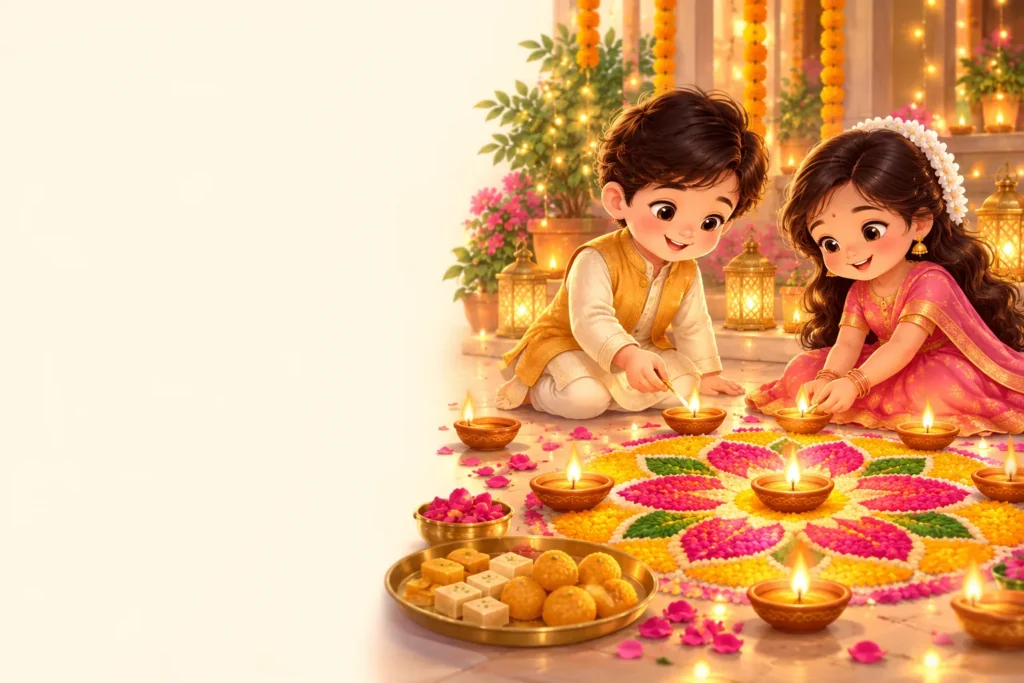
A no-cook Diwali sweet kids can make
21. Coconut ladoo
Makes about 12: mix 1 cup of desiccated coconut with about half a cup of sweetened condensed milk and a pinch of cardamom until it holds together. Roll into small balls with damp hands and coat in more coconut. Cooking is one of the activities that needs the most adult help, but here there is no stove involved, so children do the shaping while an adult measures. Check for coconut and milk allergies first.
Diwali activities for school: a week in the classroom
These Diwali activities for school spread across five days so that the diyas have time to dry before the Friday celebration.

| Day | Morning | Afternoon |
|---|---|---|
| Monday | Story of Rama and Sita; sequence four pictures | Paint clay or salt dough diyas |
| Tuesday | Diya counting (younger) or sweet shop math (older) | Paper lanterns for the room |
| Wednesday | Word search and vocabulary; rangoli symmetry | Paper-plate rangoli, one color per group |
| Thursday | Writing prompt: the sights, sounds and smells of Diwali | Toran for the door; greeting cards |
| Friday | Diwali quiz in teams | Bingo or tambola, then coconut ladoo |
If your class includes children who celebrate Diwali, invite them and their families to share a tradition, a song or a photo. It is often the most memorable part of the week.
Diwali around the world
Diwali is an official holiday in India, Nepal (where Hindus call it Tihar), Sri Lanka, Pakistan, Myanmar, Singapore, Malaysia, Mauritius, Fiji, Trinidad and Tobago, Guyana and Suriname. In December 2025, UNESCO added Deepavali to its list of the Intangible Cultural Heritage of Humanity. Leicester in the UK holds one of the largest Diwali celebrations outside India, along the Golden Mile on Belgrave Road.
One of the best Diwali activities for kids aged 9 and up is a world map: children color in each country above, then find their own town and draw a line to the nearest one. Our India GK quiz makes a good follow-up for older children.
Common mistakes to avoid
- Planning too many crafts for one session. One craft and one game per hour is plenty for under-7s.
- Forgetting drying time. Painted diyas and rice rangoli need hours to dry, so start them early in the day or the week.
- Using real flames near paper. Keep lit diyas away from lanterns, torans and loose sleeves; use LED lights for young children.
- Telling only one story. Mention the Sikh, Jain and regional traditions too, so every child sees their family in the lesson.
- Skipping the allergy check before any sweet-making or tasting activity.
A safe and green Diwali
The safest Diwali activities for kids use LED lights and unlit diyas. Talk with children about why loud crackers frighten pets and elderly neighbors and add smoke to the air; many families now choose a quieter Diwali with more lamps and fewer crackers. Choose natural rangoli colors such as turmeric, flower petals and colored rice, which are easy to sweep up.
Free printable Diwali worksheets and online games
- Diwali activity pack: Diwali worksheets with a word search, scramble, bingo, writing prompt and greeting card.
- Diwali quiz: questions with answers, to play online or print.
- Diwali tambola tickets and an online caller for family parties.
- Color by number maker and dot to dot printables for a quiet corner.
- Diwali party games for families, kitty parties and the office.
Sources
Facts about the five days, the communities that celebrate and the countries where Diwali is a public holiday follow the Diwali article on Wikipedia and its cited sources. Rangoli materials and regional names follow the Rangoli article on Wikipedia. The UNESCO listing is from UNESCO’s announcement. Diwali (Lakshmi Puja) 2026 is on Sunday 8 November.
Frequently asked questions
8 quick answers
What are some easy Diwali activities for kids at home?
Painting clay diyas, a rice rangoli on a paper plate, paper lanterns, pass the diya and a Diwali word search. These use simple materials and work for ages 4 and up.
Which Diwali activities for kids work in a classroom?
Story sequencing of Rama and Sita, diya counting, sweet shop math, rangoli symmetry, writing prompts, a team quiz and picture bingo. The five-day plan above fits them into one school week.
How do you explain Diwali to kids?
Diwali is the festival of lights. Many families remember Lord Rama coming home to Ayodhya, when people lit lamps to welcome him, and celebrate light winning over darkness with diyas, rangoli, prayers, sweets and time with family.
When is Diwali in 2026?
Diwali (Lakshmi Puja) is on Sunday 8 November 2026. The smaller days before and after can differ by a day between local calendars.
Are there Diwali activities for kids that need no preparation?
Yes: pass the diya, Diwali charades and the online Diwali quiz need nothing more than a phone or a small object.
How many Diwali activities for kids should I plan for one afternoon?
Two or three are enough for an afternoon: one craft, one game and one learning activity. Children enjoy fewer activities when each one has time to dry, finish and be shared.
What Diwali activities for school work best for a short lesson?
For a 30-minute lesson, choose one idea: sweet shop math, rangoli symmetry, a team quiz or a word search. They need only paper and pencils, and the answers are quick to check.
Which Diwali games indoor suit a small room?
Pass the diya, picture bingo, a team quiz and tambola need only chairs. Charades and the lantern hunt need a little more space but can be played in one corner of a room.