Adding and subtracting money uses the same column method as whole numbers, with one new idea: dollars and cents are decimals, so the decimal points must line up. The five PDFs on this page have additions and subtractions with dollars and cents, in columns, with amounts up to $99, and every sheet has an answer key. They follow standard 4.MD.A.2 of the Common Core standards for grade 4 measurement and data, and the notes below show how to line up the amounts, when to carry and borrow, and how to estimate.
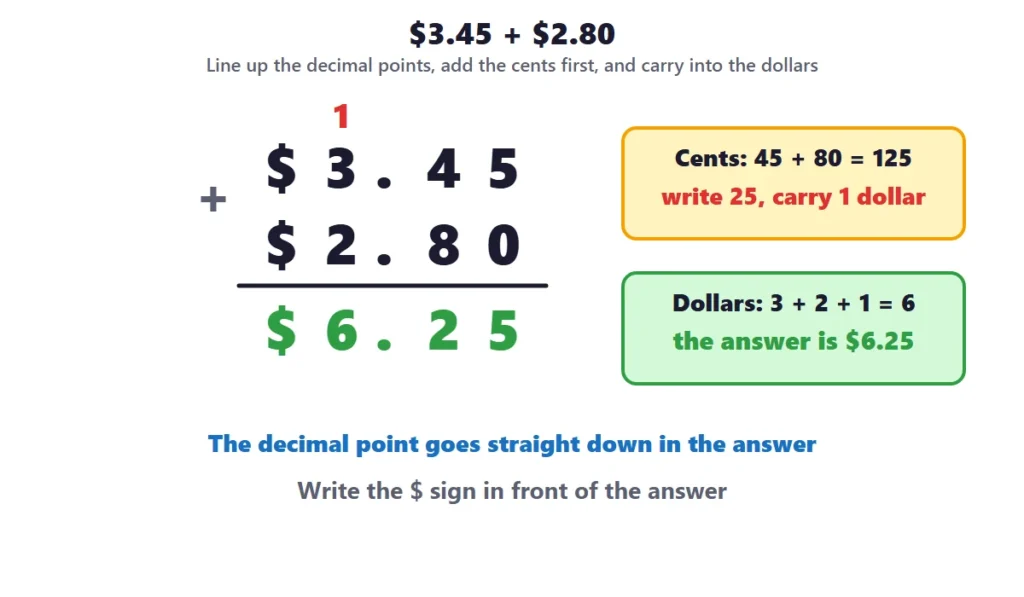
Adding money. $3.45 + $2.80 = $6.25.
Line up the points
Dollars and cents are decimals: the digits after the point are cents. Line up the decimal points so dollars sit under dollars and cents under cents, then add or subtract as with whole numbers. Bring the point straight down and write the $ sign in the answer.
Adding and subtracting money worksheets: what is in the set
There are 5 adding and subtracting money worksheets on this page, and every one has an answer key except for any cut-out games. Two sheets add, two subtract, and the last mixes both with amounts up to $99.
Worksheet
What children do
Standard
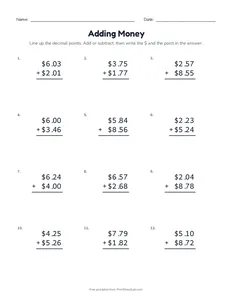
Adding Money
12 additions with dollars and cents.
4.MD.A.2
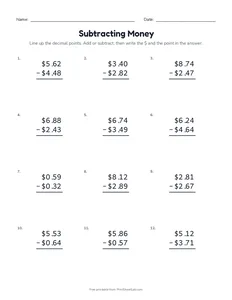
Subtracting Money
12 subtractions with dollars and cents.
4.MD.A.2
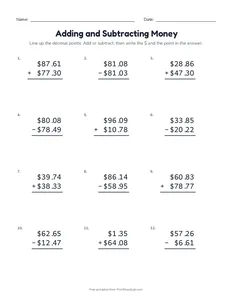
Adding and Subtracting Money
A mixed set with amounts up to $99.
4.MD.A.2
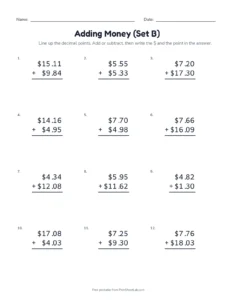
Adding Money (Set B)
Add dollars and cents up to $20, lined up by the decimal point.
4.MD.A.2
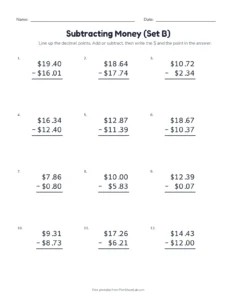
Subtracting Money (Set B)
Subtract dollars and cents up to $20.
4.MD.A.2
Dollars and cents worksheets: how money is written
The dollars and cents worksheets use amounts like $5.07 and $12.50, and the first thing to learn is how they are written. The dollar sign comes first, the decimal point separates dollars from cents, and there are always two digits after the point. Wikipedia’s article on decimals explains the idea, and the place value worksheets pages explain tenths and hundredths. This table shows six amounts in words, with a dollar sign and in cents:
In words
With a dollar sign
In cents
What the zero does
5 dollars 7 cents
$5.07
507¢
holds the dimes place
12 dollars 50 cents
$12.50
1,250¢
no zero needed
3 dollars 5 cents
$3.05
305¢
holds the dimes place
20 dollars 0 cents
$20.00
2,000¢
holds the cents places
0 dollars 85 cents
$0.85
85¢
shows there are no dollars
9 dollars 99 cents
$9.99
999¢
no zero needed
The zero in $5.07 holds the place of the dimes, since there are no dimes. A child who writes $5.7 for 5 dollars and 7 cents has made one of the most common money mistakes. The decimals worksheets pages have more about decimals.
Adding money worksheets: line up the points and carry
The adding money worksheets use column addition. Write the amounts one under the other with the decimal points in a line, add the cents column first, and carry into the dollars when the cents reach 100 or more. This table shows four sums with the cents, the carry and the dollars:
Problem
Cents column
What to do
Dollars column
Answer
$3.45 + $2.80
45 + 80 = 125
write 25, carry 1 dollar
3 + 2 + 1 = 6
$6.25
$7.68 + $4.75
68 + 75 = 143
write 43, carry 1 dollar
7 + 4 + 1 = 12
$12.43
$12.50 + $6.95
50 + 95 = 145
write 45, carry 1 dollar
12 + 6 + 1 = 19
$19.45
$9.99 + $0.99
99 + 99 = 198
write 98, carry 1 dollar
9 + 0 + 1 = 10
$10.98
When the cents add up to 100 or more, a dollar is carried, just as ten ones become a ten. For 45 + 80 = 125 cents, the 125 cents are 1 dollar and 25 cents, so 25 is written and 1 is carried into the dollars. The addition worksheets pages practice the whole-number carry.
Subtracting money worksheets: borrow when the cents are too small
The subtracting money worksheets use column subtraction, and the cents column often needs a borrow. When the top cents are smaller than the bottom cents, a dollar is changed into 100 cents. How often does this happen? This table counts all the pairs of cent amounts from 0 to 99:
Cents of two amounts from 0 to 99
Pairs
How many
Share
Cents add up to 100 or more: carry into the dollars
10000
4,950
49.5%
Top cents smaller than bottom cents: borrow a dollar
10000
4,950
49.5%
No carry in an addition
10000
5,050
50.5%
No borrow in a subtraction
10000
5,050
50.5%
Nearly half of all pairs need a carry in an addition, and nearly half need a borrow in a subtraction. That is why the worksheets have so many problems with regrouping, and why a child who is not secure with it needs a separate page, such as 2-digit subtraction with regrouping. The hardest case is a subtraction from a whole number of dollars. This table shows six prices paid with $10.00, with two ways to find the change:
Price
Subtract from $10.00
Count up from the price
Change
$6.35
1000¢ − 635¢ = 365¢
$6.35 → $7.00 → $10.00
$3.65
$2.80
1000¢ − 280¢ = 720¢
$2.80 → $3.00 → $10.00
$7.20
$7.45
1000¢ − 745¢ = 255¢
$7.45 → $8.00 → $10.00
$2.55
$4.15
1000¢ − 415¢ = 585¢
$4.15 → $5.00 → $10.00
$5.85
$9.05
1000¢ − 905¢ = 95¢
$9.05 → $10.00
$0.95
$1.99
1000¢ − 199¢ = 801¢
$1.99 → $2.00 → $10.00
$8.01
Money addition grade 3: estimating the answer
For money addition grade 3, the standard is 3.NBT.A.2 for adding within 1,000, and it is used with money in grade 4. A quick estimate is the best check, and it only needs rounding each amount to the nearest dollar. This table shows six problems, with the estimate, the exact answer and the difference:
Problem
Round each to the nearest dollar
Exact answer
Difference
Reasonable?
$3.45 + $2.80
$3.00 + $3.00 = $6.00
$6.25
$0.25
close
$7.68 + $4.75
$8.00 + $5.00 = $13.00
$12.43
$0.57
close
$12.50 + $6.95
$13.00 + $7.00 = $20.00
$19.45
$0.55
close
$10.00 − $6.35
$10.00 − $6.00 = $4.00
$3.65
$0.35
close
$20.00 − $13.78
$20.00 − $14.00 = $6.00
$6.22
$0.22
close
$9.99 + $4.99
$10.00 + $5.00 = $15.00
$14.98
$0.02
close
The estimates are all within one dollar of the exact answers. If an answer is far from the estimate, there is a mistake, such as a missing carry. The estimating with rounding and rounding worksheets pages have more estimating practice.
Decimal money worksheets: a shopping list
The decimal money worksheets are easiest with a shopping list. Children use the prices to make up their own questions, add the prices of two or three items, find how much more one item costs than another, and find the change. This table shows a list of six items and prices:
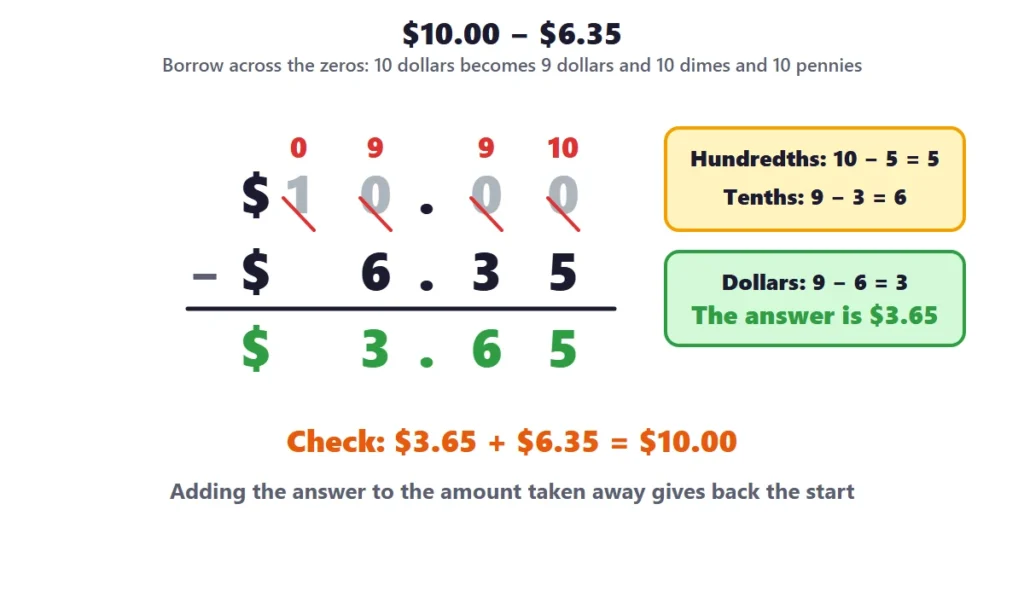
Subtracting money. $10.00 − $6.35 = $3.65.
Item
Price
In cents
Pencil
$0.85
85
Eraser
$0.35
35
Ruler
$1.20
120
Glue stick
$1.79
179
Notebook
$2.49
249
Scissors
$3.99
399
Each question is a one-step or two-step problem. This table shows six questions with the working and the answer:
Question
Working
Answer
Notebook and ruler together
$2.49 + $1.20
$3.69
Pencil, eraser and glue stick together
$0.85 + $0.35 + $1.79
$2.99
How much more is the scissors than the notebook
$3.99 − $2.49
$1.50
Change from $5.00 for a notebook and a pencil
$5.00 − ($2.49 + $0.85)
$1.66
How many pencils can you buy with $3.40
$3.40 ÷ $0.85
4 pencils, with $0.00 left
All six items together
$0.85 + $0.35 + $1.20 + $1.79 + $2.49 + $3.99
$10.67
The same list can be used again with other questions. The two-step word problems page has more problems that need two steps, and the money worksheets page has the whole sequence.
Checking money answers with the opposite operation
Every money problem can be checked with the opposite operation. If $3.45 + $2.80 = $6.25, then $6.25 − $2.80 must be $3.45. If $10.00 − $6.35 = $3.65, then $3.65 + $6.35 must be $10.00. A child who checks every answer finds most of the mistakes with the decimal point and the carries. Standard 4.MD.A.2 asks for money word problems with decimals, and the Common Core standards for grade 4 measurement and data list the other measurement standards.
Common mistakes with adding and subtracting money
The most common mistake is not lining up the decimal points. This table shows five mistakes, what went wrong and the fix:
What the child writes or says
What went wrong
The fix
$5 + $2.75 = $2.80
lines up the digits on the right, not the decimal points
write $5.00 and line up the points: $5.00 + $2.75 = $7.75
$3.45 + $2.80 = $5.125
adds the cents and the dollars separately, with no carry
45 + 80 = 125 cents is $1.25: carry 1 dollar, so $6.25
$10.00 − $6.35 = $4.35
subtracts the smaller digit from the bigger in each column
borrow across the zeros: $3.65
$6.5 is $6.05
does not see that the 5 is in the tenths place
$6.50 means 6 dollars and 50 cents
The answer is 7.75
forgets the dollar sign
write the unit: $7.75
Adding and subtracting money word problems
Money problems come from shopping. Ask children to write the amounts in a column with the decimal points lined up, and then to check with an estimate:
Word problem
Working
Answer
A book costs $3.45 and a pen costs $2.80. How much do they cost together?
$3.45 + $2.80
$6.25
Sam has $10.00 and buys a toy for $6.35. How much does he have left?
$10.00 − $6.35
$3.65
A sandwich costs $4.75 and a drink costs $1.95. How much for both?
$4.75 + $1.95
$6.70
Mia has $20.00. She spends $13.78. How much is left?
$20.00 − $13.78
$6.22
A shirt costs $12.50 and shorts cost $9.95. How much do they cost together?
$12.50 + $9.95
$22.45
A toy costs $8.40. A kit costs $5.15 less. How much is the kit?
$8.40 − $5.15
$3.25
Games and activities for adding and subtracting money
Children learn adding and subtracting money best when they play with it. These games use things that are found at home or in a classroom:
Class shop: put prices on classroom objects, and let children buy two things and find the total
Price race: draw two price cards and add them as fast as possible
Budget challenge: give each child $20.00 and a catalog, and ask them to spend as close to the amount as possible
Receipt check: check the total on a real store receipt
Lemonade stand: plan a stand with prices, and find the money collected from a list of sales
Money bingo: a bingo card with amounts, and calling cards with sums and differences
Extra support and extra challenge with adding and subtracting money
For children who need more support: use real or play money and make each amount with coins and bills first. Write $5.00 for 5 dollars, so the decimal points always line up. Add the cents first, and write the carry above the dollars. Do the sheets that add before the sheets that subtract, and use the answer key to check each column.
For children who need more challenge: ask for the change from $50.00 for a bill of $37.86, for the total of five items from a catalog, and for the amount that makes $20.00 when added to $13.78. The mixed sheet with amounts up to $99, and the problems with two steps, are good challenges.
How to tell that a child is ready to move on from adding and subtracting money
Before moving on from adding and subtracting money, check that the child can do all four of these things:
The child lines up the decimal points in a column.
The child carries from the cents to the dollars.
The child borrows across zeros, as in $10.00 − $6.35.
The child checks an answer with an estimate or with the opposite operation.
A 20-minute lesson on adding and subtracting money
A short lesson is the best way to introduce adding and subtracting money. This 20-minute plan can be used in a classroom, at a tutoring session or at home, and it uses the worksheets at the end:
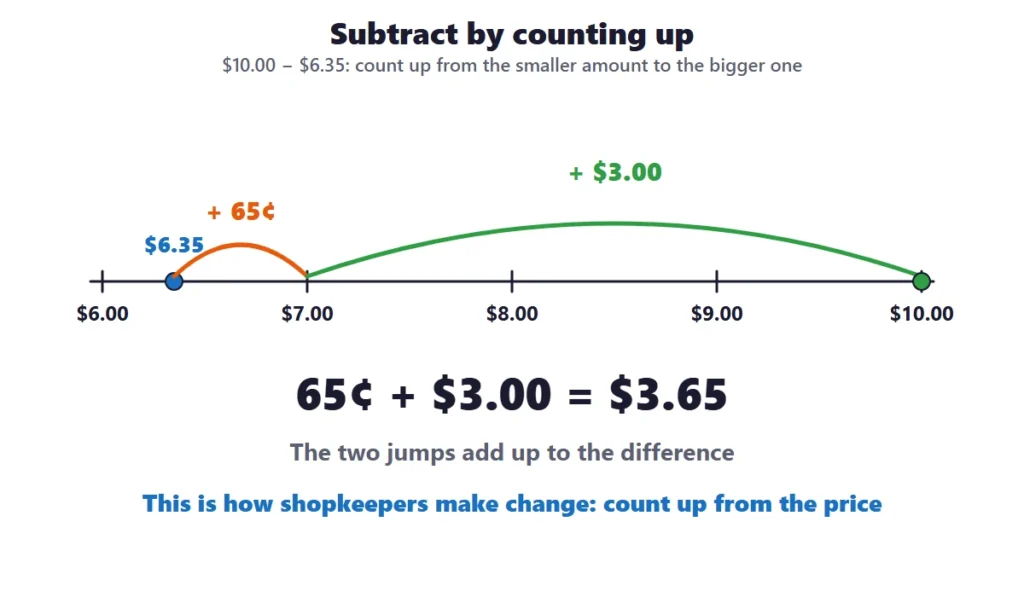
Count up. 65¢ + $3.00 = $3.65.
Minutes
Activity
What to say or ask
0 to 3
Show $3.45 and $2.80 with play money
How many dollars? How many cents?
3 to 8
Write the amounts in a column, and line up the decimal points
Where does the point go in the answer?
8 to 13
Add the cents, and carry a dollar
What is 125 cents in dollars?
13 to 18
Subtract $6.35 from $10.00 and check by adding
Do we get $10.00 back?
18 to 20
Start a worksheet and check one answer
Is the answer close to the estimate?
Where adding and subtracting money fits across the grades
No skill stands alone. This table shows what children learn before and after adding and subtracting money, with the standard that goes with each step:
Grade
What children do
Standard or page
Grade 2
Count coins and solve money word problems with $ and ¢
This page is the main page for money calculations. The whole sequence is on the money worksheets page.
Helping at home with adding and subtracting money
Parents do not need to be experts to help with adding and subtracting money. These suggestions work well, and each takes only a few minutes:
Let the child add the prices in the store while you shop.
Ask the child to estimate the bill by rounding to the nearest dollar.
Use a receipt to check the total.
Let the child pay and check the change.
Write the amounts in a column, with the decimal points lined up.
How to check progress in adding and subtracting money
A teacher or parent can check progress in adding and subtracting money with the answer key and a few questions. This table shows three common situations, what they mean and what to do next:
What you see
What it means
What to do next
The child does not line up the decimal points
The decimal point is not yet seen as a place marker
Write the amounts with two decimal places, such as $5.00
The child gets 9 of 10 right in every set
The skill is secure
Move on to making change and word problems
The child does not borrow across zeros
The regrouping across zeros is not yet secure
Count up from the smaller amount, or do the borrowing one column at a time
A five-day plan for adding and subtracting money
Most children need about a week of short sessions for adding and subtracting money. This plan follows the order of the worksheets on this page:
Day
What to do
Practice
Day 1
Write amounts with dollar signs and decimal points, and line them up
Adding Money
Day 2
Add dollars and cents, and carry from the cents
Adding Money (Set B)
Day 3
Subtract dollars and cents, and borrow when needed
Subtracting Money
Day 4
Subtract across zeros, and check by adding
Subtracting Money (Set B)
Day 5
Mixed adding and subtracting with amounts up to $99
Adding and Subtracting Money
When the plan for adding and subtracting money is complete, move on to the making change page. The whole sequence is on the money worksheets page.
Frequently asked questions
5 quick answers
Why line up the decimal points?
It keeps dimes under dimes and pennies under pennies, just like lining up tens and ones.
How do I write 5 dollars and 7 cents?
$5.07. The 0 holds the dimes place, because there are no dimes.
How do you add money with cents?
Line up the decimal points, add the cents column first, and carry 1 dollar if the cents add up to 100 or more. Then add the dollars, and put the decimal point and dollar sign in the answer.
How do you subtract money from a whole number of dollars?
Write the whole number with a decimal point and two zeros, such as $10.00, and borrow across the zeros. Or count up from the smaller amount to the bigger: $6.35 to $7.00 is 65¢, and $7.00 to $10.00 is $3.00, so the difference is $3.65.
Why do you write two digits after the decimal point in money?
Because there are 100 cents in a dollar, so cents are hundredths. Writing $5.70 and not $5.7 shows the cents place clearly, and makes it easy to line up amounts.