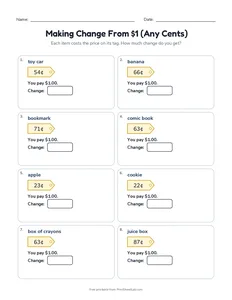
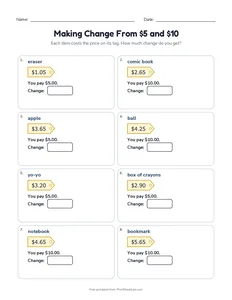
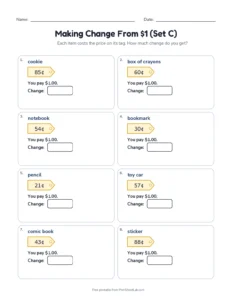
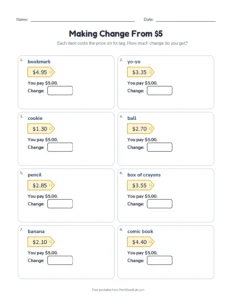
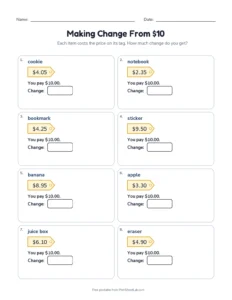
Making change means finding how much money to give back when a buyer pays more than the price. The six PDFs on this page have price tags and payments of $1, $5 and $10, and children find the change, and every sheet has an answer key. They follow standard 2.MD.C.8 of the Common Core standards for grade 2 measurement and data, and the notes below show how to count up, how to subtract, and how many coins the change needs.
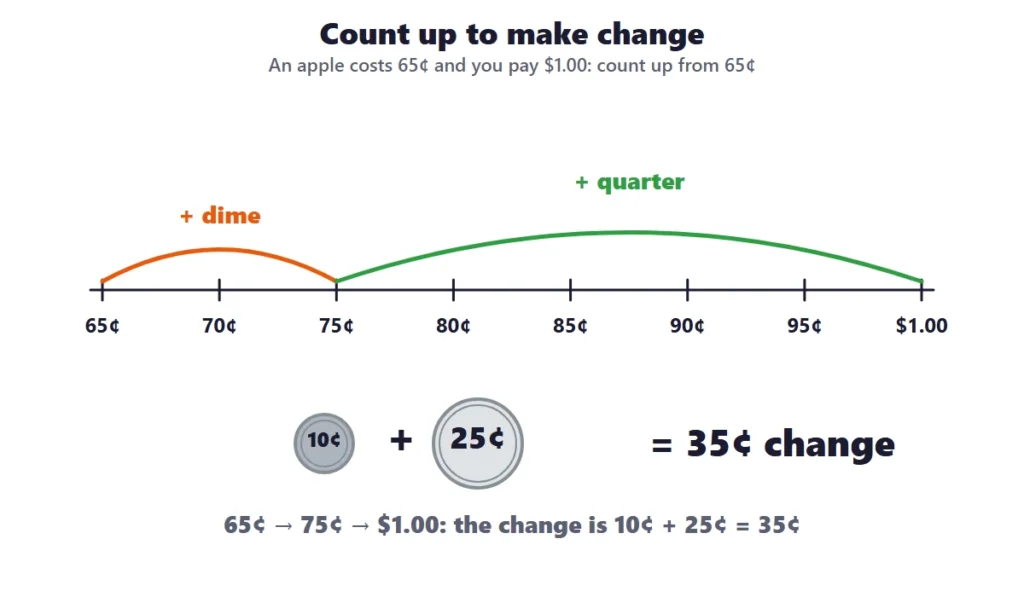
Count up. Change from $1.00 for 65¢.
Counting up to make change
Shopkeepers make change by counting up, not subtracting. If an apple costs 65¢ and you pay $1.00: 65¢ plus 10¢ is 75¢, plus 25¢ is $1.00, so the change is 35¢. Children who learn to count up make fewer mistakes with money than those who subtract.
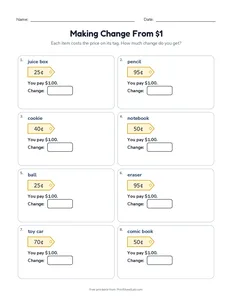
Pay $1.00 for items under a dollar.
Pay $5.00 and $10.00 for bigger prices.
Making change worksheets: what is in the set
There are 6 making change worksheets on this page, and every one has an answer key except for any cut-out games. Three sheets are paid with $1, one with $5, one with $10, and one mixes $5 and $10.
Worksheet
What children do
Standard
Making Change From $1
Pay $1.00 and find the change.
2.MD.C.8
Making Change From $1 (Any Cents)
Prices to the cent; pay $1.00.
2.MD.C.8
Making Change From $5 and $10
Bigger prices paid with $5 or $10 bills.
2.MD.C.8
Making Change From $1 (Set C)
Eight more shopping trips paid with a dollar.
2.MD.C.8
Making Change From $5
Find the change when paying with a five-dollar bill.
2.MD.C.8
Making Change From $10
Find the change when paying with a ten-dollar bill.
2.MD.C.8
Making change worksheets: counting up with coins
The making change worksheets teach the way that shopkeepers have always made change: count up from the price to the amount paid, adding coins as you go. If an apple costs 65¢ and a customer pays $1.00, you add a dime to make 75¢, and a quarter to make $1.00, so the change is 10¢ and 25¢, which is 35¢. Wikipedia’s article on the change-making problem shows how the same idea is used to find the fewest coins. This table shows six purchases paid with $1.00, with the steps and the coins:
Price
Change from $1.00
Counting up
Coins to give
Number of coins
18¢
82¢
18¢ → 19¢ → 20¢ → 25¢ → 50¢ → 75¢ → $1.00
3 quarters, 1 nickel, 2 pennies
6
35¢
65¢
35¢ → 40¢ → 50¢ → 75¢ → $1.00
2 quarters, 1 dime, 1 nickel
4
47¢
53¢
47¢ → 48¢ → 49¢ → 50¢ → 75¢ → $1.00
2 quarters, 3 pennies
5
65¢
35¢
65¢ → 75¢ → $1.00
1 quarter, 1 dime
2
82¢
18¢
82¢ → 83¢ → 84¢ → 85¢ → 90¢ → $1.00
1 dime, 1 nickel, 3 pennies
5
94¢
6¢
94¢ → 95¢ → $1.00
1 nickel, 1 penny
2
Counting up uses addition, which children find easier than subtraction, and it needs no borrowing. It also shows the coins to give back at the same time as the amount. The counting coins page practices the coin values that the steps use.
Counting change worksheets: from and
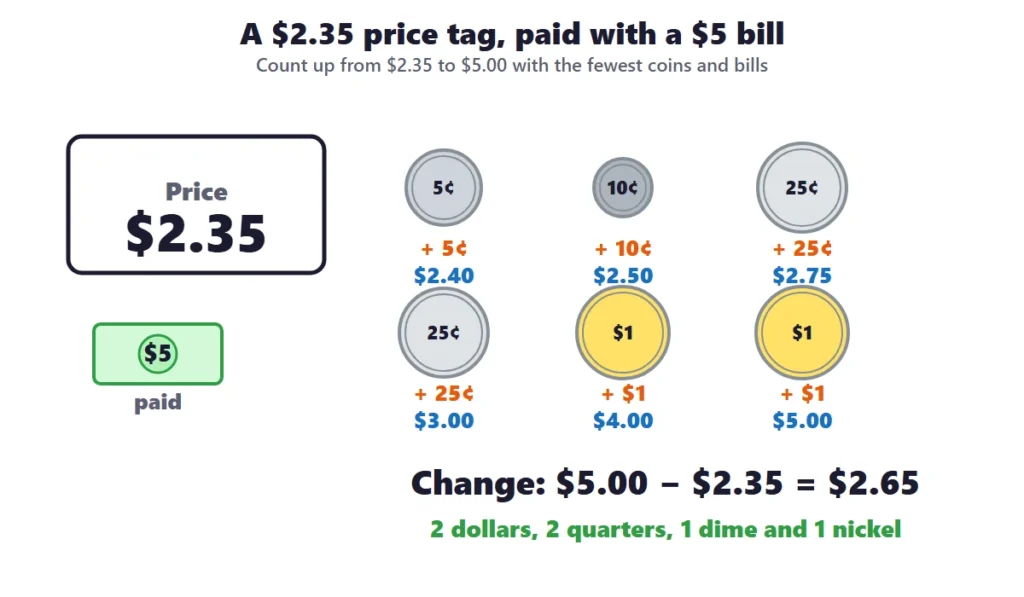
The counting change worksheets with bigger bills use the same method, with one more step, which is to count up to the next dollar. For a price of $2.35 and a payment of $5.00, the steps are 5¢ to $2.40, 10¢ to $2.50, a quarter to $2.75 and another to $3.00, and then two dollars to $5.00. This table shows six purchases:
Price
Paid with
Change
Bills and coins to give (dollar coins or bills)
Pieces of money
$2.35
$5.00
$2.65
2 dollars, 2 quarters, 1 dime, 1 nickel
6
$3.80
$5.00
$1.20
1 dollar, 2 dimes
3
$6.45
$10.00
$3.55
3 dollars, 2 quarters, 1 nickel
6
$7.99
$10.00
$2.01
2 dollars, 1 penny
3
$8.25
$10.00
$1.75
1 dollar, 3 quarters
4
$4.60
$5.00
$0.40
1 quarter, 1 dime, 1 nickel
3
The change from $5.00 for $2.35 is $2.65, and it is given as 2 dollars, 2 quarters, a dime and a nickel. If dollar bills are used, the number of pieces of money is the same. The adding and subtracting money page has the column method for the same problems.
Giving change worksheets: how many pieces of change?
The giving change worksheets with a dollar have an interesting hidden pattern. For prices from 1¢ to 99¢ paid with $1.00, the change is also from 1¢ to 99¢, and the number of coins in the change is between 1 and 9. This table counts how many prices give each number of coins:
Pieces of change
Prices from 1¢ to 99¢ paid with $1 that give this many
1
4
2
9
3
14
4
18
5
19
6
16
7
11
8
6
9
2
45 of the 99 prices need 4 coins or fewer, and only a few need 8 or 9. A child who gives a lot of coins can be asked: “can you give back fewer coins?” This is also a good way to practice the fewest coins from the counting coins page.
Money word problems: shopping stories
The money word problems on this page are all shopping stories, and each has two numbers: the price and the amount paid. Children can say the story in words first: “It costs 65¢, I pay a dollar, how much do I get back?” The math word problems worksheets pages have other kinds of story. This table shows six stories with the working and the answer:
Story
Working
Answer
An apple costs 65¢. Ben pays with $1.00. How much change does he get?
$1.00 − 65¢
35¢
A pencil costs 18¢. Mia pays with $1.00. How much change does she get?
$1.00 − 18¢
82¢
A toy costs $2.35. Sam pays with a $5 bill. How much change?
$5.00 − $2.35
$2.65
A book costs $6.45. Lin pays with a $10 bill. How much change?
$10.00 − $6.45
$3.55
A sticker costs 47¢. Tia pays with a dollar. What coins could she get back?
$1.00 − 47¢ = 53¢
2 quarters and 3 pennies
A shop sells a ball for $7.99. Max pays with $10. How much change?
$10.00 − $7.99
$2.01
The two-step word problems page has stories where the price has to be found first, such as the cost of three notebooks, and then the change.
Shopping worksheets for kids: subtract or count up?
Shopping worksheets for kids can use either way to find the change. Subtracting is quick when there is no borrowing, and counting up is better when there is. The two ways always give the same answer, as this table shows for six purchases paid with $1.00:
Pay with $5. Change from $5.00 for $2.35.
Price
Subtract
Count up with the change coins
Change
65¢
100 − 65 = 35
65¢ → 75¢ → $1.00
35¢
38¢
100 − 38 = 62
38¢ → 39¢ → 40¢ → 50¢ → 75¢ → $1.00
62¢
79¢
100 − 79 = 21
79¢ → 80¢ → 90¢ → $1.00
21¢
23¢
100 − 23 = 77
23¢ → 24¢ → 25¢ → 50¢ → 75¢ → $1.00
77¢
56¢
100 − 56 = 44
56¢ → 57¢ → 58¢ → 59¢ → 60¢ → 65¢ → 75¢ → $1.00
44¢
91¢
100 − 91 = 9
91¢ → 92¢ → 93¢ → 94¢ → 95¢ → $1.00
9¢
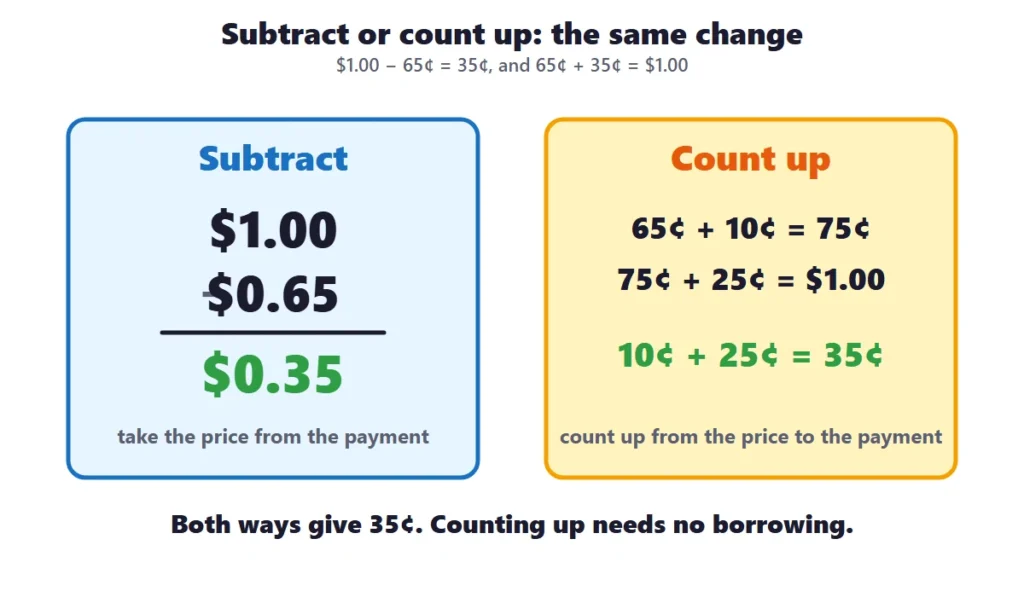
For 65¢ the subtraction is 100 − 65 = 35, and the counting up is 65, 75, 100, which gives 10 + 25 = 35. Children who do both will see that change is just the difference between the payment and the price. The 2-digit subtraction with regrouping page explains the borrowing.
Exact change: paying without getting change
Sometimes a buyer has exactly the right coins, and no change is needed. There are many ways to make an amount exactly, and the fewest coins is only one of them. This table shows three amounts, the fewest coins and the number of different ways to pay:
Amount
Fewest coins
Number of ways to pay exactly (pennies, nickels, dimes, quarters)
65¢
2 quarters, 1 dime, 1 nickel
87
35¢
1 quarter, 1 dime
24
90¢
3 quarters, 1 dime, 1 nickel
187
There are 49 ways to make 50¢ with pennies, nickels, dimes and quarters, and more than a hundred for 90¢. Finding the fewest coins is a different question from finding all the ways, and children enjoy both.
Common mistakes with making change
The most common mistake is to subtract the digits in each column and get the wrong change. This table shows five mistakes, what went wrong and the fix:
What the child writes or says
What went wrong
The fix
$1.00 − 65¢ = 45¢
subtracts the smaller digit from the bigger one in each column
count up: 65 + 10 = 75, 75 + 25 = 100, so the change is 35¢
any set of coins with the same value is correct, but the fewest coins is neatest
Counts up from the paid amount
counts the wrong way
start at the price, and count up to the amount paid
Making change word problems
Change problems come from shopping. Ask children to say the price and the payment, and then to count up to find the change:
Word problem
Working
Answer
An apple costs 65¢. Ben pays with $1.00. How much change does he get?
$1.00 − 65¢
35¢
A pencil costs 18¢. Mia pays with $1.00. How much change does she get?
$1.00 − 18¢
82¢
A toy costs $2.35. Sam pays with a $5 bill. How much change?
$5.00 − $2.35
$2.65
A book costs $6.45. Lin pays with a $10 bill. How much change?
$10.00 − $6.45
$3.55
A sticker costs 47¢. Tia pays with a dollar. What coins could she get back?
$1.00 − 47¢ = 53¢
2 quarters and 3 pennies
A shop sells a ball for $7.99. Max pays with $10. How much change?
$10.00 − $7.99
$2.01
Games and activities for making change
Children learn making change best when they play with it. These games use things that are found at home or in a classroom:
Class store: put prices on classroom items, and take turns to be the shopkeeper and give change
Count up chant: say the steps aloud while counting up from the price to the payment
Change bingo: a bingo card with change amounts, and calling cards with prices
Price tag match: match price tags with the change from $1.00
Pay with a dollar: give each child a price card, and let them find the change with real coins
Fewest coins: find the change with the fewest coins, and compare with a partner
Extra support and extra challenge with making change
For children who need more support: use real coins and bills, and a class store with prices up to $1.00. Count up from the price in small steps: to the next 5¢, to the next 10¢, to 25¢ or 50¢, and to the dollar. Say each total aloud. Keep to $1.00 until counting up is secure, then move on to $5 and $10, and use the answer key to check.
For children who need more challenge: ask for the change from $20.00 for a price of $13.47, for the number of different coin sets that make 35¢ of change, and for a price that gives change of 5 coins from a dollar. The sheet with $5 and $10 and prices to the cent is a good challenge.
How to tell that a child is ready to move on from making change
Before moving on from making change, check that the child can do all four of these things:
The child counts up from the price to the payment.
The child names the coins to give back.
The child makes change from $1, $5 and $10.
The child checks the change by adding it to the price.
A short lesson is the best way to introduce making change. This 20-minute plan can be used in a classroom, at a tutoring session or at home, and it uses the worksheets at the end:
Two ways. Subtract or count up: 35¢.
Minutes
Activity
What to say or ask
0 to 3
Set up a class store, with a 65¢ apple and a dollar
How much change should I get?
3 to 8
Count up from 65¢ with a dime and a quarter
Which coins did we add?
8 to 13
Find the change from $1.00 for 47¢ and 82¢
What is the next round number?
13 to 18
Pay $5.00 for $2.35, and count up in dollars
How many dollars do we add at the end?
18 to 20
Start a worksheet and check one answer
Check by adding the change to the price.
Where making change fits across the grades
No skill stands alone. This table shows what children learn before and after making change, with the standard that goes with each step:
This page is the shopping page of the money sequence. The whole sequence is on the money worksheets page.
Helping at home with making change
Parents do not need to be experts to help with making change. These suggestions work well, and each takes only a few minutes:
Let the child pay in a store and check the change.
Count up from the price together as the cashier does.
Play shop at home with real coins and price tags.
Ask “what is the next round number?” as you count up.
Check the change by adding it to the price.
How to check progress in making change
A teacher or parent can check progress in making change with the answer key and a few questions. This table shows three common situations, what they mean and what to do next:
What you see
What it means
What to do next
The child subtracts the digits in each column
The child does not yet see change as a difference
Use counting up, and say each total aloud
The child gets 9 of 10 right in every set
The skill is secure
Move on to adding and subtracting money in columns
The child counts up but gives the wrong coins
The coin values are not yet secure
Return to counting coins, and practice the values
A five-day plan for making change
Most children need about a week of short sessions for making change. This plan follows the order of the worksheets on this page:
Yes: change = amount paid − price. Counting up from the price is just another way to subtract.
What grade learns making change?
Grade 2 solves money word problems with coins and bills, and grades 3 and 4 work with larger amounts and decimals.
Is making change subtraction?
Yes. The change is the amount paid minus the price. Counting up from the price to the amount paid is another way to subtract, and it is easier because it needs no borrowing.
How do you make change from a dollar?
Start with the price, and add coins to reach the next 5¢ or 10¢, then 25¢ or 50¢, and then the dollar. The coins you added are the change. For 65¢, add a dime to make 75¢ and a quarter to make $1.00.
What grade learns making change?
Grade 2 solves money word problems with coins and bills (2.MD.C.8), and grades 3 and 4 work with larger amounts and decimals.