Tambola dividends are the prizes of a tambola (housie) game: Early Five, the top, middle and bottom lines, Four Corners and the Full House, plus extras such as Early Seven or a Second Full House. Each one is won by the first ticket whose struck-off numbers match its pattern. This guide explains what each one means, shows each on a 3×9 ticket, gives three ways to split a prize pool, and uses 20,000 simulated games to show how many numbers are called before each prize is won.
In short: with 48 tickets in play, the median Early Five lands on call 11, the first line on call 33, Four Corners on call 34 and the Full House on call 70. A classic split of the pool is 10% for Early Five, 12% for each line, 14% for Four Corners and 40% for the Full House. Print the tambola dividends before the first call, and the game runs without arguments. The free ticket maker and number caller are linked below.
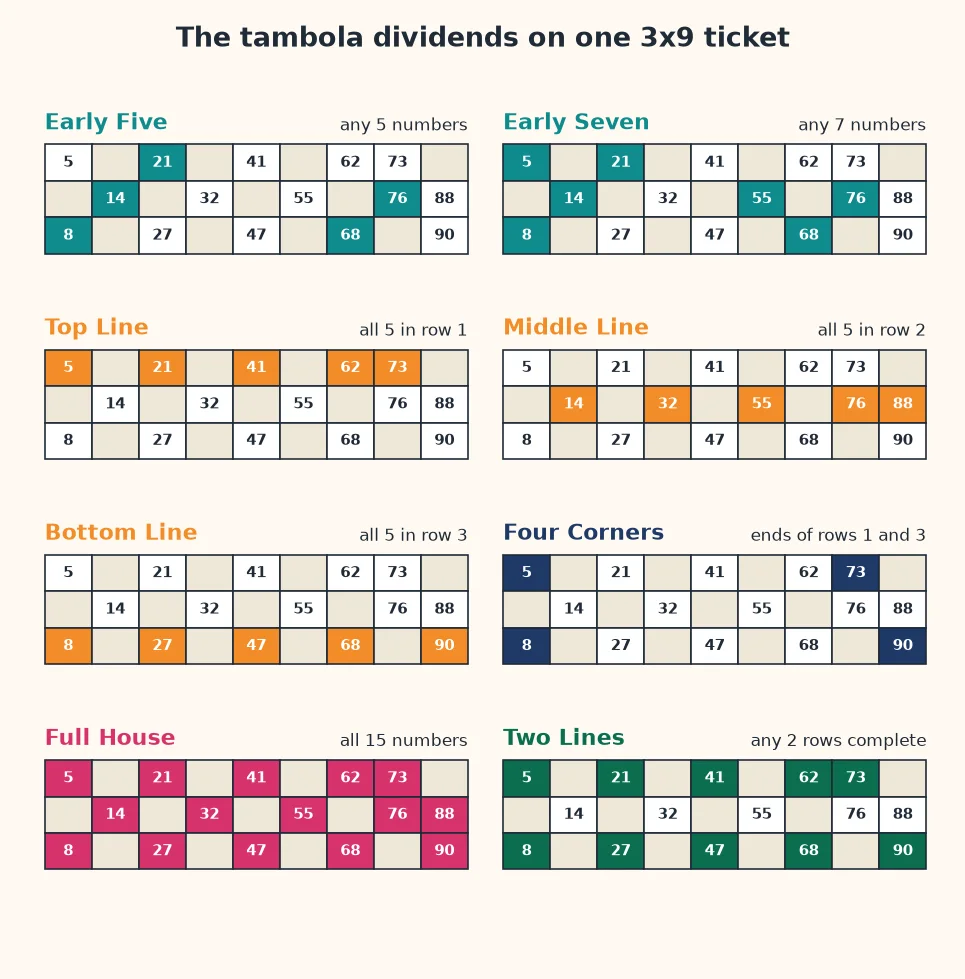
What are tambola dividends?
The word comes from the way many Indian games are run: the host announces a set of prizes before the numbers start, and each prize pays a dividend, either a fixed gift or a share of the money collected from the tickets. Players use the word for the pattern and for what it pays, so “Four Corners is a dividend” and “the Full House dividend is 40%” mean the same thing in everyday talk.
The same list is called housie prizes in other clubs, and in UK 90-ball bingo the usual prizes are one line, two lines and a full house. The Wikipedia article on 90-ball bingo lists the same patterns and defines Four Corners as the leftmost and rightmost numbers on the top and bottom lines.
All the tambola dividends rest on the same ticket: three rows, nine columns, 15 numbers, five numbers in every row. The numbers 1 to 90 are called in random order and players strike off what they hold. A prize is won by the first correct claim, so the dividend is decided by one question: whose ticket completes the pattern first? If you want the full rules of the game before the prizes, read the guide to how to play tambola, which also covers calling, claims and bogeys.
This page goes deeper on the tambola dividends themselves. It covers the exact meaning of each one, the order in which they usually fall, a computed table of when each one is won, ties, and how to turn a pool of money into fair shares. Everything here uses US spelling and works for any currency, because the splits are percentages.
Tambola prizes at a glance: all nine dividends
The table lists the tambola prizes in the order a host usually announces them. The first six are the classic set that most groups play. The last three are common extras: add them only when you have enough tickets in play to make them interesting, and say so before the game starts.
| # | Dividend | What the ticket must show | Type |
|---|---|---|---|
| 1 | Early Five (Jaldi Five) | Any five numbers struck off on one ticket, in any rows. | Classic |
| 2 | Early Seven | Any seven numbers struck off on one ticket. | Extra |
| 3 | Top Line | All five numbers in row 1 of one ticket. | Classic |
| 4 | Middle Line | All five numbers in row 2 of one ticket. | Classic |
| 5 | Bottom Line | All five numbers in row 3 of one ticket. | Classic |
| 6 | Four Corners | The first and last number of row 1 and the first and last number of row 3. | Classic |
| 7 | Two Lines | Any two complete rows on the same ticket (the 90-ball bingo “two lines”). | Extra |
| 8 | Full House | All 15 numbers on one ticket. The game normally ends here. | Classic |
| 9 | Second Full House | The next ticket to complete all 15 numbers after the Full House. | Extra |
Names for tambola dividends differ from club to club. Some halls use their own labels for extra prizes, such as Breakfast, Lunch and Dinner, and the meaning is not the same everywhere. The safe habit is to write the name and the exact pattern of every dividend on a prize sheet and read it aloud, as the rules section near the end explains.
Early Five tambola: the first prize
The Early Five (called Jaldi Five in Hindi, “quick five”) is the cheapest prize to win and the first one claimed. A ticket qualifies the moment any five of its 15 numbers have been called, no matter which rows they sit in. That makes Early Five tambola a luck prize: nothing about the layout of your ticket helps you, so it is a good opening dividend for a mixed crowd of newcomers and regulars.
It is also the prize most likely to be claimed by two people at once, because many tickets reach five struck-off numbers at almost the same time. In the simulation below, a tie on the Early Five happens in about 17% of games with 48 tickets, and in more than a quarter of games once 192 tickets are in play. Decide the tie rule before the first call.
Early Seven and other early prizes
Some groups add an Early Seven, a second early prize for any seven numbers. It follows the same logic: it lands around call 20 with 48 tickets, roughly 9 calls after the Early Five, so it keeps the opening minutes lively. Because seven numbers on a ticket do not have to form a line, it never competes with the line prizes for attention. If you use it, pay less than a line, since it arrives so much earlier.
Top, Middle and Bottom Line: three separate prizes
A line is all five numbers of one row. The three lines are usually three separate prizes, and a ticket that completes the top row after another ticket has already taken the Top Line wins nothing for it. That is why the same ticket can hold a good chance for the Middle Line even after the Top Line is gone. Each line has the same chance on a given ticket, so the host does not need to pay one row more than another.
In a common variation, there is one prize for the “first line” in any row, then another for the second. That is closer to the way 90-ball bingo is played in the UK, and it shortens the game. The simulation shows the difference: with 48 tickets the first line in any row lands around call 33, but one named row, the Top Line, takes until call 41, because every ticket now has to complete that particular row.
Two lines on one ticket
The Two Lines dividend asks for any two complete rows on the same ticket. It is a halfway house between the first line and the Full House, and it is useful when you want a prize in the long gap between them. With 48 tickets it falls at about call 55, and the typical range runs from 51 to 59.
Four Corners: the dividend with a blank-box trap
Four Corners is one of the tambola dividends that most often cause arguments. On a tambola ticket every row has four blank boxes, so the corner boxes of the ticket are often empty. The prize therefore uses the first and last number in the top row and in the bottom row, not the corner squares themselves. On the ticket below, the top row starts with 5 and ends with 73, because the last box of that row is blank. The bottom row starts with 8 and ends with 90.
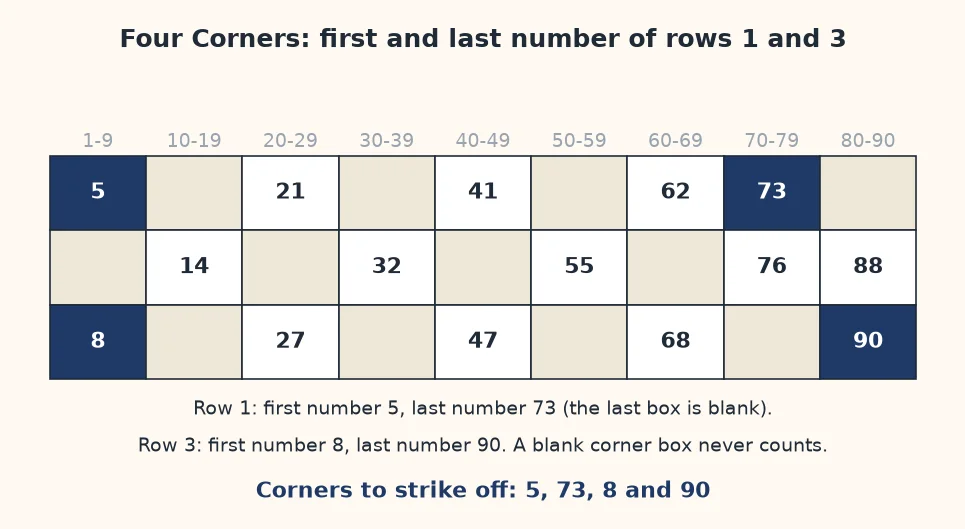
Four Corners needs only four numbers, so on paper it is easier than a line. In practice it lands very close to the first line: with 48 tickets the median Four Corners is call 34 and the median first line is call 33. It lands before the first line in about 44% of games. Pay it a little more than a single line: the claim is a big moment for the room, and it is the claim that the corner rule makes easiest to get wrong.
Always print the corner rule in your prize list. A new player who hears “Four Corners” will look at the four corner boxes, find two of them empty and give up. A one-line reminder on the caller sheet, like the one on the diagram, prevents that.
Full house tambola and the Second Full House
A Full House is the biggest of all the housie prizes: every one of the 15 numbers on a ticket has been called. It takes the longest to win, and it usually ends the game. Full house tambola is the dividend people stay for, which is why it carries the largest share of the pool. With 48 tickets in play the median Full House comes on call 70, and the middle half of games finish from call 67 to 73.
How a Second Full House works
The Second Full House is the next ticket to complete all 15 numbers, and many groups add it so that the game does not end the moment the first player shouts. It is easy to run if the host keeps playing after the first claim: the caller keeps calling and the next ticket that completes is checked. With 48 tickets the median Second Full House is call 74, only about 4 calls after the first, so it adds a few minutes of play, not a new game.
Decide whether one ticket can win both full houses. The usual answer is no: the winner of the first Full House is out for the second, which leaves the second prize for someone who has not won the top one. The number caller does not have a separate button for the second house, so use the “Calls so far” list to check the next claim, as the tools section explains.
Tambola winning patterns: which comes first?
The order of the tambola winning patterns is not fixed, but three rules always hold, and you can use them to plan a game. First, a line has five numbers, so the ticket that completes any line has at least five numbers struck off. That means the Early Five is always won on the same call as the first line or earlier, never after it. Second, a Full House includes every line, so it can never come before the lines it contains. Third, the order of the Four Corners and the lines is open.
The practical order for planning the tambola dividends is therefore Early Five, then Early Seven, then the lines and Four Corners in a cluster, then Two Lines, then the Full House. The chart in the next section turns that sequence into numbers. If your pattern list also has shapes or other tambola winning patterns from a particular club, treat them like Four Corners: describe them with a diagram and state whether they pay before or after the lines.
- Always early: Early Five and Early Seven, usually before call 30.
- The middle cluster: the first line, a named line and Four Corners, from about call 25 to 45.
- The slow prizes: Two Lines, then the Full House and the Second Full House, in the 50s, 60s and 70s.
How many numbers are called before each of the tambola dividends?
Most rule sheets say a Full House is “late” and leave it there, but tambola dividends can be measured. A simulation gives exact numbers, and they decide how many prizes fit into an evening. The method is simple and stated in full so you can judge it.
How the simulation works
The simulation builds random valid 3×9 tickets: five numbers in every row, at least one and at most three numbers in each column, and every number taken from its own column range (1 to 9, 10 to 19, and so on up to 80 to 90).
For each game it deals N distinct tickets, shuffles the numbers 1 to 90 into a random order, and records the call on which the first ticket completes each dividend. It repeats that for 20,000 games for each number of tickets (12, 24, 48, 96 and 192) and reports the median and the quartiles.
“Numbers called” means the call that completes the pattern, so a median Early Five of 11 means the claim is made right after the 11th number is read out. The claim is assumed to be instant. In a real game a claim takes 30 to 60 seconds to check, and the caller usually pauses for it.
The tickets are independent random tickets, not printed strips of six, and the figures are a guide, not a promise. A family that plays with whole strips of six tickets, where no number repeats within a strip, will see slightly different timings. The overall picture does not change.
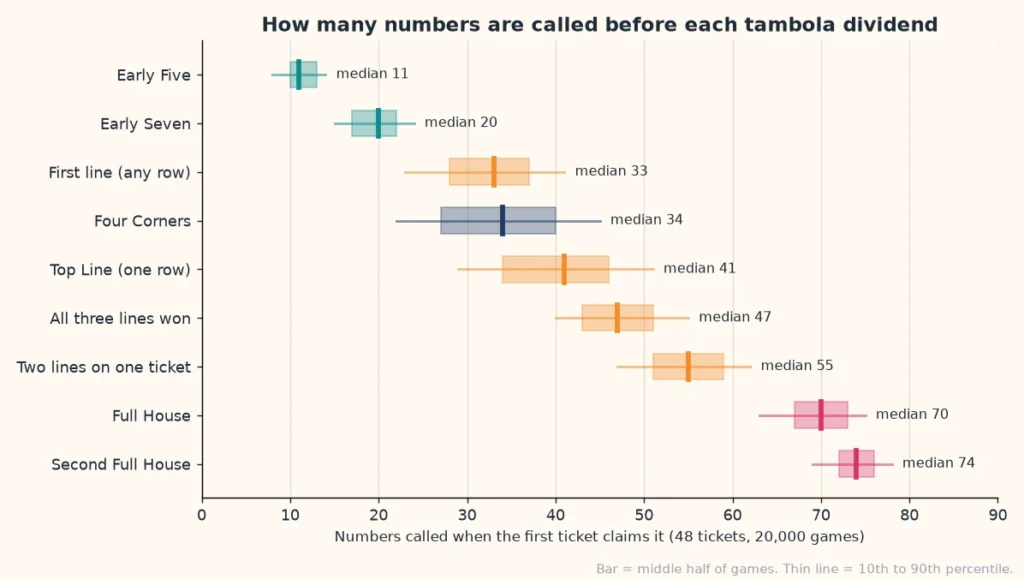
The table gives the figures behind the chart. The 10th percentile is a lucky game, where the dividend arrives that early or earlier, and the 90th percentile is an unlucky one. Half of all games land between the 25th and the 75th percentile.
| Dividend (48 tickets) | 10th percentile | 25th percentile | Median call | 75th percentile | 90th percentile |
|---|---|---|---|---|---|
| Early Five | 8 | 10 | 11 | 13 | 14 |
| Early Seven | 15 | 17 | 20 | 22 | 24 |
| First line (any row) | 23 | 28 | 33 | 37 | 41 |
| Four Corners | 22 | 27 | 34 | 40 | 45 |
| Top Line (one named row) | 29 | 34 | 41 | 46 | 51 |
| All three lines won | 40 | 43 | 47 | 51 | 55 |
| Two Lines on one ticket | 47 | 51 | 55 | 59 | 62 |
| Full House | 63 | 67 | 70 | 73 | 75 |
| Second Full House | 69 | 72 | 74 | 76 | 78 |
How the number of tickets changes the housie prizes
More tickets mean more chances to complete each pattern, so every dividend arrives earlier, and the early prizes change the least. Going from 12 to 192 tickets moves the Early Five from call 15 to call 9, but it moves the first line from call 42 to call 26 and the Full House only from call 76 to call 65. The Full House never gets very early, because completing 15 specific numbers needs most of the balls.
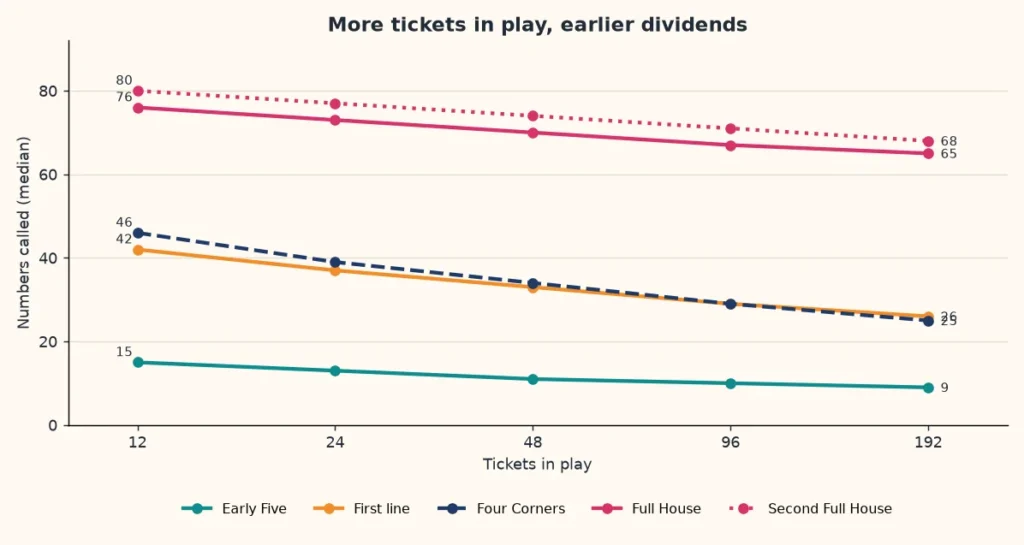
| Tickets in play | Early Five | Early Seven | First line | Four Corners | Two Lines | Full House | Second Full House |
|---|---|---|---|---|---|---|---|
| 12 | 15 | 24 | 42 | 46 | 63 | 76 | 80 |
| 24 | 13 | 22 | 37 | 39 | 59 | 73 | 77 |
| 48 | 11 | 20 | 33 | 34 | 55 | 70 | 74 |
| 96 | 10 | 18 | 29 | 29 | 52 | 67 | 71 |
| 192 | 9 | 16 | 26 | 25 | 49 | 65 | 68 |
Use the table to choose your prize list. With 12 tickets, a family-sized game, the Full House usually arrives after call 75, so a three-prize game takes around 13 minutes at ten seconds a call. With 96 or more tickets, you can afford the Second Full House, because the second claim arrives within a few calls of the first.
A single ticket on its own: the exact probabilities
You can also work out the odds for one ticket exactly, without a simulation. The k-th of 15 marked numbers appears, on average, at call k x 91 / 16, so the average Early Five arrives at call 28.4 and the average Full House at call 85.3. The table gives the chance that one ticket has completed each dividend after a given number of calls. The probabilities come from the hypergeometric formula, so they are exact.
| Numbers called | Early Five | One named line | Four Corners | Full House |
|---|---|---|---|---|
| 10 | 1.0% | <0.1% | <0.1% | <0.1% |
| 20 | 21% | <0.1% | 0.2% | <0.1% |
| 30 | 61% | 0.3% | 1.1% | <0.1% |
| 40 | 89% | 1.5% | 3.6% | <0.1% |
| 50 | 99% | 4.8% | 9.0% | <0.1% |
| 60 | 100% | 12% | 19% | 0.1% |
| 70 | 100% | 28% | 36% | 1.6% |
| 80 | 100% | 55% | 62% | 14% |
The single-ticket numbers explain why a game with many tickets feels so different from a game with one. After 60 calls a single ticket has only a 12% chance of a named line and a 0.1% chance of a Full House, yet with 48 tickets in play the first Full House is already 53% likely to have been claimed by call 70.
The chance the Full House is already claimed
Sometimes you need a safe bet instead of a median. The table gives the share of games in which the first Full House has been claimed by a given call. With 48 tickets the Full House is claimed by call 75 in 91% of games, and by call 80 almost always.
| Tickets in play | By call 60 | By call 65 | By call 70 | By call 75 | By call 80 |
|---|---|---|---|---|---|
| 12 | 1% | 5% | 17% | 46% | 84% |
| 24 | 3% | 10% | 32% | 70% | 97% |
| 48 | 5% | 20% | 53% | 91% | 100% |
| 96 | 11% | 36% | 78% | 99% | 100% |
| 192 | 20% | 58% | 95% | 100% | 100% |
So think twice before you promise a game “done in 12 minutes”. At ten seconds a call, call 75 arrives after 12.5 minutes. With 12 tickets only 46% of games have a Full House by then, while with 96 tickets 99% of games do.
Ties on the same prize: how often two tickets win together
Two tickets win the same dividend when both complete the pattern on the same call. It is not rare. The table shows the share of games in which the very first claim for each dividend was a tie, using the same simulated games as above. Among tambola dividends, the Early Five ties most often, and every figure rises with the number of tickets in play.
| Tickets in play | Early Five | A named line | First line (any row) | Four Corners | Full House |
|---|---|---|---|---|---|
| 12 | 11% | 6% | 5% | 7% | 10% |
| 48 | 17% | 7% | 7% | 10% | 11% |
| 96 | 22% | 8% | 8% | 12% | 12% |
| 192 | 26% | 10% | 9% | 14% | 12% |
A tie on the Full House is a fair surprise in about one game in nine, so the host should have a plan. The three most common tie rules are listed below. Whichever you choose, announce it at the start and apply it to every dividend.
- Split the prize equally. Simple and fair for money pools: two winners share the dividend.
- Play a tie-breaker. Both winners draw a number, or the host calls one more number and the ticket nearer to it wins.
- Pay both in full. Possible with gift prizes, when the host keeps a spare gift in the box.
The tambola number caller helps with disputes, because its “Calls so far” list shows the exact order of the calls, and the “Check a winning card” box tells you whether every number on a claimed ticket really was called. Both are described in the tools section further down.
How to split a prize pool fairly
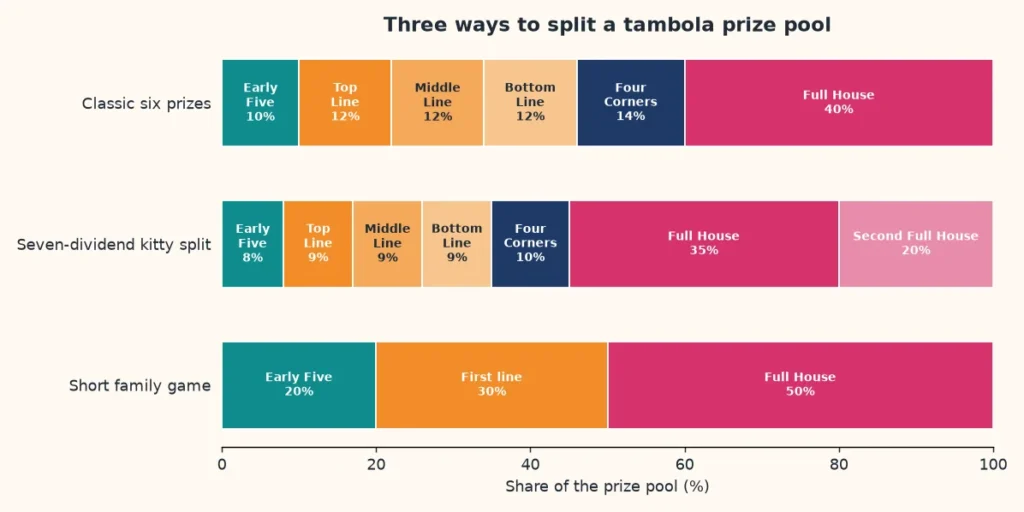
If players pay to join, as at many charity nights and kitty events, the money collected is divided between the prizes before the first call. A good split of tambola dividends follows two ideas from the simulation. Prizes that land at about the same time deserve similar amounts, and a prize that comes much later deserves much more. The first line and Four Corners both land around call 33 to 34, so they get similar shares, while the Full House comes about 36 calls later, so it gets the largest share.
Split 1: the classic six-prize split
The classic split pays 10% for the Early Five, 12% for each of the three lines, 14% for Four Corners and 40% for the Full House. It suits a charity or club night with 40 or more tickets in play. As a worked example, 60 tickets sold at 100 each bring in 6,000. If the host keeps 10% for costs, the prize pool is 5,400, and the dividends come to the amounts in the table.
| Dividend | Share | Pays (pool of 5,400) | Median call (48 tickets) |
|---|---|---|---|
| Early Five | 10% | 540 | 11 |
| Top Line | 12% | 648 | 41 |
| Middle Line | 12% | 648 | 40 |
| Bottom Line | 12% | 648 | 41 |
| Four Corners | 14% | 756 | 34 |
| Full House | 40% | 2,160 | 70 |
| Total | 100% | 5,400 |
Split 2: a seven-dividend split for kitty parties
A kitty party often plays for longer, with more prizes to share around the table. This split uses the six classic prizes plus a Second Full House paying 20%, and it trims every other share to make room. Twenty members who each put in 200 make a pool of 4,000. Because the money is shared among friends, a smaller Early Five and equal lines keep the mood light. The kitty party tambola page has tickets and a prize list for such a game.
| Dividend | Share | Pays (pool of 4,000) |
|---|---|---|
| Early Five | 8% | 320 |
| Top Line | 9% | 360 |
| Middle Line | 9% | 360 |
| Bottom Line | 9% | 360 |
| Four Corners | 10% | 400 |
| Full House | 35% | 1,400 |
| Second Full House | 20% | 800 |
| Total | 100% | 4,000 |
Split 3: a short family game with three prizes
For children, grandparents and newcomers, three prizes are enough: an Early Five, the first line in any row and the Full House. A single prize for the first line in any row keeps the game short. Ten players who put in 20 each make a pool of 200: 40 for the Early Five, 60 for the first line and 100 for the Full House. Gift prizes work just as well as money.
If you prefer your own split, keep the Full House as the largest share and avoid any dividend below 5%, since a prize that small is not worth claiming. Round every amount to a value you can actually hand over, and add any remainder to the Full House.
Prizes that are not money
Paying tambola dividends in money raises legal questions in some places, and this guide cannot give legal advice. Rules for games of chance and prizes vary by country, state and venue, so check local rules before you charge for tickets or pay out cash. Many hosts avoid the question: they keep tickets free and give small gifts, vouchers or snacks. Gift prizes are easy to rank, because the Full House simply gets the best gift, and they remove any argument about shares.
Run the game with the free caller and tickets
Two free tools cover all the tambola dividends above. The tambola ticket generator makes the 3×9 tickets, in classic or illustrated theme versions, and prints up to 100 different tickets in one PDF. The tambola number caller calls every number from 1 to 90 once, in random order, shuffled with the secure random generator of your browser. Neither needs a sign-up, and everything stays in your browser.
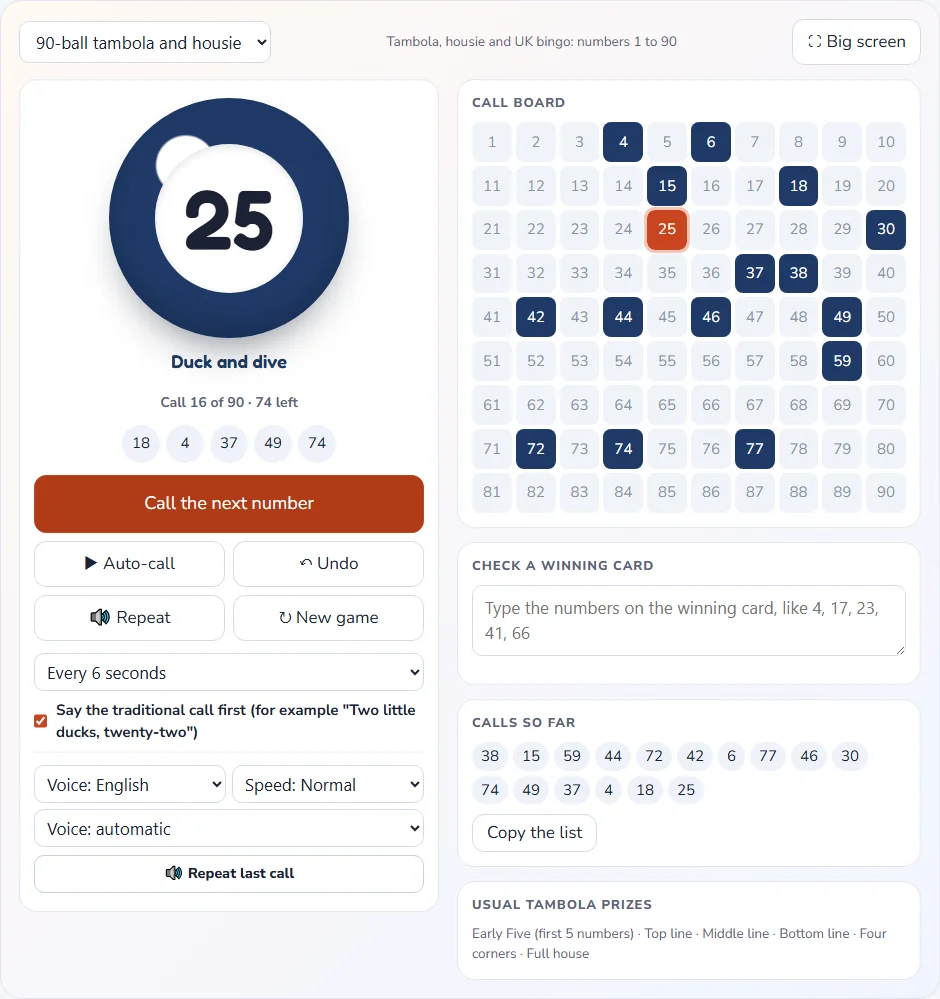
The caller has a winning pattern picker that lists the usual tambola prizes: Early Five, the top, middle and bottom lines, Four Corners and the Full House. Use it as a reminder on the big screen. When a player shouts, type the numbers from the claimed ticket into “Check a winning card”, and the caller says whether they were all called. The “Calls so far” list can be copied, and the undo and repeat buttons help when someone missed a number.
The caller does not track who has won what, and it has no separate Second Full House button, so keep a written prize sheet beside it. For the calls themselves, including the traditional rhymes, the guide to housie number calls lists all 90. For themed tickets, see theme tambola tickets, and to see how the game compares with the others, the guide on tambola, bingo and housie.
The prize sheet: rules to read aloud
Most arguments about housie prizes come from rules that were never said aloud. A prize sheet with ten lines, read once before the game, prevents nearly all of them. Copy the list below and adjust it to your event.
- List every dividend by name, with the pattern, in the order you will play it, and put Four Corners on a diagram so that nobody reads the blank boxes as corners.
- State the share or gift for each dividend, and the total pool if money is involved.
- Say whether one ticket can win more than one dividend. Many groups allow one prize per ticket at a time and keep the Full House open to all.
- Say how to claim: a loud word such as “Housie!”, then wait for the host to check. A claim after the next number has been called is late.
- Say what a bogey is. A false claim usually means the player is out of that dividend, and the game goes on.
- Say what happens in a tie: split, tie-breaker or pay both.
- Say whether the game continues after the Full House, for a Second Full House or extra prizes.
- Say who checks claims, and what is used as the record of the calls (the number caller list, a caller sheet, or both).
- Announce the pace, so players know how fast numbers will be called.
- Give one example claim, so newcomers see how it is done.
Mistakes that spoil the prize list
Four slips cause most of the trouble with tambola dividends. Avoid them and a dispute rarely lasts a minute.
- Announcing the prizes late. If nobody knew that Four Corners was a prize, nobody claims it, and the host has to rewind the calls.
- Paying every dividend the same. The Full House arrives about 23 calls after the three lines are gone (with 48 tickets), so it needs much more luck and deserves the biggest share.
- Too many prizes for too few tickets. With 12 tickets the first line and Four Corners fall a few calls apart, so a nine-prize game feels crowded. Add the extras as the number of tickets grows.
- Losing the record of calls. A claim cannot be checked without the list of what was called, so keep the caller list open or tick a printed sheet.
In UK halls, a game for Four Corners or one line is usually followed by a game for two lines and then a full house, which is the same escalation as the order above. For office or club versions with a time limit, the guide to corporate tambola shows how to fit the prizes into a one-hour plan, and the guide to kitty party tambola themes has theme ideas for the prize table.
Frequently asked questions
14 quick answers
What are tambola dividends?
Tambola dividends are the prizes of a tambola game: Early Five, the top, middle and bottom lines, Four Corners and the Full House, plus extras such as Early Seven or a Second Full House. Each dividend can be a gift or a share of the money collected from the tickets.
How many tambola dividends are there?
The classic set has six: Early Five, Top Line, Middle Line, Bottom Line, Four Corners and Full House. Many groups add Early Seven, Two Lines and a Second Full House, which gives the nine prizes in this guide. The host decides, so print the list before the game.
What is the Early Five in tambola?
The Early Five, or Jaldi Five, goes to the first ticket with any five numbers struck off. The five numbers can be in any rows, so it is a pure luck prize. With 48 tickets in play, the median Early Five is claimed at call 11.
What is a full house in tambola?
A full house means all 15 numbers on one ticket have been called. It is the biggest prize and usually ends the game. With 48 tickets, the median full house tambola claim comes on call 70, and with 12 tickets on call 76.
Do the blank boxes count in Four Corners?
No. Four Corners uses the first and last number of the top row and of the bottom row. If a corner box is blank, the dividend still uses the first and last number of the row, wherever they sit, so a ticket can have corner numbers such as 5, 73, 8 and 90.
Which of the tambola dividends is won first?
The Early Five is always won on the same call as the first line or earlier, because a line has five numbers. Four Corners and the lines come next, in either order, and the Full House comes last. About 44% of games see Four Corners before the first line with 48 tickets.
How do you split the prize money across tambola dividends?
A classic split is 10%, 12% for each line, 14% and 40%. For a kitty party, 8%, three lines at 9%, 10%, 35% and 20% for a Second Full House works. For a short family game, use 20%, 30% and 50%. Write the shares on the prize sheet.
What happens if two people win the same tambola dividend?
Decide before the game: split the prize, run a tie-breaker, or pay both. Ties are common. With 48 tickets about 17% of games have a tied Early Five and about 11% a tied Full House.
Can one ticket win more than one dividend?
That is a house rule. Many groups let a ticket win several dividends, but some give one prize per ticket until the Full House. Whichever you choose, state it in the rules before the first number is called.
What is a Second Full House?
It is the prize for the second ticket to complete all 15 numbers, claimed after the first Full House. It adds a few minutes of play: with 48 tickets the median Second Full House is call 74, only 4 calls after the first.
How many numbers are called before the Full House?
About 65 to 76 in typical games, depending on the number of tickets: the median is 65 with 192 tickets and 76 with 12. A single ticket alone averages call 85.
Are tambola prizes the same as housie prizes?
Yes, tambola and housie are the same game with the same 3×9 ticket, and the prizes are the same patterns. UK 90-ball bingo uses a shorter list of one line, two lines and a full house.
Is it legal to play tambola for money?
Rules differ by country, state and venue, and this guide cannot give legal advice. Check local rules before you sell tickets or pay cash prizes. Many hosts play for free with gift prizes.
Do I need special software to run the game?
No. The free number caller and the free ticket maker run in your browser with no sign-up, and nothing you type is uploaded. A paper prize sheet is enough to track who has won each dividend.