Tambola vs bingo is mostly a question of numbers and grids. Tambola, housie and British 90-ball bingo are one game played with the numbers 1 to 90 on a ticket of 3 rows and 9 columns, while American bingo uses the numbers 1 to 75 on a 5 x 5 card with a free space. This guide settles the three names in seven differences, adds exact ticket counts and a real simulation of how long each game lasts, and links free tickets and a number caller for both.
In short: tambola and housie are the same game, and it is the cousin of bingo rather than the same thing. Housie is the older British name, tambola is the Indian name, and both mean 90 numbers, 15 numbers per ticket and prizes such as Early Five and Full House. American bingo has 75 numbers, 24 numbers per card plus a free center and prizes for patterns such as lines, corners and blackout.
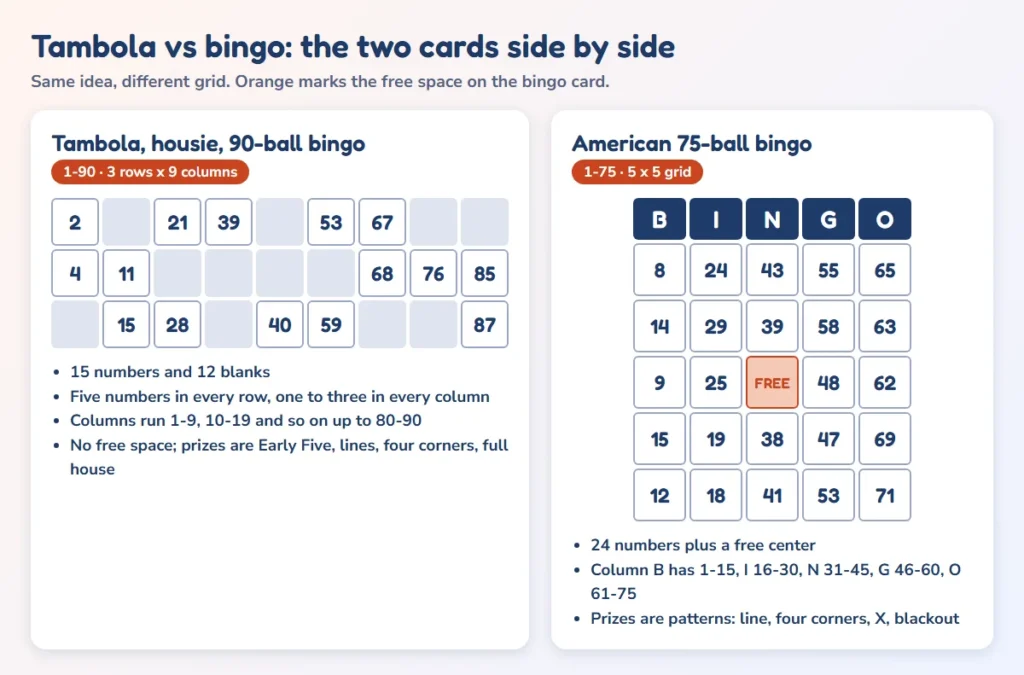
Tambola vs bingo: the 7 differences at a glance
Here is the whole tambola vs bingo comparison in one table. Each row is explained in the sections that follow, with the numbers worked out. Where a name or a rule varies by country, the table shows both versions.
| Tambola, housie, 90-ball bingo | American 75-ball bingo | |
|---|---|---|
| 1. Numbers drawn | 1 to 90 | 1 to 75 |
| 2. Card shape | 3 rows x 9 columns, 27 squares | 5 rows x 5 columns, 25 squares |
| 3. Numbers on the card | 15 numbers (5 in every row) and 12 blanks | 24 numbers plus a free space in the center |
| 4. Free space | None | The center square counts as marked |
| 5. Where numbers sit | Column 1 holds 1-9, column 2 holds 10-19, and so on up to 80-90 | B holds 1-15, I 16-30, N 31-45, G 46-60, O 61-75 |
| 6. How numbers are called | The number, often with a rhyming nickname such as “Two little ducks, twenty-two” | The letter and the number, such as B-12 |
| 7. What wins | Fixed prizes: Early Five, lines, four corners, full house (UK: line, two lines, full house) | Patterns: any line, four corners, X, letter shapes, blackout |
| Where it is played | India, the UK, and wherever Indian and British communities play | The United States and Canada |
| Cards per player | One ticket, or a strip of six tickets in the UK | One card or many separate cards |
| Median call of the first line (10 cards) | 44 | 26 |
| Median call to cover the whole card (10 cards) | 77 | 69 |
The last two rows come from our own simulation, described below. Everything else in the table can be checked against the Wikipedia articles listed in the sources section at the end of this guide.
Quick answers: the six questions people ask most
- Tambola vs housie: the same game. Tambola is the Indian name and housie the traditional British one, with a 3 x 9 ticket of 15 numbers in both.
- Housie vs bingo: UK 90-ball bingo is housie in a bingo hall, so those match. American 75-ball bingo has a square card and fewer numbers, so it differs.
- Difference between tambola and bingo: 90 numbers against 75, a wide ticket against a square card, 15 numbers on the ticket against 24 on the card, and fixed prizes against patterns.
- What is the difference between bingo and housie? The card, the number pool, the calling style and the prizes. The act of listening, marking and shouting is identical.
- Tambola vs bingo vs housie: tambola and housie are one game, UK bingo is the same game again, and only American bingo is a genuinely different design.
- Tombola vs tambola: a spelling difference for the party game, though a tombola in the UK is a raffle with instant prizes.
Difference between tambola and bingo, explained one by one
The difference between tambola and bingo is easier to remember if you take it in seven small steps. None of them is hard, but together they explain why the two games feel different at a party even though both are “call a number, cross it off”.
Difference 1: 90 numbers or 75
Tambola draws from 1 to 90, so a full game can run up to 90 calls. American bingo draws from 1 to 75. That sounds like a small change, but it affects everything else: with more numbers in the pool, each number is less likely to be on your ticket, and the game takes longer. The tambola number caller deals the numbers 1 to 90, and the bingo caller deals 1 to 75 with the letters B, I, N, G and O.
Difference 2: a wide ticket or a square card
A tambola ticket is wide and short: nine columns and three rows. A bingo card is square: five columns and five rows. The shape decides which lines can win. A tambola ticket has just three horizontal lines, because a column never has five numbers. A bingo card can be won by any of five rows, five columns or two diagonals, which is twelve lines in total.
Difference 3: 15 numbers or 24
This is the difference that matters most for how the game feels. A tambola ticket holds 15 numbers out of 90, so about one call in six helps you. A bingo card holds 24 numbers out of 75, so almost one call in three helps you. Players on a bingo card are marking something every few calls. Players on a tambola ticket wait longer and cheer louder when a number lands.
Difference 4: the free space
The center square of an American bingo card is free, and it counts as marked from the start (Wikipedia describes it as automatically filled). A tambola ticket has no free square. Its twelve blanks are not free spaces: they are empty and never need a number. Our bingo card generator can put a picture or word in the free space of a custom card, but the rule stays the same.
Difference 5: how the numbers are laid out
Both games sort numbers into columns by size. On a bingo card the five columns are labeled B, I, N, G and O and each holds one block of 15 numbers. On a tambola ticket the nine columns hold blocks of ten: 1-9, 10-19, 20-29 and so on, with the last column running 80-90. Wikipedia notes that bingo played in the UK is distinct from American bingo and has a different style of calling, and this column layout is the visual reason why.
Difference 6: how the numbers are called
An American caller reads the letter with the number, and players listen for the column letter. A tambola or housie caller reads the number and often a nickname first. The British calls described by Wikipedia include “Both the fives, fifty five” and “Two and three, twenty three”. Our caller can say the traditional list of 90 nicknames before each number, and the housie number calls guide lists them.
Difference 7: what you win
Tambola has a fixed set of prizes, which are called dividends in India. The usual six are Early Five, top line, middle line, bottom line, four corners and full house. In UK 90-ball bingo the prizes are one line, two lines and a full house.
American bingo is built around patterns: a game can be a straight line, four corners, a letter X, a postage stamp or a full blackout, and Wikipedia notes there are nearly unlimited patterns a host can specify. Fixed prizes against changing patterns is the clearest sign at the table of which game you are playing.
Tambola vs housie: the same game with two names
People often ask about tambola vs housie as if they were rivals. They are not. Wikipedia describes the British game as traditionally known as Housey-Housey, and notes that in India the same game is called Tambola. The ticket is the same 3 x 9 grid with 15 numbers, the numbers run from 1 to 90, and the winner is the first to mark all their numbers. In everyday speech, “housie” can also mean the full house prize, which is why a player may shout “House!” when they finish the ticket.
There are small local habits that make the two names feel different. Indian tambola nights, especially kitty parties, often run six or more prizes in a game and add extras such as Pyramid or Breakfast, Lunch and Dinner, which Wikipedia lists for India. British housie and bingo clubs usually play a line, then two lines, then a full house. In New Zealand, bonus Super Housie games may allow top, middle and bottom lines to be claimed separately.
If you are choosing which word to put on your invitation, use the one your guests use. Tambola is the natural word for an Indian family or a kitty group. Housie suits older relatives and UK or New Zealand readers. Both are fine with our tambola ticket generator, which prints the same tickets whatever you call the game. In tambola vs housie the paper is identical; only the word on the invitation changes.
Tambola vs bingo vs housie: the three names sorted out
The quickest way to sort out tambola vs bingo vs housie is to ask two questions. First, how many numbers? If the answer is 90, you are in tambola, housie or UK bingo territory. If it is 75, you are playing American bingo. Second, what is the card shape? A wide 3 x 9 ticket means tambola or housie. A square 5 x 5 card means American bingo.
| Name | Numbers | Card | Usually heard in |
|---|---|---|---|
| Tambola | 1-90 | 3 x 9 ticket, 15 numbers | India, kitty parties, family nights |
| Housie (Housey-Housey) | 1-90 | The same 3 x 9 ticket | The UK and other British-influenced places |
| Bingo, UK version | 1-90 | The same ticket, printed in strips of six | UK bingo halls and online bingo |
| Bingo, American version | 1-75 | 5 x 5 card with a free center | United States and Canada |
So when someone says tambola vs bingo vs housie, the honest reply is that tambola and housie are the same, UK bingo is the same again with a different prize list, and only American bingo is a genuinely different card and number pool.
Housie vs bingo: what changes when you sit down to play
Housie vs bingo is usually asked by someone planning a party who wonders whether guests will find it confusing. The rules of marking are identical: you listen, you mark, you shout. What changes is the pace and the prizes.
- Pace. Housie is slower because each ticket has fewer of the called numbers. Bingo gets its first winner sooner, as the simulation below shows.
- Prizes. Housie plays several different prizes in one game. Bingo usually plays one pattern per round, then starts a new round.
- Shouting. In housie the winner shouts “House” or “Line” or the name of the prize; Wikipedia notes there are no formal rules about what is shouted in UK clubs. In bingo the winner shouts “Bingo”.
- Cards. Housie players usually hold one ticket, or a strip of six in a UK club. Bingo players can hold a stack of separate cards.
For a party host, the practical test is time. If you have fifteen minutes between dinner and cake, play bingo. If you have an evening and want several prizes, play housie. If you cannot decide, run one short bingo round as a warm-up, then switch to housie for the main event.
What is the difference between bingo and housie for a beginner?
What is the difference between bingo and housie when you have never played either? For a beginner it comes down to this: bingo asks you to complete a shape on a square card, while housie asks you to finish rows on a wide ticket. If you can spot the number 47 on a ticket, you can play both. The only skill that differs is scanning: on a bingo card you scan one column by letter, while on a tambola ticket you scan across nine short columns.
A good way to teach a mixed group is to hand out tickets, call five numbers slowly, and let everyone mark. Then show how a line is formed. In the printable bingo card generator you can make a 75-ball card, and in the tambola tool a 90-ball ticket, so beginners see both versions on paper in under a minute.
Tombola vs tambola: spelling, Italy and the UK raffle
Tombola vs tambola is a spelling question with a surprise inside. Tombola is the Italian game that started it all, and Wikipedia says that in India the game is often called Tambola, although Tombola is the official spelling. So tambola is simply the common Indian spelling of the same word.
The surprise is that “tombola” means different things in different countries. In Italy it is a Christmas and New Year family game with prizes for two, three, four and five numbers on a row (Ambo, Terno, Quaterna and Cinquina) and a final Tombola when the whole card is filled.
In the United Kingdom, Wikipedia explains that a tombola is a type of raffle where prizes are already assigned to winning tickets, often those ending in a particular digit, and it is popular at village fetes and coffee mornings. That UK tombola is not housie at all.
| Where | What “tombola” or “tambola” means there |
|---|---|
| Italy | A family board game with cards, called numbers and five prize levels from Ambo to Tombola. The Neapolitan version is thought to date from 1734. |
| India | The party game on 3 x 9 tickets with 90 numbers; spelled tambola in everyday use, tombola officially. |
| United Kingdom | A raffle where you draw a numbered ticket and win instantly if it ends in a prize digit. The numbers-on-a-ticket game is called housie or bingo. |
| Philippines | A “tambiolo” is the revolving drum from which numbered tickets or balls are drawn. |
So when you see tombola vs tambola online, check the context. Search results about a village fete raffle are not about the game in this guide. If the page talks about tickets with 15 numbers and Early Five, it is the right game.
A short history: from Italian lotto to Beano and Housey-Housey
The history explains why the two games look so alike and still differ. According to Wikipedia, a game of chance named lotto was being played in Italy by about 1530. In the 18th century a home version called Tombola was created in Naples, adding cards, tokens and the calling of numbers. The French game Le Lotto appeared in 1778, with 27 squares in three rows and nine columns, five squares in each row filled with numbers from 1 to 90. That is exactly the modern tambola ticket.
The American branch started later. In the early 1920s Hugh J. Ward standardized the game at carnivals around Pittsburgh. In December 1929 toy merchandiser Edwin S. Lowe saw a game called Beano near Atlanta, played with dried beans, a rubber stamp and cardboard sheets. He took it to New York, where a friend is said to have shouted “Bingo” by mistake, although Wikipedia says the origin of the name is unknown. The Great Depression made it popular as churches adopted it as a fundraiser.
In Britain the same 90-number game was traditionally known as Housey-Housey, and it grew quickly after the Betting and Gaming Act 1960, which legalized large cash prizes from 1 January 1961. India kept the older Italian name in its own spelling. That is why you can answer almost any question about how the two games differ with a date, and tombola vs tambola with a spelling: one game went east and stayed 90-ball, the other went west and became 75-ball.
How many tambola tickets and bingo cards can exist?
Here is a number you will not find on most pages about tambola vs bingo. We counted every valid ticket. A tambola ticket is valid when every row has five numbers, every column holds one to three numbers from its own block of ten (the first block 1-9, the last 80-90), and the numbers in a column go from small to large down the page. With a short program that works through the nine columns one at a time, the count is exactly 3,669,688,706,217,187,500 different tambola tickets, about 3.67 x 10¹⁸.
For American bingo the count depends on what you call a different card. If two cards use the same numbers in each column, with the order inside the column ignored, there are C(15,5) x C(15,5) x C(15,5) x C(15,5) x C(15,4) = 111,007,923,832,370,565 (about 1.11 x 10¹⁷). If the order of numbers in a column also counts, Wikipedia gives P(15,5) to the fourth power times P(15,4), which is 552,446,474,061,128,648,601,600,000, about 5.52 x 1026.
| What is counted | Tambola ticket | American bingo card |
|---|---|---|
| Different sets of numbers | 3,669,688,706,217,187,500 (3.67 x 10¹⁸) | 111,007,923,832,370,565 (1.11 x 10¹⁷) |
| If order inside a column also counts | Not applicable: numbers in a column are always ascending | 552,446,474,061,128,648,601,600,000 (5.52 x 1026) |
| Numbers on one card | 15 out of 90 | 24 out of 75 (plus the free center) |
| Chance that a called number is on your card | 15 in 90, which is 16.7% (1 in 6) | 24 in 75, which is 32% |
| Average call at which one card is completely covered | 85.3 | 73.0 |
Both numbers are astronomically large, so a printable generator never runs out of different cards. That is why our 90-ball bingo cards page and the bingo card generator can print a hundred different cards at once without a duplicate. It is also why the old advice to “swap tickets in the middle of the game” is not needed: two random tickets are almost never the same. The theme tambola tickets page has 25 illustrated versions.
The last row of the table is an exact average: if one card holds k of N numbers, the last of its numbers is called on average at call k x (N + 1) / (k + 1). For a tambola ticket that is 15 x 91 / 16 = 85.3, and for a bingo blackout it is 24 x 76 / 25 = 73.0.
A solo player on a tambola ticket would on average wait until about call 85 for a full house, while a solo bingo player would be done by about call 73. In the tambola vs bingo comparison, tambola also has about 33 times as many different tickets as bingo has different sets of numbers.
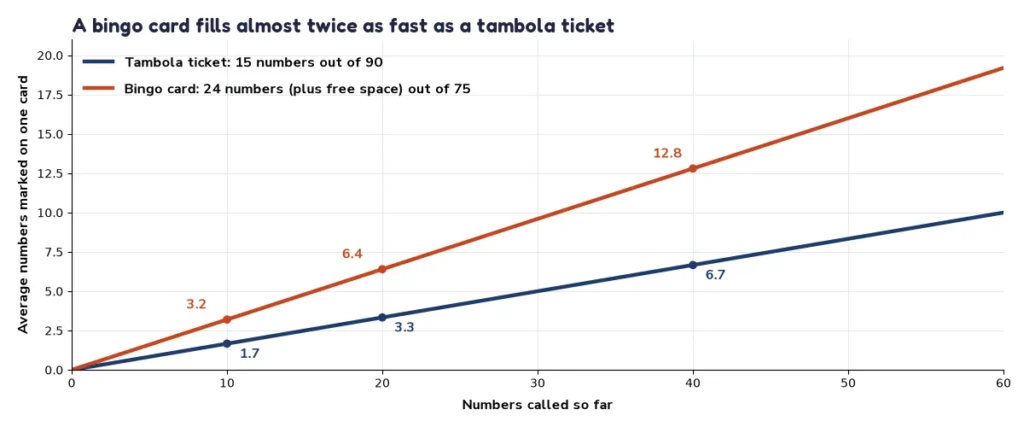
The chart shows why the games feel so different. After 20 calls the average tambola ticket has 3.3 numbers marked, while the average bingo card has 6.4. After 40 calls it is 6.7 against 12.8. A tambola player is still waiting for the first few rows to take shape when a bingo player is already one square away from a line.
How long each game lasts: a real simulation
To measure the tambola vs bingo difference in minutes, we simulated both games on a computer. For tambola we generated random tickets that follow the layout above (three rows, nine columns, five numbers per row, one to three numbers per column) and shuffled 1 to 90 for each game. For bingo we generated random 75-ball cards with a free center and shuffled 1 to 75. Each game recorded the call on which the first card completed a prize. The table shows the median call, which is the middle result across thousands of games.
| Cards in play | Prize | Tambola: median call | Bingo: median call | Tambola at 8 s per call | Bingo at 8 s per call |
|---|---|---|---|---|---|
| 1 card | First line | 66 | 41 | 8:48 | 5:28 |
| 1 card | Whole card | 87 | 74 | 11:36 | 9:52 |
| 10 cards | First line | 44 | 26 | 5:52 | 3:28 |
| 10 cards | Whole card | 77 | 69 | 10:16 | 9:12 |
| 30 cards | First line | 36 | 21 | 4:48 | 2:48 |
| 30 cards | Whole card | 72 | 66 | 9:36 | 8:48 |
| 100 cards | First line | 29 | 15 | 3:52 | 2:00 |
| 100 cards | Whole card | 68 | 64 | 9:04 | 8:32 |
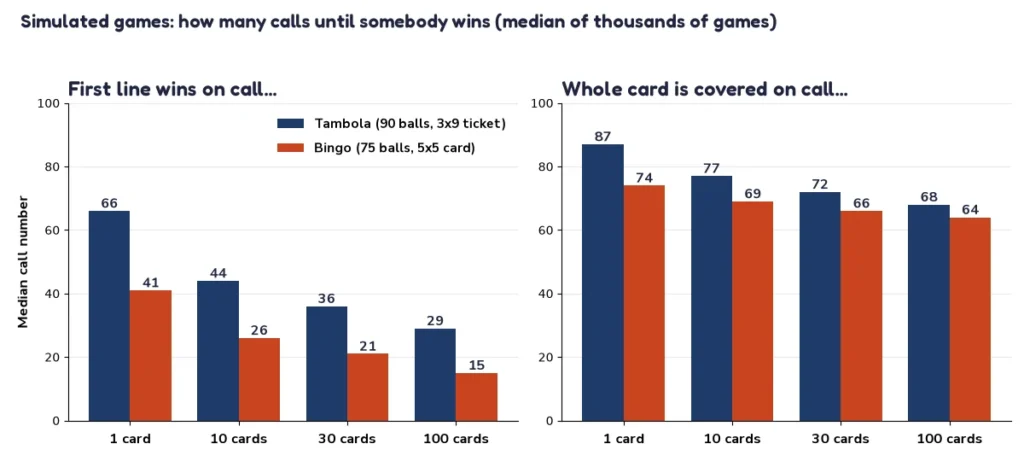
Two patterns stand out. First, the line prize is where tambola vs bingo differs most. With 30 cards in play, a bingo line arrives around call 21 while the first tambola line takes until call 36.
Bingo has twelve possible lines on every card and a free center that supplies one square for nothing, while tambola has three lines of five numbers out of 90. Second, the whole-card prize is much closer: 72 calls for a full house with 30 tickets and 66 for a blackout with 30 cards. Everyone needs almost every number to cover a whole card.
Early Five, the usual first tambola prize, is much faster than a line. In our tambola simulation it was won around call 15 with 10 tickets, around call 12 with 30 and around call 10 with 100. That is why the first prize in a tambola game often lands within the first minute or two, while the lines come much later.
These are simulated medians, not promises: any single game can be shorter or longer. The middle half of games stays within a few calls either side, and a game with more tickets in play ends sooner. Run a longer game by adding more prizes, a shorter one by playing fewer.
Planning the evening: how long to allow
The time per call decides how long you need. At 8 seconds per call, a bingo round to a first line with 30 cards takes about 2:48 and a full tambola game with 30 tickets takes about 9:36. Add a minute for every prize check, and a few more for the prize ceremony. A kitty party with a dozen guests will usually get through two or three full tambola games in an hour if the host keeps a steady pace.
| Seconds per call | Time for 75 calls (whole bingo game) | Time for 90 calls (whole tambola game) |
|---|---|---|
| 5 | 6:15 | 7:30 |
| 8 | 10:00 | 12:00 |
| 10 | 12:30 | 15:00 |
| 15 | 18:45 | 22:30 |
Those are the upper limits, because a game ends when the last prize is claimed, not when every number is out. In practice most tambola games stop between about call 68 and call 87, and a bingo game never needs more than 75.
Tambola vs bingo: which game for which party?
Now the practical part of tambola vs bingo. Pick the game by the group, the time and the mood, not by tradition. The table gives a suggestion for the most common situations, with the free tool that fits each one.
| Party | Better choice | Why | Free tool |
|---|---|---|---|
| Kids (about 5 to 8) | Bingo with pictures or a small grid | Small numbers or pictures, many squares marked early, a win within minutes. | Picture bingo for kids |
| Kitty party | Tambola | Several prizes in one game, a familiar format, and a natural pause between rounds. | Kitty party tambola |
| Office or team event | Bingo with custom words | Fast rounds, no numbers to read out, easy to theme. | Meeting bingo |
| Family evening, mixed ages | Tambola, with a few quick bingo rounds | Grandparents know housie, children enjoy rhyming calls; bingo rounds keep the pace up. | Tambola games |
| Fundraiser with a big hall | Bingo | One pattern per round and a fast turnaround; check local rules before charging for cards or giving cash prizes. | Bingo card generator |
| Classroom | Bingo with words or pictures | Cards carry vocabulary, sight words or facts instead of numbers. | Classroom bingo |
| Video call | Either, with the big-screen caller | The host shares one screen; guests print or open their own cards. | Play bingo online |
| Festival or wedding event | Tambola with themed tickets | Illustrated tickets are the decoration and the game at once. | Theme tambola |
The tambola vs bingo choice, like housie vs bingo, also depends on how many cards each person plays. Tambola works well with exactly one ticket each, and it is easy to follow while chatting. Bingo scales better when some players hold several cards, because the extra squares are quick to mark. If you are unsure, ask the group what they already know: people will always enjoy the version they played as children.
Which is easier to learn?
Most beginners find bingo easier for the first five minutes, because the card is square, the free center gives an instant mark, and the caller says the letter. Tambola is easier after that, because there is no need to think about patterns: every prize is a set of rows or the whole ticket. If you choose tambola vs bingo for a group of beginners, write the prize list on a card or screen where everyone can see it.
Calling the numbers for each game
Whichever side of tambola vs bingo you choose, one caller can run both games. The free tambola number caller deals the numbers 1 to 90 in a shuffled order and never repeats a number. It can say the calls aloud in English or Hindi, add a traditional nickname before the number, and keep a board of what has been called. Here is the 90-ball version of the screen.
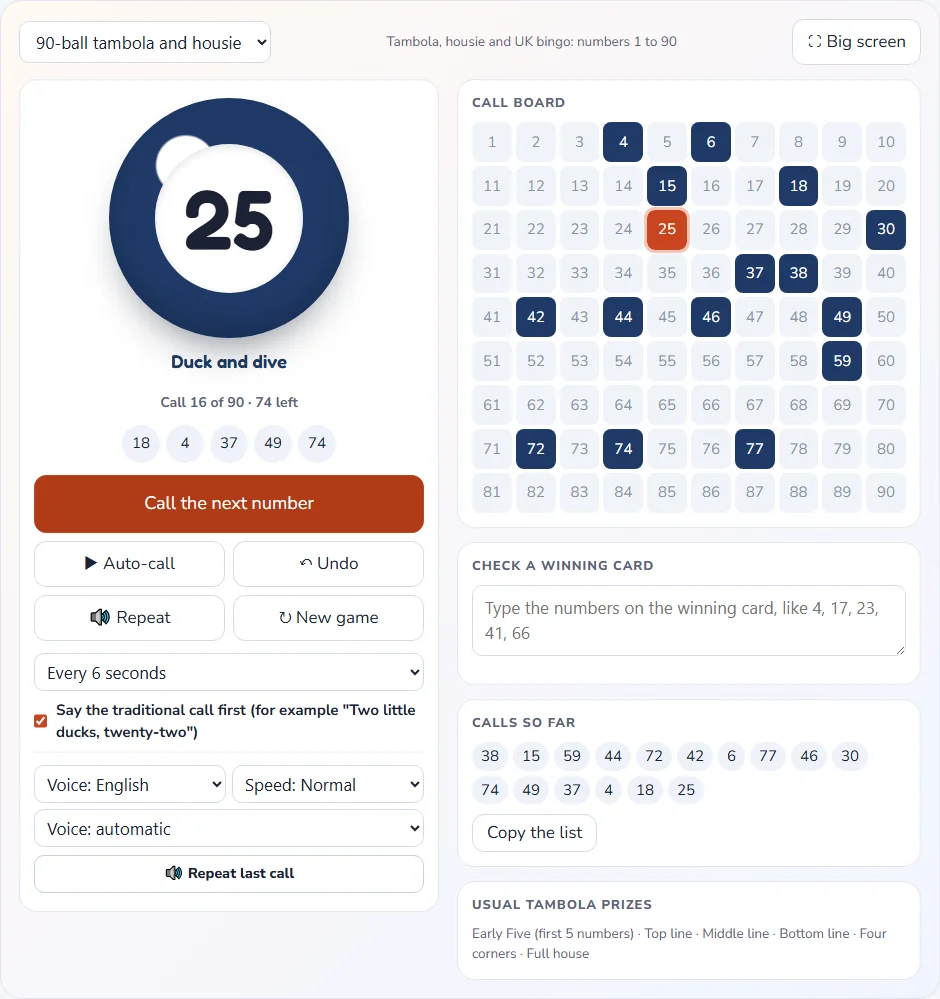
The same tool has a 75-ball preset. The bingo caller marks each number against the letters B, I, N, G and O and shows a pattern picker with the shapes American bingo uses: any line, four corners, X, letter T, letter L, postage stamp, picture frame and blackout.
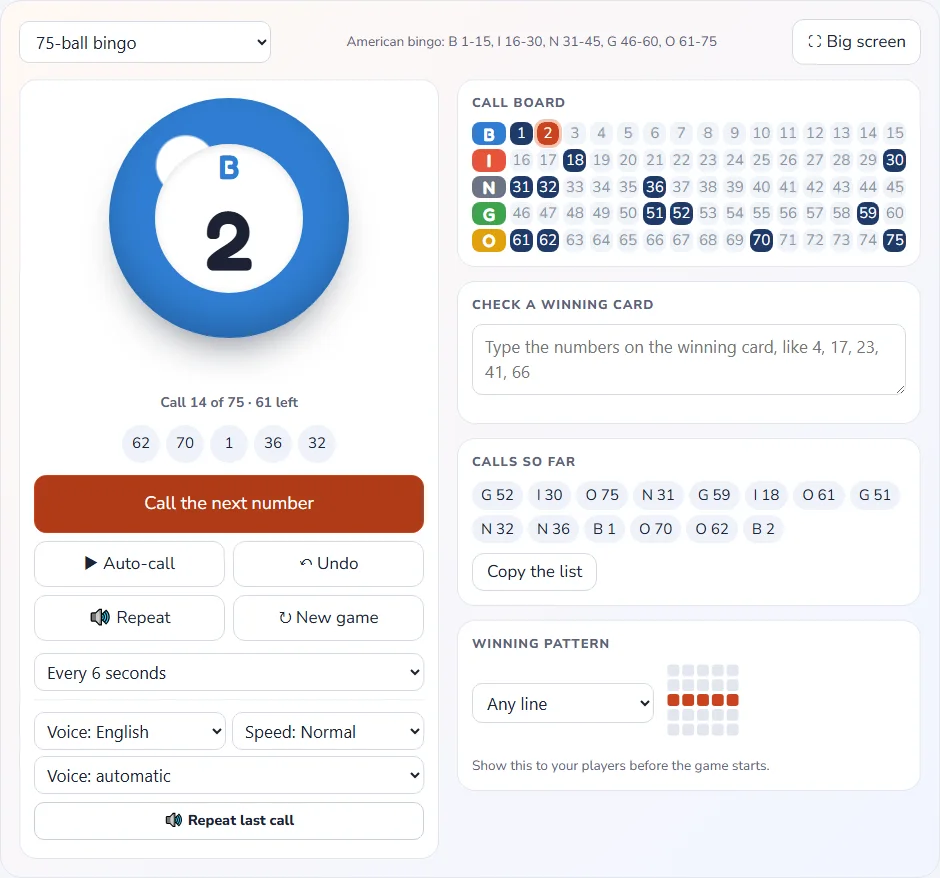
Both presets share the same helpful extras. There is a Check a winning card box where you type the numbers on a card and the tool tells you whether all of them were called, auto-call every 3 to 30 seconds, undo and repeat buttons, and a big-screen mode for a TV or a video call.
The game is saved in your browser, so a reload does not lose your place. Guests cannot join from their own phones in the caller itself. For a live bingo game that guests join by link, use play bingo online, and for the tambola version see the party games hub.
Free tickets and cards for each game
For tambola vs housie, nothing needs to change on paper, and for housie vs bingo you only swap the card. You do not need to buy anything to play either game. All of these run in the browser, are free and need no sign-up.
- Tambola ticket generator makes classic or illustrated 90-ball tickets, up to 100 different tickets in one PDF.
- 90-ball bingo cards prints the same 3 x 9 layout for UK-style housie and bingo nights.
- Bingo card generator makes 75-ball cards, junior cards and custom cards with your own words or pictures.
- Printable bingo cards collects ready-made templates for baby showers, Christmas, road trips and classrooms.
- How to play tambola explains the rules and prizes in full.
- How to play bingo online with friends covers the remote version of the game.
For tambola, print one ticket per player and check that no two guests hold the same ticket, because identical tickets win together. For bingo, print as many different cards as you have players and let each person choose how many to use. Both generators shuffle for you, so every card is a different random arrangement.
Common mix-ups between tambola, bingo and housie
- Using 75-ball cards with a 90-ball caller. A bingo card has no numbers above 75, so a caller set to 1-90 will keep calling numbers nobody can mark. Match the preset to the cards.
- Calling “bingo” in tambola. Tambola winners usually shout the prize they have claimed, such as “Top line” or “Full house”. Agree the shout beforehand.
- Treating the free space as a blank. On a bingo card the free space counts as marked. On a tambola ticket the blanks do not count at all.
- Expecting a full house at call 60. A tambola full house usually arrives around call 70 to 80 with a normal group, as the simulation shows.
- Confusing a UK tombola raffle with housie. The raffle gives instant prizes from a drum; housie is the numbers game.
- Running prizes the group has not heard. Early Five, Pyramid and Breakfast are lovely if everyone knows them and confusing if nobody does. Say them out loud before the first call.
None of these is serious, and all of them disappear if the host spends one minute before the game explaining the card in front of everyone. Hold up a ticket, point at a row, say what wins, and then start. The difference takes one minute to show and a whole evening to enjoy.
The short version
If you remember only one paragraph about tambola vs bingo, make it this one. Tambola vs housie is a naming question: they are the same game with 90 numbers and 15 numbers on a 3 x 9 ticket. Housie vs bingo depends on the bingo: the UK version is the same 90-ball game, while the American version has 75 numbers and a 5 x 5 card.
The difference between tambola and bingo therefore lives in the number pool, the grid, the free space and the prizes, and all of it is easy to teach in one minute with a ticket and a card in your hands.
Sources
The history, card layouts, names and prize lists in this guide come from these Wikipedia articles, which we read and checked: Tombola (game) for the Italian, Indian and UK uses of the word, Bingo (British version) for the 90-ball ticket, housie and the UK prizes, and Bingo (American version) for the 75-ball card, its history and the 5.52 x 1026 count.
The exact tambola ticket count, the average-call figures and all simulation results are our own calculations. The simulation uses tickets that follow the standard layout; real strips printed by a bingo company can differ slightly.
Frequently asked questions
10 quick answers
What is the main difference between tambola and bingo?
The main difference between tambola and bingo is the numbers and the card. Tambola uses 90 numbers on a 3 x 9 ticket with 15 numbers, while American bingo uses 75 numbers on a 5 x 5 card with 24 numbers and a free space. The marking and calling work the same way in both.
Tambola vs housie: is tambola the same as housie?
Yes. Tambola and housie are two names for the same 90-number game with the same 3 x 9 ticket. Tambola is the Indian name and housie is the traditional British one. Some groups also use housie to mean the full house prize.
Housie vs bingo: is housie the same as bingo?
Housie vs bingo depends on the version. UK 90-ball bingo is housie played in a bingo hall, so they are the same game. American 75-ball bingo uses a different card and number range, so it is a cousin rather than the same game.
Tambola vs bingo: which is easier to play?
In tambola vs bingo, bingo is a little easier at first because the square card and the free center give quick marks. Tambola is easy once the prizes are written down, because every prize is just a row or the full ticket.
Tambola vs bingo: which is faster?
Bingo is faster to a first win. In our simulation with 30 cards the first line arrived around call 21 in bingo and call 36 in tambola. A whole card takes much longer in both games, around call 66 to 72.
How many numbers are in tambola and in bingo?
Tambola has 90 numbers (1 to 90) and a ticket carries 15 of them. American bingo has 75 numbers (1 to 75) and a card carries 24 of them plus a free center.
Is tombola vs tambola just a spelling difference?
For the numbers game, yes: Tombola is the Italian spelling and Tambola is the common Indian one. But in the UK a tombola is a raffle with instant prizes, so check the context before you search.
Can I use bingo cards for a tambola game?
Not with a 75-ball card. A tambola caller reads numbers up to 90 and a bingo card stops at 75. Use a 3 x 9 ticket for tambola and set the caller to 90-ball, or use a 5 x 5 card and the 75-ball preset.
Which is better for a kitty party or a family evening?
Tambola suits a kitty party or a family evening because it has several prizes in one game and many people already know it. For a short break or a mixed group of children, add a quick bingo round.
Where can I get free tambola tickets and bingo cards?
Use the free tambola ticket generator for 90-ball tickets and the bingo card generator for 75-ball and custom cards. Both print up to 100 different cards as a PDF, with no sign-up.