Phonics for beginners starts with a handful of letter sounds, usually s, a, t, p, i and n, that can be blended straight away into real words such as sat, pin and tap. Children then add a few new sounds each week, learn to blend sounds to read and segment words to spell, and meet a small number of tricky words along the way.
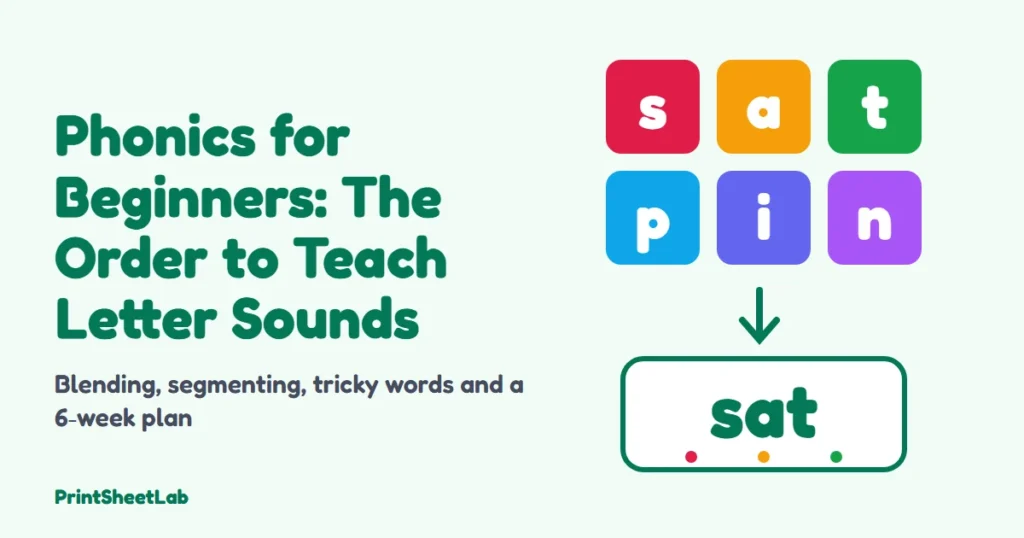
This guide explains systematic synthetic phonics in plain English, gives a typical order to teach letter sounds, and sets out a six-week plan you can follow at home. Once your child can read simple three-letter words, our word family worksheets are the natural next step: they group CVC words like cat, hat and mat so children practise blending with a familiar ending.
One note before you start at home: every school uses its own programme, and the order varies a little between them. If your child is already at school, ask which programme they use and follow the same sounds and actions at home.
What is phonics? Phonics for beginners in one minute
Phonics teaches children that letters, and groups of letters, stand for the sounds in spoken words. The US National Reading Panel listed systematic phonics instruction among the elements of effective reading teaching, describing phonics as the knowledge that letters represent phonemes (speech sounds).
Three words come up again and again in early phonics:
- Phoneme: the smallest sound in a word. Cat has three: /c/ /a/ /t/.
- Grapheme: the letter or letters that write a phoneme. In ship, “sh” is one grapheme for one sound.
- Digraph: two letters making one sound, such as sh, ch, th, ee and ai.
What is systematic synthetic phonics?
Systematic synthetic phonics (SSP) is the approach the Department for Education recommends for schools in England. “Systematic” means sounds are taught in a planned order, building week by week. “Synthetic” comes from the verb synthesise, meaning to combine: children say each sound in a word and combine (blend) them to read it. The DfE’s reading framework explains that reading and spelling are “reversible processes”: reading means blending sounds into a word, and spelling means segmenting a word into its sounds.
The DfE also publishes a list of validated SSP programmes, including Jolly Phonics, Little Wandle Letters and Sounds Revised, Read Write Inc. and Sounds-Write. The page states there is no statutory requirement for schools to choose a programme from the list, and that Ofsted has no preferred programme. For a wider overview of the method and its history, see the encyclopaedia entry on synthetic phonics.
The order to teach letter sounds
There is no single correct order, but most programmes share the same logic: start with sounds that make lots of short words, keep similar-looking letters (b and d) apart, and introduce digraphs once single letters are secure. The sequence below follows the progression in the DfES Letters and Sounds guidance (2007), which many later programmes built on. Jolly Phonics, for example, starts with s, a, t, i, p, n, a slightly different order.
| Step | Letter sounds to teach | Words your child can read | Tricky words |
|---|---|---|---|
| Set 1 | s, a, t, p | at, sat, pat, tap, sap | none yet |
| Set 2 | i, n, m, d | pin, tin, man, dad, sit | none yet |
| Set 3 | g, o, c, k | dog, cat, got, kit, cod | none yet |
| Set 4 | ck, e, u, r | duck, red, sun, rock, pen | the, to |
| Set 5 | h, b, f, ff, l, ll, ss | hat, bed, fun, off, bell, kiss | I, no, go |
| Sets 6 and 7 | j, v, w, x, y, z, qu | jam, van, web, box, yes, zip, quit | Taught across this stage: he, she, we, me, be, was, my, you, her, they, all, are |
| Digraphs | ch, sh, th, ng | chip, shop, thin, ring | |
| Vowel digraphs and trigraphs | ai, ee, igh, oa, oo, ar, or, ur, ow, oi, ear, air, ure, er | rain, feet, night, boat, farm, coin |

Letters and Sounds suggests one set per week for the first five sets, then moves on to the remaining letters and the digraphs. Notice that by the end of Set 1 your child can already read real words. That quick success is the reason phonics for beginners almost always opens with s, a, t and p.
How to teach phonics at home in 5 steps
If you are starting at home, this is the routine to repeat for every new sound.
- Hear it. Say the pure sound and words that start with it: /s/, sun, sock, sand.
- See it. Show the letter on a card and say the sound as you point.
- Write it. Trace the letter in the air, in sand, then on paper.
- Blend it. Read two or three words using the new sound and the ones already learned.
- Spell it. Say a word and let your child build it with magnetic letters.
What you need is simple: a set of sound cards (write them on index cards), magnetic letters or letter tiles, a small whiteboard and a few decodable books matched to the sounds your child knows. You do not need an expensive kit to start.
How to say the sounds (pure sounds)
The single most useful tip in phonics for beginners is to say sounds cleanly, without an extra “uh” on the end. The reading framework gives the example that /s/ /p/ /or/ /t/ is much easier to blend into “sport” than /suh/ /puh/ /or/ /tuh/.
- Stretch sounds that can be held: sss, mmm, nnn, fff.
- Keep short sounds short and clipped: /t/, /p/, /k/.
- Say the sound, not the letter name, while learning: /s/ as in sun, not “ess”. Letter names come too, and our guide to uppercase vs lowercase letters explains when to introduce capitals.
Blending and segmenting: the two core phonics skills
Every phonics lesson practises both skills. They are mirror images of each other.
| Blending (for reading) | Segmenting (for spelling) | |
|---|---|---|
| What the child does | Sees letters, says each sound, pushes the sounds together | Hears a word, splits it into sounds, writes a letter for each |
| Example | s-a-t … sat | “dog” … /d/ /o/ /g/ … d-o-g |
| Home game | Robot talk: you say “p-i-n”, they say “pin” | Sound fingers: hold up one finger per sound |
| Common stumbling block | Saying the sounds but not hearing the word | Missing the middle vowel (writing “dg” for dog) |
How to teach blending: point under each letter as your child says the sound, then sweep your finger under the whole word and say it together. Start with oral blending before letters: say “c-a-t” and let your child shout “cat!” and find the cat picture. If your child gets stuck, say the first two sounds together (“sa… t”) before adding the last one.
How to teach segmenting: say a word slowly, then ask your child to tap the sounds on their arm, from shoulder to wrist. Once they can hear three sounds, give them magnetic letters or a pencil to write them.
Tricky words: what they are and how to teach them
In phonics for beginners, tricky words are common words that cannot be fully sounded out with the sounds taught so far, such as the, to, said and was. The national curriculum calls them common exception words. The reading framework recommends keeping them to a minimum at first and teaching children to notice the unusual part: in said, the s and d work as normal, but “ai” makes an unexpected sound.
Introduce one or two tricky words a week, write them on cards and play “snap” or “find the word” in a picture book. Tricky words overlap with sight words, the high-frequency words children learn to read on sight. Our guide to what sight words are explains the difference, and the sight word worksheets and sight words game give extra practice.
Phonics for beginners: a 6-week plan for home
This plan follows the typical order above. Keep sessions short: the reading framework notes that phonics sessions in Reception might be only ten minutes long in the first few days. At home, 10 to 15 minutes a day is plenty.

| Week | New sounds | Focus | Words to try |
|---|---|---|---|
| 1 | s, a, t, p | Sound cards and oral blending games | at, sat, pat, tap |
| 2 | i, n, m, d | Blending letters to read | pin, tin, man, sit, it, is, in |
| 3 | g, o, c, k | Segmenting to spell with magnetic letters | dog, got, cat, kid, and |
| 4 | ck, e, u, r | Tricky words the and to; reading captions | duck, red, sun, rock |
| 5 | h, b, f, ff, l, ll, ss | ff, ll and ss at the ends of words; tricky words I, no, go | hat, bed, off, bell, kiss |
| 6 | Review | Revise every sound; read captions and short sentences | a red hat; the dog can run |
A 10-minute session: 2 minutes flashing the sound cards you have already learned, 3 minutes on one new sound (say it, find it, write it in the air), 3 minutes blending words, and 2 minutes reading a tricky word card or a short caption.
After week 6, phonics carries on with the remaining letters and the digraphs ch, sh, th and ng. When your child can blend three-letter words reliably, move on to the short a word families and the other vowel sets.
What should a child know by the end of Reception?
In England, the EYFS statutory framework sets the early learning goal for word reading. By the end of Reception (age 4 to 5), children at the expected level say a sound for each letter of the alphabet and at least 10 digraphs, read words consistent with their phonic knowledge by sound-blending, and read aloud simple sentences and books that match their phonic knowledge, including some common exception words.
These goals are a useful end point for phonics for beginners at home, whichever country you live in. In Year 1, children in England take the phonics screening check, which includes real words and nonsense words to check blending. For the other skills children build at this age, see our guide to what a preschooler should know.
Common mistakes parents make with phonics
- Teaching the alphabet in A to Z order as sounds. Alphabet order is useful for songs and dictionaries, but s-a-t-p-i-n gets children reading much faster.
- Adding “uh” to sounds. “Cuh-a-tuh” does not blend into cat. Use pure sounds.
- Guessing from pictures. Encourage your child to sound out every letter rather than guess from the picture or the first letter.
- Moving on too fast. If blending is shaky, spend another week on the same sets. Speed comes later.
- Books that are too hard. In the first months of phonics for beginners, children need decodable books that only use the sounds they know.
Printables and practice for the first sounds
Pair each new sound with handwriting. The alphabet worksheets give one letter per page, and you can jump straight to the first sounds with the letter s worksheets or letter a worksheets. The beginning sounds worksheets practise hearing the first sound in a word, and once your child reads short sentences, our guide on how to improve reading comprehension shows how to build understanding alongside decoding.
Related guides and printables
- CVC word family worksheets
- What are sight words? Lists and teaching tips
- Uppercase vs lowercase letters: which to teach first
- How to teach a child to write their name
- Reading comprehension worksheets
- Pre-primer sight words
Sources
Definitions, pure sounds and tricky words follow the Department for Education’s The reading framework; the validated programmes are from the DfE’s choosing a phonics teaching programme page; the typical order is from Letters and Sounds (DfES, 2007); Reception goals are from the EYFS statutory framework; and the US research summary is from the NICHD National Reading Panel page.
Frequently asked questions
7 quick answers
What are the first letter sounds to teach in phonics for beginners?
Most programmes begin with s, a, t, p, i and n because they make many simple words, such as sat, tap, pin and nap. Letters and Sounds teaches s, a, t, p first, then i, n, m, d; Jolly Phonics starts with s, a, t, i, p, n.
At what age should a child start phonics?
In England, the reading framework says daily phonics sessions should begin as soon as children start Reception, usually at age 4. Before that, listening games, rhymes and hearing the first sound in words are good preparation.
How long should a phonics session be?
Keep it short: about 10 minutes at first, building to 10 to 15 minutes a day at home. Little and often works better than one long session.
What is the difference between blending and segmenting?
Blending is for reading: saying each sound and pushing them together into a word (s-a-t, sat). Segmenting is for spelling: hearing a word and splitting it into its sounds (dog, /d/ /o/ /g/).
Should I teach letter names or letter sounds first?
Most programmes teach letter sounds first, because sounds are what children blend to read. Letter names can be learned alongside, through the alphabet song, and are needed later for spelling words aloud.
Can I teach phonics for beginners at home without a programme?
Yes. Follow a typical order such as s, a, t, p, i, n, keep sessions short and use pure sounds. If your child is at school, use the same order and sound names as their class, so home practice supports school rather than confusing it.
Are tricky words the same as sight words?
They overlap. Tricky words (common exception words) have a part that cannot be sounded out with the sounds taught so far, such as the or said. Sight words are high-frequency words children learn to read quickly, and many of them are decodable.