To solve fraction of a fraction word problems, read the word “of” as “multiply”: multiply the numerators, multiply the denominators and simplify. So 1/3 of 1/2 of a pizza is 1/3 × 1/2 = 1/6 of the pizza. Below you will find why this works, shown with area models, and 20 original problems sorted from easy to hard, each with a full worked solution and a simplified answer.
Before you start, it helps to have something to fold or shade. Our printable fraction strips and fraction bars let children see “half of a half” or “a third of a quarter” before they write any numbers. Every answer below was checked with Python’s fractions module, and you can check your own working with the step-by-step fraction calculator.
What are fraction of a fraction word problems?
These problems describe taking part of something that is already a part. “Half of the cake is left and Sam eats a third of what is left” is one. The answer is a fraction of the original whole, not of the leftover piece.
These questions are the same as fraction multiplication word problems. In the US they belong to Grade 5: the Common Core standards ask pupils to multiply a fraction by a fraction (5.NF.B.4) and to “solve real world problems involving multiplication of fractions and mixed numbers” (5.NF.B.6), as set out in the official Common Core mathematics standards (PDF). In England, the national curriculum for mathematics asks Year 6 pupils to “multiply simple pairs of proper fractions, writing the answer in its simplest form”, after Year 5 work on multiplying fractions by whole numbers.
Why “of” means multiply: the area model
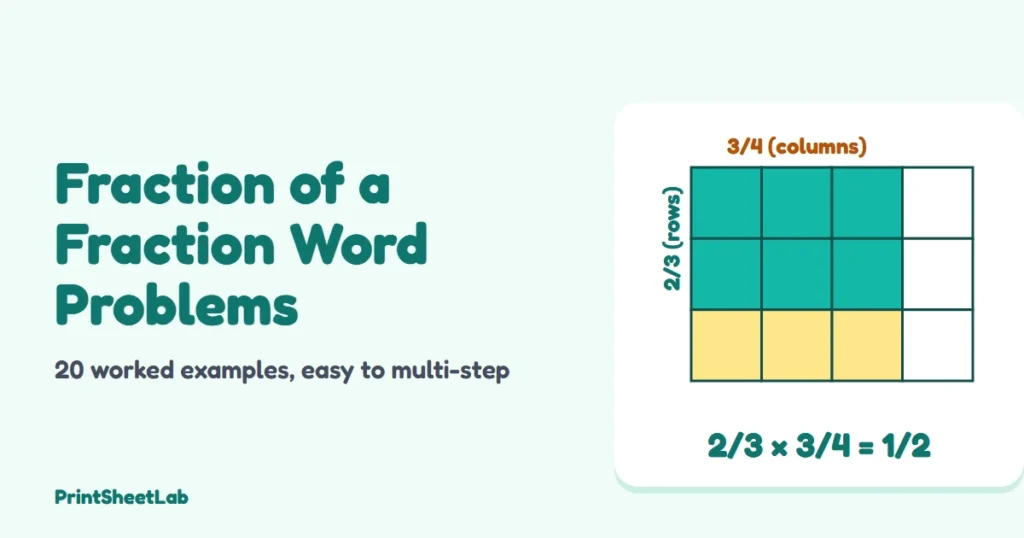
Take 2/3 of 3/4. Draw a rectangle and split it into 4 columns. Shade 3 columns: that is 3/4. Now split the rectangle into 3 rows and shade 2 of the rows across the shaded columns. The double-shaded part is 2/3 of 3/4.
Count the small boxes. The whole rectangle has 3 × 4 = 12 boxes, and 2 × 3 = 6 of them are double-shaded. So 2/3 of 3/4 = 6/12 = 1/2. Multiplying the denominators counts all the boxes; multiplying the numerators counts the double-shaded ones. That is the whole rule behind fraction of a fraction word problems: (a/b) × (c/d) = ac/bd.

The area model also shows why the answer is smaller than both fractions when both are less than 1: a part of a part is smaller still. Common Core calls this “multiplication as scaling” (5.NF.B.5), and it is your best quick check.
How to solve these problems in 4 steps
Use the same four steps for all fraction of a fraction word problems, from the easiest to the multi-step ones.
- Find the whole. Ask “a fraction of what?” The last thing mentioned is usually the whole: the pizza, the class, the tank.
- Turn “of” into ×. Write the fractions in the order the sentence gives them. Order does not change the answer, but it keeps your working clear.
- Multiply and simplify. Multiply across, or cancel common factors first to keep numbers small. Change mixed numbers to improper fractions before you multiply.
- Check and label. Is the answer smaller than the starting fraction? Does it have a unit, such as kg, m or “of the class”?

Key words that tell you what to do
| Words in the problem | What to do | Example |
|---|---|---|
| “of”, “part of”, “a fraction of” | Multiply | 2/3 of 3/4 = 1/2 |
| “of the rest”, “of what was left” | Subtract from 1 first, then multiply | 2/5 of the rest after 3/8 is eaten = 2/5 × 5/8 |
| “how much”, “how many kg/m/litres” | Multiply, then give the unit | 3/5 of 2 1/2 kg = 1 1/2 kg |
| “what fraction of the whole” | Multiply all the “of” fractions together | 2/3 of 1/4 of 3/5 = 1/10 |
| “and”, “altogether”, “more than” | Usually add or subtract, not multiply | 1/3 + 2/5 = 11/15 |
20 fraction of a fraction word problems with answers
These fraction word problems examples get harder as you go, so they double as fraction multiplication story problems for any level. Problems 1 to 5 use unit fractions, 6 to 10 need simplifying, 11 to 15 bring in areas, mixed numbers and amounts, and 16 to 20 are multi-step word problems multiplying fractions. Cover the solution, try the problem, then check.
Level 1: start with unit fractions
1. Leftover pizza. Half a pizza is left. Ali eats 1/3 of the leftover half. What fraction of the whole pizza does Ali eat?
Solution: 1/3 of 1/2 = 1/3 × 1/2 = 1/6. Answer: 1/6 of the pizza.
2. Carrot patch. A quarter of a garden is a vegetable patch. Half of the vegetable patch is carrots. What fraction of the garden is carrots?
Solution: 1/2 × 1/4 = 1/8. Answer: 1/8 of the garden.
3. Juice bottle. Maya has 1/2 litre of juice and drinks 1/4 of it. How much juice does she drink?
Solution: 1/4 × 1/2 = 1/8. Answer: 1/8 litre (125 ml).
4. Comic books. One fifth of the books on a shelf are comics, and half of the comics are in Urdu. What fraction of all the books are Urdu comics?
Solution: 1/2 × 1/5 = 1/10. Answer: 1/10 of the books.
5. Ribbon. A ribbon is 3/4 m long. Zara uses half of it to wrap a present. How long is the piece she uses?
Solution: 1/2 × 3/4 = 3/8. Answer: 3/8 m.
Level 2: problems that need simplifying
6. Wheat field. Three quarters of a field is planted with wheat. By Friday, 2/3 of the wheat has been harvested. What fraction of the field has been harvested?
Solution: 2/3 × 3/4 = 6/12 = 1/2. Answer: 1/2 of the field.
7. Smaller recipe. A recipe needs 3/4 cup of sugar. Dev makes 1/3 of the recipe. How much sugar does he need?
Solution: 1/3 × 3/4 = 3/12 = 1/4. Answer: 1/4 cup.
8. Water tank. A tank is 5/6 full. The family uses 2/5 of the water in it. What fraction of the full tank did they use?
Solution: 2/5 × 5/6 = 10/30 = 1/3. Answer: 1/3 of the tank.
9. Cricket club. 3/5 of the pupils in Year 6 play a sport after school, and 2/3 of those pupils play cricket. What fraction of Year 6 plays cricket?
Solution: 2/3 × 3/5 = 6/15 = 2/5. Answer: 2/5 of Year 6.
10. Party cake. After lunch, 4/9 of a cake is left. Guests eat 3/8 of what is left. What fraction of the whole cake do the guests eat?
Solution: 3/8 × 4/9 = 12/72 = 1/6. Cancelling first is quicker: 3 and 9 share 3; 4 and 8 share 4, giving 1/2 × 1/3 = 1/6. Answer: 1/6 of the cake.
Level 3: areas, mixed numbers and amounts
11. Flower bed. A rectangular flower bed is 3/4 m long and 2/3 m wide. What is its area?
Solution: area = length × width = 3/4 × 2/3 = 6/12 = 1/2. Answer: 1/2 m².
12. Bag of rice. A bag holds 2 1/2 kg of rice. The cook uses 3/5 of it. How much rice is used?
Solution: 2 1/2 = 5/2, so 3/5 × 5/2 = 15/10 = 3/2. Answer: 1 1/2 kg.
13. Park run. A path round the park is 1 1/4 km. Sara runs 2/3 of the way before she stops for water. How far has she run?
Solution: 1 1/4 = 5/4, so 2/3 × 5/4 = 10/12 = 5/6. Answer: 5/6 km.
14. Rug. A rug measures 1 1/2 m by 2/3 m. What is its area?
Solution: 3/2 × 2/3 = 6/6 = 1. Answer: 1 m².
15. Pocket money. Bilal gets Rs 1,200. He saves 1/4 of it and spends 2/3 of his savings on a book. How much does the book cost?
Solution: 2/3 of 1/4 = 2/12 = 1/6 of the money. 1/6 of 1,200 = 200. Answer: Rs 200.
Level 4: multi-step problems
16. Chocolate bar. Ella eats 3/8 of a chocolate bar. She gives 2/5 of the rest to her sister. What fraction of the bar does her sister get, and how much is left?
Solution: the rest is 1 − 3/8 = 5/8. Sister: 2/5 × 5/8 = 10/40 = 1/4. Left: 1 − 3/8 − 1/4 = 3/8. Answer: sister 1/4, left 3/8.
17. Library loans. 3/5 of a library’s books are fiction, 1/4 of the fiction books are mysteries, and 2/3 of the mysteries are on loan. What fraction of all the books are mysteries on loan? If the library has 600 books, how many is that?
Solution: 2/3 × 1/4 × 3/5 = 6/60 = 1/10. 1/10 of 600 = 60. Answer: 1/10 of the books, or 60 books.
18. Working backwards. 2/3 of 3/4 of the pupils in a class walk to school. That is 18 pupils. How many pupils are in the class?
Solution: 2/3 × 3/4 = 1/2, so half the class is 18. Answer: 36 pupils.
19. Plank. A plank is 4/5 m long. A carpenter cuts off 5/6 of it. Without working it out, is the piece longer or shorter than 4/5 m? Then find its length.
Solution: 5/6 is less than 1, so the piece must be shorter than 4/5 m. 5/6 × 4/5 = 20/30 = 2/3. Answer: 2/3 m, which is shorter.
20. Paint tins. A painter has 2 2/3 tins of paint. She uses 3/4 of the paint on the walls, then half of what is left on the door. How much paint is left?
Solution: 2 2/3 = 8/3. Walls: 3/4 × 8/3 = 2 tins. Left: 8/3 − 2 = 2/3 tin. Door: 1/2 × 2/3 = 1/3 tin. Left at the end: 2/3 − 1/3 = 1/3. Answer: 1/3 of a tin.
Answer key for all 20 problems
| No. | Calculation | Answer | No. | Calculation | Answer |
|---|---|---|---|---|---|
| 1 | 1/3 × 1/2 | 1/6 | 11 | 3/4 × 2/3 | 1/2 m² |
| 2 | 1/2 × 1/4 | 1/8 | 12 | 3/5 × 5/2 | 1 1/2 kg |
| 3 | 1/4 × 1/2 | 1/8 litre | 13 | 2/3 × 5/4 | 5/6 km |
| 4 | 1/2 × 1/5 | 1/10 | 14 | 3/2 × 2/3 | 1 m² |
| 5 | 1/2 × 3/4 | 3/8 m | 15 | 2/3 × 1/4 × 1,200 | Rs 200 |
| 6 | 2/3 × 3/4 | 1/2 | 16 | 2/5 × 5/8 | 1/4 (3/8 left) |
| 7 | 1/3 × 3/4 | 1/4 cup | 17 | 2/3 × 1/4 × 3/5 | 1/10 (60 books) |
| 8 | 2/5 × 5/6 | 1/3 | 18 | 18 ÷ (2/3 × 3/4) | 36 pupils |
| 9 | 2/3 × 3/5 | 2/5 | 19 | 5/6 × 4/5 | 2/3 m |
| 10 | 3/8 × 4/9 | 1/6 | 20 | 8/3 − 2 − 1/3 | 1/3 tin |
Common mistakes and how to avoid them
Most wrong answers to fraction of a fraction word problems come from five slips.
- Adding instead of multiplying. 1/3 of 2/5 is 2/15, but 1/3 + 2/5 is 11/15. If your answer is bigger than both fractions, you probably added.
- Using the wrong whole. In problem 16, the sister gets 2/5 of the rest, not 2/5 of the bar. Find the rest first.
- Multiplying when the wholes differ. “3/5 of the class are girls and 1/2 of the boys wear glasses” cannot be solved by 1/2 × 3/5, because the boys are the other 2/5. Thompson Rivers University’s Mathematics for Elementary Teachers explains this trap.
- Multiplying the whole number in a mixed number only. 3/5 of 2 1/2 is not 3/5 × 2 plus 1/2. Convert to 5/2 first.
- Forgetting to simplify or label. 12/72 is correct but unfinished. Give 1/6, plus the unit if there is one. The simplify fractions calculator is handy for checking.
Which grade learns to multiply fractions?
| Stage | What children learn | Problems to try |
|---|---|---|
| US Grade 4 / England Year 5 | A fraction times a whole number (4.NF.B.4 in Common Core; Year 5 in England) | Warm up with fractions of a number before this page |
| US Grade 5 / England Year 6 | A fraction of a fraction, area with fractional sides, real-world problems (5.NF.B.4 to 5.NF.B.6; Year 6 in England) | Problems 1 to 14, 18 and 19 |
| US Grade 6 and up / Key Stage 3 | Multi-step problems, mixed numbers, working backwards | Problems 15 to 20 |
If a child is unsure about fractions on their own, go back a step. Our fractions on a number line guide builds the sense of size that makes estimating easy, and the fraction rules cheat sheet puts multiplying, dividing, adding and subtracting side by side.
Where to go for more practice
Once these 20 feel easy, move on to printable practice. The multiplying fractions worksheets drill the calculation, and the fractions of a number and mixed numbers worksheets cover the “2/3 of 1,200” type of question. A good routine is five fraction multiplication story problems a day: two easy, two medium and one multi-step, taken from the fraction of a fraction word problems above or your own.
To make up your own fraction word problems examples, pick a real whole (a pizza, a class, a tank), write two “of” steps and check the answer with fraction strips. Writing problems like these for a friend is one of the best ways to learn the language of “of the rest”.
Related guides and printables
- Fractions worksheets by topic
- Dividing fractions worksheets for the next step
- Math problems for 5th graders with answers
- Comparing fractions game for quick practice
- Free online math games for kids
Sources
Standards 5.NF.B.4, 5.NF.B.5 and 5.NF.B.6 are quoted from the official Common Core State Standards for Mathematics (Grade 5, Number and Operations: Fractions). The Year 5 and Year 6 statements come from the Department for Education’s national curriculum in England: mathematics programmes of study. The note on matching wholes follows Thompson Rivers University’s Mathematics for Elementary Teachers. All 20 fraction of a fraction word problems are original, and every answer was checked with Python’s fractions module.
Frequently asked questions
7 quick answers
How do you solve fraction of a fraction word problems?
Find the whole, replace “of” with ×, multiply the numerators and the denominators, then simplify. Check that the answer is smaller than the fraction you started with and add the unit.
Does “of” always mean multiply in fraction word problems?
In fraction of a fraction word problems, yes, as long as the second fraction is a part of the first. If the two fractions describe different groups, such as girls and boys, you cannot simply multiply them.
What is an example of a fraction multiplication word problem?
A recipe needs 3/4 cup of sugar and you make 1/3 of the recipe. You need 1/3 × 3/4 = 3/12 = 1/4 cup of sugar.
Why is the answer smaller when you multiply two fractions?
When both fractions are less than 1, you are taking a part of a part, so the result is smaller than either one. This is called multiplication as scaling.
How do you multiply mixed numbers in word problems?
Change each mixed number to an improper fraction first. For example, 3/5 of 2 1/2 kg becomes 3/5 × 5/2 = 15/10 = 1 1/2 kg.
Where can I find printable fraction of a fraction word problems?
Use the 20 problems on this page with the answer key, then move on to the PrintSheetLab multiplying fractions worksheets and fractions of a number worksheets.
What grade learns word problems multiplying fractions?
In the US, Common Core places them in Grade 5 (5.NF.B.4 and 5.NF.B.6). In England, multiplying pairs of proper fractions is in Year 6.