Fractions of a number, such as 3/4 of 12, and mixed numbers, such as 1 3/4, are the last steps of grade 4 fractions. The four PDFs on this page have pictures of equal groups, fractions of a number, improper fractions to mixed numbers, and both directions, with answer keys. They follow standards 4.NF.B.3 and 4.NF.B.4 of the Common Core standards for grade 4 fractions.
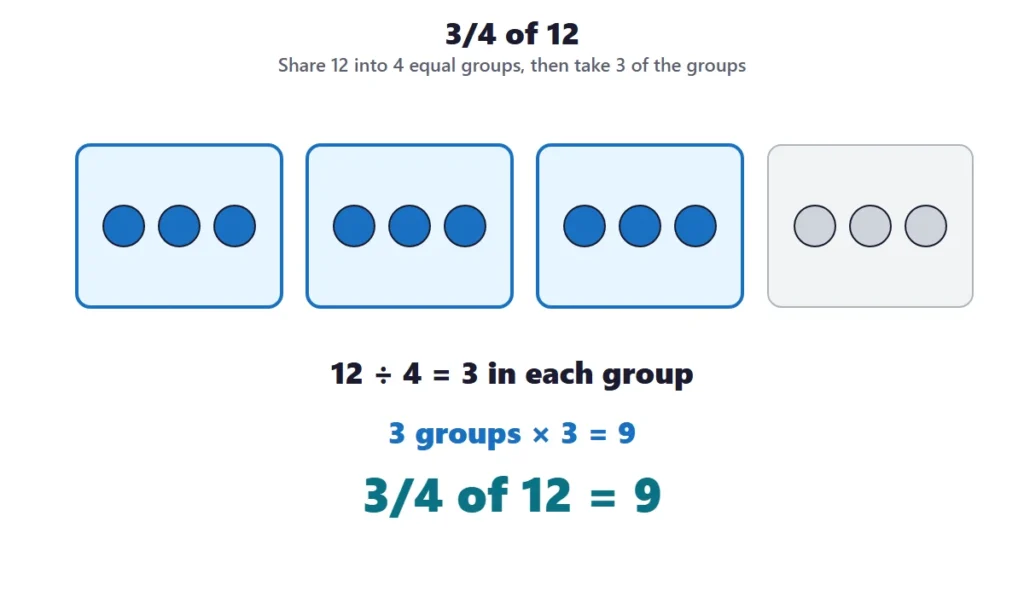
Fraction of a number. 3/4 of 12 is 9.
Quick answer: To find a fraction of a number, divide the number by the bottom of the fraction, then multiply by the top: 3/4 of 12 is 12 ÷ 4 = 3, then 3 × 3 = 9. A mixed number, such as 2 1/3, is a whole number and a fraction. This page has 4 free printable worksheets with answer keys for grades 4 and 5. Updated October 2026.
Finding a fraction of a number
To find 3/4 of 12, share 12 into 4 equal groups (3 in each), then take 3 of the groups: 9. In short: divide by the denominator, multiply by the numerator. The picture worksheets let children circle the groups before they learn the shortcut.
Mixed numbers and improper fractions
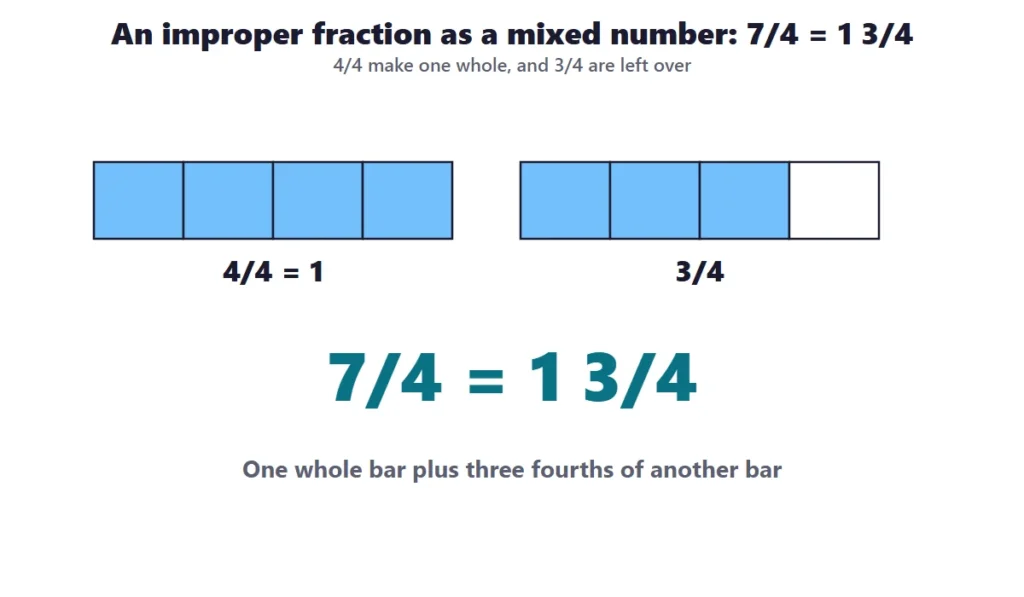
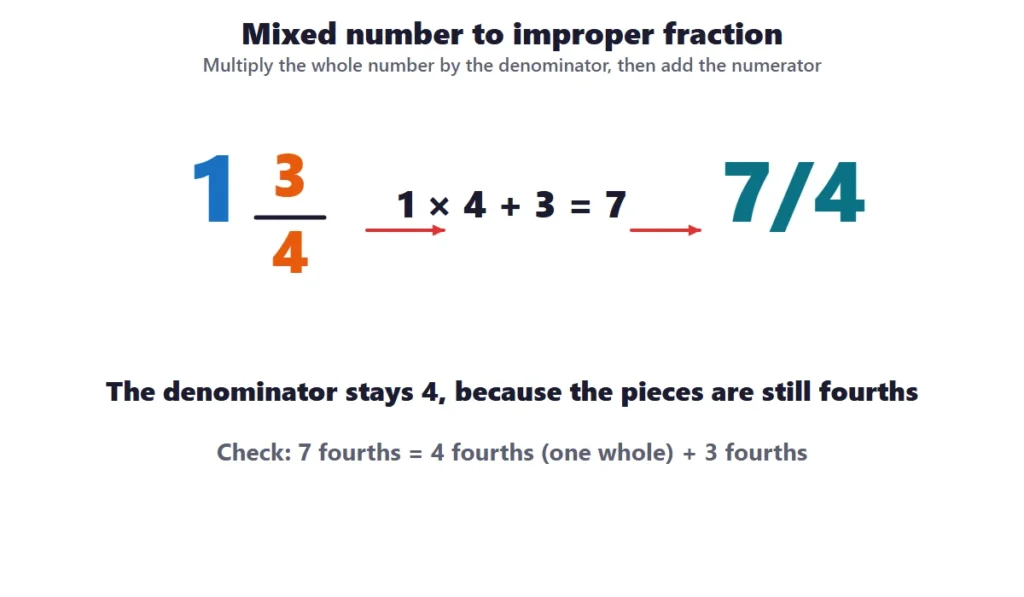
An improper fraction has a numerator bigger than its denominator, like 7/4. It is more than one whole: 4/4 makes 1 whole, with 3/4 left over, so 7/4 = 1 3/4. To go back, multiply the whole number by the denominator and add the numerator: 1 × 4 + 3 = 7, so 1 3/4 = 7/4.
What is in the set
There are 4 fractions of a number worksheets on this page, and every one has an answer key except for any cut-out games. The first two sets are about fractions of a number, and the last two sets change between improper fractions and mixed numbers.
Worksheet
What children do
Standard
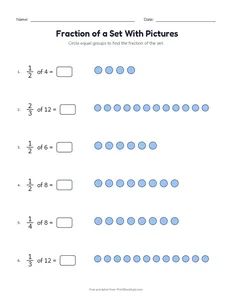
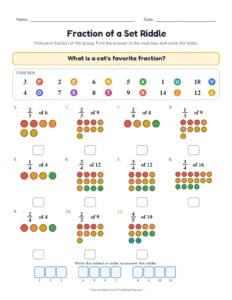
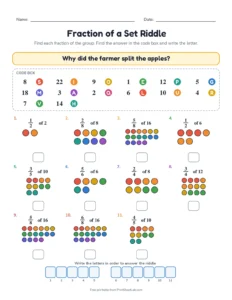
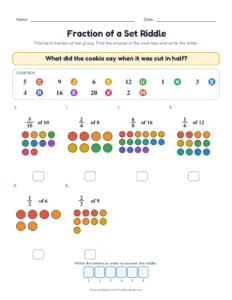
Fraction of a Set With Pictures
Circle equal groups to find a fraction of a number.
4.NF.B.3
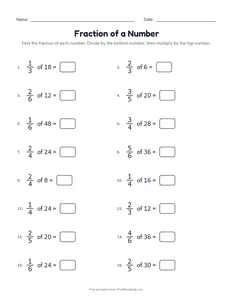
Fraction of a Number
16 problems like 3/4 of 20.
4.NF.B.3
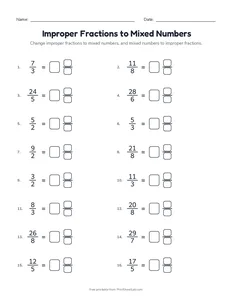
Improper Fractions to Mixed Numbers
Change 16 improper fractions to mixed numbers.
4.NF.B.3
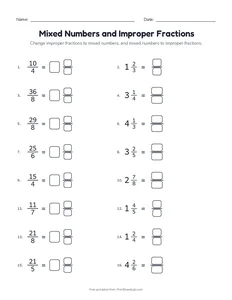
Mixed Numbers and Improper Fractions
Change between mixed numbers and improper fractions.
4.NF.B.3
Share, then multiply
The worksheets teach one rule: divide the number by the denominator, then multiply by the numerator. To find 3/4 of 12, share 12 into 4 equal groups, which gives 3 in each, and then take 3 groups, which is 9. The fraction is an instruction: the denominator says how many equal groups, and the numerator says how many groups to take. This is also how the standard 4.NF.B.4 describes a fraction of a quantity, as a multiple of a unit fraction. This table shows eight examples:
Fraction of a number
Divide by the denominator
Multiply by the numerator
Answer
3/4 of 12
12 ÷ 4 = 3
3 × 3 = 9
9
2/3 of 18
18 ÷ 3 = 6
6 × 2 = 12
12
5/6 of 24
24 ÷ 6 = 4
4 × 5 = 20
20
3/8 of 40
40 ÷ 8 = 5
5 × 3 = 15
15
7/10 of 50
50 ÷ 10 = 5
5 × 7 = 35
35
4/5 of 35
35 ÷ 5 = 7
7 × 4 = 28
28
5/12 of 36
36 ÷ 12 = 3
3 × 5 = 15
15
2/9 of 45
45 ÷ 9 = 5
5 × 2 = 10
10
The order does not matter for the answer, since 3 × 12 ÷ 4 is also 9, but dividing first keeps the numbers small. Wikipedia’s article on fractions explains why multiplying by a fraction and finding a fraction of a number are the same thing.
Which numbers work?
The answer comes out as a whole number only when the number is a multiple of the denominator. This is the reason why the worksheets use 12, 18, 24, 36 and 40, and not 13 or 25. The table shows how many numbers from 1 to 100 work for each denominator from 2 to 10:
Denominator
Numbers from 1 to 100 that give a whole number
The first five
Example
2
50
2, 4, 6, 8, 10, …
1/2 of 8 = 4
3
33
3, 6, 9, 12, 15, …
1/3 of 12 = 4
4
25
4, 8, 12, 16, 20, …
1/4 of 16 = 4
5
20
5, 10, 15, 20, 25, …
1/5 of 20 = 4
6
16
6, 12, 18, 24, 30, …
1/6 of 24 = 4
7
14
7, 14, 21, 28, 35, …
1/7 of 28 = 4
8
12
8, 16, 24, 32, 40, …
1/8 of 32 = 4
9
11
9, 18, 27, 36, 45, …
1/9 of 36 = 4
10
10
10, 20, 30, 40, 50, …
1/10 of 40 = 4
A denominator of 2 works for half of the numbers and a denominator of 4 for a quarter of them. A denominator of 7 works for only 14 of the numbers, so the worksheets leave it for later. The times tables worksheets page is the best help, because the multiples of the denominator are the numbers that work.
The number 24 works for the denominators 2, 3, 4, 6, 8 and 12, which makes it a favorite on these worksheets. This table shows eleven fractions of 24:
Fraction
Of 24
Fraction
Of 24
1/2
12
5/6
20
1/3
8
1/8
3
2/3
16
3/8
9
1/4
6
5/8
15
3/4
18
7/8
21
1/6
4
Fractions of a set: pictures first
The fraction of a set worksheets have pictures of counters or objects, and children circle equal groups to find the fraction of the number. For 12 counters and the fraction 3/4, they circle 4 equal groups of 3, then color 3 of the groups, and count 9 colored counters. This table shows six pictures, with the groups and the counters in each:
Counters
Equal groups
Counters in each group
Groups circled
Counters circled
Fraction
12
4
3
3
9
3/4
12
3
4
2
8
2/3
15
5
3
2
6
2/5
20
4
5
3
15
3/4
18
6
3
5
15
5/6
16
8
2
3
6
3/8
The picture is a bridge between the first page in the series, the identifying fractions page, where children name the fraction of a set, and the number sentence. After a few weeks children can answer without drawing, since the division and the multiplication are the same steps as the groups.
The bar model for fractions of a number
A bar model shows a fraction of a number as a bar split into equal boxes: the denominator is the number of boxes, and the numerator is the number of boxes to take. For 3/4 of 20, draw a bar worth 20, split it into 4 boxes of 5, and take 3 boxes: 5 + 5 + 5 = 15. This is why 3/4 can be read as 3 lots of 1/4. Find the unit fraction first, then count it as many times as the numerator says. Many fraction of a number worksheets use this drawing as the step between counters and the written rule. This table shows four bars:
Fractions of amounts are used for money, time, weight and length, and it is helpful for children to see these in context. A discount of 1/4 off $20, 3/4 of an hour, and 2/3 of a recipe all use the same two steps. This table shows eight everyday examples:
Where it appears
Fraction of an amount
Working
Answer
Money
3/4 of $20
20 ÷ 4 = 5, × 3
$15
Time
2/5 of 30 minutes
30 ÷ 5 = 6, × 2
12
Time
1/3 of 24 hours
24 ÷ 3 = 8, × 1
8
Money
3/10 of $50
50 ÷ 10 = 5, × 3
$15
Calendar
5/6 of 12 months
12 ÷ 6 = 2, × 5
10
Time
3/4 of an hour (60 minutes)
60 ÷ 4 = 15, × 3
45
Length
2/3 of 18 inches
18 ÷ 3 = 6, × 2
12
Weight
3/8 of 64 ounces
64 ÷ 8 = 8, × 3
24
These are also good examples for the money worksheets and telling time worksheets pages, where fractions of a dollar and fractions of an hour are used with coins and clocks.
Mixed numbers worksheets: a whole number and a fraction
The mixed numbers worksheets use numbers such as 1 3/4, which are a whole number and a fraction written together. Every mixed number can also be written as an improper fraction, with the numerator greater than the denominator. To change a mixed number to an improper fraction, multiply the whole number by the denominator and add the numerator. The denominator stays the same. This table shows six examples:
Mixed number. 7/4 = 1 3/4.
Mixed number
Whole × denominator
Add the numerator
Improper fraction
1 3/4
1 × 4 = 4
4 + 3 = 7
7/4
2 1/2
2 × 2 = 4
4 + 1 = 5
5/2
3 2/3
3 × 3 = 9
9 + 2 = 11
11/3
1 5/8
1 × 8 = 8
8 + 5 = 13
13/8
4 3/5
4 × 5 = 20
20 + 3 = 23
23/5
2 7/10
2 × 10 = 20
20 + 7 = 27
27/10
The check is to turn the improper fraction back: 7/4 is 4/4 and 3/4, which is 1 3/4. The picture of a bar for each whole and a part-bar for the fraction makes the idea clear, and the same picture is on the number line, where a mixed number is a point between two whole numbers.
This change from mixed number to improper fraction comes back in grades 5 and 6, when children divide fractions: 2 1/4 ÷ 1 1/2 is first rewritten as 9/4 ÷ 3/2, and only then solved. The worksheets that divide fractions with keep, change, flip pick up from there.
Improper fractions to mixed numbers: divide and find the remainder
To change improper fractions to mixed numbers, divide the numerator by the denominator. The quotient is the whole number, and the remainder is the new numerator over the same denominator. For 17/5, 17 ÷ 5 = 3 R2, so the mixed number is 3 2/5. The division worksheets page has the division facts, and the remainder idea is the same as in division with remainders. This table shows eight examples:
Improper fraction
Divide
Whole number
Remainder
Mixed number
7/4
7 ÷ 4
1
3
1 3/4
9/4
9 ÷ 4
2
1
2 1/4
11/3
11 ÷ 3
3
2
3 2/3
17/5
17 ÷ 5
3
2
3 2/5
23/6
23 ÷ 6
3
5
3 5/6
29/8
29 ÷ 8
3
5
3 5/8
25/9
25 ÷ 9
2
7
2 7/9
31/10
31 ÷ 10
3
1
3 1/10
If the remainder is zero, the answer is a whole number: 12/4 = 3. A fraction with a numerator that is a multiple of the denominator is a whole number in disguise, and the fractions on a number line page shows these as points on the number line.
Children who are unsure of the remainder step can practice it first on the division with remainders worksheets for grades 3 and 4. Every answer there is a quotient and a remainder, the same two numbers that are needed to change improper fractions to mixed numbers.
Multiplying a whole number by a fraction
Standard 4.NF.B.4 also asks for a whole number times a fraction, such as 3 × 2/5. This is repeated addition: 2/5 + 2/5 + 2/5 = 6/5, which is 1 1/5. This table shows six examples:
Whole number × fraction
As repeated addition
Improper fraction
Mixed number
3 × 2/5
2/5 + 2/5 + 2/5
6/5
1 1/5
4 × 3/8
3/8 + 3/8 + 3/8 + 3/8
12/8
1 4/8
5 × 2/3
2/3 + 2/3 + 2/3 + 2/3 + …
10/3
3 1/3
6 × 3/4
3/4 + 3/4 + 3/4 + 3/4 + …
18/4
4 2/4
2 × 5/6
5/6 + 5/6
10/6
1 4/6
7 × 1/2
1/2 + 1/2 + 1/2 + 1/2 + …
7/2
3 1/2
Finding a fraction of a number, such as 2/5 of 15, is the same as multiplying: 2/5 × 15 = 6. Grade 5 extends this to a fraction times a fraction, as described in the Common Core standards for grade 5 fractions.
Common mistakes with fractions of a number and mixed numbers
Most mistakes come from mixing up the two steps, or from forgetting what the remainder means. Here are five mistakes, with what went wrong and the fix:
What the child writes or says
What went wrong
The fix
3/4 of 12 = 4
divides by the denominator and stops
then multiply by the numerator: 3 × 3 = 9
3/4 of 12 = 12 ÷ 3 = 4
divides by the numerator
the denominator tells how many equal groups: 12 ÷ 4 = 3
7/4 = 1 7/4
does not take away the whole
7 ÷ 4 = 1 R3, so the answer is 1 3/4
1 3/4 = 4/4
adds the whole number to the numerator only
multiply the whole number by the denominator first: 1 × 4 + 3 = 7, so 7/4
2/3 of 10 = 6 2/3 written as 6
drops the remainder
when the division does not come out exactly, the answer is a mixed number
Fractions of a number word problems
Fractions of a number are used for sharing and for amounts of money. Ask children to find the unit fraction first, and to write the working in two steps:
Word problem
Working
Answer
A class has 24 children and 3/4 of them walk to school. How many walk?
24 ÷ 4 = 6, 6 × 3
18 children
A bag has 30 marbles and 2/5 are blue. How many are blue?
30 ÷ 5 = 6, 6 × 2
12 marbles
Sam has $40 and spends 3/8 of it. How much does he spend?
40 ÷ 8 = 5, 5 × 3
$15
A recipe needs 7/4 cups of flour. Write the amount as a mixed number.
7 ÷ 4 = 1 R3
1 3/4 cups
A tank holds 2 1/3 liters. Write the amount as an improper fraction.
2 × 3 + 1 = 7
7/3 liters
A runner finishes 5/6 of an 18-lap race. How many laps is that?
18 ÷ 6 = 3, 3 × 5
15 laps
Games and activities
Counters, an egg carton and a set of measuring cups are enough to practice fractions of a number and mixed numbers away from the page. Four of these games are about a fraction of a group, and the mixed number race and the measuring cups are about amounts greater than 1:
Group and circle: put 12 counters on the table, and ask the child to find 1/3, 2/3 and 3/4 of them
Fraction shops: a sale of 1/4 off or 1/2 off, with price tags in dollars
Mixed number race: turn cards to make an improper fraction, and the first to write it as a mixed number wins
Dozen fractions: use an egg carton of 12 to find fractions of 12
Measuring cups: fill a 1/3 cup five times, and write the amount as an improper fraction and as a mixed number
Fraction bingo: a bingo card with whole-number answers, and calling cards with fractions of a number
Extra support and extra challenge
For children who need more support: use counters and a picture of equal groups for every problem. Start with 1/2 and 1/4 of small numbers, and then move to thirds. Ask “how many equal groups?” before the child divides. For mixed numbers, use bars: one whole bar for each whole number, and part of a bar for the fraction.
For children who need more challenge: ask for the number that has 3/5 equal to 18, for a mixed number between 4 and 5 with a denominator of 8, and for 5/6 of 7 1/2. The worksheet that changes between the two forms is a good challenge, and so is the question “is 3/4 of a number always smaller than the number?”.
How to tell that a child is ready to move on
The child divides by the denominator and multiplies by the numerator.
The child changes an improper fraction to a mixed number.
The child changes a mixed number to an improper fraction.
The child solves a story problem with a fraction of an amount.
This 20-minute lesson introduces both halves of the topic with 12 counters and a drawing of 7/4 as bars. The first eight minutes are for finding a fraction of 12, the next ten for improper fractions to mixed numbers and back again, and the last two for starting a worksheet:
Minutes
Activity
What to say or ask
0 to 3
Show 12 counters and ask for 1/4 of them
How many equal groups? How many in each?
3 to 8
Find 3/4 of 12: share, then take 3 groups
What is the first step? What is the second?
8 to 13
Draw 7/4 as bars and count the wholes
How many whole bars? How many fourths are left?
13 to 18
Change 1 3/4 to an improper fraction
What do we multiply? What do we add?
18 to 20
Start a worksheet and check one answer
Check with a picture.
Where this skill fits across the grades
Fractions of a number and mixed numbers belong to grade 4, between naming unit fractions in grade 3 and multiplying a fraction by a fraction in grade 5. This table shows the steps before and after, with the standard for each:
Fractions of a number are a bridge to multiplication of fractions. The whole sequence is on the fractions worksheets page.
Helping at home
At home, fractions of a number come up with money, food and measuring cups, so practice can be a question asked aloud instead of a worksheet. Choose amounts that divide exactly, such as 12, 20 or 24, so that the answer is a whole number:
Ask “what is 1/4 of 20 dollars?” when shopping.
Use 12 eggs or 24 crayons to find 1/3, 1/4 and 1/2.
Look at a recipe: a half batch uses half of each amount.
Turn improper fractions into mixed numbers while measuring in cups.
Ask the child to explain the two steps in their own words.
How to check progress
Two questions are enough to check progress on this skill: one fraction of an amount, such as 3/4 of 20, and one improper fraction to change, such as 7/4. Ask the child to say each step aloud. This table shows three things you may see, what each means and what to do next:
What you see
What it means
What to do next
The child finds the unit fraction but forgets to multiply
The child thinks the division is the whole answer
Ask “how many of these groups do we need?”
The child gets 9 of 10 right in every set
The skill is secure
Move on to grade 5 fractions
The child writes 1 7/4 for 7/4
The child has not yet taken away the whole
Draw bars, and count the wholes first
A five-day plan
This five-day plan gives one of the four worksheets to each of the first four days: two days on fractions of a number, then two days on mixed numbers and improper fractions. Day 5 mixes both, with story problems:
Day
What to do
Practice
Day 1
Share objects into equal groups, and circle a fraction of the groups
Fraction of a Set With Pictures
Day 2
Find a fraction of a number: divide, then multiply
Fraction of a Number
Day 3
Change improper fractions to mixed numbers
Improper Fractions to Mixed Numbers
Day 4
Change mixed numbers to improper fractions
Mixed Numbers and Improper Fractions
Day 5
Mixed practice, with stories
two sets of your choice
When the plan is complete, the child is ready for grade 5 fractions.
Finding a fraction of a number is the same as multiplying a fraction by a whole number: 3/4 of 12 means 3/4 × 12. A multiplying fractions by whole numbers worksheet asks children to multiply the numerator by the whole number and then divide by the denominator. When the answer is not a whole number, write it as a mixed number. Six examples:
Problem
Multiply the top
Then divide by the bottom
Answer
3/4 × 12
3 × 12 = 36
36 ÷ 4
9
2/5 × 20
2 × 20 = 40
40 ÷ 5
8
5/6 × 18
5 × 18 = 90
90 ÷ 6
15
3/8 × 24
3 × 24 = 72
72 ÷ 8
9
2/3 × 7
2 × 7 = 14
14 ÷ 3
4 2/3
3/4 × 5
3 × 5 = 15
15 ÷ 4
3 3/4
Fraction times whole number practice
The fraction of a number pages above cover the whole number result, and the mixed numbers pages cover answers such as 2 2/3. Use each worksheet with the answer key, and check by drawing the fraction of a set.
A fraction with 1 on top, such as 1/3. Finding a unit fraction of a number is just dividing: 1/3 of 15 is 5.
Is 7/4 a proper fraction?
No. 7/4 is improper because the top is bigger than the bottom. It equals the mixed number 1 3/4.
How do you find a fraction of a number?
Divide the number by the denominator, then multiply the answer by the numerator. For 3/4 of 12, 12 ÷ 4 = 3, and 3 × 3 = 9.
How do you change an improper fraction to a mixed number?
Divide the numerator by the denominator. The quotient is the whole number, and the remainder is the numerator of the fraction part. For 7/4, 7 ÷ 4 = 1 R3, so 7/4 = 1 3/4.
How do you change a mixed number to an improper fraction?
Multiply the whole number by the denominator, add the numerator, and keep the denominator. For 1 3/4, 1 × 4 + 3 = 7, so the improper fraction is 7/4.
Where can I download free fractions of a number worksheets?
Open any of the four worksheets in the gallery above, such as Fraction of a Number or Improper Fractions to Mixed Numbers, choose US Letter or A4, then print or save the PDF. They are free and each has an answer key.
How do you multiply a fraction by a whole number?
Multiply the numerator by the whole number and keep the denominator: 3/4 × 5 = 15/4, which is 3 3/4 as a mixed number.
Does this set include a fraction times whole number worksheet?
Not as a separate sheet. The Fraction of a Number worksheet comes closest, because finding 2/5 of 15 is the same as multiplying 2/5 × 15 = 6. Its 16 problems, such as 3/4 of 20, practise the same steps.
Are fractions of a number always smaller than the number?
Only when the fraction is less than 1. 3/4 of 12 is 9, which is smaller than 12, but an improper fraction gives a bigger answer: 5/4 of 12 is 12 ÷ 4 = 3, then 3 × 5 = 15. A fraction equal to 1, such as 4/4, gives the number itself.
Should a mixed number answer be simplified?
It is good practice, but the value does not change. 1 4/8 and 1 1/2 are the same amount. To simplify, divide the top and bottom of the fraction part by the same number, here 4, and leave the whole number alone. The same check is useful after changing improper fractions to mixed numbers: 12/8 is 1 4/8, or 1 1/2.
We hope you're enjoying Print Sheet Lab! Need a different option, noticed something missing, or have an idea for a new tool or calculator?
Whether it's a small improvement, a technical issue or something customized for your business, we'd love to hear from you.
✓ Existing tool improvements and bug fixes – Free
✓ Custom calculators, tools and websites – Affordable development charges
We aim to respond within 24 hours.
How Can We Help You?
Tell us what you're looking for. Whether you need an improvement to an existing tool, want to report an issue, or have an idea for something new, we're here to help.
✓
Thank you for sharing your request!
We've successfully received your message. Our team will review it and aim to respond within 24 hours.
We'll contact you at your provided email address with an update.