To show fractions on a number line, treat the space from 0 to 1 as one whole, cut it into equal parts (4 parts for quarters), and count jumps from 0: three jumps of 1/4 lands on 3/4. Fractions that land on the same point are equivalent, and the fraction further right is always the greater one.
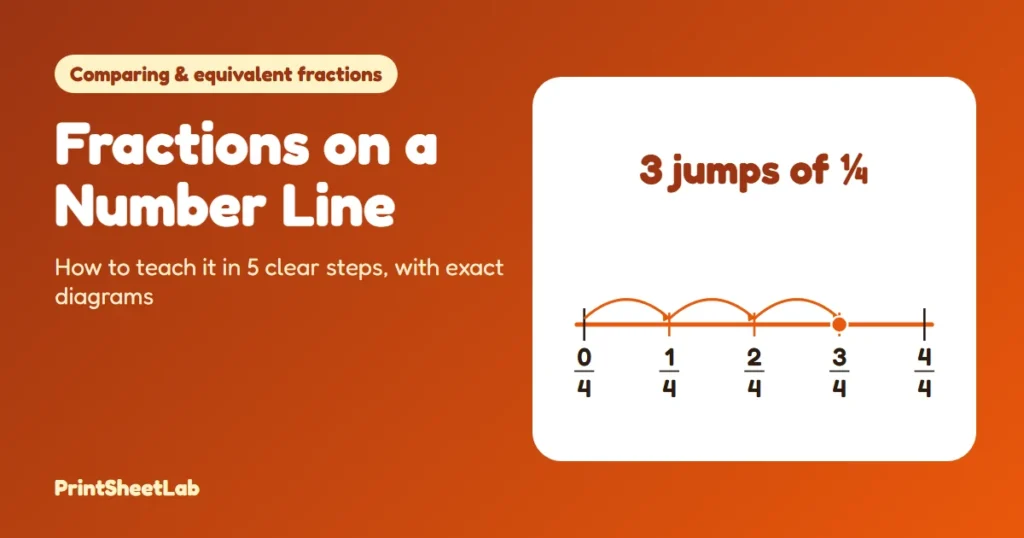
This guide shows how to teach fractions on a number line in five steps: partitioning 0 to 1, placing unit fractions, placing fractions greater than 1, comparing fractions on a number line and finding equivalent fractions on stacked number lines. Every example has been checked, and there is a practice set with answers at the end.
You need very little equipment. Print a ruler-straight line from our printable number line maker or a set of blank number lines, and keep a set of fraction strips nearby so children can check each answer with a length they can hold.
Why teach fractions on a number line?
Pizza and pie pictures show a fraction as part of a shape. A number line shows something different: that 3/4 is a number with its own place between 0 and 1, just like 7 has a place between 6 and 8. That idea makes comparing fractions on a number line, ordering them and adding them much easier later.
The US Department of Education’s fractions practice guide (What Works Clearinghouse) recommends helping students see that fractions are numbers, using number lines as a central representational tool, including locating and comparing fractions on number lines. Both the US Common Core and the national curriculum in England build their fraction work around the same idea.
Fractions on a number line by grade
| Stage | What the official document says | Number line work |
|---|---|---|
| US Grade 3: 3.NF.A.2 | Understand a fraction as a number on the number line; represent fractions on a number line diagram | Partition 0 to 1; place 1/b and a/b |
| US Grade 3: 3.NF.A.3 | Equivalent fractions are the same size or the same point on a number line; compare fractions with the same numerator or denominator | Stacked lines; 4/4 and 1 at the same point |
| US Grade 4: 4.NF.A.1 and 4.NF.A.2 | Explain why fractions are equivalent; compare fractions with different numerators and denominators | Benchmarks such as 1/2; common denominators |
| England Year 3 | Recognise and use fractions as numbers; show equivalent fractions with diagrams; compare and order unit fractions and fractions with the same denominator | Notes and guidance: fractions as numbers on the number line, going beyond 0 to 1 |
| England Year 4 and 5 | Families of common equivalent fractions (Year 4); compare and order fractions whose denominators are multiples of the same number (Year 5) | Longer lines with tenths and hundredths |
In the Common Core, Grade 3 fraction work is limited to denominators 2, 3, 4, 6 and 8, so every Grade 3 example in this guide uses those. The full wording of 3.NF.A.2 and 3.NF.A.3 is in the official Common Core State Standards for Mathematics (PDF). The England wording comes from the national curriculum mathematics programmes of study.
Step 1: partition 0 to 1 into equal parts
Start every lesson on fractions with the whole. Draw a line, mark 0 at the left and 1 at the right, and say: “The distance from 0 to 1 is one whole.” Then cut it into equal parts. The denominator tells you how many parts.
- Halves: one mark in the middle makes 2 equal parts.
- Quarters: halve each half. That makes 4 equal parts.
- Eighths: halve each quarter. That makes 8 equal parts.
- Thirds and sixths: fold a paper strip into 3 equal parts, then halve each third for sixths.
Folding a paper strip is more accurate than guessing by eye, and children can lay the folded strip on the line to mark the ticks. Point out that 4 equal parts needs 5 tick marks (0, three marks inside, and 1). Counting the marks instead of the spaces is an easy slip, so talk about it from day one.
Step 2: placing unit fractions on a number line
A unit fraction has 1 as its numerator, such as 1/2, 1/3 or 1/8. On a line from 0 to 1 cut into b equal parts, the end of the first part is 1/b. So 1/4 sits at the end of the first quarter-jump from 0.
Placing unit fractions on a number line teaches the idea children find most surprising: the bigger the denominator, the smaller the fraction. On lines of the same length, 1/8 sits much closer to 0 than 1/2, because the whole has been cut into more, smaller pieces. In order from smallest to largest: 1/8, 1/6, 1/4, 1/3, 1/2.
Step 3: count jumps to place any fraction
A fraction like 3/4 means three jumps of 1/4. Children put a finger on 0, jump one part at a time and say “one quarter, two quarters, three quarters”. The point where they stop is 3/4. Common Core 3.NF.A.2b describes this as marking off lengths of 1/b from 0.
Counting aloud in fractions works just like counting in ones or in fives. If your child has used number lines for skip counting, link it to our skip counting guide: counting in quarters is skip counting with smaller jumps. Then label every tick on fraction number line worksheets until the pattern feels automatic.

Fractions greater than 1 on a number line
Keep jumping past 1 and the fractions carry on. Draw a line from 0 to 2 cut into quarters (9 tick marks). Count in quarters: after 4/4 you reach 1, then 5/4, 6/4, 7/4 and 8/4, which is 2.
- 5/4 is one jump past 1, so it is the same as 1 1/4.
- 7/3 lies between 2 and 3, one third past 2, so it equals 2 1/3.
- 6/3 and 8/4 both land exactly on 2.
This is also where whole numbers become fractions. Common Core 3.NF.A.3c asks children to locate 4/4 and 1 at the same point of a number line diagram and to see that 3 = 3/1. The England Year 3 guidance likewise says pupils should go beyond the 0 to 1 interval.
Comparing fractions on a number line
The rule for comparing fractions on a number line is simple: further right is greater. The only condition is that both fractions must be on lines of the same length with the same 0 and 1, because a comparison only works when the fractions refer to the same whole.
Same denominator
Put 3/8 and 5/8 on one line cut into eighths. 5/8 is two jumps further right, so 3/8 < 5/8. With the same denominator, the parts are the same size, so more parts means a bigger fraction.
Same numerator
Compare 2/3 and 2/4 on two stacked lines of the same length, one in thirds and one in quarters. Two thirds reaches further right than two quarters because each third is longer than each quarter. So 2/3 > 2/4. The same reasoning shows 1/6 < 1/4 and 5/6 > 5/8.
Benchmark fractions (Grade 4)
From Grade 4, children compare fractions with different numerators and denominators. A quick method is to compare each one with 1/2 on the line: 3/8 is left of 1/2 and 4/6 is right of it, so 3/8 < 4/6.
| Comparing fractions on a number line | What you see on the line | Result |
|---|---|---|
| 3/8 and 5/8 | Same line in eighths; 5/8 is two jumps further right | 3/8 < 5/8 |
| 2/3 and 2/4 | Stacked lines; 2/3 reaches further right | 2/3 > 2/4 |
| 1/6 and 1/4 | 1/6 is closer to 0 | 1/6 < 1/4 |
| 7/4 and 5/4 | Line from 0 to 2 in quarters; 7/4 is further right | 7/4 > 5/4 |
| 3/8 and 4/6 | 3/8 is left of 1/2; 4/6 is right of 1/2 | 3/8 < 4/6 |
For more practice, use the comparing fractions worksheets or play the comparing fractions game online.
Equivalent fractions on number lines
Common Core 3.NF.A.3a defines equivalent fractions as fractions that are the same size or the same point on a number line. Stacked number lines make this visible. Draw lines of exactly the same length, one under another, cut into halves, quarters and eighths. Then lay a ruler straight down from any tick.
- 1/2, 2/4 and 4/8 line up, so 1/2 = 2/4 = 4/8.
- 3/4 lines up with 6/8.
- On lines in thirds and sixths, 1/3 = 2/6 and 2/3 = 4/6.
- At the right-hand end, 2/2, 3/3, 4/4, 6/6 and 8/8 all equal 1.

Ask children what they notice. When the number of parts doubles (quarters to eighths), the number of jumps to the same point doubles too: 3/4 becomes 6/8. That pattern is the start of the Grade 4 rule for equivalent fractions on number lines and fraction strips. Our equivalent fractions worksheets practise exactly this.
An anchor chart for fractions on a number line
A classroom anchor chart keeps the key ideas in view. Keep it to five things:
- A line from 0 to 1 labelled “one whole”.
- The same line cut into quarters, with every tick labelled 0/4 to 4/4.
- The rule “Count the jumps, not the ticks”.
- Three stacked lines (halves, quarters, eighths) with a dotted line through 1/2 = 2/4 = 4/8.
- The rule for comparing fractions on a number line: “Further right is greater”.
Our place value anchor chart guide has layout and colour tips that work just as well for a fractions on a number line anchor chart.
Common mistakes and how to fix them
| Mistake | Example | Fix |
|---|---|---|
| Counting tick marks, not spaces | Calls a line in quarters “fifths” because it has 5 marks | Shade each space and count the shaded jumps |
| Unequal parts | Draws quarters of different lengths | Fold a paper strip, or use printed lines |
| Bigger denominator means bigger fraction | Thinks 1/8 > 1/4 | Place both on stacked lines of the same length |
| Starting at 1 instead of 0 | Says “one quarter” at 0, so labels the first tick after 0 as 2/4 | Put a finger on 0 before every count |
| Comparing on lines of different lengths | Says 1/2 on a short line is less than 1/3 on a long line | Always compare on the same whole |
Practice questions with answers
Draw your own lines or use printed ones, and practise comparing fractions on a number line as well as placing them. Questions 9 and 10 are Grade 4 stretch questions.
- Which is greater, 1/4 or 1/3? 1/3
- Which is greater, 3/8 or 5/8? 5/8
- Which is greater, 2/3 or 2/6? 2/3
- 2/4 = ?/8 4/8
- 6/8 = ?/4 3/4
- Between which two whole numbers is 9/4? 2 and 3 (9/4 = 2 1/4)
- Write 1 as a fraction with denominator 6. 6/6
- Is 5/6 greater or less than 1/2? Greater
- Which is greater, 2/3 or 3/4? 3/4
- Which is closer to 1, 7/8 or 5/6? 7/8 (it is 1/8 away; 5/6 is 1/6 away)
For printable practice, the fractions on a number line worksheets cover labelling ticks, unit fractions and fractions greater than 1. Children who are still shaky on what a fraction is can start with identifying fractions worksheets.
Related guides and printables
- All fractions worksheets
- Skip counting for kids, with number lines
- Place value anchor chart: how to make one
- Free online math games for kids
- 3rd grade math worksheets
Sources
Standards 3.NF.A.2 and 3.NF.A.3 and the Grade 3 denominator limit are from the Common Core State Standards for Mathematics. England requirements are from the national curriculum in England: mathematics programmes of study. The number line recommendation is from the IES practice guide Developing Effective Fractions Instruction for Kindergarten Through 8th Grade (2010).
Frequently asked questions
6 quick answers
How do you find fractions on a number line?
Mark 0 and 1, cut the space between them into as many equal parts as the denominator, then count that many jumps from 0 as the numerator. For 3/4, cut into 4 parts and count 3 jumps.
How do you compare fractions on a number line?
Place both fractions on lines of the same length with the same 0 and 1. The fraction further to the right is greater; if they land on the same point, they are equal.
How do you show equivalent fractions on a number line?
Draw two or more number lines of the same length, one under another, with different denominators. Fractions that line up at the same point, such as 1/2, 2/4 and 4/8, are equivalent.
How do you put a fraction greater than 1 on a number line?
Extend the line past 1 and keep the same equal parts. 5/4 is five quarter-jumps from 0, which is one quarter past 1, so 5/4 = 1 1/4.
Why is 1/8 smaller than 1/4 on a number line?
Both lines show the same whole. Cutting it into 8 parts makes each part smaller than cutting it into 4, so 1/8 lands closer to 0 than 1/4.
What grade learns fractions on a number line?
In the US, Common Core introduces fractions on a number line in Grade 3 (3.NF.A.2). In England, pupils begin to see fractions as numbers on the number line in Year 3.