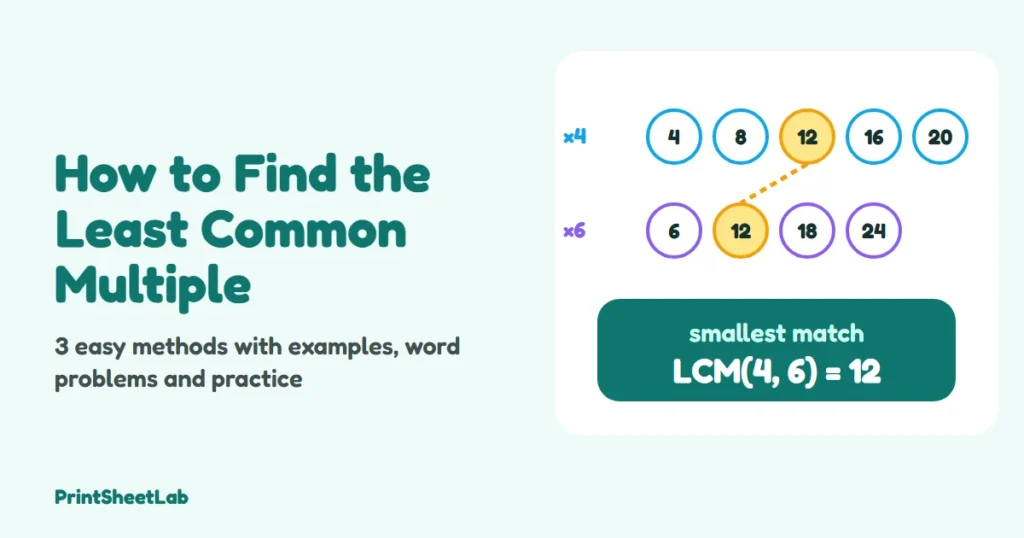
Here is how to find the least common multiple: list the multiples of each number, multiply the highest power of every prime factor, or divide the numbers by primes on a ladder. Whichever method you pick, the LCM is the smallest number that all of them divide into exactly, so the LCM of 4 and 6 is 12.
This guide shows how to find the least common multiple with three methods, worked step by step, plus word problems, fractions and 12 practice questions. For printable practice, use our GCF and LCM worksheets, and check answers with the GCF and LCM calculator.
It suits Grades 4 to 7 in the US and Years 5 and 6 in the UK, where the same idea is called the lowest common multiple.
What is the least common multiple?
A multiple of a number is what you get when you multiply it by 1, 2, 3 and so on: multiples of 4 are 4, 8, 12, 16. A common multiple of two numbers is on both lists. The least common multiple is the smallest of those, not counting zero.
Two look-alike terms cause most mix-ups, so compare all three before you go further.
| Term | What it means | Example with 4 and 6 |
|---|---|---|
| Least common multiple (LCM) | Smallest number both numbers divide into | 12 |
| Greatest common factor (GCF, also HCF) | Largest number that divides into both | 2 |
| Least common denominator (LCD) | The LCM of the denominators of two fractions | For 1/4 and 1/6 it is 12 |
Whichever way you learn how to find the least common multiple, sense-check the answer: the LCM is never smaller than the larger number.
How to find the least common multiple: 3 easy methods at a glance
The table shows how to find the least common multiple of 12 and 18 with each one, so you can pick the method that suits the numbers in front of you.
| Method | Steps | Best for | Example: 12 and 18 |
|---|---|---|---|
| 1. Listing multiples | Write multiples of each number until one appears on both lists | Small numbers, Grades 4 to 6 | 12, 24, 36 and 18, 36 give 36 |
| 2. Prime factorisation | Split each number into primes, take the highest power of each prime, multiply | Bigger numbers, three or more numbers | 2² × 3 and 2 × 3² give 2² × 3² = 36 |
| 3. Ladder (division) | Divide both numbers by common primes, then multiply around the L | Finding the GCF and LCM together | 2 × 3 × 2 × 3 = 36 |

Method 1: listing multiples for small numbers
This is the method children meet first, because it only needs times tables.
- Write the first few multiples of the larger number.
- Write multiples of the smaller number underneath.
- Circle the first number that appears in both lists. That is the LCM.
Example: 4 and 6. Multiples of 6: 6, 12, 18, 24. Multiples of 4: 4, 8, 12, 16. The first match is 12, so LCM(4, 6) = 12.
Example: 6 and 8. Multiples of 8: 8, 16, 24. Is 8 a multiple of 6? No. Is 16? No. Is 24? Yes, 6 × 4 = 24. So LCM(6, 8) = 24.
The second example shows a time-saver: list multiples of the larger number only and test each one. Children who are quick at skip counting find this easy; if times tables are shaky, our times tables tricks help first. Listing gets slow above about 100, so the next two methods show how to find the least common multiple of bigger numbers.
Method 2: prime factorisation for bigger numbers
Every whole number above 1 can be written as a product of primes in exactly one way, apart from the order. Prime factorisation uses that fact to build the LCM without long lists.
Step 1: draw a factor tree
Write the number at the top, split it into any two factors, and keep splitting until every branch ends in a prime. The factor tree for 84:
- 84 splits into 2 × 42
- 42 splits into 2 × 21
- 21 splits into 3 × 7
The branches end in 2, 2, 3 and 7, so 84 = 2² × 3 × 7. A tree for 60 ends in 2, 2, 3 and 5, so 60 = 2² × 3 × 5. Check any tree with our prime factorization calculator.
Step 2: take the highest power of each prime
Write every prime that appears in either number, using the highest power you see: 2² (in both), 3 (in both), 5 (only in 60) and 7 (only in 84). Multiply: 2² × 3 × 5 × 7 = 420. So LCM(60, 84) = 420.
The same steps give the LCM of 12 and 18: 12 = 2² × 3 and 18 = 2 × 3², so the LCM is 2² × 3² = 36.
Method 3: the ladder method for GCF and LCM
The ladder method (also called the division method or the cake method) finds the GCF and the LCM in one go.
- Write the numbers side by side and divide both by a prime that goes into both. Write the prime on the left and the answers underneath.
- Repeat until the bottom numbers have no common factor except 1.
- Multiply the left column for the GCF. Multiply the left column and the bottom row (an L shape) for the LCM.
| Divide by | First number | Second number |
|---|---|---|
| (start) | 24 | 36 |
| 2 | 12 | 18 |
| 2 | 6 | 9 |
| 3 | 2 | 3 |
2 and 3 share no common factor, so stop. GCF = 2 × 2 × 3 = 12. LCM = 2 × 2 × 3 × 2 × 3 = 72.

Finding the LCM of three numbers
Take 8, 12 and 18. Divide by a prime that goes into at least two of the numbers, and bring down any number it does not divide. Dividing by 2 gives 4, 6, 9. Dividing by 2 again gives 2, 3, 9 (9 is brought down). Dividing by 3 gives 2, 1, 3. No two of these share a factor, so the LCM is 2 × 2 × 3 × 2 × 1 × 3 = 72.
How to find the least common multiple from the GCF
For any two whole numbers, LCM × GCF = a × b: the LCM multiplied by the GCF equals the two numbers multiplied together. So if you already know the GCF:
LCM = (a × b) ÷ GCF
- 24 and 36: 24 × 36 = 864, the GCF is 12, and 864 ÷ 12 = 72.
- 60 and 84: 60 × 84 = 5,040, the GCF is 12, and 5,040 ÷ 12 = 420.
Be careful: this rule only works for two numbers. For 2, 4 and 6, the product is 48 and the GCF is 2, which would give 24, but the real LCM is 12. With three numbers, find the LCM of the first two, then the LCM of that answer and the third.
Shortcuts that find the LCM faster
- One number divides the other: the LCM is the larger number. LCM(6, 18) = 18.
- No common factor except 1: the LCM is the product. LCM(8, 9) = 72.
- Two different primes: multiply them. LCM(3, 5) = 15.
Least common multiple problems: word problems with answers
Word problems test when, not just how to find the least common multiple. If the question asks when things happen together again, or for the smallest amount that matches exactly, it is an LCM question. If it asks for the largest equal groups, it is a GCF question.
The bus problem
Bus A leaves every 12 minutes and Bus B every 15 minutes. Both leave at 8:00. When do they next leave together? Multiples of 15 are 15, 30, 45, 60, and 60 is the first one that 12 divides into. LCM(12, 15) = 60, so they leave together again at 9:00.
Hot dogs and buns
Hot dogs come in packs of 10 and buns in packs of 8. What is the smallest number of each you can buy so that none are left over? LCM(10, 8) = 40, so you need 40 of each: 4 packs of hot dogs and 5 packs of buns.
For more least common multiple problems, try the GCF and LCM word problems on our worksheet page.
Using the least common denominator to add fractions
Knowing how to find the least common multiple pays off with fractions. To add fractions with different denominators you need a common denominator, and the smallest one, the least common denominator, is the LCM of the denominators.
Example: 5/6 + 3/8. LCM(6, 8) = 24, so the least common denominator is 24. 5/6 = 20/24 and 3/8 = 9/24, so the sum is 29/24, which is 1 5/24.
Example: 1/4 + 2/9. 4 and 9 share no factor, so the least common denominator is 36. 1/4 = 9/36 and 2/9 = 8/36, giving 17/36.
Practise with our least common denominator worksheet set on unlike denominators, check answers with the fraction calculator, or revise the basics in our fraction rules guide.
Common mistakes and how to fix them
| Mistake | Example | Fix |
|---|---|---|
| Giving the GCF instead of the LCM | Answering 2 for 6 and 8 | The LCM is at least as big as the larger number: 24 |
| Always multiplying the two numbers | 12 × 10 = 120 | That is a common multiple, but the least is 60 |
| Taking the lowest power of each prime | 2 × 3 for 12 and 18 | Take the highest powers: 2² × 3² = 36 |
| Missing a prime found in only one number | Leaving out the 7 for 60 and 84 | Include every prime from either number: 420 |
| Using LCM × GCF = a × b for three numbers | Getting 24 for 2, 4 and 6 | Work two numbers at a time: 12 |
When children learn the least common multiple
In the US, the Common Core State Standards for Mathematics place the LCM in Grade 6: standard 6.NS.B.4 asks students to find the least common multiple of two whole numbers less than or equal to 12. In England, the national curriculum for mathematics covers multiples, factors and prime factors in Year 5, then common multiples in Year 6.
| Grade or year | What the official document says |
|---|---|
| US Grade 4 (4.OA.B.4) | Factor pairs and multiples for numbers 1 to 100; prime or composite |
| UK Year 5 | Identify multiples and factors; vocabulary of prime numbers and prime factors |
| US Grade 5 (5.NF.A.1) | Add and subtract fractions with unlike denominators |
| UK Year 6 | Identify common factors, common multiples and prime numbers; use common multiples to put fractions in the same denomination |
| US Grade 6 (6.NS.B.4) | GCF of two numbers up to 100 and LCM of two numbers up to 12 |
Least common multiple questions: 12 practice problems with answers
These least common multiple questions get harder as you go. Cover the answers before you start.
- LCM of 3 and 5. Answer: 15
- LCM of 4 and 10. Answer: 20
- LCM of 6 and 9. Answer: 18
- LCM of 8 and 12. Answer: 24
- LCM of 7 and 8. Answer: 56
- LCM of 9 and 12. Answer: 36
- LCM of 10 and 15. Answer: 30
- LCM of 12 and 16. Answer: 48
- LCM of 14 and 21. Answer: 42
- LCM of 4, 6 and 10. Answer: 60
- The GCF of 18 and 30 is 6. Use it to find the LCM. Answer: 18 × 30 = 540, and 540 ÷ 6 = 90
- One light flashes every 8 seconds and another every 20 seconds. They flash together now. When do they next flash together? Answer: after 40 seconds
Every answer was checked with Python’s math.lcm. Nine or more right? Your child knows how to find the least common multiple, so move on to fractions. Fewer? Spend a week on listing multiples.
Printable least common multiple practice
Our least common multiple worksheet page has 8 free PDFs with answers, covering GCF, LCM, prime factorisation and word problems. For screen time, mix in our free online math games for kids, and use the math riddles for kids as a warm-up.
Related guides and printables
- Printable worksheets for least common multiple and GCF
- LCM calculator with GCF
- Prime factorisation calculator
- Fractions worksheets
- Skip counting for kids
- Fun ways to practise times tables
Sources
Grade 4, 5 and 6 standards are quoted from the Common Core State Standards for Mathematics (PDF). Year 5 and Year 6 statements are from the Department for Education’s mathematics programmes of study for key stages 1 and 2 (PDF). The LCM and GCF formula is explained in the encyclopaedia entry on the least common multiple.
Frequently asked questions
5 quick answers
What is the easiest way for kids to learn how to find the least common multiple?
Start with listing multiples: write multiples of the larger number and stop at the first one the smaller number divides into. For 6 and 8 that is 24. Move to prime factorisation or the ladder once the numbers get bigger.
How do you find the least common multiple of 3 numbers?
Take the highest power of every prime, or work two at a time: find the LCM of the first two numbers, then the LCM of that answer and the third. For 4, 6 and 10: LCM(4, 6) = 12, then LCM(12, 10) = 60.
What is the difference between LCM and GCF?
The LCM is the smallest number both numbers divide into; the GCF is the largest number that divides into both. For 12 and 18, the LCM is 36 and the GCF is 6.
Is the least common denominator the same as the least common multiple?
The least common denominator is the least common multiple of the denominators. For 5/6 and 3/8 it is LCM(6, 8) = 24.
Can the LCM be smaller than one of the numbers?
No. The LCM is always at least as big as the larger number, and equals it only when the smaller number divides into it, as with 6 and 18.