This free simplify fractions calculator reduces any fraction, improper fraction or mixed number to lowest terms and shows the greatest common factor (GCF) it divided by. It also reduces a whole list at once, so it works as a reduce fractions calculator, a simplest form calculator and a lowest terms calculator in one.
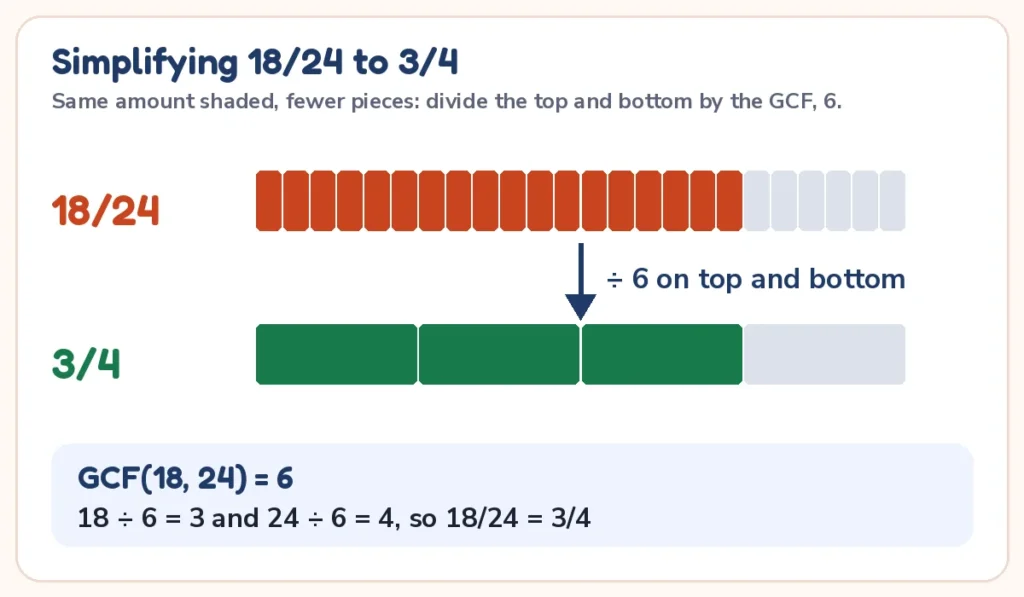
The rule: divide the numerator and the denominator by their greatest common factor (GCF). 18/24 has a GCF of 6, so 18/24 = 3/4.
Quick answer: to simplify a fraction, divide the top and the bottom by their greatest common factor. For 42/56 the GCF is 14, so 42 ÷ 14 = 3 and 56 ÷ 14 = 4, which gives 3/4. If the GCF is 1, the fraction is already in simplest form, like 8/15.
How to use the simplify fractions calculator
- Type a fraction such as 18/24. Mixed numbers (2 6/8), improper fractions (42/12), negative fractions (-10/15) and decimals (0.75) also work.
- Pick how you want the working shown: greatest common factor, prime factors or divide in stages.
- Read the simplest form, the GCF, the mixed number for improper fractions and the decimal. The answer updates as you type.
- To reduce many fractions, choose a list of fractions and put one on each line.
The three working styles give the same answer, so pick the one your teacher wants to see.
| Working style | What the steps show | Best for |
|---|---|---|
| Greatest common factor | Lists the factors of both numbers, picks the largest shared one and divides | Small numbers and most homework |
| Prime factors | Writes both numbers as products of primes and cancels the shared primes | Larger numbers and prime factorization lessons |
| Divide in stages | Divides by one small shared prime at a time until none is left | Mental math and when the GCF is hard to spot |
| List of fractions | A table with the simplest form, mixed number, GCF and decimal for each line | Checking a worksheet or a long answer list |
Simplifying examples and a printable practice sheet
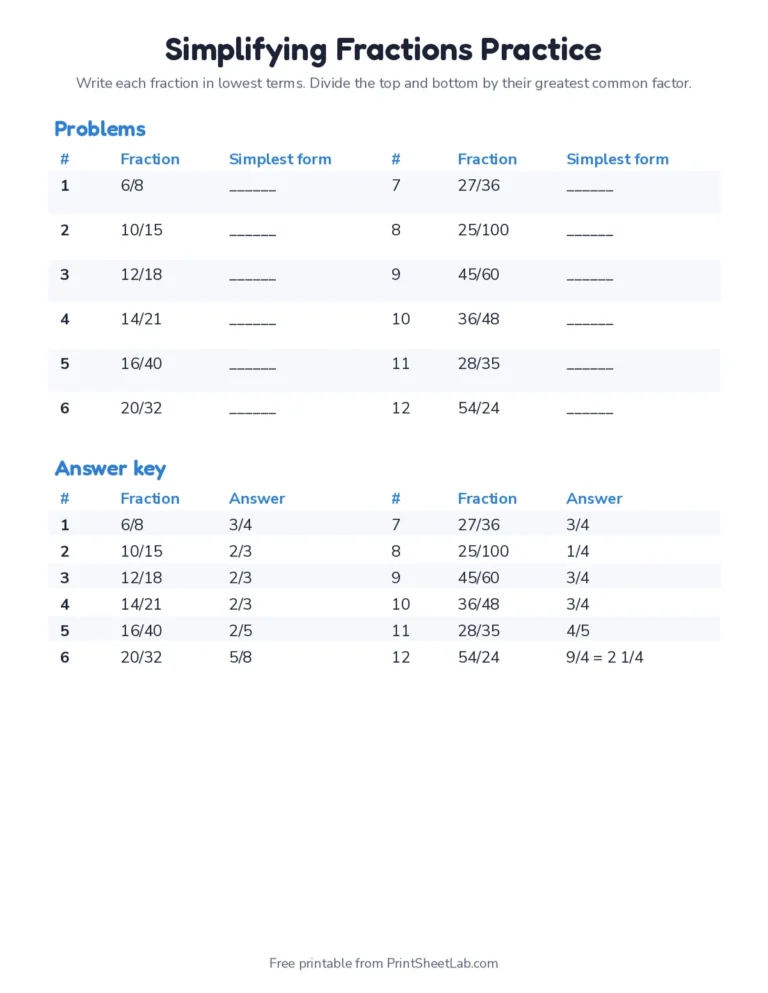
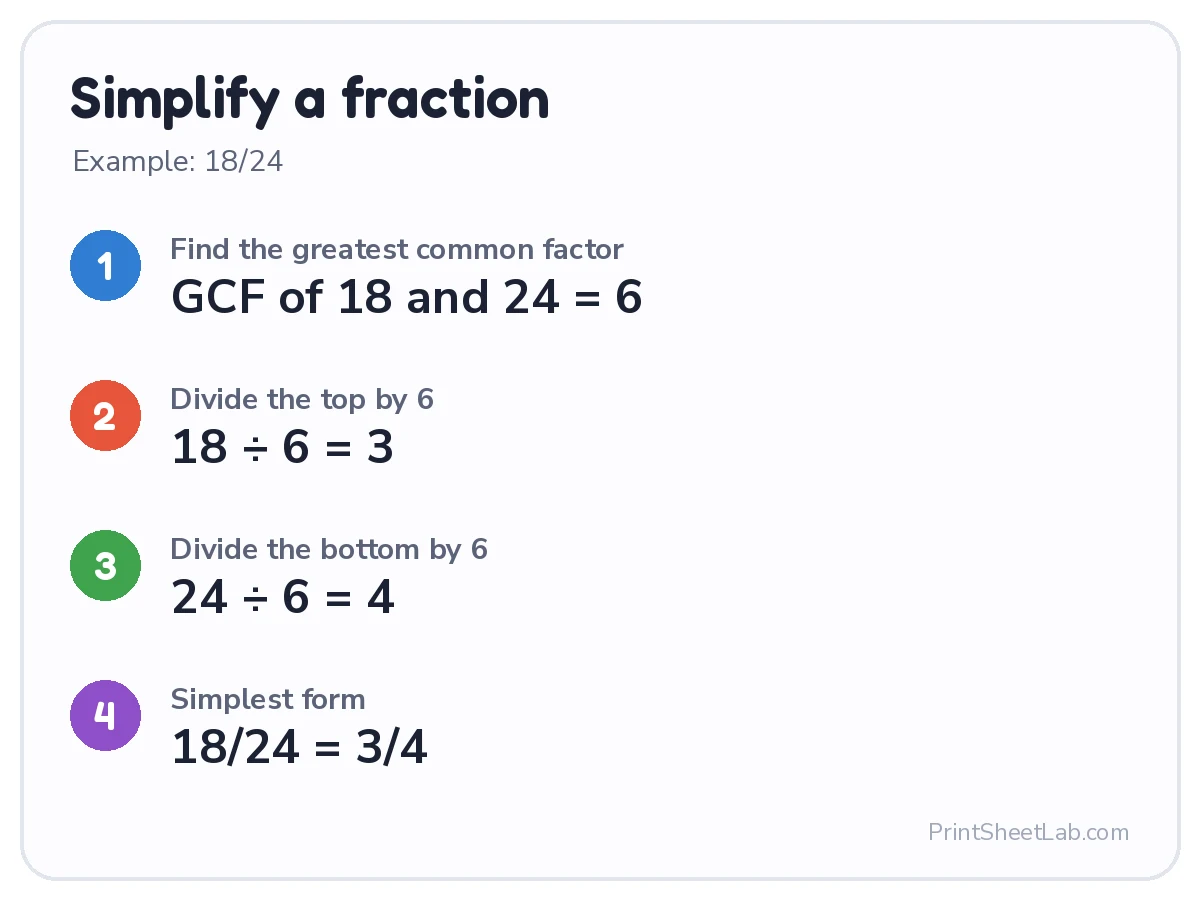
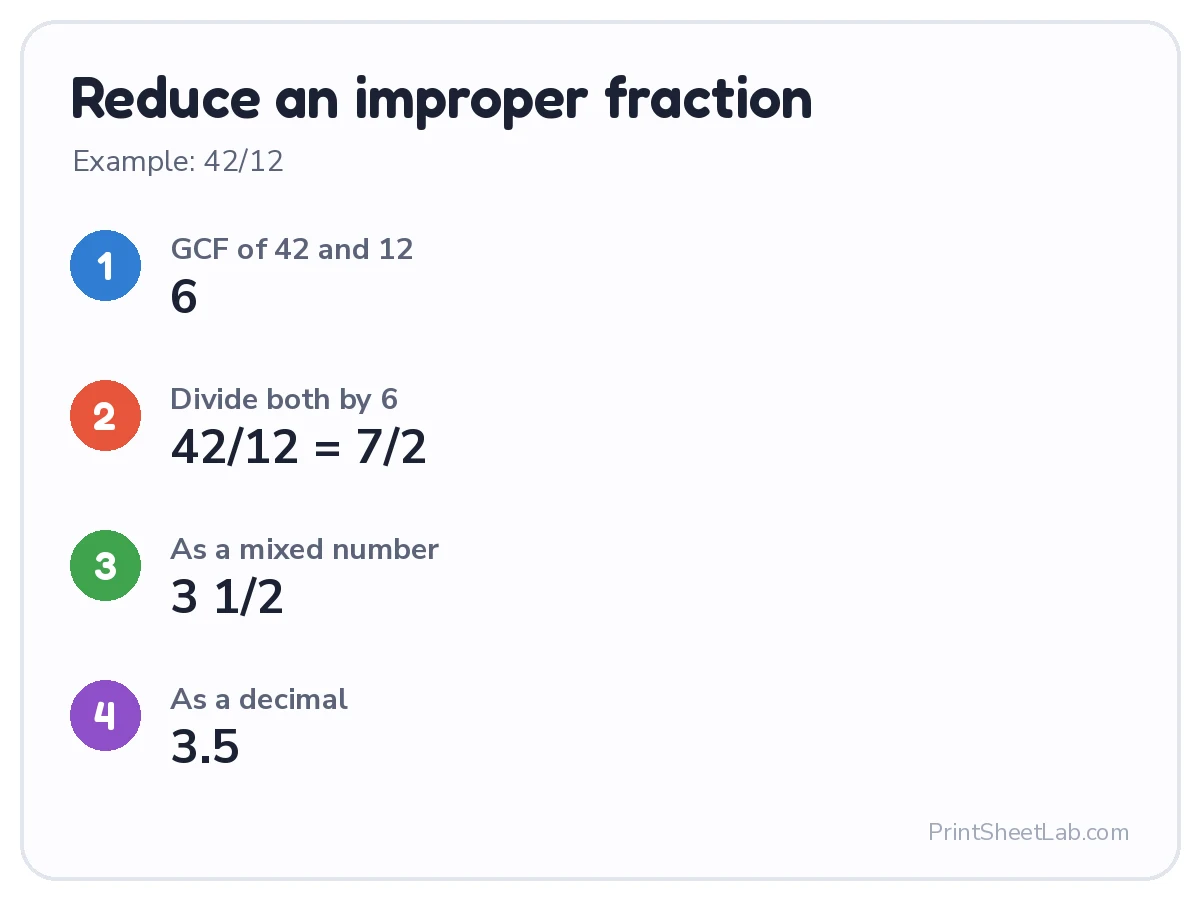
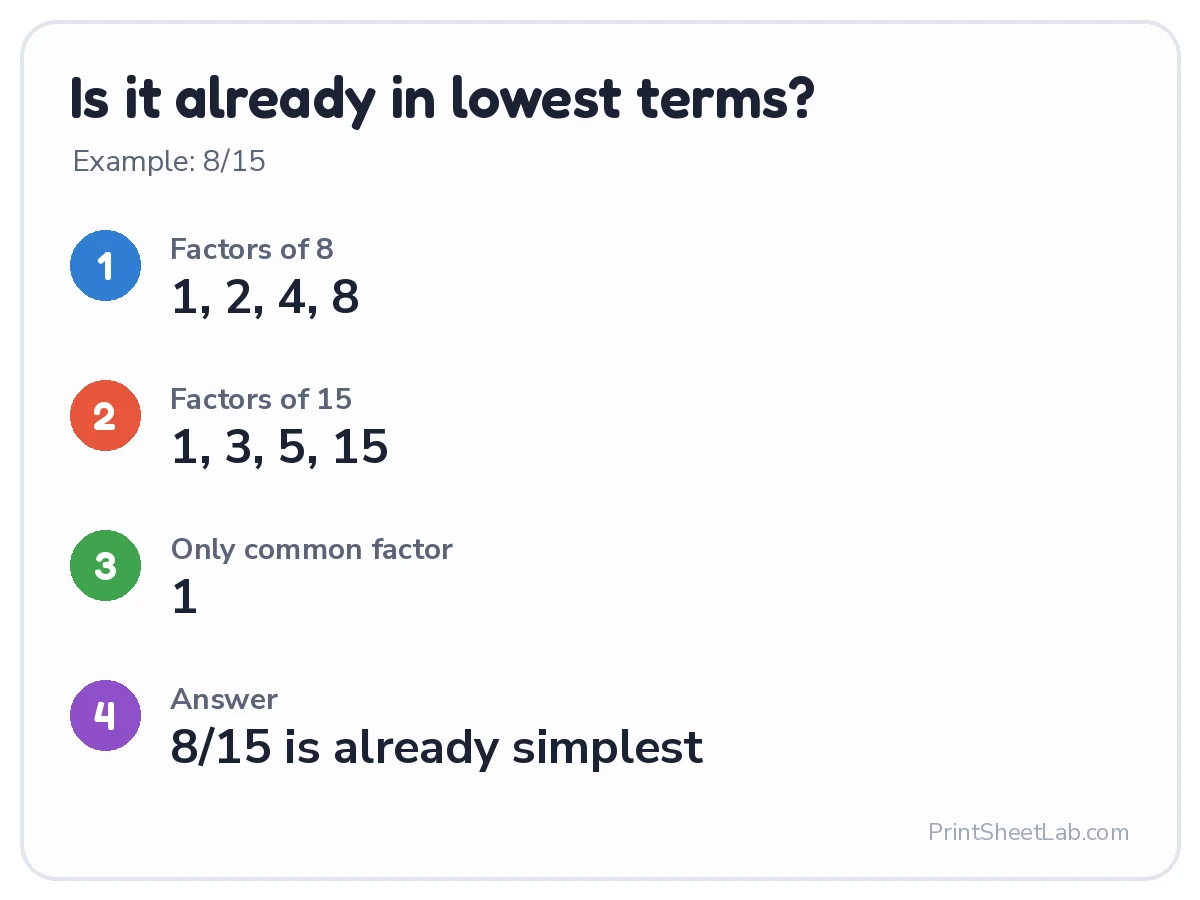
The cards show a basic simplification, an improper fraction reduced to a mixed number and how to tell when a fraction is already in lowest terms. The printable practice sheet has twelve fractions to reduce, with an answer key at the bottom.
How to reduce fractions step by step
To reduce fractions, find the largest number that divides both the top and the bottom, then divide. For 18/24:
- List the factors: 18 has 1, 2, 3, 6, 9 and 18; 24 has 1, 2, 3, 4, 6, 8, 12 and 24.
- The greatest common factor is 6.
- Divide both: 18 ÷ 6 = 3 and 24 ÷ 6 = 4.
- The simplest form is 3/4.
The simplify fractions calculator follows exactly these steps. The fraction keeps the same value; only the numbers get smaller. You can check this with decimals: 18 ÷ 24 = 0.75 and 3 ÷ 4 = 0.75.
How to simplify fractions with the greatest common factor
The greatest common factor method is the one most schools teach first, and it is the fastest when the numbers are small. Once you know the greatest common factor, a single division finishes the job. The table below lists the GCF for pairs that come up often, with the reduced fraction next to each one.
| Fraction | GCF of top and bottom | Simplest form |
|---|---|---|
| 12/30 | 6 | 2/5 |
| 18/24 | 6 | 3/4 |
| 45/60 | 15 | 3/4 |
| 42/56 | 14 | 3/4 |
| 84/126 | 42 | 2/3 |
| 100/250 | 50 | 2/5 |
| 144/360 | 72 | 2/5 |
| 35/49 | 7 | 5/7 |
| 17/51 | 17 | 1/3 |
| 91/143 | 13 | 7/11 |
How to simplify fractions with prime factors
When the greatest common factor is hard to see, break both numbers into primes. For 84/126, 84 = 22 × 3 × 7 and 126 = 2 × 32 × 7. The primes they share are 2, 3 and 7, and 2 × 3 × 7 = 42. Cancel them and what is left is 2 on the top and 3 on the bottom, so 84/126 = 2/3. The prime factorization calculator does the first step for any number.
Lowest terms calculator: dividing in stages
You do not have to find the greatest common factor straight away. Dividing by any common factor, then repeating, gives the same answer. For 48/64: divide by 2 to get 24/32, by 2 again to get 12/16, then by 4 to get 3/4. Dividing once by the GCF of 16 is quicker, but dividing in stages is fine when the GCF is hard to spot. Keep going until the only common factor left is 1. This lowest terms calculator can show either route.
Divisibility tests make the stages quick. If both numbers pass the same test, divide by that number and test again.
| Divisible by | Quick test | Example | After dividing |
|---|---|---|---|
| 2 | The last digit is even | 14/22 | 14 ÷ 2 = 7 and 22 ÷ 2 = 11 |
| 3 | The digits add up to a multiple of 3 | 27/45 | 27 ÷ 3 = 9 and 45 ÷ 3 = 15 |
| 4 | The last two digits make a multiple of 4 | 36/52 | 36 ÷ 4 = 9 and 52 ÷ 4 = 13 |
| 5 | The last digit is 0 or 5 | 35/60 | 35 ÷ 5 = 7 and 60 ÷ 5 = 12 |
| 9 | The digits add up to a multiple of 9 | 63/81 | 63 ÷ 9 = 7 and 81 ÷ 9 = 9 |
| 10 | The last digit is 0 | 70/130 | 70 ÷ 10 = 7 and 130 ÷ 10 = 13 |
| 11 | Adding and subtracting the digits in turn gives 0 or a multiple of 11 | 33/121 | 33 ÷ 11 = 3 and 121 ÷ 11 = 11 |
Simplest form calculator for improper fractions and mixed numbers
An improper fraction has a numerator bigger than its denominator, such as 42/12. Simplify it first (GCF 6, giving 7/2), then turn it into a mixed number: 7 ÷ 2 = 3 remainder 1, so 7/2 = 3 1/2. The simplest form calculator gives both forms, because some teachers want the improper fraction and others the mixed number.
For a mixed number like 2 6/8, only the fraction part needs simplifying: 6/8 = 3/4, so 2 6/8 = 2 3/4. Typing 2 6/8 into the calculator converts it to 22/8 and simplifies to 11/4, which is the same value, 2 3/4.
| Improper fraction | GCF | Simplest form | Mixed number |
|---|---|---|---|
| 42/12 | 6 | 7/2 | 3 1/2 |
| 30/8 | 2 | 15/4 | 3 3/4 |
| 100/24 | 4 | 25/6 | 4 1/6 |
| 91/14 | 7 | 13/2 | 6 1/2 |
| 250/100 | 50 | 5/2 | 2 1/2 |
| 45/9 | 9 | 5 | 5 |
| 77/21 | 7 | 11/3 | 3 2/3 |
When is a fraction in simplest form?
A fraction is in simplest form, also called lowest terms or reduced form, when the numerator and denominator have no common factor other than 1. 8/15 is already simplest: the factors of 8 are 1, 2, 4 and 8, and the factors of 15 are 1, 3, 5 and 15, so they share only 1. Wikipedia calls this an irreducible fraction.
Some pairs are always in lowest terms, so you can skip the work. Any fraction with 1 on top is simplest, two different prime numbers such as 7/11 never share a factor, and neither do two numbers next to each other, such as 8/9, because consecutive numbers have a GCF of 1.
| Fraction | Why it cannot be reduced | GCF |
|---|---|---|
| 1/12 | 1 on top | 1 |
| 7/11 | two different primes | 1 |
| 8/9 | consecutive numbers | 1 |
| 21/22 | consecutive numbers | 1 |
| 8/15 | factors of 8 and 15 share only 1 | 1 |
| 35/36 | consecutive numbers | 1 |
Reduce fractions with large numbers
Big fractions look scary but follow the same rule. For 1,250/2,000, both numbers are multiples of 250, their greatest common factor, so dividing gives 5/8. For 391/667, no small prime works, but the Euclidean algorithm finds the common factor 23 and gives 17/29.
The Euclidean algorithm divides the bigger number by the smaller one, then repeats with the remainder until nothing is left. The last non-zero remainder is the GCF:
- 667 = 1 × 391 + 276
- 391 = 1 × 276 + 115
- 276 = 2 × 115 + 46
- 115 = 2 × 46 + 23
- 46 = 2 × 23 + 0, so the GCF is 23 and 391/667 = 17/29.
The calculator switches to this method automatically when the numbers are too large to list every factor. Read more about the method on Wikipedia’s Euclidean algorithm page.
Reduce fractions calculator for lists, decimals and negatives
Choose “A list of fractions” and the reduce fractions calculator simplifies up to 40 lines in one go, with a table of the simplest form, the mixed number, the GCF and the decimal. That is handy for checking a whole worksheet. A few special inputs are handled like this:
| You type | You get | Why |
|---|---|---|
| 0.75 | 3/4 | 0.75 = 75/100, and the GCF is 25 |
| -10/15 | -2/3 | the minus sign stays on the top |
| 2 6/8 | 11/4 = 2 3/4 | converted to 22/8 first |
| 0/5 | 0 | zero divided by anything is zero |
| 7/1 | 7 | a denominator of 1 is a whole number |
| 1,250/2,000 | 5/8 | commas are ignored |
| 5/0 | error | a denominator cannot be zero |
Simplified fractions lookup: twelfths, sixteenths and hundredths
This lookup shows how the most common unreduced fractions reduce. Twelfths show up in clocks and months, sixteenths on a tape measure, and hundredths in percents.
| Fraction | Simplest form | GCF |
|---|---|---|
| 2/12 | 1/6 | 2 |
| 3/12 | 1/4 | 3 |
| 4/12 | 1/3 | 4 |
| 6/12 | 1/2 | 6 |
| 8/12 | 2/3 | 4 |
| 9/12 | 3/4 | 3 |
| 10/12 | 5/6 | 2 |
| 2/16 | 1/8 | 2 |
| 4/16 | 1/4 | 4 |
| 6/16 | 3/8 | 2 |
| 8/16 | 1/2 | 8 |
| 10/16 | 5/8 | 2 |
| 12/16 | 3/4 | 4 |
| 14/16 | 7/8 | 2 |
| 10/100 | 1/10 | 10 |
| 20/100 | 1/5 | 20 |
| 25/100 | 1/4 | 25 |
| 40/100 | 2/5 | 20 |
| 50/100 | 1/2 | 50 |
| 75/100 | 3/4 | 25 |
| 80/100 | 4/5 | 20 |
Reduce fractions in a spreadsheet or on a handheld calculator
You can reduce fractions without this page too. In Excel or Google Sheets, divide each number by the GCD function: with 18 in A1 and 24 in B1, =A1/GCD(A1,B1) gives 3 and =B1/GCD(A1,B1) gives 4. On a TI-84, enter 18/24 and use the fraction conversion in the MATH menu; many Casio models use the S<>D key. This page is quicker when you also want the steps.
Equivalent fractions: one value, many names
Every fraction has an endless family of equivalent fractions, made by multiplying the top and bottom by the same number. Simplifying walks back down the family to the smallest member. Here are the families of 3/4, 2/3 and 5/8, with the simplest form in the first column.
| Simplest form | × 2 | × 3 | × 4 | × 5 | × 6 |
|---|---|---|---|---|---|
| 3/4 | 6/8 | 9/12 | 12/16 | 15/20 | 18/24 |
| 2/3 | 4/6 | 6/9 | 8/12 | 10/15 | 12/18 |
| 5/8 | 10/16 | 15/24 | 20/32 | 25/40 | 30/48 |
Practice: reduce these fractions
Try these on paper, then check them with the calculator: 14/21, 36/48, 45/75, 64/80, 90/120, 121/143. The answers are 2/3, 3/4, 3/5, 4/5, 3/4, 11/13.
Simplifying fractions in recipes and measurements
Measurements often produce unsimplified fractions. Halving a recipe that needs 3/4 cup gives 3/8 cup, which is already in lowest terms, but doubling 3/8 gives 6/8 cup, which reduces to 3/4. On a tape measure, 12/16 of an inch is the same mark as 3/4 of an inch, and 4/8 is the 1/2 mark. Reducing makes these amounts much easier to read and measure.
Everyday fractions, reduced
Fractions made from counts are almost never in lowest terms at first, so reducing is part of reading them. Here are some everyday examples of the simplify fractions calculator at work.
| Situation | Fraction | Simplest form |
|---|---|---|
| 15 of 20 questions correct | 15/20 | 3/4 |
| 24 of 36 students present | 24/36 | 2/3 |
| 45 minutes of an hour | 45/60 | 3/4 |
| 250 g of a 1,000 g bag | 250/1000 | 1/4 |
| 9 of 12 months | 9/12 | 3/4 |
| 18 holes of 72 | 18/72 | 1/4 |
Why simplifying fractions matters
- Clear answers: most teachers and tests expect final answers in simplest form.
- Comparing fractions: 15/20 and 9/12 look different, but both simplify to 3/4.
- Easier arithmetic: smaller numbers mean fewer mistakes when you add, multiply or divide; the fraction calculator simplifies its answers for the same reason.
- Real measurements: 8/16 of an inch is simply 1/2 an inch on a ruler.
For more practice, print the free fractions worksheets and the equivalent fractions worksheets, or try the visual fraction strips.
Fractions in school: equivalent fractions and lowest terms
In the United States, grade 4 students learn why a/b equals (n × a)/(n × b), which is the idea behind every simplification, in the Common Core standards for fractions. Reducing is that idea run backward: divide the top and the bottom by the same number. Other countries order the topic differently, so check your own syllabus. Many classes in the UK, India and Australia say “lowest terms” or “simplest form” interchangeably, and both mean the same as reduced.
Questions people ask about reducing fractions
How do I simplify fractions before multiplying?
Cancel common factors across the multiplication sign first. For 4/9 × 3/8, divide 4 and 8 by 4, and 3 and 9 by 3, to get 1/3 × 1/2 = 1/6. You get the same answer as multiplying first (12/72 = 1/6) with much smaller numbers.
Can I simplify fractions with variables?
This calculator works with numbers only. For letters, cancel the factor the top and bottom share: 6x/9x = 2/3, and 4a/10b = 2a/5b. Reduce the number parts with the GCF and cancel identical letters.
What is the quickest way to reduce a fraction in my head?
Try 2, 3 and 5 first with the divisibility tests, divide when both numbers pass, and repeat. Most school fractions finish in one or two divisions.
Simplify fractions calculator: frequently asked questions
What is 18/24 in simplest form?
3/4. The greatest common factor of 18 and 24 is 6, and 18 ÷ 6 = 3 while 24 ÷ 6 = 4.
How do I know when to stop simplifying?
Stop when the only number that divides both the numerator and the denominator is 1.
Can I simplify a fraction with a negative number?
Yes. Simplify as usual and keep the minus sign: -10/15 = -2/3.
Is reduce fractions the same as simplify fractions?
Yes. Reducing, simplifying and writing in lowest terms all mean the same thing: dividing the top and the bottom by their greatest common factor.
Can I type a decimal?
Yes. A decimal like 0.75 is turned into 75/100 and simplified to 3/4. For more on decimals, use the decimal to fraction calculator.
Can I simplify a mixed number?
Yes. Type 2 6/8 and the calculator converts it to 22/8, simplifies it to 11/4 and shows 2 3/4 as the mixed number.
How do I simplify an improper fraction?
Divide the top and the bottom by the GCF, then convert to a mixed number if you need one. 42/12 becomes 7/2, which is 3 1/2.
Can the calculator simplify many fractions at once?
Yes. Choose A list of fractions and type one fraction per line, up to 40 at a time.
Why does the simplify fractions calculator show a decimal too?
So you can check that the simplified fraction has the same value as the original.
Is the simplify fractions calculator free?
Yes, it is free with no sign-up, and the practice sheet PDF is free to print.
More calculators
- Fraction calculator: add, subtract, multiply, divide and compare
- GCF and LCM calculator: find the greatest common factor of any numbers
- Prime factorization calculator
- Decimal to fraction calculator
- Ratio calculator: simplify ratios the same way
- All calculators
Sources and further reading
- Wikipedia: Irreducible fraction
- Wikipedia: Greatest common divisor
- Common Core State Standards: Grade 4, Number and Operations in Fractions
Last updated: October 2026.