The three graph paper sizes most people need are 1 cm squares, 5 mm squares and 1/4 inch squares (4 per inch, 6.35 mm). Use 1 cm for young children and big number work, 5 mm for metric school math on A4, and 1/4 inch for US school math on Letter paper. This guide gives the exact measurements, how many squares fit on A4 and US Letter pages, a true-to-scale comparison chart, and which size suits each age and job.
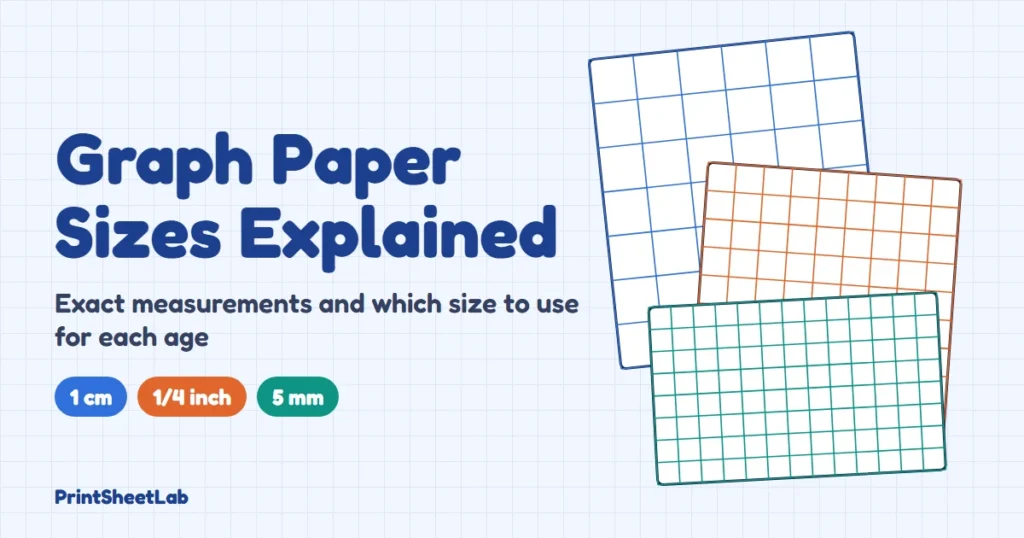
Graph paper sizes at a glance
Each size is named by the side of one square. Metric sizes are given in millimeters or centimeters; imperial sizes are given as a fraction of an inch or as “squares per inch”. Since 1959 the inch has been defined as exactly 25.4 mm (see NIST’s page on SI units of length), so every imperial size converts to an exact metric value.
| Square size | Exact width | Squares per inch | US Letter, whole squares (total) | A4, whole squares (total) |
|---|---|---|---|---|
| 1/2 inch | 12.7 mm | 2 | 15 × 20 (300) | 14 × 21 (294) |
| 1 cm | 10 mm | 2.54 | 19 × 25 (475) | 18 × 27 (486) |
| 1/4 inch | 6.35 mm | 4 | 30 × 40 (1,200) | 29 × 42 (1,218) |
| 1/5 inch | 5.08 mm | 5 | 37 × 50 (1,850) | 36 × 53 (1,908) |
| 5 mm | 5 mm | 5.08 | 38 × 50 (1,900) | 36 × 54 (1,944) |
| 1/8 inch | 3.175 mm | 8 | 60 × 80 (4,800) | 58 × 85 (4,930) |
| 1/10 inch | 2.54 mm | 10 | 75 × 100 (7,500) | 72 × 106 (7,632) |
| 2 mm | 2 mm | 12.7 | 95 × 127 (12,065) | 92 × 135 (12,420) |
Counts are across × down in portrait, inside half-inch (12.7 mm) margins, counting whole squares only. Letter is 8.5 × 11 inches (215.9 × 279.4 mm) and A4 is 210 × 297 mm, so A4 is 5.9 mm narrower but 17.6 mm taller. That is why A4 fits fewer squares across and more squares down for every size in the table.
Metric or imperial: which should you choose?
Start with the units your child’s school, textbook or project uses. If worksheets and rulers are in centimeters, metric graph paper sizes (1 cm, 5 mm, 2 mm) make every measurement a whole number. If plans, patterns or textbooks are in inches, imperial sizes (1/4, 1/5, 1/8 inch) keep the arithmetic simple.
Do not choose by paper size alone. A US family can print 5 mm squares on Letter paper, and a UK family can print 1/4 inch squares on A4; the grid is drawn to the exact size either way. What matters is that the squares, the ruler and the instructions all use the same unit.
The three main sizes, one by one
1 cm graph paper (10 mm squares)
A 1 cm square is big enough for a five- or six-year-old to write one digit in, color neatly or count by pointing. It is the usual choice for early arrays, area by counting squares and lining up digits in column addition. On US Letter with half-inch margins you get 19 × 25 squares (475); on A4 you get 18 × 27 (486).
5 mm graph paper (the metric standard)
Five millimeter squares are the everyday metric grid, printed in many exercise books sold in countries that use A4. Two squares make exactly 1 cm, so scale drawings and bar charts are easy to measure with a ruler. An A4 page with half-inch margins holds 36 × 54 squares (1,944).
1/4 inch graph paper (quad ruled, 4 squares per inch)
Quarter-inch squares measure 6.35 mm, and four of them make an inch. This is the common US school size, often sold as “quad ruled” pads. A US Letter page with half-inch margins holds exactly 30 × 40 squares (1,200), because 7.5 × 10 inches divides evenly into quarter inches.

5 mm vs 1/4 inch graph paper, and where 1/5 inch fits
In the 5 mm vs 1/4 inch graph paper question, the sizes look almost the same on screen, but the differences add up quickly on paper. A worked example makes it clear: measure along 10 squares with a ruler.
| Grid | Length of 10 squares | Length of 25 squares | Compared with 5 mm |
|---|---|---|---|
| 5 mm | 50 mm | 125 mm | – |
| 1/5 inch | 50.8 mm (2 in) | 127 mm (5 in) | 1.6% wider, 0.08 mm per square |
| 1/4 inch | 63.5 mm (2.5 in) | 158.75 mm (6.25 in) | 27% wider, 61% more area per square |
| 1 cm | 100 mm | 250 mm | twice as wide, four times the area |
So a 1/4 inch square is 1.27 times as wide as a 5 mm square and has 1.61 times the area. The 1/5 inch grid (5 squares per inch, often used for engineering and science graphs) is only 0.08 mm wider per square than 5 mm, but after 25 squares the two grids are 2 mm apart. If a worksheet says “use 5 mm squares” and a child uses 1/5 inch paper, a drawing to scale will be slightly too big.
How to tell which grid you have
- Lay a ruler along one line and count 10 squares from a thick line or the edge of the grid.
- Read the length: 50 mm means 5 mm squares; 50.8 mm (2 inches) means 1/5 inch; 63.5 mm (2.5 inches) means 1/4 inch; 100 mm means 1 cm.
- If you cannot tell 50 mm from 50.8 mm, count 25 squares instead: 125 mm for 5 mm squares, 127 mm for 1/5 inch.
Which graph paper size for each age and grade?
Choosing between graph paper sizes is mostly about hand control and how much has to fit on the page. Our suggestions below are practical guidance, not curriculum rules; the curriculum links show when each grid skill is usually taught.
| Age / grade | Best square size | Typical use |
|---|---|---|
| Ages 4 to 6 (Pre-K to Kindergarten) | 1/2 inch or 1 cm | Coloring patterns, copying shapes, one number per square |
| Grades 1 to 2 (ages 6 to 8) | 1 cm | Arrays, area by counting squares, lining up tens and ones |
| Grades 3 to 4 (ages 8 to 10) | 1 cm, moving to 1/4 inch or 5 mm | Column addition and multiplication, bar graphs, perimeter |
| Grades 5 to 6 (ages 10 to 12) | 1/4 inch or 5 mm | Coordinate grids, line graphs, scale drawings |
| Grades 7 to 8 and up | 5 mm, 1/4 inch, or 1/5 inch | Graphing equations, geometry, science results |
Coordinates are a good example of timing. In the US Common Core, grade 5 graphs points in the first quadrant and grade 6 extends this to all four quadrants of the coordinate plane (standard 6.NS.C.8 in the Common Core State Standards for Mathematics). In England, the national curriculum for mathematics introduces first-quadrant coordinates in Year 4 and the full four-quadrant grid in Year 6. For that work, print graph paper with numbered x and y axes or try the coordinate plane mystery pictures.
Matching size to task: sums, graphs and floor plans
Once you know the age, match graph paper sizes to the job in front of you:
- Handwritten sums and long multiplication: 1 cm for beginners, 1/4 inch or 5 mm once digits are small and neat. One digit per square keeps place value lined up.
- Area and perimeter: 1 cm, so each square is exactly 1 square centimeter and answers can be checked with a ruler. Pair it with our area and perimeter worksheets.
- Bar and line graphs: 5 mm or 1/4 inch, so a full scale fits on one page.
- Floor plans: 1/4 inch, because the common architectural scale is 1/4 inch = 1 foot, so one square is one foot.
- Precise science graphs: 2 mm, 1/10 inch or 1/5 inch, where you need to read values between the main lines.
- Pixel art, cross-stitch and colorwork: 1/4 inch or 5 mm; knitters can chart to their stitch gauge on knitting graph paper.

How many squares fit on a page?
Page counts matter when a whole graph, plan or pixel picture has to fit on one sheet. The table at the top counts squares inside half-inch margins, which is what most home printers can print. If you print edge to edge (or cut the page), these are the full-sheet counts for the common graph paper sizes:
| Square size | US Letter, full sheet | A4, full sheet |
|---|---|---|
| 1 cm | 21 × 27 | 21 × 29 |
| 1/4 inch | 34 × 44 | 33 × 46 |
| 1/5 inch | 42 × 55 | 41 × 58 |
| 5 mm | 43 × 55 | 42 × 59 |
Worked example: US Letter is 215.9 mm wide. With half-inch margins the grid area is 215.9 − 25.4 = 190.5 mm wide. Divide by 6.35 mm and you get exactly 30 quarter-inch squares. Divide the same width by 5 mm and you get 38.1, so 38 whole squares fit and 0.5 mm is left over.
Graph paper squares per page on six paper sizes
The table at the top of this guide counts graph paper squares per page for US Letter and A4 only. Other sizes matter for classroom posters, planners and wide tables, so we counted whole squares across and down for 1 cm, 1/4 inch and 5 mm grids on six sizes of paper, in portrait, inside half-inch margins:
| Paper size | 1 cm squares | 1/4 inch squares | 5 mm squares |
|---|---|---|---|
| A5 | 12 × 18 (216) | 19 × 29 (551) | 24 × 36 (864) |
| A4 | 18 × 27 (486) | 29 × 42 (1,218) | 36 × 54 (1,944) |
| A3 | 27 × 39 (1,053) | 42 × 62 (2,604) | 54 × 78 (4,212) |
| US Letter | 19 × 25 (475) | 30 × 40 (1,200) | 38 × 50 (1,900) |
| US Legal | 19 × 33 (627) | 30 × 52 (1,560) | 38 × 66 (2,508) |
| Tabloid (11 × 17 in) | 25 × 40 (1,000) | 40 × 64 (2,560) | 50 × 81 (4,050) |
A5, the size of a small notebook, holds only 12 × 18 squares at 1 cm but 24 × 36 at 5 mm, so it suits small drawings with the finer grid. A3, a poster size, holds 27 × 39 squares at 1 cm, which is enough for a classroom chart.
US Legal is 3 inches taller than Letter, so it adds 8 rows of 1 cm squares and 12 rows of 1/4 inch squares, and Tabloid roughly doubles the area of Letter. If you need an exact count for another page or margin, the formula is whole squares across = (page width − 2 × margin) ÷ square size, rounded down, and the same for down. These graph paper squares per page numbers use that formula.
What “fit to page” does to graph paper square sizes
The most common mistake in the list below is printing with scaling. We calculated the scale a printer uses when it shrinks a PDF to fit a different paper size (the smaller of the width and height ratios): an A4 file onto Letter is scaled to 94.1%, and a Letter file onto A4 to 97.3%. Here is what that does to the squares:
| Intended square | Correct size | A4 file shrunk onto Letter | Letter file shrunk onto A4 |
|---|---|---|---|
| 1 cm | 10.00 mm | 9.41 mm | 9.73 mm |
| 1/4 inch | 6.35 mm | 5.97 mm | 6.18 mm |
| 1/5 inch | 5.08 mm | 4.78 mm | 4.94 mm |
| 5 mm | 5.00 mm | 4.70 mm | 4.86 mm |
A 1 cm grid printed from an A4 file onto Letter becomes 9.41 mm squares, and the 5 mm grid becomes 4.70 mm. That error is easy to miss on a single square but, over 25 squares, a 5 mm grid is 7.4 mm short, which is almost one and a half squares. A ruler check on 10 squares catches it in seconds. This is why the squares on any grid must be checked with a ruler before you use it for scale work.
Graph paper size for kids: which size fits a pixel picture?
Pixel art, cross-stitch charts and mystery pictures are a popular use of graph paper, and the size of the picture decides the grid. This table shows the largest square size, from the common ones in this guide, that fits a square picture on both an A4 and a US Letter page inside half-inch margins:
| Picture size (squares) | Largest of these graph paper sizes that fits on A4 and Letter | Fits on one page |
|---|---|---|
| 10 × 10 | 1/2 inch | yes |
| 16 × 16 | 1 cm | yes |
| 20 × 20 | 1/4 inch | yes |
| 32 × 32 | 1/5 inch | yes |
| 50 × 50 | 1/8 inch | yes |
| 64 × 64 | none of these (use a finer grid or two pages) | no |
A 10 × 10 picture works on large squares, so for a graph paper size for kids who are just starting, a 1/2 inch grid is easiest. A 16 × 16 picture fits 1 cm squares on either paper, a 20 × 20 picture needs 1/4 inch squares, a 32 × 32 picture needs 1/5 inch squares and a 50 × 50 picture needs 1/8 inch squares. Children usually enjoy pictures between 10 × 10 and 20 × 20 squares, which means the 1/2 inch, 1 cm and 1/4 inch grids cover most classroom projects.
Common mistakes when printing and choosing grids
- Printing with “Fit to page”. Scaling changes every square. A Letter PDF shrunk to fit A4 is scaled by about 97%, so 1/4 inch squares print at about 6.2 mm. An A4 PDF shrunk onto Letter is scaled by about 94%, so 1 cm squares print at about 9.4 mm. Choose “Actual size” or 100%.
- Choosing the wrong paper size. Pick US Letter in the US and Canada and A4 almost everywhere else, so the grid is drawn for the paper in your printer.
- Mixing 5 mm and 1/5 inch grids. They drift apart by 2 mm every 25 squares, so keep one grid per project.
- Squares too small for young hands. If a child’s digits spill over the lines, move up one size, for example from 5 mm to 1 cm.
- Lines too dark. Light gray or blue lines let pencil work stand out; darker lines every 5 squares (or every 4 on quad ruled) make counting faster.
Printable graph paper sizes on PrintSheetLab
Our free printable graph paper page lets you pick 1/4 inch, 5 mm, 1 cm and other graph paper sizes, add darker lines or x and y axes, and download a PDF for US Letter, A4 or A5. For any spacing not in the list, the printable paper maker accepts a custom size, so you can match the grid from a textbook or a pattern exactly. Print one test page and measure 10 squares before printing a class set.
- Isometric paper (dots or lines in 1 cm, 5 mm or 1/4 inch) for cubes and 3D drawings.
- Dot grid paper with 5 mm bullet journal dots when full lines would get in the way.
- Polar graph paper and hexagon graph paper for circles, angles and game maps.
- Coordinate grid worksheets for plotting practice with answers.
Choosing lined paper for the same child? Our guide to wide ruled vs college ruled paper explains line spacing the same way.
Sources
The inch is defined as exactly 25.4 mm (NIST). A4 (ISO 216) and US Letter dimensions follow the paper size article on Wikipedia and its cited standards. Coordinate grid years are from England’s national curriculum for mathematics (Department for Education) and the Common Core State Standards for grade 6. All square counts and conversions on this page were calculated from these exact dimensions.
Frequently asked questions
9 quick answers
What is the most common of the graph paper sizes?
In the US it is 1/4 inch squares (4 squares per inch, also called quad ruled) on Letter paper. In countries that use A4, 5 mm squares are the everyday school grid.
Is 5 mm graph paper the same as 1/4 inch?
No. A 1/4 inch square is 6.35 mm, so it is 27% wider than a 5 mm square and has about 61% more area. Ten 1/4 inch squares measure 63.5 mm; ten 5 mm squares measure 50 mm.
How many squares are on 1 cm graph paper?
With half-inch margins, a US Letter page holds 19 × 25 squares (475) and an A4 page holds 18 × 27 squares (486). Edge to edge, Letter holds 21 × 27 and A4 holds 21 × 29.
Which graph paper sizes are best for kids?
Use 1/2 inch or 1 cm squares for ages 4 to 8, and move to 1/4 inch or 5 mm around grades 4 to 5, once a child can write small, neat digits inside each square.
What graph paper size is used for engineering?
Engineering paper often has 5 squares per inch (1/5 inch, 5.08 mm). Fine grids such as 1/10 inch or 2 mm are used when a graph needs precise readings.
Can I print imperial graph paper sizes on A4 paper?
Yes. Choose A4 and the square size you want, such as 1/4 inch, before downloading. The grid is drawn for A4 at the exact size, so a quarter-inch square still measures 6.35 mm. With half-inch margins, A4 fits 29 × 42 quarter-inch squares.
Why are my printed graph paper squares the wrong size?
The PDF was probably scaled. Print at 100% or “Actual size”, and download the grid for the paper in your printer (A4 or Letter) rather than letting the printer fit one to the other.
How many graph paper squares per page fit on A5?
With half-inch margins, an A5 page holds 12 × 18 squares of 1 cm, 19 × 29 squares of 1/4 inch or 24 × 36 squares of 5 mm.
What graph paper size for kids fits a 16 × 16 pixel picture?
A 1 cm grid fits a 16 × 16 picture on both A4 and Letter, because it holds 18 squares across A4 and 19 across Letter. For a 20 × 20 picture, use 1/4 inch squares.