Coordinate grids use two number lines at right angles to name the position of any point with an ordered pair, such as (5, 7). The nine PDFs on this page ask children to name points, plot points and join them to draw mystery pictures, and every sheet has an answer key. They follow standard 5.G.A.1 of the Common Core standards for grade 5 geometry, and the notes below explain the grid, the ordered pair and the quadrants.
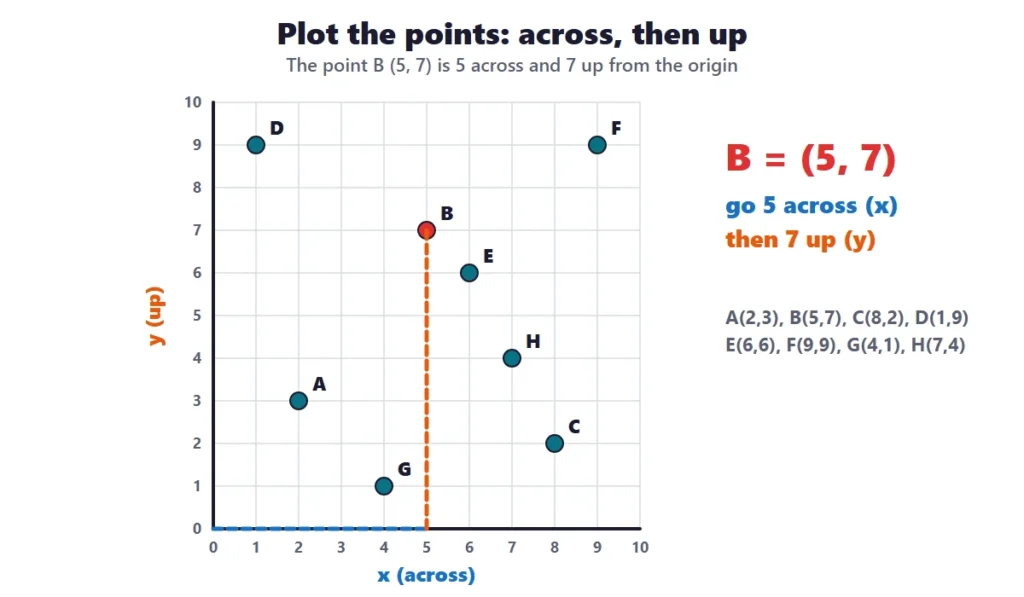
An ordered pair like (3, 7) gives two directions: the first number says how far to go across (x), the second says how far to go up (y). A simple way to remember: walk along the hall, then climb the stairs. The mystery picture worksheets reward careful plotting with a house, a boat, a star, a fish or a rocket.
Coordinate grids worksheets: what is in the set
There are 9 coordinate grids worksheets on this page, and every one has an answer key except for any cut-out games. The first four sets name and plot points, and the last five are mystery pictures that are drawn by joining the plotted points in order.
Worksheet
What children do
Standard
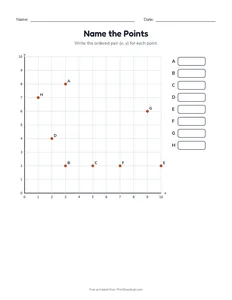
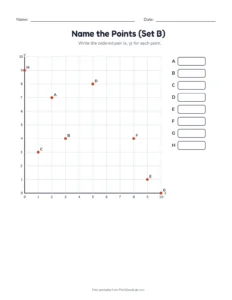
Name the Points
Write the ordered pair for eight points.
5.G.A.1
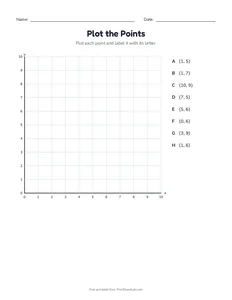
Plot the Points
Plot and label eight points.
5.G.A.1
Name the Points (Set B)
Write the ordered pair for eight more points.
5.G.A.1
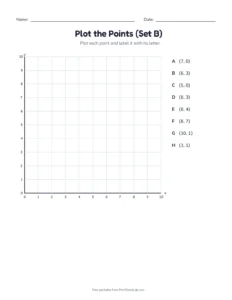
Plot the Points (Set B)
Plot and label eight more points.
5.G.A.1
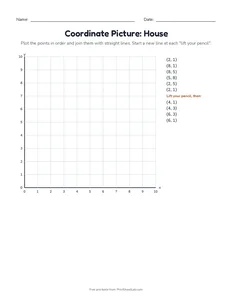
Coordinate Picture: House
Plot and join the points to draw a mystery picture.
5.G.A.1
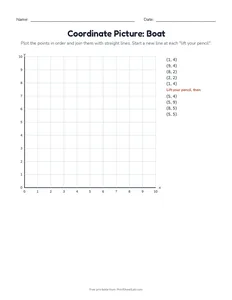
Coordinate Picture: Boat
Plot and join the points to draw a mystery picture.
5.G.A.1
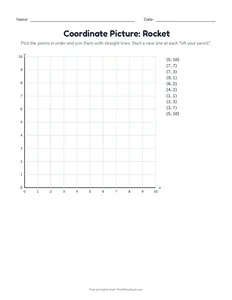
Coordinate Picture: Rocket
Plot and join the points to draw a mystery picture.
5.G.A.1
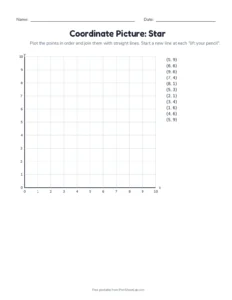
Coordinate Picture: Star
Plot and join the points to draw a mystery picture.
5.G.A.1
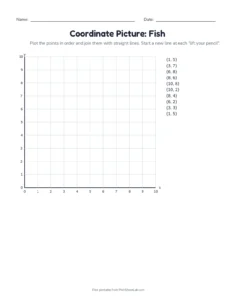
Coordinate Picture: Fish
Plot and join the points to draw a mystery picture.
5.G.A.1
Coordinate grids: the words children need
Coordinate grids have a few words that every child needs. The two number lines are called axes, and they meet at the origin. Every point has two coordinates in an ordered pair, and the order matters. Wikipedia’s article on the Cartesian coordinate system explains how this idea, which comes from René Descartes, is used in maps, graphs and computers. This table lists the six words used on the worksheets:
Word
What it means
Example
x-axis
the horizontal number line
across
y-axis
the vertical number line
up
origin
the point where the axes meet
(0, 0)
ordered pair
two numbers that name a point
(3, 7)
x-coordinate
the first number: how far across
3 in (3, 7)
y-coordinate
the second number: how far up
7 in (3, 7)
The saying “across the hall, then up the stairs” helps children remember the order: the first number is how far to go across, and the second is how far to go up. The coordinate plane tool on this site lets children plot points on screen and print their own mystery pictures.
Plotting points worksheets: across, then up
The plotting points worksheets give children eight ordered pairs and a blank grid. To plot (5, 7), start at the origin, move 5 to the right along the x-axis, then 7 up, and make a dot. This table shows the eight points from the diagram, with the number of moves from the origin:
Point
Ordered pair
Across (x)
Up (y)
Moves from the origin
A
(2, 3)
2
3
5
B
(5, 7)
5
7
12
C
(8, 2)
8
2
10
D
(1, 9)
1
9
10
E
(6, 6)
6
6
12
F
(9, 9)
9
9
18
G
(4, 1)
4
1
5
H
(7, 4)
7
4
11
Coordinate grid worksheets: how big is the grid?
The coordinate grid worksheets in this pack use a grid from 0 to 10, which is large enough for a picture and small enough to read easily. A grid from 0 to 10 has 121 points where the lines cross, and each one has its own name. A bigger grid has many more points, as this table shows:
Grid goes from 0 to
Points on each axis
Points in all, with the axes
Points not on an axis
5
6
36
25
10
11
121
100
12
13
169
144
20
21
441
400
Ordered pairs worksheets: why the order matters
The ordered pairs worksheets teach that (3, 7) and (7, 3) are different points. Only when both numbers are the same, as in (4, 4), do the two orders name the same place. On a grid from 0 to 10 there are 11 such points, and they all lie on a diagonal line. This table shows six pairs and their swapped partners:
Ordered pair
Swapped pair
Same point?
Why
(3, 7)
(7, 3)
no
across and up have changed places
(5, 2)
(2, 5)
no
across and up have changed places
(8, 1)
(1, 8)
no
across and up have changed places
(6, 6)
(6, 6)
yes
both numbers are the same
(9, 4)
(4, 9)
no
across and up have changed places
(0, 5)
(5, 0)
no
across and up have changed places
The other 110 points on the grid each have a different swapped partner, so they form 55 pairs of points that are mirror images of each other across the diagonal. A child who plots both (3, 7) and (7, 3) sees this in the picture at once.
Coordinate grid pictures: how a mystery picture works
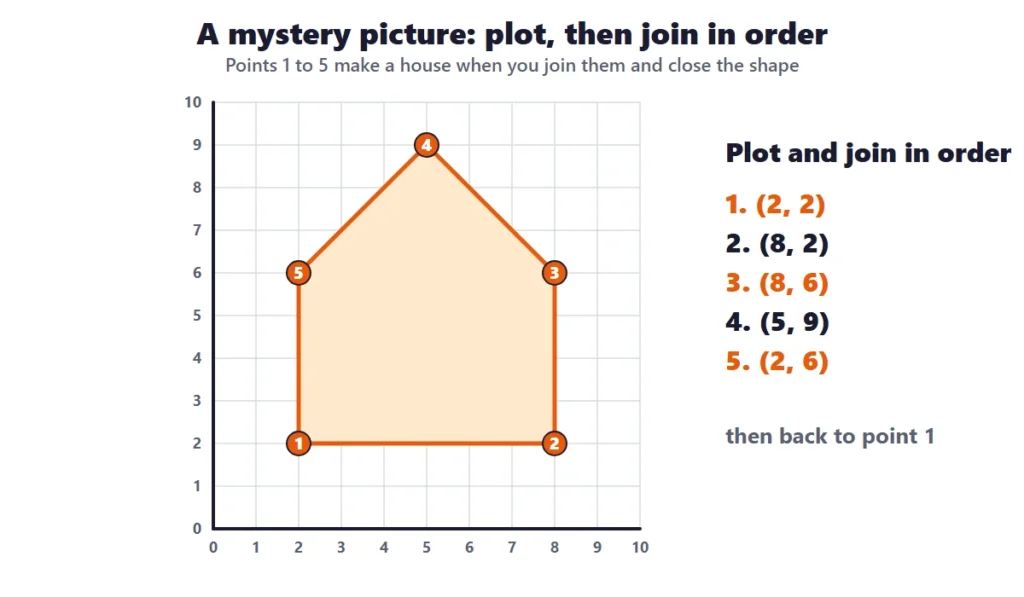
The coordinate grid pictures give a list of ordered pairs, and children plot each point and join it to the one before. When all the points are joined, the last point is joined back to the first, and a picture appears. This table shows a simple house with five points, and the length of each side:
Side
From
To
Direction
Length in units
1
(2, 2)
(8, 2)
across
6
2
(8, 2)
(8, 6)
up
4
3
(8, 6)
(5, 9)
slanted
4.24
4
(5, 9)
(2, 6)
slanted
4.24
5
(2, 6)
(2, 2)
up
4
The perimeter of this house is about 22.5 units, since the two roof sides are slanted and each is about 4.24 units long. The area is 33 square units: a rectangle of 6 by 4 and a triangle with a base of 6 and a height of 3. The mystery pictures on the worksheets are the house, the boat, the rocket, the star and the fish. The area and perimeter worksheets page shows how to find the area and perimeter of shapes like these.
First quadrant worksheets: the four quadrants
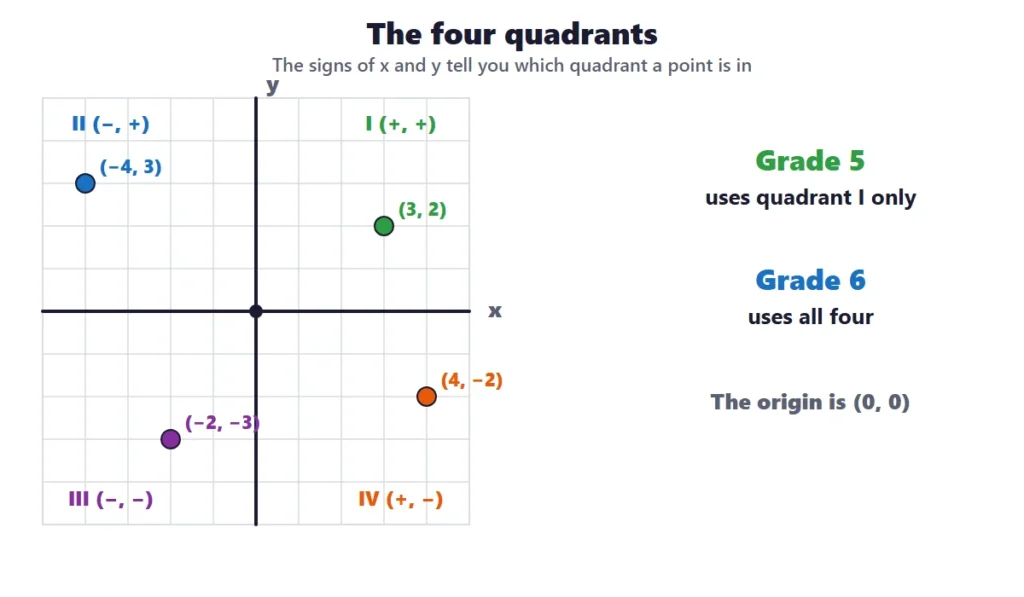
The first quadrant worksheets use only the top right part of the plane, where both numbers are positive. This is the part that grade 5 uses (5.G.A.1 and 5.G.A.2). The full plane has four quadrants, which grade 6 uses when negative numbers are introduced (6.NS.C.6). The Common Core standards for grade 6 the number system describe the next step. This table shows the four quadrants, with an example in each:
A mystery picture. Join five points to draw a house.
Quadrant
x is
y is
Example
From the origin go
I
positive
positive
(3, 2)
right and up
II
negative
positive
(−4, 3)
left and up
III
negative
negative
(−2, −3)
left and down
IV
positive
negative
(4, −2)
right and down
A point can also be reflected, or flipped, across an axis, and the ordered pair changes in a simple way. This table shows three points flipped across each axis:
Point
Reflect across the y-axis
Reflect across the x-axis
Reflect across both
(3, 2)
(−3, 2)
(3, −2)
(−3, −2)
(5, 4)
(−5, 4)
(5, −4)
(−5, −4)
(2, 7)
(−2, 7)
(2, −7)
(−2, −7)
Distance on a coordinate grid
When two points are in the same row or the same column, the distance between them is the difference of the coordinates that are not the same. For (2, 5) and (8, 5) the y values match, so the distance is 8 − 2 = 6. This table shows four pairs:
Two points
Same…
How to find the distance
Distance
(2, 5) and (8, 5)
y
|2 − 8|
6
(4, 1) and (4, 9)
x
|1 − 9|
8
(1, 3) and (7, 3)
y
|1 − 7|
6
(6, 2) and (6, 8)
x
|2 − 8|
6
A rectangle with corners at (1, 2), (7, 2), (7, 5) and (1, 5) has sides of 6 and 3, so its perimeter is 18 and its area is 18. Grade 5 children solve problems like this, and it connects coordinate grids with the work on shapes in the geometry worksheets.
Where coordinate grids are used
Coordinate grids are used all around us, and a short talk about these examples shows children why the idea matters. This table gives five of them:
Where you see it
What it does
Example
Battleship and chess
a letter and a number name a square
B4, E7
Maps
a letter and a number name a grid square
C3 on a road map
Spreadsheets
a column letter and a row number name a cell
cell D5
Theater seats
a row and a seat number name a seat
row 6, seat 12
Video games
two numbers name where a character is
x = 120, y = 45
Common mistakes with coordinate grids
The most common mistake is to reverse the order of the numbers. This table shows five mistakes, what went wrong and the fix:
What the child says
What went wrong
The fix
(3, 7) is 7 across and 3 up
reads the numbers in the wrong order
the first number is across (x), then up (y): 3 across and 7 up
(0, 5) is not on the grid
thinks 0 means nothing
it is on the y-axis, 5 up from the origin
The point is plotted in the box between the lines
plots on the spaces, not the lines
plot where the two lines cross
Counts the origin as 1
starts counting at 1
start at 0, and count the steps from the origin
(4, 4) and (4, 4) are different points
does not see that the pair is the same
the same ordered pair always names the same point
Coordinate grids word problems
Coordinate grids are used in maps and games. Ask children to draw a grid for each story and plot the points before they answer:
Word problem
Working
Answer
A treasure is at (4, 6). How many steps across and how many up from the origin?
4 across, 6 up
4 and 6
A boat is at (2, 3) and sails to (2, 9). How far does it go, and in which direction?
9 − 3
6 units up
A rectangle has corners at (1, 2), (7, 2), (7, 5) and (1, 5). What is its perimeter?
6 + 3 + 6 + 3
18 units
A robot starts at (0, 0), moves 5 units across and 2 up. Where does it stop?
(0 + 5, 0 + 2)
(5, 2)
Point P is at (3, 8). Point Q is at (3, 2). How far apart are they?
8 − 2
6 units
Plot (1, 1), (1, 4) and (5, 1). What shape do you get when you join them?
a triangle with a right angle
a right triangle
Games and activities for coordinate grids
Children learn coordinate grids best when they play with it. These games use things that are found at home or in a classroom:
Treasure map: hide a treasure on a grid, and let a partner find it with ordered pairs
Battleship: play with a grid that has numbers on both axes instead of letters
Human grid: make a big grid on the floor with tape, and ask children to stand on points
Join the dots: make up a picture, write the ordered pairs and let a friend draw it
Robot moves: give instructions such as 3 right, 2 up, and ask where the robot stops
Mystery picture bingo: a bingo card with ordered pairs and calling cards with points
Extra support and extra challenge with coordinate grids
For children who need more support: use a large grid on the floor and let children walk to each point, saying “across” and “up”. Always start at the origin. Use two colors for the two numbers, such as blue for across and orange for up. Do the first set only, and practice points on the axes after the other points.
For children who need more challenge: ask for the missing corner of a rectangle with three given corners, for the distance between two points in a column, and for a picture of their own with at least ten points. The mystery pictures with the most points are a good challenge.
How to tell that a child is ready to move on from coordinate grids
The child plots an ordered pair with the first number across.
The child names the ordered pair of a plotted point.
The child plots points on the axes, such as (0, 5).
The child joins the points in order to make a picture.
A short lesson is the best way to introduce coordinate grids. This 20-minute plan can be used in a classroom, at a tutoring session or at home, and it uses the worksheets at the end:
Minutes
Activity
What to say or ask
0 to 3
Draw a grid on the board and mark the origin
Where do we start? What is the origin called?
3 to 8
Plot (3, 2) together: across 3, then up 2
Which number comes first?
8 to 13
Plot (2, 3) and compare it with (3, 2)
Are they the same point?
13 to 18
Plot five points of a house and join them in order
What picture do we get?
18 to 20
Start a worksheet and check one point with a partner
Across, then up.
Where coordinate grids fits across the grades
No skill stands alone. This table shows what children learn before and after coordinate grids, with the standard that goes with each step:
This page is the first step in coordinate geometry. The whole sequence is on the graphing worksheets page.
Helping at home with coordinate grids
Parents do not need to be experts to help with coordinate grids. These suggestions work well, and each takes only a few minutes:
Draw a grid on the sidewalk with chalk and walk to points.
Use a map and ask “what is at B4?”.
Play Battleship with a grid of numbers.
Draw a picture on grid paper and write the ordered pairs.
Check the answers with the answer key and ask the child to explain one point.
How to check progress in coordinate grids
A teacher or parent can check progress with the answer key and a few questions. This table shows three common situations, what they mean and what to do next:
What you see
What it means
What to do next
The child reverses the two numbers
The order across and up is not yet automatic
Use the hall and stairs saying, and walk the points on the floor
The child gets 9 of 10 right in every set
The skill is secure
Move on to the mystery pictures and then the other quadrants
The child plots points between the lines
The child thinks of the grid as boxes
Show that the point is where two lines cross
A five-day plan for coordinate grids
Most children need about a week of short sessions for coordinate grids. This plan follows the order of the worksheets on this page:
Day
What to do
Practice
Day 1
Walk a big grid on the floor: across, then up
Name the Points
Day 2
Plot eight points on a grid
Plot the Points
Day 3
Name and plot more points, including points on the axes
Name the Points (Set B)
Day 4
Plot more points, and check with a partner
Plot the Points (Set B)
Day 5
Draw a mystery picture: the house, the boat, the rocket, the star or the fish
Coordinate Picture
When the plan is complete, the child is ready for all four quadrants. The whole sequence is on the graphing worksheets page.
Frequently asked questions
5 quick answers
Why does the order of the numbers matter?
(3, 7) and (7, 3) are different points. The first number is always across and the second is always up.
What is the origin?
The point (0, 0), where the two axes meet.
What is an ordered pair?
An ordered pair is two numbers in parentheses, such as (3, 7), that name a point on a grid. The first number tells how far to go across, and the second tells how far to go up.
How do you plot a point on a coordinate grid?
Start at the origin (0, 0). Move across by the first number, then up by the second number, and make a dot. For (5, 7), go 5 across and 7 up.
What grade learns coordinate grids?
Grade 5 plots points in the first quadrant (5.G.A.1 and 5.G.A.2). Grade 6 uses all four quadrants with negative numbers (6.NS.C.6).