Area and perimeter are the two ways to measure a flat shape: area tells how much surface it covers, and perimeter tells how far it is around the edge. The eight PDFs on this page start with counting squares on a grid and move on to rectangles and missing sides, and every sheet has an answer key. They follow standards 3.MD.C.5 to 3.MD.C.7 and 3.MD.D.8 of the Common Core standards for grade 3 measurement and data, and the notes below add tables, worked examples and a plan to the formulas.
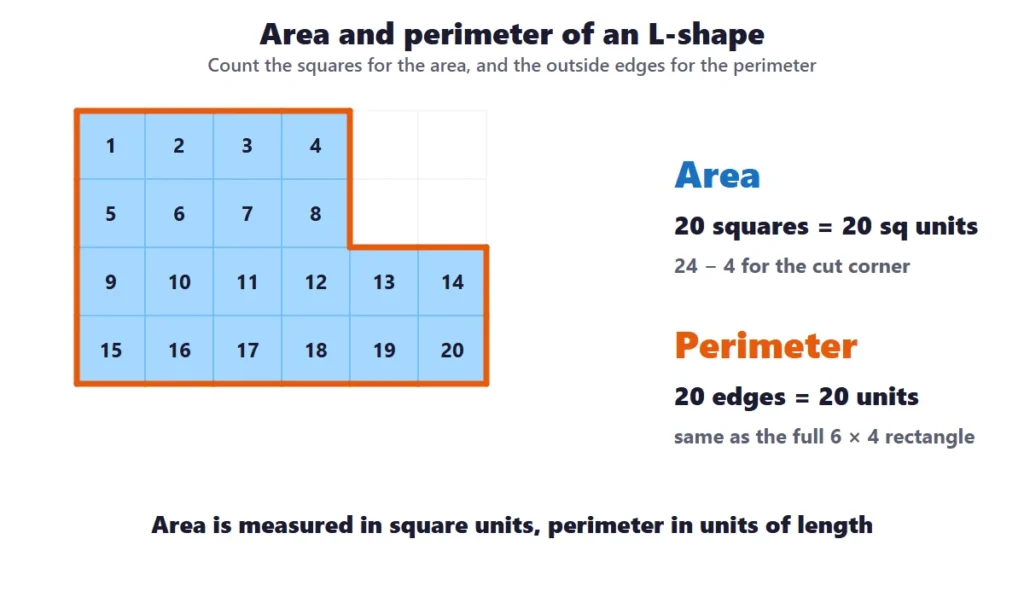
An L-shape. Area 20, perimeter 20.
From counting squares to multiplying
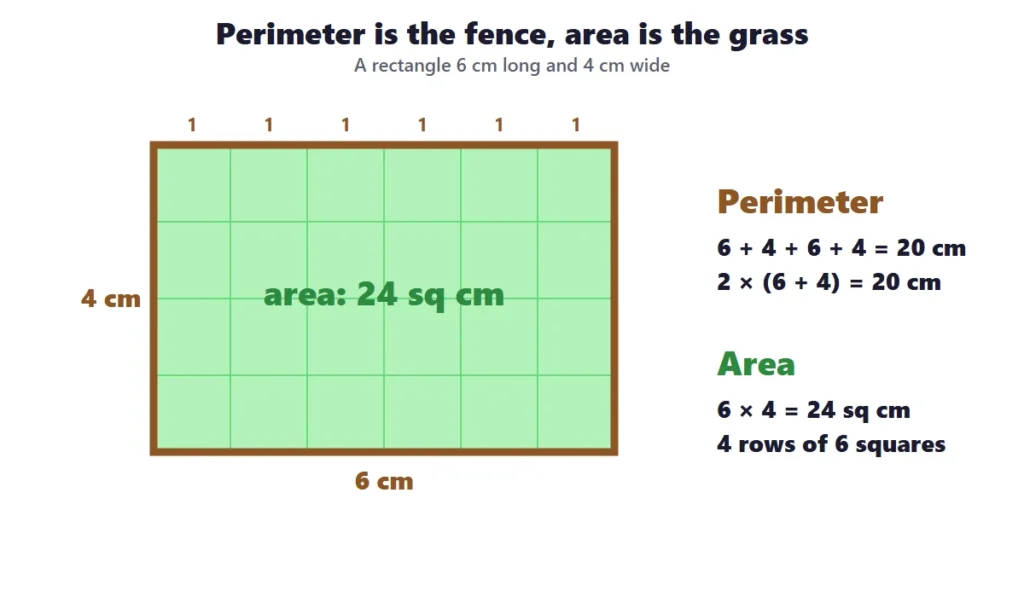
Area starts with counting: every square on the grid is 1 square unit. Children soon notice that a rectangle with 4 rows of 6 squares has 4 × 6 = 24 squares, which is the area formula (length × width). Perimeter is the total length around the edge: for a rectangle, add all four sides, or double the length plus the width.
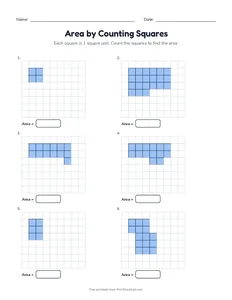
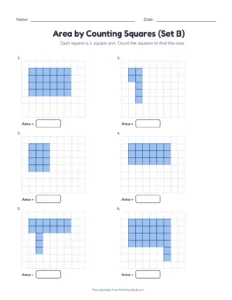
Area on a grid: count the shaded squares, including L-shapes.
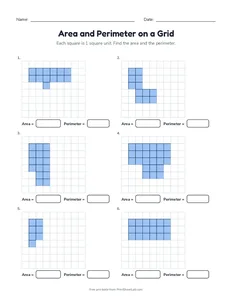
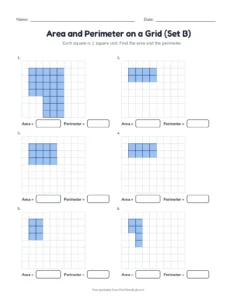
Area and perimeter on a grid: count squares and outside edges.
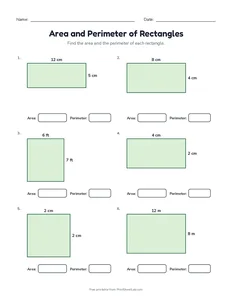
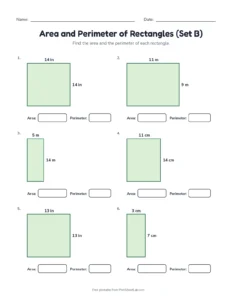
Rectangles: use the side lengths to find area and perimeter.
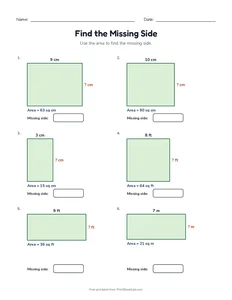
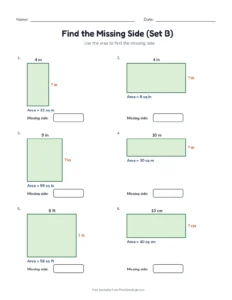
Missing side: the area is 36 sq cm and one side is 4 cm; what is the other side?
Formulas for rectangles and squares
Shape
Area
Perimeter
Rectangle
length × width
2 × (length + width)
Square
side × side
4 × side
Worked examples
A rectangle 7 cm long and 3 cm wide: area = 7 × 3 = 21 sq cm; perimeter = 2 × (7 + 3) = 20 cm.
A square with sides of 5 m: area = 25 sq m; perimeter = 20 m.
L-shape: a 6 × 4 rectangle with a 2 × 2 square cut from one corner. Area = 24 − 4 = 20 sq units. The perimeter stays 20 units, the same as the full rectangle, because the cut-out corner swaps two edges for two edges of the same length.
Missing side: the area is 36 sq cm and one side is 4 cm, so the other side is 36 ÷ 4 = 9 cm.
Area or perimeter? A memory trick
Perimeter is the fence around a field; area is the grass inside it. Perimeter is measured in units of length (cm, m); area in square units (sq cm, m²).
Try this activity
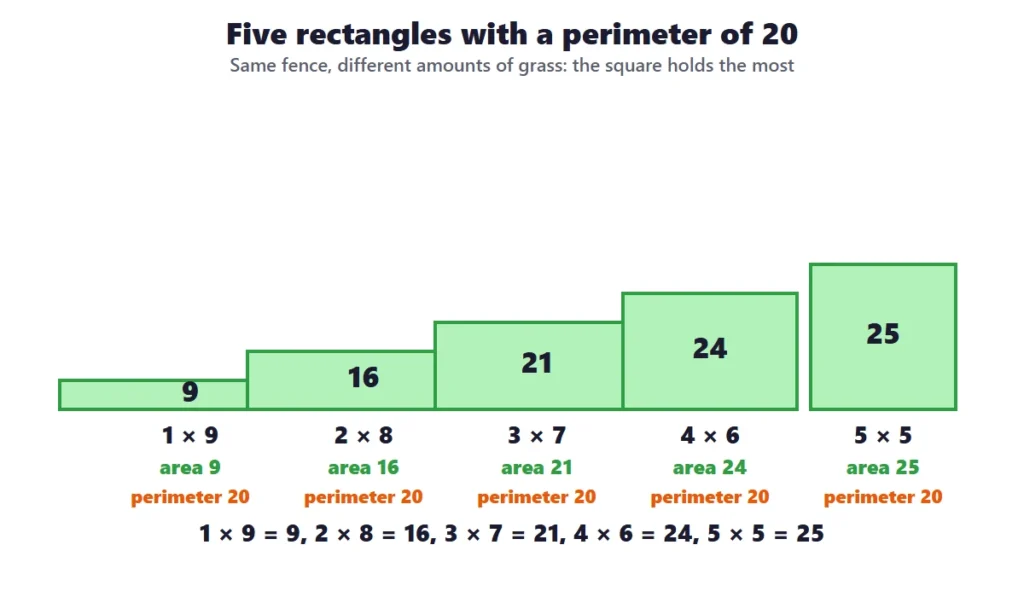
Give children 20 squares (or 20 cm of string for the perimeter). Which rectangles can they make with a perimeter of 20? 1 × 9 (area 9), 2 × 8 (16), 3 × 7 (21), 4 × 6 (24) and 5 × 5 (25). The square gives the biggest area, a result that surprises most classes.
Common mistakes
Adding only two sides for the perimeter.
Writing cm instead of sq cm for area.
Counting the corner squares twice when finding the perimeter on a grid.
Area and perimeter worksheets: what is in the set
There are 8 area and perimeter worksheets on this page, and every one has an answer key except for any cut-out games. Four sheets use grids, and the other four use the side lengths of rectangles, with two sheets that find a missing side.
Worksheet
What children do
Standard
Area by Counting Squares
Count the squares to find the area of six shapes.
3.MD.C.7
Area and Perimeter on a Grid
Find the area and perimeter of each shape.
3.MD.C.7
Area by Counting Squares (Set B)
Six more shapes to count.
3.MD.C.7
Area and Perimeter on a Grid (Set B)
Find the area and perimeter of six more shapes.
3.MD.C.7
Area and Perimeter of Rectangles
Use the side lengths to find area and perimeter.
3.MD.C.7
Find the Missing Side
Use the area to find the missing side length.
3.MD.C.7
Area and Perimeter of Rectangles (Set B)
Larger rectangles with sides up to 15.
3.MD.C.7
Find the Missing Side (Set B)
Use the area to find more missing sides.
3.MD.C.7
Area worksheets grade 3: counting squares first
The area worksheets grade 3 start with counting, because area means “how many unit squares fit inside”. Wikipedia’s article on area explains that area is always measured in square units. A child who counts the squares of a shape learns that the area of a rectangle is the number of rows times the number of columns, before they meet the formula. This table shows six shapes on a grid, with the area and the perimeter counted from the squares:
Shape on the grid
Squares (area)
Outside edges (perimeter)
Area bigger than perimeter?
Rectangle, 4 by 3
12
14
no
Square, 3 by 3
9
12
no
L-shape, 6 by 4 with a 2 by 2 corner cut out
20
20
they are equal
Plus sign
5
12
no
Staircase, rows of 1, 2, 3 and 4
10
16
no
U-shape
7
16
no
Shapes that are not rectangles, such as the L-shape and the staircase, can still have their area counted. The perimeter of the staircase is the same as the perimeter of the 4 by 4 square around it, which is 16. The plus sign has 5 squares, and its perimeter is more than twice as big, at 12. The multiplication arrays and equal groups page shows how the rows and columns of an array lead to multiplication.
Perimeter worksheets: walking around the edge
The perimeter worksheets ask children to walk around the edge of a shape and add up the lengths of the sides. For a rectangle, two sides are the length and two are the width, so the perimeter is 2 × (length + width). Wikipedia’s article on the perimeter shows the same idea for many shapes. The most surprising fact is that rectangles with the same perimeter can hold very different amounts. This table shows all the rectangles with whole-number sides and a perimeter of 20:
Rectangle
Perimeter
Area
Working
1 by 9
20
9
2 × (1 + 9) = 20 and 1 × 9 = 9
2 by 8
20
16
2 × (2 + 8) = 20 and 2 × 8 = 16
3 by 7
20
21
2 × (3 + 7) = 20 and 3 × 7 = 21
4 by 6
20
24
2 × (4 + 6) = 20 and 4 × 6 = 24
5 by 5
20
25
2 × (5 + 5) = 20 and 5 × 5 = 25
The area goes up from 9 to 25 as the rectangle gets closer to a square, and the square has the greatest area. The opposite is also true: rectangles with the same area can have very different perimeters. This table shows the four rectangles with an area of 24:
Rectangle
Area
Perimeter
Working
1 by 24
24
50
1 × 24 = 24 and 2 × (1 + 24) = 50
2 by 12
24
28
2 × 12 = 24 and 2 × (2 + 12) = 28
3 by 8
24
22
3 × 8 = 24 and 2 × (3 + 8) = 22
4 by 6
24
20
4 × 6 = 24 and 2 × (4 + 6) = 20
The thin 1 by 24 rectangle needs 50 units of fence, and the 4 by 6 rectangle needs only 20. This is why farmers and builders use shapes that are close to a square.
Area of rectangles worksheets: length times width
The area of rectangles worksheets use the side lengths instead of a grid, so the formula length × width is needed. Each square unit in the rectangle is one in a row of length squares, and there are width rows. This table shows six rectangles with both the area and the perimeter:
Perimeter 20. Five rectangles, five areas.
Length
Width
Area: length × width
Perimeter: 2 × (length + width)
7
3
21
20
9
5
45
28
12
4
48
32
15
6
90
42
8
8
64
32
11
2
22
26
The area and the perimeter can be compared only for the numbers, not for the meaning, since one is in square units and the other in units of length. If both sides of a rectangle are doubled, the perimeter doubles but the area becomes four times as big, as this table shows:
Rectangle
Area
Perimeter
Both sides doubled
New area
New perimeter
Area changes
Perimeter changes
3 by 4
12
14
6 by 8
48
28
× 4
× 2
2 by 5
10
14
4 by 10
40
28
× 4
× 2
4 by 4
16
16
8 by 8
64
32
× 4
× 2
Counting squares area: composite shapes and the L-shape
For counting squares area in an L-shape, there are two ways to find the area without counting every square. One way is to split the shape into two rectangles and add. The other is to take a smaller rectangle away from a bigger one, as in 6 × 4 − 2 × 2 = 20. The perimeter of an L-shape is a surprise: it is the same as the perimeter of the outer rectangle. This table shows five examples:
Outer rectangle
Corner cut out
Area of the L-shape
Perimeter of the L-shape
Same as the outer rectangle?
6 by 4
2 by 2
6 × 4 − 2 × 2 = 20
20
yes
8 by 5
3 by 2
8 × 5 − 3 × 2 = 34
26
yes
7 by 7
4 by 3
7 × 7 − 4 × 3 = 37
28
yes
10 by 6
5 by 4
10 × 6 − 5 × 4 = 40
32
yes
9 by 4
3 by 1
9 × 4 − 3 × 1 = 33
26
yes
The cut-out corner removes two edges from the outside, but adds two edges of the same length on the inside, so the perimeter does not change. This works for any corner that is cut out of a rectangle, which makes a good question for a class.
Missing side: using the area to find a side
The worksheets that find the missing side use the area and one side of a rectangle to find the other side. Since area = length × width, the missing side is the area divided by the side that is known. This is a use of division facts, and the times tables worksheets page has the facts. This table shows five problems, and the perimeter of each rectangle once the side is found:
Area
One side
Missing side
Perimeter of the rectangle
36
4
9
26
48
6
8
28
45
9
5
28
72
8
9
34
63
7
9
32
Squares: how area and perimeter grow
A square has equal sides, so its area is side × side and its perimeter is 4 × side. As the side grows, the area grows much faster than the perimeter. This table shows the squares from 1 to 8:
Side of a square
Area: side × side
Perimeter: 4 × side
Area is bigger than perimeter?
1
1
4
no
2
4
8
no
3
9
12
no
4
16
16
equal
5
25
20
yes
6
36
24
yes
7
49
28
yes
8
64
32
yes
A square of side 4 is special, since its area and perimeter are both 16. For smaller squares the perimeter is bigger, and for bigger squares the area is bigger. Because area and perimeter have different units, this is just a number fact, but it is a good puzzle.
Square units: why area has its own units
Area is measured in square units, such as square centimeters, which are written sq cm or cm². A square unit is a square with sides of one unit. When the unit of length changes, the square unit changes by the square of the factor. This table shows four examples:
Units of length and area
What a square unit is
Changing square units
cm and sq cm
1 sq cm is a square 1 cm by 1 cm
1 m = 100 cm, so 1 sq m = 100 × 100 = 10,000 sq cm
inches and sq inches
1 sq in is a square 1 in by 1 in
1 ft = 12 in, so 1 sq ft = 12 × 12 = 144 sq in
feet and sq feet
1 sq ft is a square 1 ft by 1 ft
1 yd = 3 ft, so 1 sq yd = 3 × 3 = 9 sq ft
meters and sq meters
1 sq m is a square 1 m by 1 m
1 km = 1,000 m, so 1 sq km = 1,000,000 sq m
This is the reason why changing between square units is harder than changing between units of length. The converting units page has the conversions for length, weight, capacity and time.
Where area and perimeter are used
Every job that involves covering or surrounding a shape uses area or perimeter. This table shows six jobs and which one each uses:
Job
Area or perimeter?
Example
Fence around a yard
perimeter
20 m of fence for a 6 m by 4 m yard
Carpet for a floor
area
24 sq m of carpet for the same size
Frame for a picture
perimeter
wood for the 4 sides
Tiles for a bathroom wall
area
count the tiles that cover the wall
Seed for a lawn
area
a bag covers a number of sq m
Running track
perimeter
the distance of one lap
The perimeter and area calculator checks answers for rectangles and other shapes, and the geometry worksheets pages show the shapes themselves. The two measures come back in grade 4, where children use the formulas to solve problems in standard 4.MD.A.3, and in grade 6, where they find areas of triangles and other polygons.
More common mistakes with area and perimeter
The mistakes below add to the list above. They come up most with rectangles and with L-shapes. This table shows five of them, what went wrong and the fix:
What the child writes or says
What went wrong
The fix
A 7 by 3 rectangle has a perimeter of 21
multiplies, which gives the area
add all four sides: 7 + 3 + 7 + 3 = 20
The perimeter of a 6 by 4 rectangle is 10
adds only two sides
a rectangle has four sides: 2 × (6 + 4) = 20
The area is 24 cm
writes the wrong unit
area is in square units: 24 sq cm
The L-shape has a bigger perimeter than its outer rectangle
thinks the cut-out makes the outline longer
the outline is the same length as the outer rectangle
The missing side is 36 × 4 = 144
multiplies instead of dividing
area ÷ the known side: 36 ÷ 4 = 9
Area and perimeter word problems
Area and perimeter come up in gardens, rooms and posters. Ask children to draw the shape, label the sides, and say whether the question is about area or perimeter:
Word problem
Working
Answer
A garden is 8 m long and 5 m wide. How much fence is needed to go all the way around it?
2 × (8 + 5)
26 m
A rug is 6 ft long and 4 ft wide. How much floor does it cover?
6 × 4
24 sq ft
A square tile has sides of 9 cm. What are its area and its perimeter?
9 × 9 and 4 × 9
81 sq cm and 36 cm
The area of a rectangle is 48 sq m and one side is 6 m. How long is the other side?
48 ÷ 6
8 m
A poster is 12 in by 9 in. How much ribbon is needed to go around the edge?
2 × (12 + 9)
42 in
A room 7 m by 5 m has a 2 m by 2 m cupboard in one corner. How much floor is left uncovered by the cupboard?
7 × 5 − 2 × 2
31 sq m
Games and activities for area and perimeter
Children learn area and perimeter best when they play with it. These games use things that are found at home or in a classroom:
Fence and grass. 6 by 4: area 24, perimeter 20.
Fence the field: give each child 20 cm of string, and ask them to find the rectangle with the most area
Tile a floor: cover a rectangle on grid paper with square tiles, and count them
Same area, new shape: find as many rectangles with an area of 24 as you can, and write their perimeters
Playground sketch: draw a plan of a playground on grid paper, and find its area and perimeter
L-shape challenge: cut a corner from a rectangle, and find the area and perimeter before and after
Area and perimeter bingo: a bingo card with the answers, and calling cards with the shapes
Extra support and extra challenge with area and perimeter
For children who need more support: start with squares on a grid, and count them one by one. Color the inside for the area, and trace the outside edge in another color for the perimeter. Say the units aloud: square units for area, units for perimeter. Do the grid sheets before the sheets that use only side lengths, and use the answer key to check.
For children who need more challenge: ask for the rectangle with a perimeter of 30 and the greatest area, for an L-shape with an area of 30, and for two shapes with the same perimeter and different areas. The sheets with larger rectangles and the missing sides are good challenges, and so is the L-shape with a cut-out.
How to tell that a child is ready to move on from area and perimeter
Before moving on from area and perimeter, check that the child can do all four of these things:
The child counts squares to find the area of a shape on a grid.
The child finds the perimeter by adding all the sides.
The child uses length × width for the area of a rectangle.
A short lesson is the best way to introduce area and perimeter. This 20-minute plan can be used in a classroom, at a tutoring session or at home, and it uses the worksheets at the end:
Minutes
Activity
What to say or ask
0 to 3
Show a rectangle on a grid and ask how many squares fit inside
How can we count them quickly?
3 to 8
Write 4 rows of 6 squares as 4 × 6 = 24
Where is the area, and where is the perimeter?
8 to 13
Trace the edge of the rectangle in a second color and count
How long is the edge?
13 to 18
Find all the rectangles with a perimeter of 20
Which has the most area?
18 to 20
Start a worksheet and check one answer
Did we use the right units?
Where area and perimeter fits across the grades
No skill stands alone. This table shows what children learn before and after area and perimeter, with the standard that goes with each step:
Grade
What children do
Standard or page
Grade 2
Partition a rectangle into rows and columns of squares
This page is the main page for area and perimeter. The whole sequence is on the measurement worksheets page.
Helping at home with area and perimeter
Parents do not need to be experts to help with area and perimeter. These suggestions work well, and each takes only a few minutes:
Measure a room or a table and find its area and perimeter.
Ask “how much fence?” or “how much carpet?” to see the difference.
Use graph paper to draw a rectangle and count the squares.
Use a baking tray to find the area of the cake.
Check each answer for the right units.
How to check progress in area and perimeter
A teacher or parent can check progress in area and perimeter with the answer key and a few questions. This table shows three common situations, what they mean and what to do next:
What you see
What it means
What to do next
The child mixes up area and perimeter
The two ideas have not yet been tied to a picture
Color the inside for the area and trace the edge for the perimeter
The child gets 9 of 10 right in every set
The skill is secure
Move on to converting units, or to larger shapes
The child writes the wrong units
The idea of a square unit is not clear
Show a square unit, and count how many fit
A five-day plan for area and perimeter
Most children need about a week of short sessions for area and perimeter. This plan follows the order of the worksheets on this page:
Day
What to do
Practice
Day 1
Count squares on a grid, and find the area of six shapes
Count every outside edge of the squares, or add up the lengths of all the sides as you walk around the shape.
Can two shapes have the same area but different perimeters?
Yes. A 1 × 12 rectangle and a 3 × 4 rectangle both have area 12, but their perimeters are 26 and 14.
What grade learns area and perimeter?
In US schools, grade 3 (standards 3.MD.C.5–7 for area and 3.MD.D.8 for perimeter), with formulas used more in grade 4.
Is area always bigger than perimeter?
No. They are different kinds of measure, so they cannot be compared directly. A 1 × 1 square has area 1 sq unit and perimeter 4 units.
What is the difference between area and perimeter?
Perimeter is the distance around the edge of a shape, and it is measured in units of length. Area is the amount of surface inside the shape, and it is measured in square units.
Do rectangles with the same area always have the same perimeter?
No. A 1 by 24 rectangle and a 4 by 6 rectangle both have an area of 24, but their perimeters are 50 and 20. For a fixed area, the closer the rectangle is to a square, the shorter its perimeter.