Handwriting paper by grade usually steps down from about 1 inch rows with a dotted midline in pre-K and kindergarten, to 5/8 inch in grade 1, 1/2 inch in grade 2 and 3/8 inch in grades 3 and 4, before children move to wide ruled lined paper (11/32 inch). The exact size depends on the handwriting programme your school uses, so this guide gives every common ruling in inches and millimetres, shows them to scale, and explains when to move down a size.
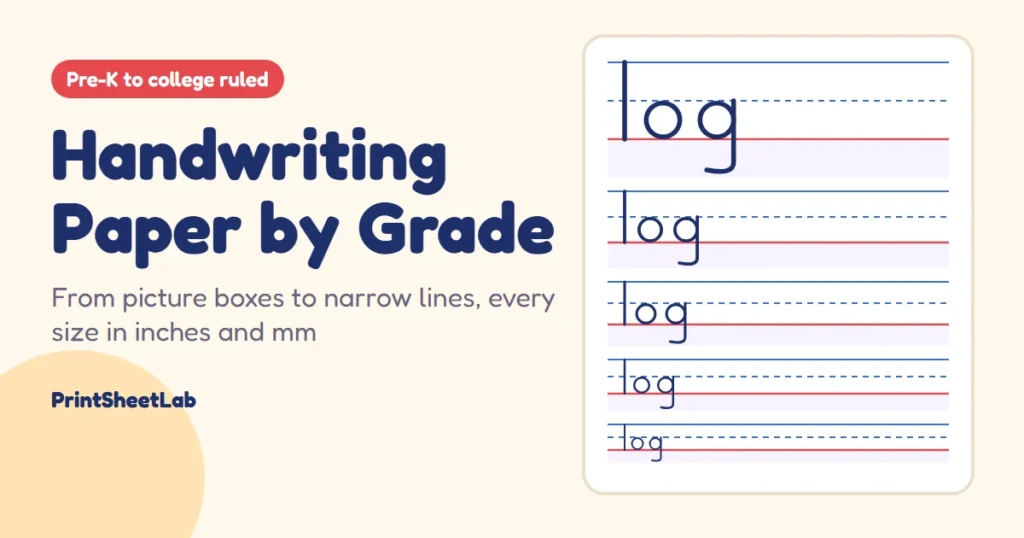
If you just need a page now, our free handwriting paper for kindergarten prints 1 inch, 3/4 inch, 5/8 inch, 1/2 inch and 3/8 inch rows, with an optional picture box and red baseline. Everything below helps you match handwriting paper by grade to the child in front of you.
Handwriting paper by grade: the full size chart
US primary paper is described by its ruling: the distance from the top line (headline) to the baseline. A dotted midline sits exactly halfway, and most sheets leave a skip space of the same height below each row for tails. The sizes and programme matches below come from the School Specialty ruled paper guide, a US school paper maker’s catalogue of rulings.
| Handwriting paper by grade (typical stage) | Ruling (top line to baseline) | Dotted midline height | Skip space for tails | Sold to match |
|---|---|---|---|---|
| Preschool and pre-K | 1 1/8 in (28.57 mm) | 9/16 in (14.29 mm) | 9/16 in (14.29 mm) | Zaner-Bloser pre-K and K |
| Preschool to early K | 1 in (25.4 mm) | 1/2 in (12.7 mm) | 1/2 in (12.7 mm) | No programme stated |
| Kindergarten to grade 1 | 7/8 in (22.23 mm) | 7/16 in (11.11 mm) | 7/16 in (11.11 mm) | No programme stated |
| Kindergarten | 3/4 in (19.05 mm) | 3/8 in (9.53 mm) | 3/8 in (9.53 mm) | Zaner-Bloser K |
| Grade 1 | 5/8 in (15.88 mm) | 5/16 in (7.94 mm) | 5/16 in (7.94 mm) | Zaner-Bloser grade 1, D’Nealian K |
| Grade 2 | 1/2 in (12.7 mm) | 1/4 in (6.35 mm) | 1/4 in (6.35 mm) | Zaner-Bloser grade 2, D’Nealian grades 1 to 3 |
| Grades 3 and 4 | 3/8 in (9.53 mm) | 3/16 in (4.76 mm) | 3/16 in (4.76 mm) | Zaner-Bloser grades 3 and 4 |
Millimetres are exact conversions using 1 inch = 25.4 mm, the definition published by NIST. Treat any handwriting paper by grade chart, this one included, as a guide rather than a rule: Zaner-Bloser and D’Nealian match different sizes to the same grade, and many teachers choose by the child rather than the year group.

Why the size of the lines matters
The lines tell a child how big each letter should be. Rows that are too narrow squash letters and push tails into the next row. Rows that are too wide make writing slow, and a short sentence fills the page.
Older pupils are expected to control this spacing themselves. The English national curriculum asks Year 2 pupils to “form lower-case letters of the correct size relative to one another”, and Years 3 and 4 to space lines so that ascenders and descenders do not touch (gov.uk, English programmes of study). Picking the right handwriting paper by grade is how younger children practise that relationship before they have to judge it on plain lines.
In the US, the Common Core language standards expect kindergarteners to “print many upper- and lowercase letters” and first graders to print all of them (Common Core, L.K.1a). They set no paper size, so rulings vary between schools.
Picture boxes and preschool handwriting paper
Preschool handwriting paper uses the biggest rows (1 inch or 1 1/8 inch) and often only two or three rows per page, with a large picture box on top. The picture comes first: a child draws, then writes one word or a short label underneath. That keeps the writing load small while the child learns where the top line, midline and baseline are. It is the first rung of handwriting paper by grade, and many children stay on it for most of the preschool year.
Use our story paper with a picture box for draw-and-write journals, and switch the picture box on in the kindergarten handwriting paper when you want bigger rows. Tracing comes before free writing for many children, so pair the paper with letter tracing worksheets or name tracing sheets.
If your child still finds the pencil hard to control, paper size is not the first fix. Our guide to fine motor skills activities at home covers the hand strength side, and how to teach a child to write their name covers the usual first word.
Letter sizing on dotted midline paper
Every lowercase letter belongs to one of three height groups, and the three lines show each group where to stop. The groups are the same on every rung of handwriting paper by grade; only the measurements change. Here is the 5/8 inch grade 1 ruling as a worked example:
| Letter group | Letters | Where it sits | Height on 5/8 inch paper |
|---|---|---|---|
| Short letters | a c e i m n o r s u v w x z | Baseline up to the dotted midline | 5/16 in (7.94 mm) |
| Tall letters | b d f h k l (t is a little shorter in some styles) | Baseline up to the top line | 5/8 in (15.88 mm) |
| Tail letters | g j p q y | Body to the midline, tail into the skip space | Body 5/16 in, tail up to 5/16 in below |
| Capitals and digits | A to Z, 0 to 9 | Baseline up to the top line | 5/8 in (15.88 mm) |
Dots on i and j go in the space between the midline and the top line. Halve or scale these numbers for any other ruling: on 1/2 inch paper short letters are 1/4 inch (6.35 mm) tall, and on 3/8 inch paper they are 3/16 inch (4.76 mm).
The most common mistake is letting short letters grow to the top line, so “a” and “d” look the same height. Say the group aloud as the child writes (“short letter, stop at the dots”). Our guide to letter formation order groups letters by stroke, and uppercase vs lowercase letters explains when capitals belong in a word.
When to move down a size
Moving to the next size of handwriting paper by grade is a small change: the table shows how much shorter each row gets. Go one size at a time rather than jumping from 1 inch to 1/2 inch.
| Step | Row height drops by | Change in letter size |
|---|---|---|
| 1 1/8 in to 1 in | 3.17 mm shorter | 11% smaller |
| 1 in to 7/8 in | 3.17 mm shorter | 12% smaller |
| 7/8 in to 3/4 in | 3.17 mm shorter | 14% smaller |
| 3/4 in to 5/8 in | 3.17 mm shorter | 17% smaller |
| 5/8 in to 1/2 in | 3.17 mm shorter | 20% smaller |
| 1/2 in to 3/8 in | 3.17 mm shorter | 25% smaller |
Signs your child is ready for the next handwriting paper size:
- Short letters stop at the midline and tall letters reach the top line without being reminded.
- Letters sit on the baseline instead of floating above it.
- Tails stay in the skip space and don’t touch the next row.
- The child can write a full sentence on the current ruling without tiring or pressing hard.
- Letters are starting to look small for the rows, with lots of empty space above them.
Keep the bigger rows for new skills, such as a tricky new letter or the start of joined writing. Try each new size of handwriting paper by grade for a week of short tasks (a list, a card, a sentence a day) before longer writing.

Wide ruled and college ruled: the last steps of handwriting paper by grade
Once children write neatly on 3/8 inch rows, the next stage is ordinary lined paper with no midline. The jump is bigger than it looks, because on lined paper the spacing is measured line to line and a whole letter, tail included, has to fit inside it.
| Lined paper | Line spacing | In mm | Lines per inch | Typical stage |
|---|---|---|---|---|
| Wide ruled | 11/32 in | 8.73 mm | 2.91 | Upper elementary, often from about grade 3 to 5 |
| College ruled | 9/32 in | 7.14 mm | 3.56 | Middle school and up |
| Narrow ruled | 1/4 in | 6.35 mm | 4 | Small handwriting, older students |
So wide ruled is not the same as 3/8 inch handwriting paper. On 3/8 inch primary paper a row plus its skip space is 9/16 inch (14.29 mm) tall; on wide ruled paper the whole line is 11/32 inch (8.73 mm). Spacings are from the ruled paper article on Wikipedia. For the side-by-side comparison, read our wide ruled vs college ruled guide, then print either from the printable lined paper page.
Handwriting paper by grade in the UK, India and elsewhere
Outside the US, handwriting paper by grade is measured in millimetres, and there is no single national size. In the UK, a British Standard for school exercise books exists (BS 4448), primary books are commonly ruled at 15 mm, and secondary pupils move to adult ruling, most often 8 mm. Suppliers also sell 12 mm books, which sit between the two.
| UK ruling | Exact inches | Closest US size | Where you will see it |
|---|---|---|---|
| 15 mm | 0.591 in | Just under 5/8 in (15.88 mm) | Early primary exercise books |
| 12 mm | 0.472 in | Just under 1/2 in (12.7 mm) | Some primary books, between the two |
| 8 mm | 0.315 in | Between college (7.14 mm) and wide (8.73 mm) | Secondary (adult ruling) and some upper primary classes |
A difference from US paper: many UK books are single lines with no dotted midline, so children judge letter size by eye. In India, notebooks come four-ruled (the closest to US handwriting paper), double-ruled and single-ruled, and the school list usually says which one each class needs. In Pakistan and the Gulf, the notebook style usually follows the school’s curriculum (British, Indian or local), so check the stationery list before buying.
To print UK sizes, use the printable paper generator, choose lined paper and type a custom spacing in millimetres (15, 12 or 8).
Printable handwriting paper by grade on PrintSheetLab
- Pre-K and kindergarten: 1 inch or 3/4 inch rows on the kindergarten handwriting paper, plus kindergarten writing worksheets for guided sentences.
- Grade 1 and 2: 5/8 inch then 1/2 inch rows; add letter practice worksheets and number writing practice for digits.
- Grades 3 and 4: 3/8 inch rows, then cursive writing worksheets if your school teaches joined writing.
- Grade 4 and up: wide ruled, then college ruled lined paper.
The full printable paper library also covers paper children meet in other subjects: graph paper and graph paper with axes for maths, dot grid, isometric, hexagon and perspective drawing paper for art, blank number lines, Cornell notes, calligraphy practice paper, storyboards and comic book pages. Music and craft pages include staff paper, guitar tab paper, blank chord charts and knitting graph paper. Older students can use polar, semi-log and log-log graph paper, or design anything else in the specialty paper generator.
Always print at 100% (“actual size”), not “fit to page”, or every ruling shrinks slightly and the sizes in this guide no longer match.
Common mistakes when choosing handwriting paper by grade
- Reading handwriting paper by grade too literally. A child who is struggling in grade 2 may still need 5/8 inch rows.
- Mixing programmes. If school uses Zaner-Bloser 3/4 inch paper in kindergarten, home practice on 1/2 inch D’Nealian sheets will feel cramped.
- Skipping the skip space. Paper with rows touching each other leaves no room for tails, so g, p and y collide.
Related guides and printables
- Graph paper sizes explained, the maths-grid version of handwriting paper by grade
- Scissor skills by age, another fine motor milestone
- Kindergarten tracing worksheets for first letters
- The order to teach letter formation
Sources
Primary rulings and programme matches: School Specialty ruled paper guide (PDF). Lined paper spacings, UK and India notes: Wikipedia, Ruled paper. Inch to millimetre: NIST. England handwriting requirements: gov.uk. US standards: Common Core, L.1.1a. Handwriting paper by grade labels in this guide are typical, and schools vary.
Frequently asked questions
7 quick answers
What size handwriting paper is best for kindergarten?
Most kindergarten children start on 1 inch or 3/4 inch rows with a dotted midline. Zaner-Bloser matched paper uses 3/4 inch for kindergarten (1 1/8 inch for pre-K and K), while D’Nealian matched paper uses 5/8 inch.
What is the line size for 1st grade handwriting paper?
Grade 1 paper is usually 5/8 inch (15.88 mm) from top line to baseline, with a dotted midline 5/16 inch above the baseline. Some D’Nealian classrooms already use 1/2 inch rows in grade 1.
What is preschool handwriting paper?
Preschool handwriting paper has the largest rows, usually 1 inch or 1 1/8 inch, with a dotted midline, few rows per page and often a picture box at the top for drawing.
When should a child switch to wide ruled paper?
Usually once they write evenly on 3/8 inch primary rows, often between grades 3 and 5. Wide ruled paper is 11/32 inch (8.73 mm) line to line with no midline, so try it for short tasks first.
Is there an official standard for handwriting paper by grade?
No. In the US, rulings follow the handwriting programme a school uses (Zaner-Bloser and D’Nealian differ), and the Common Core standards do not set a paper size. Check the paper your child brings home from school and match it.
Can I print handwriting paper by grade at home?
Yes. The PrintSheetLab handwriting paper prints 1 inch, 3/4 inch, 5/8 inch, 1/2 inch and 3/8 inch rows as a free PDF for US Letter or A4. Print at 100% (actual size) so the rows keep their exact height.
Is handwriting paper by grade the same in the UK?
No. UK schools use metric exercise books: 15 mm ruling is common in early primary, 12 mm in between, and 8 mm in upper primary and secondary. Many UK books have no dotted midline.