Elapsed time is the amount of time that passes between a start time and an end time, and working it out means counting in hours and minutes, which is harder than counting in tens. The four PDFs on this page ask how much time has passed between two clocks, what time it will be after a number of minutes, and mixed problems, including hours and half hours, and every sheet has an answer key.
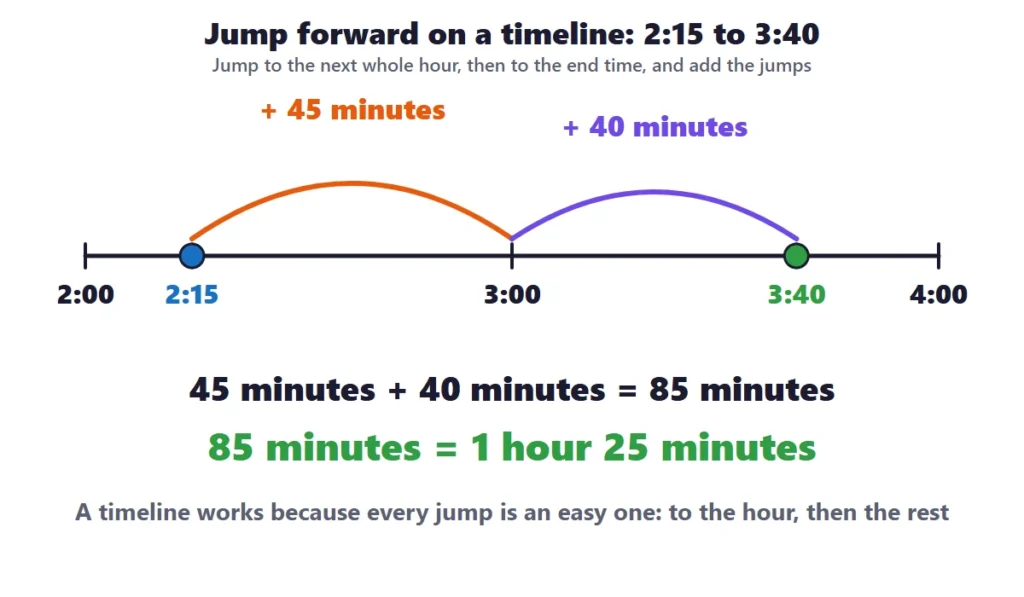
Jumping on a timeline. 2:15 to 3:40 is 1 hour 25 minutes.
Jumping forward on a timeline
The easiest way to work out elapsed time is to jump in friendly steps: first to the next whole hour, then whole hours, then the minutes left. From 2:15 to 3:40: 2:15 to 3:00 is 45 minutes, 3:00 to 3:40 is 40 minutes, so 1 hour 25 minutes in total.
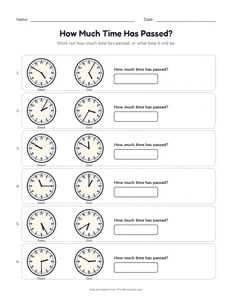
How long? Start and end clocks: how much time has passed?
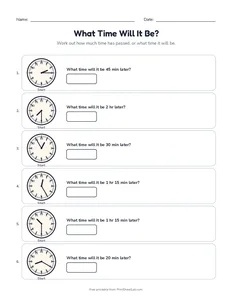
What time? A start clock and a number of minutes: what time will it be?
Elapsed time worksheets: what is in the set
There are 4 elapsed time worksheets on this page, and every one has an answer key except for any cut-out games. Two sheets of clocks ask how much time has passed and what time it will be, a mixed sheet combines both, and a fourth sheet uses start and end times an hour or more apart.
Worksheet
What children do
Standard
How Much Time Has Passed?
Compare start and end clocks.
3.MD.A.1
What Time Will It Be?
Add minutes to the start time.
3.MD.A.1
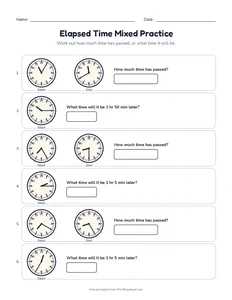
Elapsed Time Mixed Practice
How long, and what time, together.
3.MD.A.1
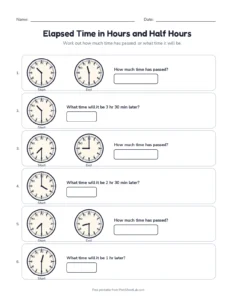
Elapsed Time in Hours and Half Hours
Start and end times an hour or more apart.
3.MD.A.1
How much time has passed? The timeline method in a table
How much time has passed between two times is easy to find when it is broken into three jumps: to the next whole hour, then whole hours, then the minutes that are left. The jumps are all easy, so the method works for any problem, even when the clock crosses noon. This table shows six problems, and the picture above shows the first one on a timeline:
Start and end
Jump to the next whole hour
Whole hours
Minutes left
Elapsed time
2:15 to 3:40
45 min
0 h
40 min
1 h 25 min
8:50 to 10:20
10 min
1 h
20 min
1 h 30 min
3:25 to 4:05
35 min
0 h
5 min
40 min
7:45 to 9:10
15 min
1 h
10 min
1 h 25 min
11:30 a.m. to 2:15 p.m.
30 min
2 h
15 min
2 h 45 min
9:05 a.m. to 12:40 p.m.
55 min
2 h
40 min
3 h 35 min
The elapsed time is the total of the three jumps. For 2:15 to 3:40, the jump to 3:00 is 45 minutes and the minutes left are 40, so the answer is 85 minutes, which is 1 hour 25 minutes. The jump to the next whole hour is the clever one, because it turns a hard subtraction such as 3:40 − 2:15 into two easy additions.
Elapsed time grade 3: three ways to get the same answer
For elapsed time grade 3 children use the timeline, but there is a second way that older children enjoy. They change both times to minutes since midnight and subtract. The answers are the same. This table shows the two methods for the six problems:
Problem
Timeline jumps
Minutes since midnight
Answer
2:15 to 3:40
45 min + 40 min
220 − 135 = 85
1 h 25 min
8:50 to 10:20
10 min + 1 h + 20 min
620 − 530 = 90
1 h 30 min
3:25 to 4:05
35 min + 5 min
245 − 205 = 40
40 min
7:45 to 9:10
15 min + 1 h + 10 min
550 − 465 = 85
1 h 25 min
11:30 a.m. to 2:15 p.m.
30 min + 2 h + 15 min
855 − 690 = 165
2 h 45 min
9:05 a.m. to 12:40 p.m.
55 min + 2 h + 40 min
760 − 545 = 215
3 h 35 min
The second method is useful as a check, since it uses ordinary subtraction. It needs care with a.m. and p.m.: 2:15 p.m. is 14:15 on a 24-hour clock, which is 855 minutes after midnight. The third way is to move the minute hand on a printable clock, counting how many minutes it goes round. The standard 3.MD.A.1 asks for time intervals in minutes, and in grade 4 children solve problems with hours and minutes together (4.MD.A.2).
Elapsed time with clocks: how far do the hands turn?
Elapsed time with clocks is easiest to see when children watch both hands. The minute hand turns 6 degrees every minute, so it makes a full turn in 60 minutes. The hour hand turns half a degree every minute, so it moves from one number to the next in an hour. This table shows how far each hand turns for six elapsed times:
Elapsed time
Minute hand turns
In full turns
Hour hand moves
15 min
90 degrees
1/4
7.5 degrees
30 min
180 degrees
1/2
15 degrees
45 min
270 degrees
3/4
22.5 degrees
1 h
360 degrees
1
30 degrees
1 h 30 min
540 degrees
1 1/2
45 degrees
2 h 15 min
810 degrees
2 1/4
67.5 degrees
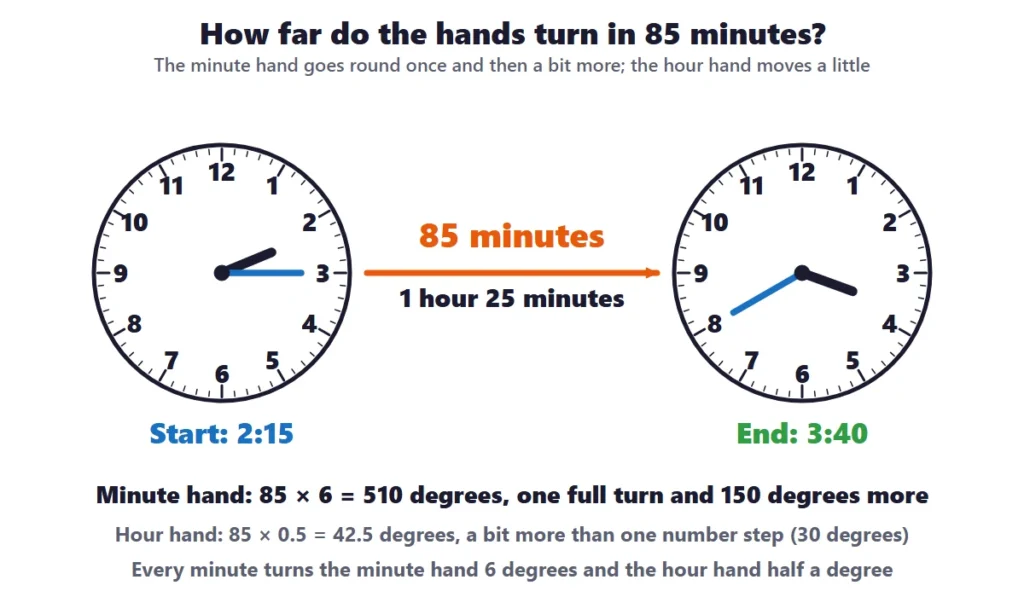
In 85 minutes the minute hand turns 510 degrees, a full turn plus 150 degrees, and the hour hand moves 42.5 degrees. The picture above shows the start and end clocks for 2:15 to 3:40. A child who counts how many times the minute hand passes the 12 has counted the whole hours. The telling time to 5 minutes and telling time to the minute pages explain how to read the hands.
What time will it be? Adding minutes to a start time
The second type of problem on these worksheets gives a start time and a number of minutes and asks for the end time. The method is the same, but the other way round: add enough minutes to reach the next whole hour, then add the rest. This table shows six problems:
Problem
Steps
End time
3:35 + 40 min
3:35 to 4:00 is 25 min, then 15 more
4:15
8:20 + 25 min
8:20 + 25 min = 8:45
8:45
10:50 + 1 h 15 min
10:50 to 11:00 is 10 min, then 65 more
12:05
4:15 + 1 h 30 min
4:15 to 5:00 is 45 min, then 45 more
5:45
6:45 + 50 min
6:45 to 7:00 is 15 min, then 35 more
7:35
11:30 + 45 min
11:30 to 12:00 is 30 min, then 15 more
12:15
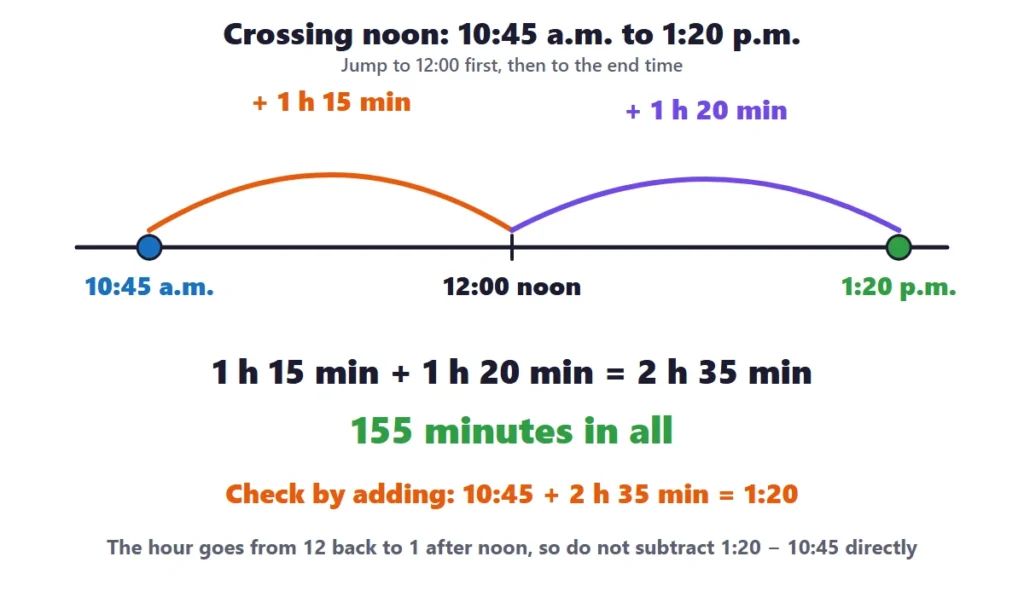
When the minutes go over an hour, as in 10:50 + 1 h 15 min, it helps to add the hour first and then the 15 minutes. The answer, 12:05, is past noon, so the clock goes from 11:59 to 12:00 and not to 13:00. On a 12-hour clock the hour number goes back to 1 after 12.
The base-60 trap: why elapsed time goes wrong
Elapsed time goes wrong when children subtract time as if it were a decimal number. An hour has 60 minutes, not 100, so the usual “take the smaller from the larger” in the minutes column gives wrong answers. This table shows five problems where that happens:
Start and end
What the child does
The wrong answer
The right answer
2:50 to 4:20
4 h − 2 h = 2 h, and 50 − 20 minutes looks like 30
2 h 30 min
1 h 30 min
3:45 to 5:10
5 h − 3 h = 2 h, and 45 − 10 minutes looks like 35
2 h 35 min
1 h 25 min
1:35 to 3:05
3 h − 1 h = 2 h, and 35 − 5 minutes looks like 30
2 h 30 min
1 h 30 min
6:40 to 8:15
8 h − 6 h = 2 h, and 40 − 15 minutes looks like 25
2 h 25 min
1 h 35 min
9:55 to 11:20
11 h − 9 h = 2 h, and 55 − 20 minutes looks like 35
2 h 35 min
1 h 25 min
Each wrong answer is between 50 and 70 minutes too long, because the borrowed hour was never taken from the hours. The timeline method avoids the trap, since it never subtracts minutes: it only adds. A child who says “from 2:50 to 3:00 is 10 minutes” cannot go wrong in this way.
Time word problems: finding the start time
The time word problems on the worksheets ask for the time that something ends, or for how long it lasts. A harder kind asks for the time that something started, when the end time and the length are known. The method is to jump back, first by the hours and then by the minutes. This table shows four problems:
Problem
Steps
Start time
Ends at 4:10, lasts 1 h 40 min
4:10 − 1 h = 3:10, then back 40 min
2:30
Ends at 7:05, lasts 55 min
7:05 back 5 min = 7:00, then back 50 more
6:10
Ends at 12:20, lasts 2 h 15 min
12:20 − 2 h = 10:20, then back 15 min
10:05
Ends at 9:35, lasts 1 h 20 min
9:35 − 1 h = 8:35, then back 20 min
8:15
Start and end clocks. The hands turn 510 and 42.5 degrees.
Jumping back is just the reverse of jumping forward, so children can check each answer by adding the length to the start time. The two-step word problems page has more time stories that need two steps.
How much time has passed in a school day?
A school day gives children real elapsed times to work out. This table shows one school day in parts, with the elapsed time and the minutes for each part:
Part of the day
Times
Elapsed time
Minutes
Arrive at school to Morning break
8:30 to 10:15
1 h 45 min
105
Morning break to Lunch
10:15 to 12:00
1 h 45 min
105
Lunch to Afternoon lessons
12:00 to 1:00
1 h
60
Afternoon lessons to Home time
1:00 to 3:15
2 h 15 min
135
Whole day
8:30 to 3:15
6 h 45 min
405
The parts add up to the whole day, a check that children should make: the four parts total 405 minutes, which is 6 hours 45 minutes. If the times on your own timetable are different, children can work out their own day. The telling time worksheets page has the clock-reading pages that come before this.
Common mistakes with elapsed time
Most mistakes come from treating hours and minutes as ordinary numbers. This table shows five mistakes, what went wrong and the fix:
What the child writes
What went wrong
The fix
11:30 a.m. to 2:15 p.m. = 9 h 15 min
subtracts 2:15 − 11:30 as if both were on the same side of 12
jump to 12:00 first (30 min), then to 2:15 (2 h 15 min): 2 h 45 min
3:25 to 4:05 = 80 minutes
subtracts 4.05 − 3.25 as decimals and reads the 0.80 as 80 minutes
time is not decimal: jump to 4:00 (35 min), then 5 more, which is 40 minutes
2:50 to 4:20 = 2 h 30 min
takes the smaller minutes from the larger
jump to 3:00 (10 min), to 4:00 (1 h), to 4:20 (20 min): 1 h 30 min
2:15 + 50 min = 2:65
adds minutes without changing 60 to an hour
there are only 60 minutes in an hour: 2:15 + 45 = 3:00, then 5 more is 3:05
A 90-minute film is 1 h 90 min
writes the minutes without changing them to hours
90 minutes is 60 + 30, so 1 hour 30 minutes
Elapsed time word problems
Elapsed time problems are about real events: lessons, films, journeys and baking. Ask children to say which kind of problem it is, to draw a timeline and to give the answer in a sentence:
Word problem
Working
Answer
School starts at 8:50 and the first lesson ends at 9:40. How long is the lesson?
8:50 to 9:00 is 10 min, then 40 min
50 minutes
A movie starts at 2:15 and lasts 1 hour 40 minutes. What time does it end?
2:15 + 1 h = 3:15, + 40 min = 3:55
3:55
Mia starts her homework at 4:25 and finishes at 5:10. How long did it take?
4:25 to 5:00 is 35 min, then 10 min
45 minutes
A train leaves at 10:45 a.m. and arrives at 1:20 p.m. How long is the journey?
10:45 to 12:00 is 1 h 15 min, then 1 h 20 min
2 hours 35 minutes
A cake bakes for 50 minutes. It goes in the oven at 3:35. What time should it come out?
3:35 + 25 min = 4:00, + 25 min = 4:25
4:25
A soccer game ends at 6:10 and lasted 1 hour 30 minutes. What time did it start?
6:10 − 1 h = 5:10, − 30 min = 4:40
4:40
Games and activities for elapsed time
Children learn elapsed time best when they play with it. These games use things that are found at home or in a classroom:
Timeline jumps: draw a long line on the floor with chalk, mark the start and the end, and hop to the next hour and then on
Clock race: one child sets a start time on a clock and the other sets the end time after a number of minutes
Schedule maker: plan a Saturday with five events, and work out how long each one lasts
What time will it be?: turn over a time card and a minutes card, and add them
Stopwatch challenge: guess when 30 seconds, one minute and two minutes have passed, and check with a timer
Fix the answer: a teacher writes a wrong elapsed time and children find and fix the mistake
Extra support and extra challenge with elapsed time
For children who need more support: use a real clock, or the printable clock, and move the minute hand to the next hour, then on. Say each jump aloud: “from 2:15 to 3:00 is 45 minutes”. Draw the timeline before solving. Start with times that do not cross an hour, then times that do, and use only whole hours and half hours at first.
For children who need more challenge: ask for the start time when the end time and the length are known, for problems that cross noon or midnight, and for the total time of a trip with two stops. Try 24-hour times, such as 13:25 to 16:10, and a timetable from a train or bus.
How to tell that a child is ready to move on from elapsed time
Before moving on from elapsed time, check that the child can do all four of these things:
Crossing noon. 2 hours 35 minutes.
The child can read analog and digital clocks to the nearest minute.
The child jumps to the next whole hour and then adds the rest.
The child can find an end time and a start time.
The child checks an answer by adding the length to the start time.
A short lesson is the best way to introduce elapsed time. This 20-minute plan can be used in a classroom, at a tutoring session or at home, and it uses the worksheets at the end:
Minutes
Activity
What to say or ask
0 to 4
Show 2:15 and 3:40 on two clocks and ask how much time has passed
How could we split the time into easy jumps?
4 to 9
Jump to 3:00, then to 3:40, and add: 45 + 40
How many minutes is that in all?
9 to 14
Change 85 minutes to hours and minutes
How many minutes are in an hour?
14 to 18
Find the end time for a start time and a number of minutes
What do we add first?
18 to 20
Start a worksheet and check one answer
Did you go to the next hour first?
Where elapsed time fits across the grades
No skill stands alone. This table shows what children learn before and after elapsed time, with the standard that goes with each step:
This page is the main page for elapsed time. The whole sequence is on the telling time worksheets page.
Helping at home with elapsed time
Parents do not need to be experts to help with elapsed time. These suggestions work well, and each takes only a few minutes:
Ask “how long until…?” at home: dinner, bedtime, the start of a show.
Use a clock with hands and move the hands together.
Check every answer by adding the length to the start time.
Keep a timer for chores and homework, and look at how long each takes.
Praise the jump to the next hour as a strategy.
How to check progress in elapsed time
A teacher or parent can check progress in elapsed time with the answer key and a few questions. This table shows three common situations, what they mean and what to do next:
What you see
What it means
What to do next
The child subtracts the minutes as if they were tens
It is the amount of time that passes between a start time and an end time.
How many minutes are in 1 hour 25 minutes?
85 minutes, because 1 hour is 60 minutes and 60 + 25 = 85.
How do you calculate elapsed time?
Jump from the start time to the next whole hour, add the whole hours, and then add the minutes left. For 2:15 to 3:40 that is 45 minutes plus 40 minutes, which is 85 minutes or 1 hour 25 minutes.
What grade learns elapsed time?
Grade 3 children tell and write time to the minute and solve elapsed time word problems in minutes (Common Core 3.MD.A.1). In grade 4 they solve problems with hours, minutes and seconds (4.MD.A.1 and 4.MD.A.2).
How long does it take to learn elapsed time?
Most children need two to three weeks of short sessions for elapsed time, if they can already read a clock to the minute. The sheets on this page go from reading two clocks to mixed problems and hours, so a child can practice for as long as they need.