Telling time to the hour and half hour is the first step in reading an analog clock, and it needs only two ideas: the long hand shows the minutes, and the short hand shows the hour. The six PDFs on this page ask children to read clocks that show o’clock and half past, to draw the hands for each time and to match clocks to digital times, and every sheet has an answer key.
They follow standard 1.MD.B.3 of the Common Core standards for grade 1 measurement and data, and the notes below count the times, show where each hand points and explain why the short hand sits between numbers at half past.
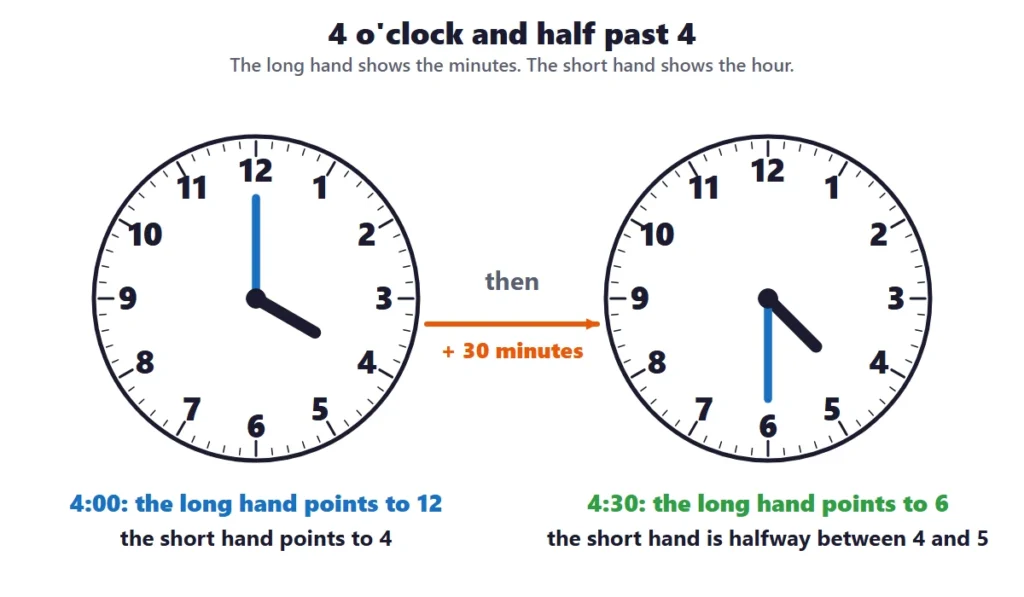
At o’clock times the long hand points straight up at 12 and the short hand points right at the hour. At half past, the long hand has gone halfway round to the 6, and the short hand has moved halfway to the next number. Noticing that the short hand is between numbers at half past is the key idea on these worksheets.
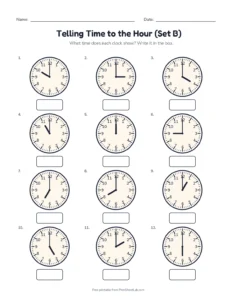
Read 12 clocks to the hour.
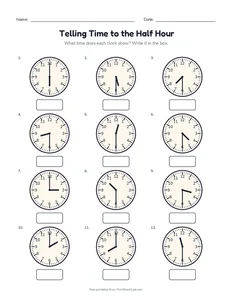
Read clocks to the half hour.
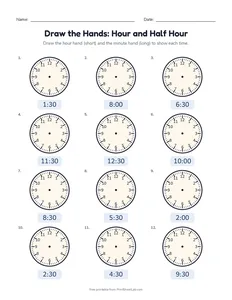
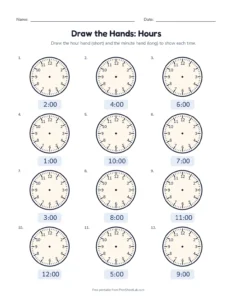
Draw the hands for hours and half hours.
Match-up cards: pair each clock face with its digital time.
Telling time to the hour and half hour worksheets: what is in the set
There are 6 telling time to the hour and half hour worksheets on this page, and every one has an answer key except for any cut-out games. Three sheets of clocks to read, two sheets of hands to draw and a set of match-up cards cover o’clock times first and then half past.
Worksheet
What children do
Standard
Telling Time to the Hour
Read 12 clocks showing o’clock times.
1.MD.B.3
Telling Time to the Half Hour
Read 12 clocks showing hours and half hours.
1.MD.B.3
Telling Time to the Hour (Set B)
Read more clocks to the hour.
1.MD.B.3
Draw the Hands: Hour and Half Hour
Draw the hands to show each time.
1.MD.B.3
Draw the Hands: Hours
Draw the hands to show each o’clock time.
1.MD.B.3
Clock Match-Up Cards
Cut out the cards and match clocks to digital times.
1.MD.B.3
O’clock worksheets: where the hands point
The o’clock worksheets use one picture that children can learn in a minute: at an o’clock time the long hand points straight up at the 12, and the short hand points at the hour. At half past, the long hand points straight down at the 6 and the short hand moves halfway to the next number. This table shows six times and where each hand points, with the angle that each hand has turned from the 12:
Time
Long hand points to
Long hand angle
Short hand points to
Short hand angle
3:00
12
0 degrees
the 3
90 degrees
7:00
12
0 degrees
the 7
210 degrees
12:00
12
0 degrees
the 12
0 degrees
3:30
6
180 degrees
halfway between the 3 and the 4
105 degrees
7:30
6
180 degrees
halfway between the 7 and the 8
225 degrees
12:30
6
180 degrees
halfway between the 12 and the 1
15 degrees
The picture above shows 4:00 and 4:30 side by side, and the printable clock lets children move the hands and watch the digital time change. The long hand does a full turn of 360 degrees every hour, so at half past it has turned 180 degrees. The short hand takes 12 hours for a full turn, so it turns 30 degrees for every hour.
Telling time to the hour worksheets: how many times are there?
The telling time to the hour worksheets use only 12 times on a 12-hour clock face, so they are the simplest of all the clock sheets, and children can learn all of them in a few days. Half past adds 12 more. This table counts the times:
Kind of time
On a 12-hour clock face
In a whole day, with a.m. and p.m.
o’clock (3:00)
12
24
half past (3:30)
12
24
Both kinds
24
48
There are only 24 times on the face of a clock that children need for this page, or 48 in a whole day with a.m. and p.m. By comparison the page on telling time to 5 minutes has 144 times, six times as many. The small size of the set is why hour and half hour are taught first.
Telling time to the half hour: half past
Telling time to the half hour means saying and writing half past, the time that is 30 minutes after an hour. The long hand has gone halfway around the clock, from the 12 to the 6, and half of a circle is half of an hour. This idea fits with fractions, and the fractions worksheets pages show halves of a circle. This table shows six half past times in words and in numbers:
In words
In numbers
The short hand is between
Short hand angle
half past 1
1:30
the 1 and the 2
45 degrees
half past 3
3:30
the 3 and the 4
105 degrees
half past 5
5:30
the 5 and the 6
165 degrees
half past 8
8:30
the 8 and the 9
255 degrees
half past 10
10:30
the 10 and the 11
315 degrees
half past 12
12:30
the 12 and the 1
15 degrees
In every case the number in words is the hour that has just finished, so half past 8 is 8:30 and not 9:30. The short hand has moved 15 degrees beyond the hour number, which is half of the 30 degrees to the next number. This is the key idea of the whole page, and the next section explains it.
Half past worksheets: why the short hand is between numbers
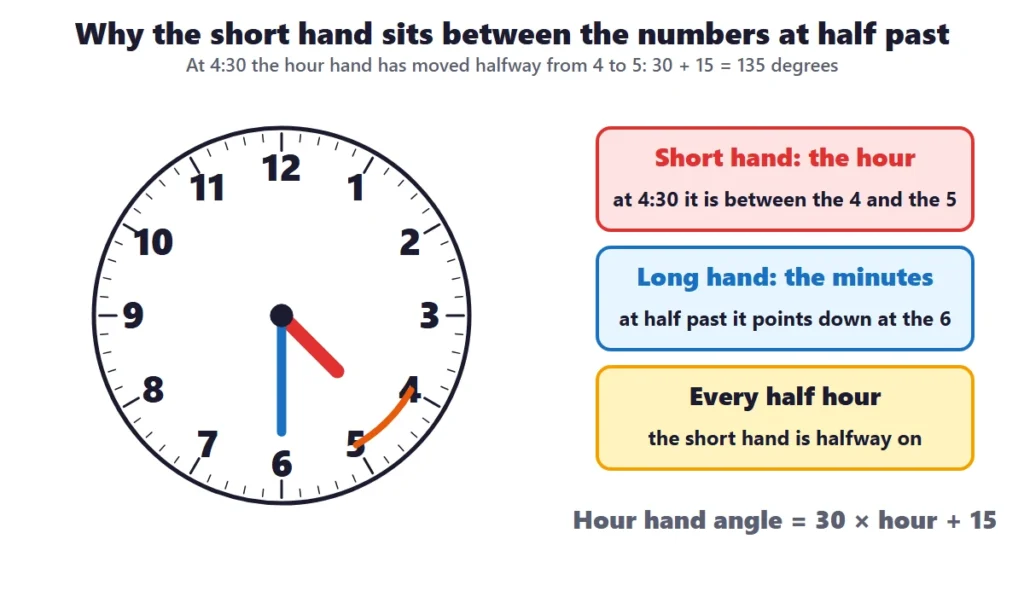
The half past worksheets are harder than the o’clock ones because the short hand no longer points at a number. At 4:30 the hour has half gone, and so the short hand has moved halfway from the 4 to the 5. The picture above shows this with a mark for the angle: the short hand points to 135 degrees, which is 30 × 4 plus 15. A child who sees the short hand between the 4 and the 5 should say “it is past 4 but not yet 5, so the hour is 4”.
Children can test this with a real clock. Move the long hand slowly from the 12 to the 6 and watch the short hand drift from the 4 towards the 5. It reaches halfway when the long hand is at the 6. The how to teach a child to tell time page describes the order for teaching this idea.
Grade 1 clock worksheets: what to add up in half hours
Grade 1 clock worksheets also ask children to think about how much time passes, as in “what time will it be in half an hour?”. Counting in half hours is a first step to elapsed time. This table shows six start times with 30 minutes, 1 hour and 1 hour 30 minutes later:
Start time
30 minutes later
1 hour later
1 hour 30 minutes later
3:00
3:30
4:00
4:30
3:30
4:00
4:30
5:00
7:00
7:30
8:00
8:30
10:30
11:00
11:30
12:00
11:30
12:00
12:30
1:00
12:00
12:30
1:00
1:30
The hour hand at half past. Halfway between 4 and 5.
The pattern is that half an hour later flips between o’clock and half past, and an hour later keeps the same minutes. At 12:00, one hour later is 1:00, so the hour number goes back to 1 after 12. This table counts the half hours in six real events:
Event
Time it lasts
Minutes
Half hours
Lunch
30 min
30
1
A cartoon
30 min
30
1
A movie
2 h
120
4
A soccer game
1 h 30 min
90
3
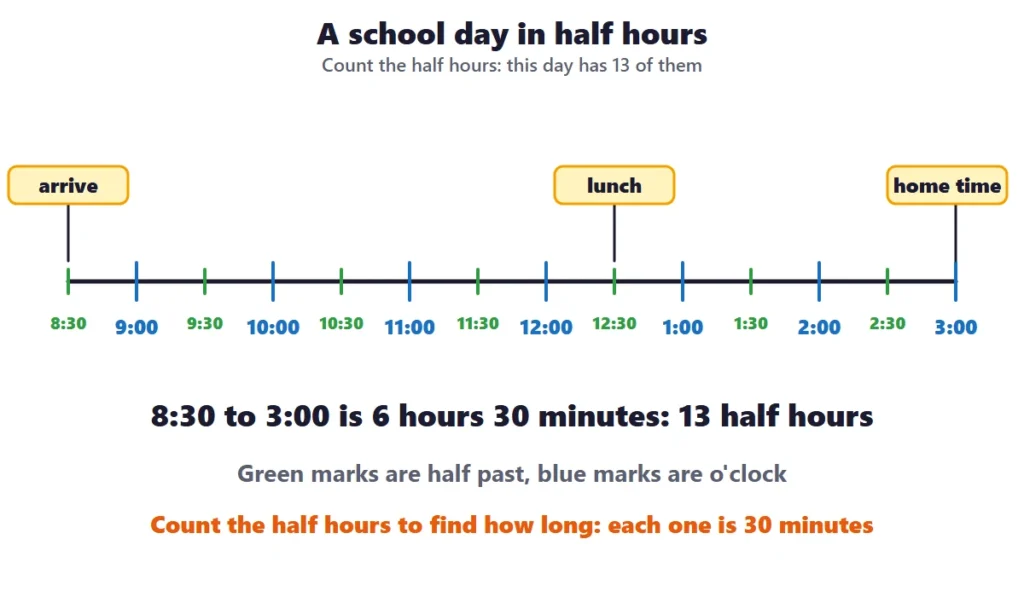
A school day, 8:30 to 3:00
6 h 30 min
390
13
A night’s sleep, 8:00 p.m. to 7:00 a.m.
11 h
660
22
The last two lines show why half hours are useful: a school day is 13 half hours, and a night’s sleep is 22. The elapsed time page extends the same idea to any number of minutes.
Common mistakes with telling time to the hour and half hour
Most mistakes come from mixing up the two hands, or from the position of the short hand at half past. This table shows five mistakes, what went wrong and the fix:
What the child writes or says
What went wrong
The fix
The child reads 6:00 as 12:30
cannot tell the long and short hands apart
the long hand shows the minutes: pointing at 12 means o’clock, pointing at 6 means half past
Half past 4 is written 5:30
uses the next hour because the short hand is near the 5
half past 4 means 30 minutes after 4: the hour is still 4
The child writes 4:6 for half past 4
writes the number the long hand points to
the long hand points to the 6, which means 6 × 5 = 30 minutes: 4:30
The short hand is drawn on the 4 for 4:30
does not move the short hand for the extra half hour
at half past the short hand is halfway between the 4 and the 5
3:00 and 3:30 look the same on the picture
looks only at the short hand
check the long hand first: 12 or 6
Telling time to the hour and half hour word problems
O’clock and half past come up in daily life. Ask children to say what each hand shows, to write the time and to give the answer in a sentence:
Word problem
Working
Answer
Lunch starts when the long hand points to the 12 and the short hand points to the 12. What time is it?
both hands on the 12
12 o’clock
The long hand points to the 6 and the short hand is between the 7 and the 8. What time is it?
long hand on the 6 means half past
7:30
Bedtime is half past 8. Write the time in numbers.
8 and 30 minutes
8:30
School starts at 9:00. It is now 8:30. How long must we wait?
8:30 to 9:00
30 minutes, half an hour
A movie starts at 3:00 and lasts 2 hours. What time does it end?
3:00 + 2 hours
5 o’clock
It is 4:30. What time will it be in half an hour?
4:30 + 30 minutes
5 o’clock
Games and activities for telling time to the hour and half hour
Children learn telling time to the hour and half hour best when they play with it. These games use things that are found at home or in a classroom:
Human clock: one child is the long hand and one is the short hand, and the others call out the time
Clock bingo: call a time, and children cover the clock that shows it
Move the hands: call a time and children move the hands on a toy clock; the first correct clock scores a point
Daily routine cards: put cards for waking up, lunch and bedtime in order, and match each to a clock
Match-up cards: match clocks to digital times
Hands behind the back: a child shows a time with their arms, and the others guess it
Extra support and extra challenge with telling time to the hour and half hour
For children who need more support: use a clock with moving hands, and always read the long hand first. Say “the long hand is on the 12, so it is o’clock” and “on the 6, so it is half past”. Stay with o’clock times until they are quick, and only then add half past. Mark the half way point between two numbers with a small dot on the clock.
For children who need more challenge: ask for the time in half an hour, and in one hour and half an hour, and for how many half hours there are between two times. Move on to telling time to 5 minutes and to quarter past and quarter to.
How to tell that a child is ready to move on from telling time to the hour and half hour
Before moving on from telling time to the hour and half hour, check that the child can do all four of these things:
The child says which hand is the long hand and which is the short hand.
The child reads o’clock times from the long hand on the 12 and the short hand on the hour.
The child reads half past times, and says the hour that has just finished.
The child draws both hands in the right places for an hour or a half hour.
A 20-minute lesson on telling time to the hour and half hour
A short lesson is the best way to introduce telling time to the hour and half hour. This 20-minute plan can be used in a classroom, at a tutoring session or at home, and it uses the worksheets at the end:
Minutes
Activity
What to say or ask
0 to 4
Show 4:00 on a big clock, and ask which hand shows the hour
Where does the long hand point?
4 to 9
Move the long hand to the 6 and watch the short hand move
How far has the short hand moved?
9 to 14
Draw 4:00 and 4:30 on blank clocks
Where does the short hand go at 4:30?
14 to 18
Match three clocks to three digital times
How do you know it is 4:30 and not 5:30?
18 to 20
Start a worksheet and read one clock aloud
What time is it, in words and in numbers?
A school day in half hours. 8:30 to 3:00.
Where telling time to the hour and half hour fits across the grades
No skill stands alone. This table shows what children learn before and after telling time to the hour and half hour, with the standard that goes with each step:
This page is the first step in learning to tell time. The whole sequence is on the telling time worksheets page.
Helping at home with telling time to the hour and half hour
Parents do not need to be experts to help with telling time to the hour and half hour. These suggestions work well, and each takes only a few minutes:
Ask “what time is it?” on the hour and at half past, using the kitchen clock.
Say the time of daily events, such as lunch at 12:00 and a walk at half past 3.
Move the hands of a toy clock with your child.
Compare a digital clock with an analog clock side by side.
Praise the child who says which hand they looked at first.
How to check progress in telling time to the hour and half hour
A teacher or parent can check progress in telling time to the hour and half hour with the answer key and a few questions. This table shows three common situations, what they mean and what to do next:
What you see
What it means
What to do next
The child mixes up the long and short hands
The roles of the hands are not yet clear
Say “long hand, minutes; short hand, hour” each time
A five-day plan for telling time to the hour and half hour
Most children need about a week of short sessions for telling time to the hour and half hour. This plan follows the order of the worksheets on this page:
Day
What to do
Practice
Day 1
Read o’clock times, and say where each hand points
Telling Time to the Hour (Set A and Set B)
Day 2
Draw the hands for the hour
Draw the Hands: Hours
Day 3
Half past: move the long hand to the 6
Telling Time to the Half Hour
Day 4
Draw the hands for hours and half hours
Draw the Hands: Hour and Half Hour
Day 5
Match clocks to digital times, and play a clock game
The long hand has gone half way around the clock, from 12 to 6. That is 30 minutes, half of an hour.
Why is the short hand between two numbers at 4:30?
Because it is half way between 4 o’clock and 5 o’clock, so the hour hand is half way between the 4 and the 5.
How do you teach telling time to the hour and half hour?
Start with the long hand and the short hand, and teach that the long hand shows the minutes and the short hand shows the hour. Use o’clock times first, with the long hand on the 12, and then half past, with the long hand on the 6. Use a real clock with moving hands.
What grade learns telling time to the hour and half hour?
Grade 1. The Common Core standard 1.MD.B.3 asks first graders to tell and write time in hours and half-hours using analog and digital clocks.
How long does it take to learn telling time to the hour and half hour?
Most children need two to three weeks of short sessions for telling time to the hour and half hour, if they know their numbers to 12. The sheets on this page go from o’clock times to half past and from reading to drawing, so a child can practice for as long as they need.