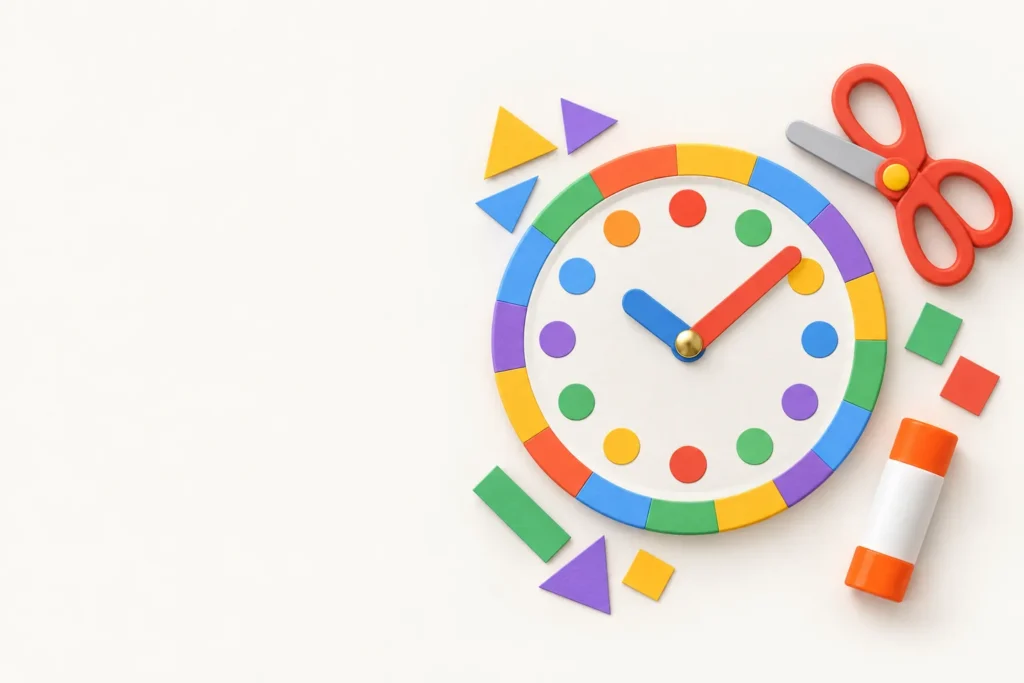
Make a free printable clock or clock face template in seconds. Choose a big learning clock with minutes around the outside and cut-out hands (perfect for a paper plate clock), a blank clock face page with or without numbers, or practice sheets where children read the clock or draw the hands, with answer keys. Every printable clock works on US Letter or A4 paper, in color or black and white, and you can change the font, the numbers and the level of difficulty in the generator above.

Interactive clock
Drag anywhere on the clock face to turn the hands. Just like a real geared clock, the hour hand creeps forward as the minute hand goes around, and the time is shown in numbers and in words. Try the Set the clock game: read the time, move the hands, then press Check.
Ready-to-print printable clock sheets (PDF)
Every clock below is a ready PDF. To swap the numbers, the minute ring or the level of the times, choose Customize and the generator opens with the same settings.
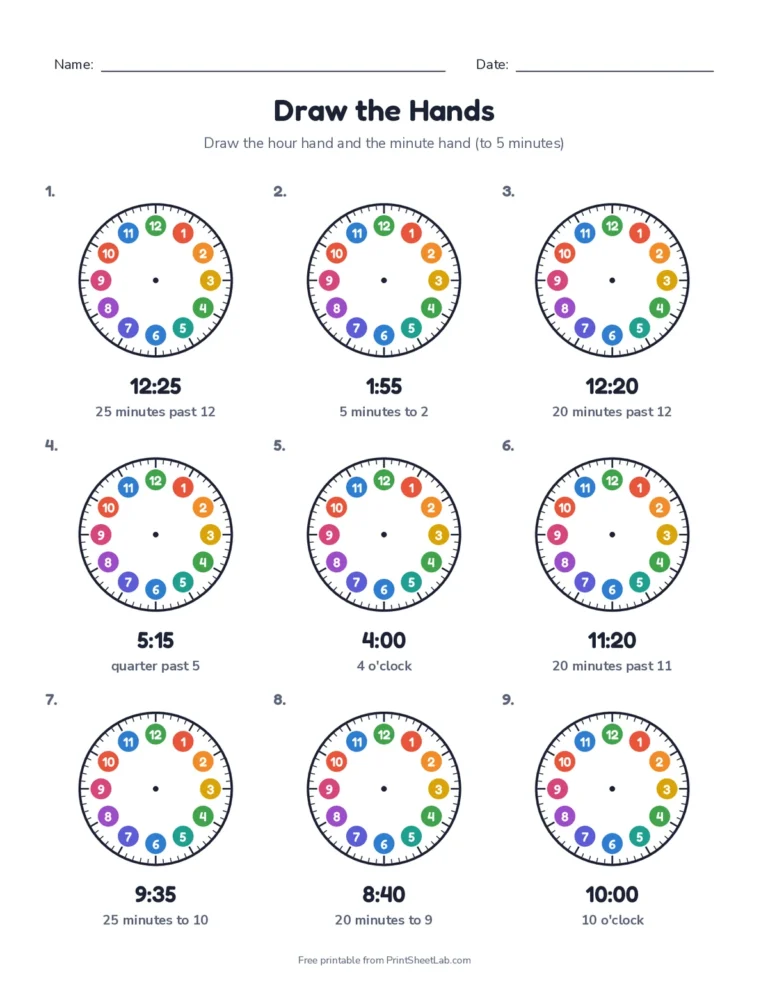
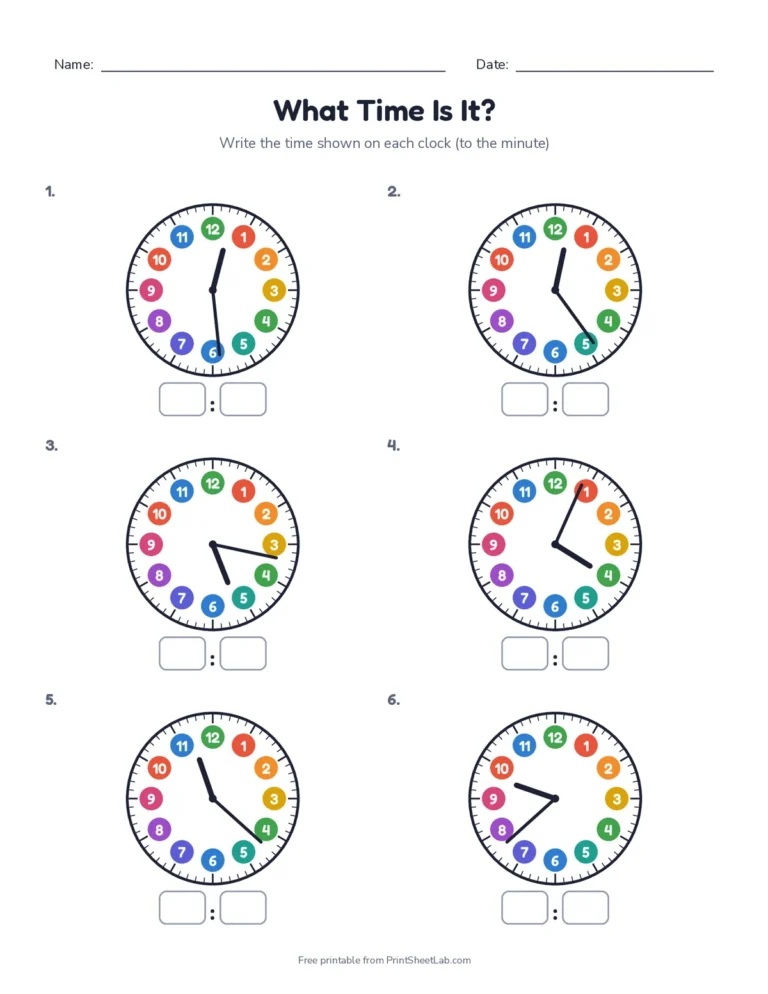
How to make a paper plate clock from our printable clock
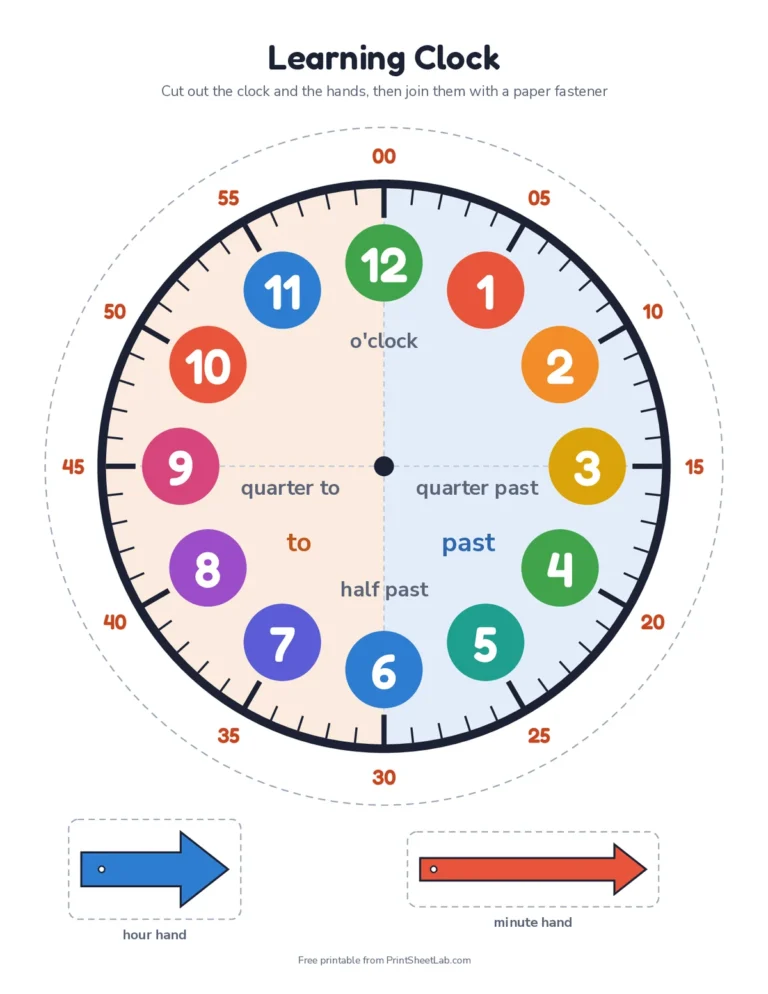
- Print the learning clock with “Cut-out hands” turned on. Card stock or thick paper works best.
- Color and cut out the clock face along the dashed circle, then cut out the hour hand (short) and the minute hand (long).
- Glue the face onto a paper plate for a sturdy clock with a colorful rim.
- Poke a hole through the center dot of the clock and the round end of each hand. An adult should do this with a sharp pencil.
- Join the hands with a paper fastener (brad): long hand on top, short hand underneath. Leave it loose enough to turn.
- Play! Call out times like “half past 4” and let your child set the clock.
Reading the printable clock
The learning clock is designed to make both hands easy to read:
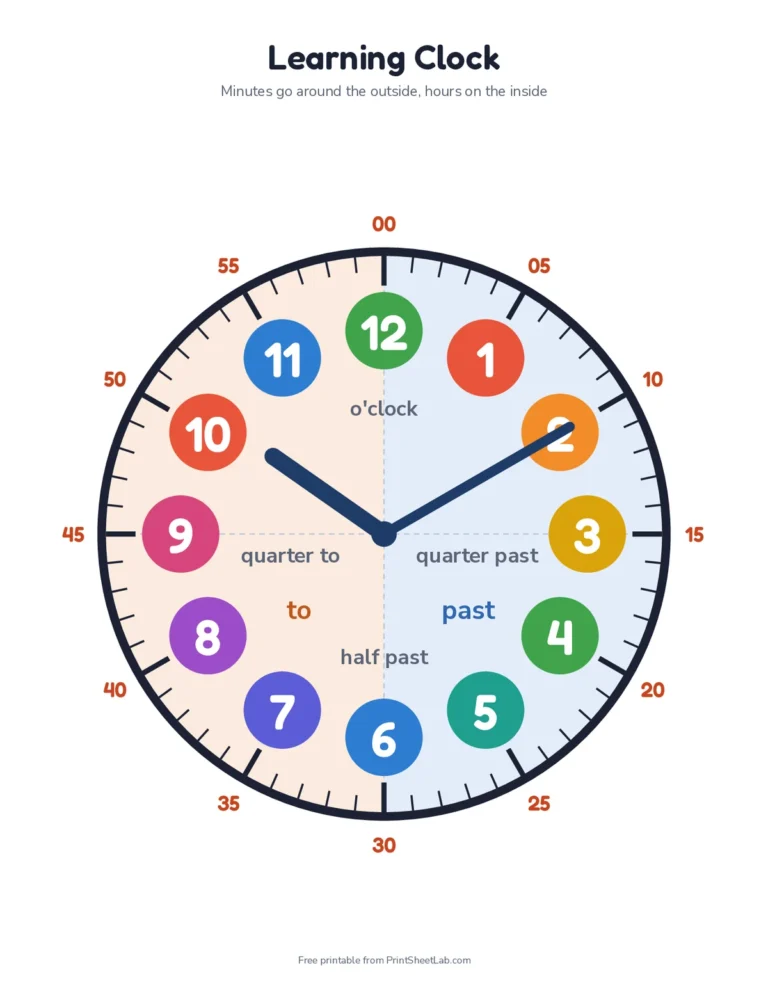
- Hours on the inside: the big numbers 1 to 12 are for the short hour hand.
- Minutes on the outside: the small orange numbers 00, 05, 10 up to 55 show how many minutes the long hand points to, so children do not have to count by fives in their heads.
- Past and to: the right half of the face is shaded blue for “past” and the left half orange for “to”. When the minute hand is on the right, we say minutes past the hour; on the left, minutes to the next hour.
- Quarter and half: the dashed lines mark o’clock, quarter past, half past and quarter to, the four times children learn first.
Which printable clock should I use?
| Printable | Best for |
|---|---|
| Learning clock with hands | A paper plate clock or a classroom demonstration clock |
| Learning clock poster | A wall poster showing minutes, past, to, quarter and half |
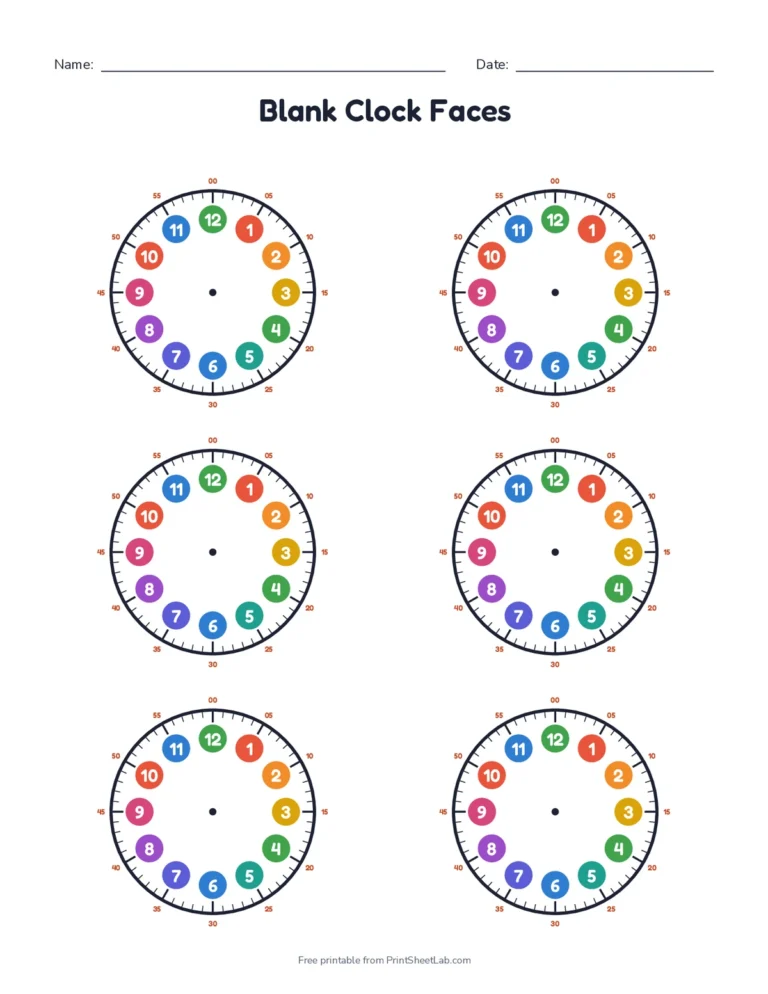
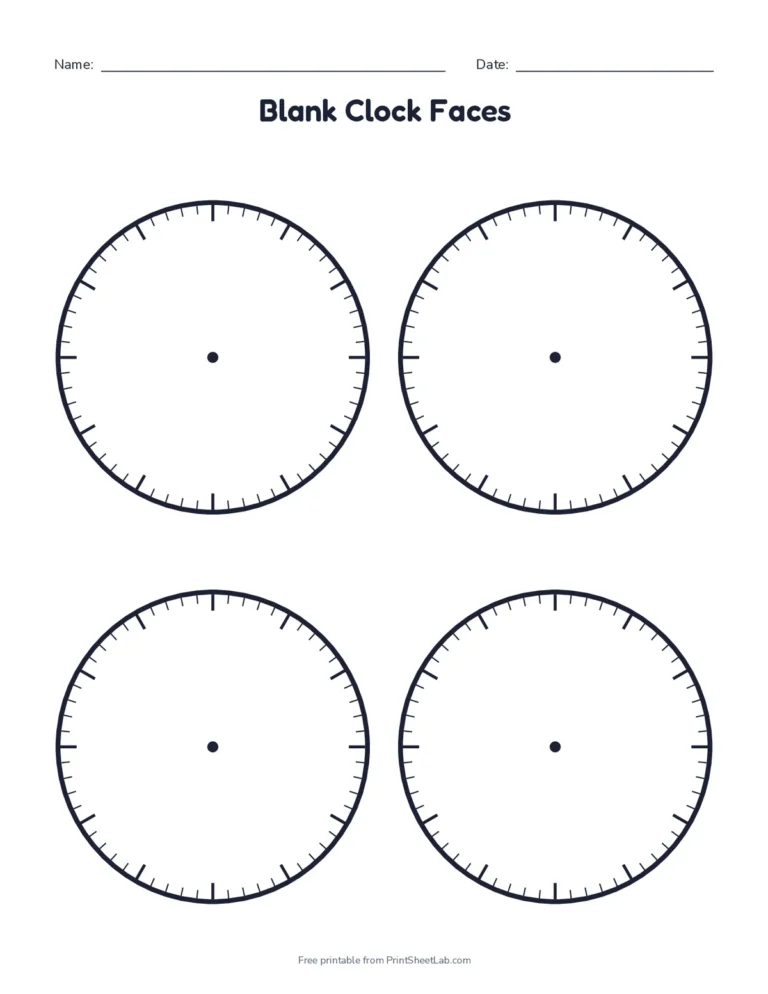
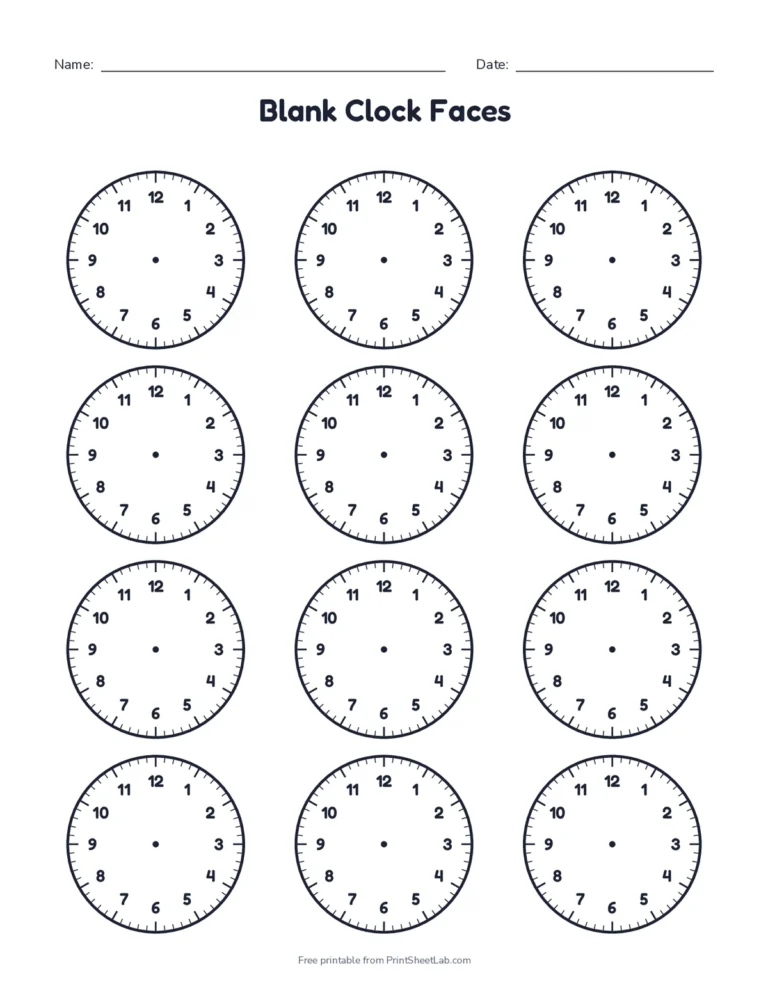
| Blank clock faces with numbers | Drawing your own times, daily schedules and routines |
| Blank clock without numbers | Children write the numbers themselves, a great first clock lesson |
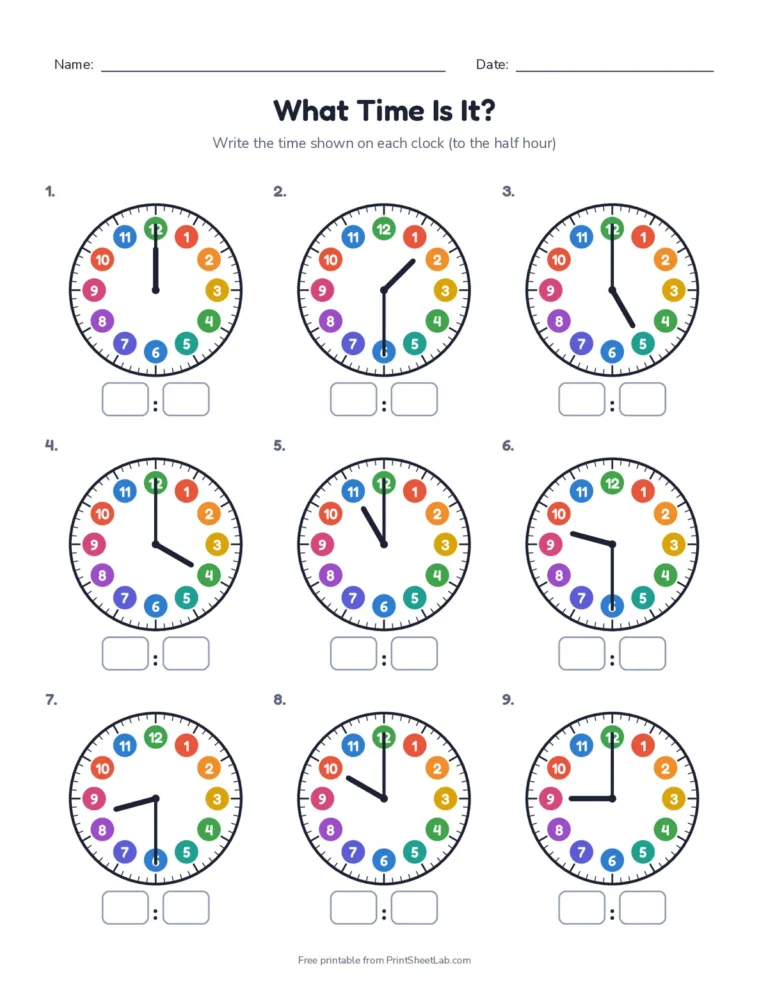
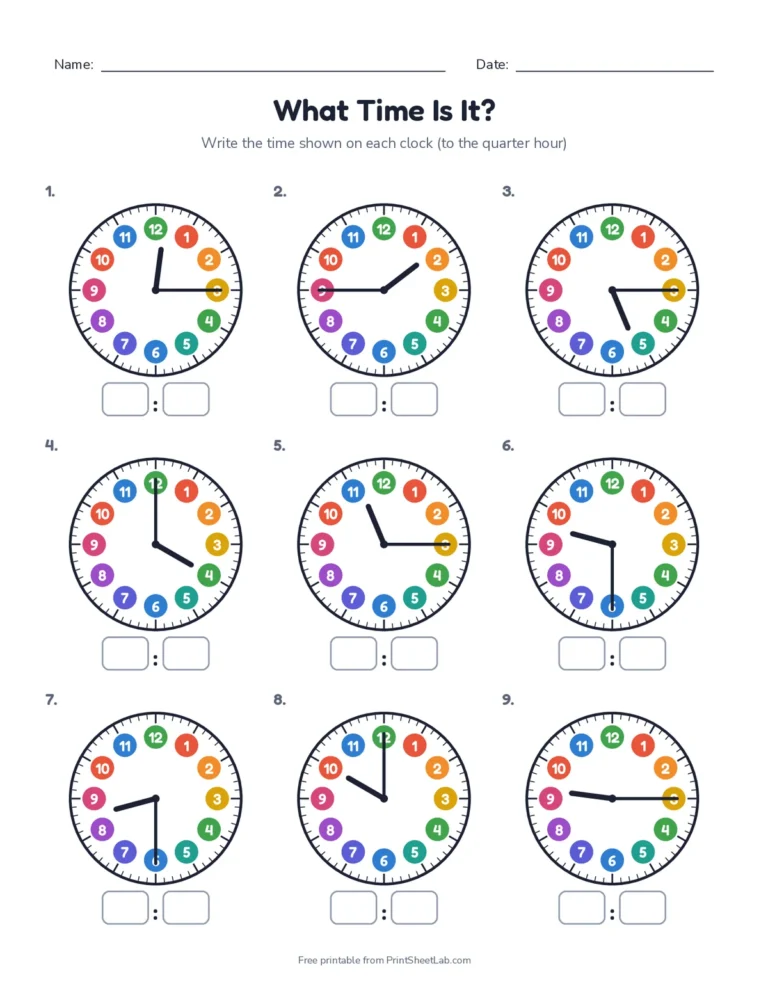
| Read the clock | Practice reading o’clock and half past, with answers |
| Draw the hands | Practice showing a time, with the time written in numbers and words |
Printable clock practice by grade
Telling time is taught in small steps, and each printable clock above matches one of them. For the full teaching order with worked examples and a six-week plan, see our guide on how to teach a child to tell time. The Common Core measurement and data standards set out the usual order:
- Grade 1: tell and write time in hours and half hours (1.MD.B.3). Use the printable clock with hands and the o’clock and half past sheets.
- Grade 2: tell time to the nearest five minutes and use a.m. and p.m. (2.MD.C.7). Switch the printable clock sheets to 5-minute times and add the minutes ring.
- Grade 3: tell time to the nearest minute and work out elapsed time (3.MD.A.1). Use the to-the-minute sheets and the draw-the-hands pages.
Younger children can start before grade 1 with a blank clock face: writing the numbers 1 to 12 in the right places is a great first lesson in how a clock is laid out. If you are curious why 12 sits at the top and the hands turn the way they do, the clock face article on Wikipedia tells the story.
Teaching tips for telling time
- Start with the hour hand only. Before minutes make sense, children can read “about 3 o’clock” from the short hand alone.
- Connect the minute numbers to counting by 5s. Point to each number and count: 5, 10, 15… The outer ring on our learning clock does this for them at first.
- Watch the hour hand move. At half past 3 the hour hand is halfway between 3 and 4, not on the 3. The interactive clock above shows this clearly.
- Use real routines. Draw the times for breakfast, school and bedtime on a sheet of blank clock faces and hang it on the fridge.
- Practice little and often. A quick “what time is it?” several times a day beats a long lesson. Keep a printable clock on the fridge so it is always handy.
Ready for more practice after the printable clock? Our telling time worksheets build step by step from the hour and half hour to 5 minutes, the minute and elapsed time.
Practice it as a game
Free online games for the same skill: balloon pop, memory match, races and more. No sign-up.
Frequently asked questions
8 quick answers
How do I print a clock face template?
Choose “Big learning clock” or “Blank clock faces” in the generator above, pick your options, then press Print or download the PDF. The clock fits US Letter or A4 paper.
What is a learning clock?
A learning clock is a clock face designed for children. It shows the hour numbers on the inside and the minutes (00 to 55) around the outside, and often marks past, to, quarter and half, so both hands are easy to read.
How do you make a paper clock with moving hands?
Print the learning clock with cut-out hands, cut out the face and the two hands, then join them through the center with a paper fastener. Gluing the face to a paper plate makes it stronger.
Why does the hour hand move between the numbers?
The hour hand moves slowly all the time. At 3:00 it points at the 3, at 3:30 it is halfway to the 4, and at 3:45 it is almost at the 4. That is why quarter to 4 has the hour hand near the 4.
What does “quarter past” and “quarter to” mean?
A quarter of an hour is 15 minutes. Quarter past 3 is 15 minutes after 3 o’clock (3:15). Quarter to 4 is 15 minutes before 4 o’clock (3:45).
What is a blank clock face used for?
Blank clock faces let children draw any time, plan a daily routine, or practice writing the numbers on a clock. Choose clocks with all numbers, only 12, 3, 6 and 9, or no numbers at all.
At what age do children learn to tell time?
Most children start with o’clock and half past around ages 5 to 6 (kindergarten and grade 1), move to 5-minute times around age 7 (grade 2), and read time to the minute around age 8 (grade 3).
Is this printable clock free?
Yes. Every clock template and telling time sheet here costs nothing, needs no account, and can be copied for a whole class.
More printables for young learners
- Telling time worksheets from the hour to the minute.
- Number line for counting on and back.
- Hundreds chart to practice counting by 5s and 10s.
- Ten frames for number sense to 20.
- Calendar generator to learn the days and months.