Corporate tambola is housie with a company badge on it: the same numbers game the whole office already knows, played in a 60-minute slot, with tickets that carry your company name and prizes that you choose. This guide shows how to run corporate tambola for 50 to 300 people, from the ticket maker to the run sheet, with 12 corporate tambola game ideas, office party tambola prizes by budget and game-time numbers from a real simulation, so a tambola for office party never overruns.
In short: make the tickets in the free card maker (company name as the title, event and batch in the footer, a name on every ticket), project the number caller on the big screen, and run three short rounds of six prizes each. Corporate tambola takes about 60 minutes in total, so it is an easy office tambola game to schedule. It is free, needs no sign-up, and nothing you type leaves your browser.
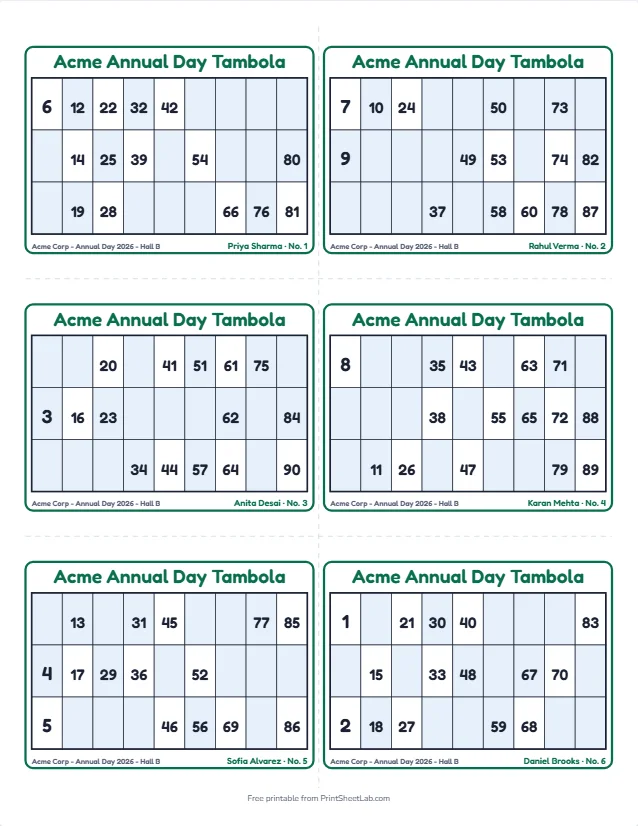
Corporate tambola: how to run it at the office
Tambola, also called housie or bingo with 90 numbers, is easy to explain and easy to run for a large crowd, which is why it suits an office party. Each player holds a ticket with 15 numbers on three rows.
The host calls the numbers 1 to 90 in random order, players mark them, and prizes go to the first ticket to complete a pattern: Early Five, the top, middle and bottom lines, four corners and the full house. If your team has never played, the guide to how to play tambola covers the rules in five minutes.
Corporate tambola works for three reasons, and they are why tambola for corporate events keeps coming back every year. It needs no skill, so a new hire and a director are equal. It is passive enough that people can chat while they play. And the host has plenty of control over pace, prizes and tone. The sections below turn that into a plan you can run this month.
- Pick the occasion and the group size (the table further down maps people to tickets).
- Make the tickets in the tambola ticket generator with your company title, footer and names.
- Set the prize table for the six standard prizes, and say how many rounds you will play.
- Open the caller on the big screen: the tambola number caller calls every number once in random order.
- Run the game using the run sheet, and keep a short list of rules on a slide.
Tambola for office party: a 60-minute plan
A tambola for office party works best as a set of short rounds with breaks for photos and announcements, not one long game. The run sheet below fits a one-hour slot. It assumes about 60 tickets in play and a call every 8 seconds, with 45 seconds allowed for each prize claim to be checked. The simulation section later shows where the round lengths come from.
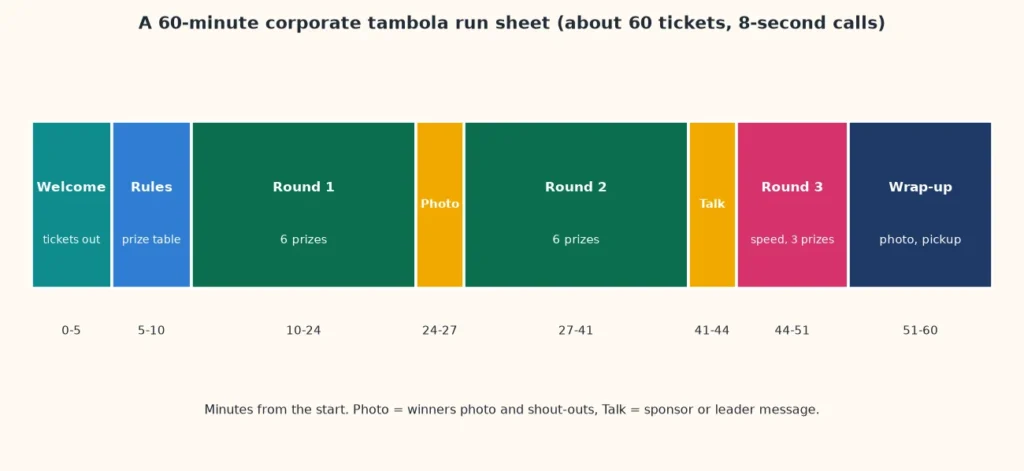
| Time | Segment | What happens | Tool or item |
|---|---|---|---|
| 0:00-0:05 | Welcome and ticket handout | Welcome from a leader, tickets on every seat, a pen for each player. | Printed tickets |
| 0:05-0:10 | Rules and prize table | Show the six prizes on a slide. Say one prize per person per round. | Slide, big screen |
| 0:10-0:24 | Round 1: six prizes | Early Five, top, middle and bottom line, four corners, full house. Auto-call every 8 seconds. | Number caller |
| 0:24-0:27 | Break for photos | Winners hold their tickets for a group photo. | Camera |
| 0:27-0:41 | Round 2: six prizes | New game in the caller. Bigger prizes if sponsors join. | Number caller |
| 0:41-0:44 | Leader message | Thank-yous, announcements, sponsor mentions. | Microphone |
| 0:44-0:51 | Round 3: speed round | Early Five, any line and four corners only. Auto-call every 8 seconds. | Number caller |
| 0:51-1:00 | Wrap-up | Final photo, prize pickup, feedback link. | Prize table |
Plan an office tambola game like a short show: a clear start, a few peaks and a defined end. If you only have 30 minutes, drop Round 2 and the break, and keep one full round and the speed round. For a 15-minute lunch version, see the team lunch idea in the list of formats below.
Office tambola game: how many tickets for 50 to 300 people?
One ticket per person is enough for a tambola for office party, and two per person works well for small groups who want more to do. A single batch in the card maker holds up to 100 different tickets, so bigger crowds are printed in batches. Put a batch letter in the footer, such as “Batch A”, so a claim can be traced back, and remember that ticket numbers restart at 1 in every batch.
| People | Tickets each | Tickets | Batches of up to 100 | Ticket pages at 6 per page | Median calls to full house (closest simulation) |
|---|---|---|---|---|---|
| 50 | 1 | 50 | 1 | 9 | 69 |
| 100 | 1 | 100 | 1 | 17 | 67 |
| 100 | 2 | 200 | 2 | 34 | 67 |
| 200 | 1 | 200 | 2 | 34 | 67 |
| 300 | 1 | 300 | 3 | 50 | 63 |
The last column is from the simulation below, using the nearest simulated size (60, 120 or 300 tickets). Notice how little it changes: a full house needs between 63 and 72 numbers whether 30 or 300 tickets are in play. More tickets mainly speed up the early prizes. The caller sheet and calling cards add a few extra pages to the PDF; switch them off if you use the digital caller on a screen.
Customize tickets: company name, logo, footer and names
Branded tickets are what turn a generic game into corporate tambola, and they cost nothing extra for any office tambola game. The free card maker at the tambola ticket generator lets you set these on numbers-only tickets:
- Title. On the Setup tab, type your company or event name, or switch the title to a picture and upload your logo.
- Footer text. One line at the bottom of every ticket: “Acme Corp – Annual Day 2026 – Hall B”. Use it for the event, the department or the batch.
- Names on tickets. Paste one name per line, and name 1 goes on ticket 1. The name prints in the footer beside the ticket number, as in the picture above.
- Numbering. A switch turns the ticket number on or off.
- Colors. On the Design tab, pick a color theme or set the Main, Accent, Card and Text colors to match your brand. You can also choose the font, border style and rounded corners.
- Black and white. A switch saves ink for large print runs.
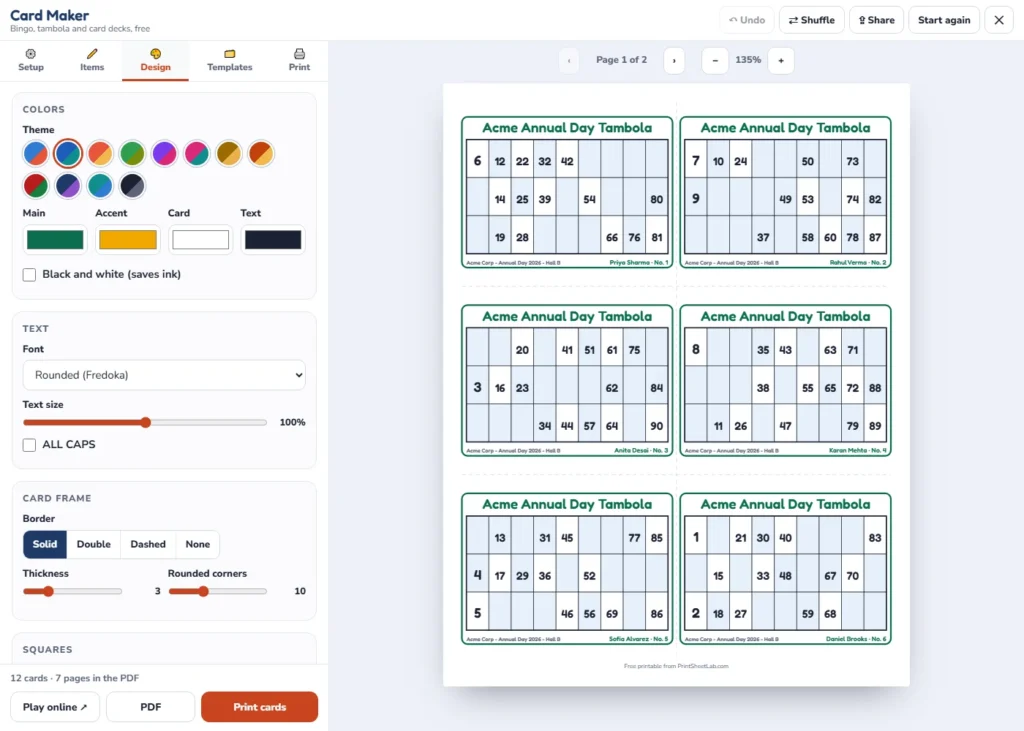
Colors apply to a whole batch, not to individual tickets. If you want every department in its own color, make one batch per department, change the main color, and put the department name in the footer. Print on plain white paper or on colored paper, whichever your office printer handles best. Under Print, choose the number of tickets (1 to 100), 1, 2, 4 or 6 per page, Letter or A4, and portrait or landscape. A PDF button saves the file to send to a print shop.
Themes for corporate events: Diwali, annual day, farewell and new year
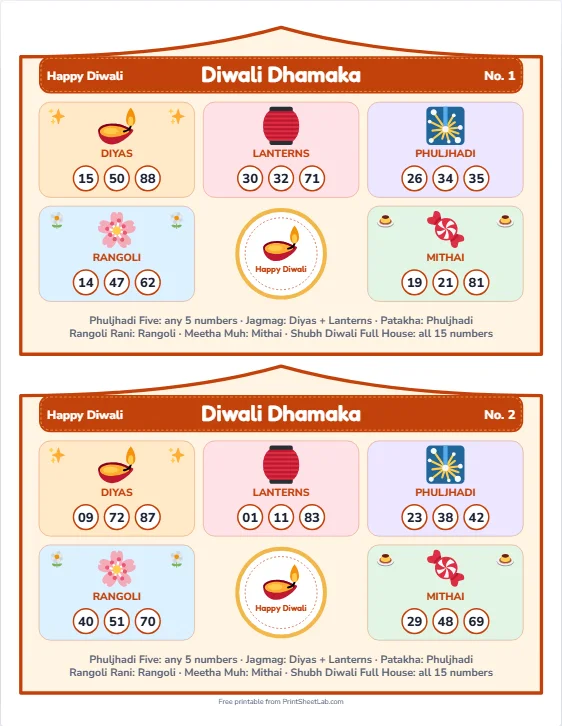
Numbers-only tickets are the formal choice. For a festival, the 25 illustrated theme tambola tickets add artwork and their own prize names to every ticket. The Diwali Dhamaka ticket, for example, prints prize lines such as “Phuljhadi Five: any 5 numbers” and “Shubh Diwali Full House: all 15 numbers”. Those tickets carry the theme’s own title and artwork, so use numbers-only tickets when you need the company name on them.
| Occasion | Ticket style | Where to start |
|---|---|---|
| Diwali office party | Illustrated theme tickets | Diwali Dhamaka tambola or Diwali tambola |
| Year-end and New Year party | Illustrated theme tickets | New Year Countdown tambola or New Year tambola |
| Christmas party | Illustrated theme tickets | Christmas Cheer tambola |
| Annual day and awards night | Numbers-only tickets with company title | Tambola ticket generator |
| Farewell or retirement | Numbers-only tickets with the leaver’s name in the footer | Tambola ticket generator |
| Coffee-break fun | Illustrated theme tickets | Chai, Chaat & Chatter tambola |
| Bollywood-themed night | Illustrated theme tickets | Bollywood Night tambola |
For a longer list of party formats, our guides to Diwali party games and kitty party games have more ideas that work in a corporate setting too.
Office party tambola prizes: ideas by budget
Good office party tambola prizes are small, useful and easy to hand out. Whatever the size of the party, office party tambola prizes work best when they match the effort of each dividend. The prize ladder follows the difficulty of each dividend: Early Five comes soonest, the full house takes longest, so the full house gets the best prize. The table gives ideas at three budget levels (rough guides; use what your office can afford).
| Prize | Light (under $5 or ₹400) | Medium ($10-25 or ₹800-2,000) | Premium ($50 and up or ₹4,000 and up) |
|---|---|---|---|
| Early Five | Chocolate bar or a desk plant | Coffee shop voucher | Gift card |
| Top line | Notebook and pen | Snack hamper | Wireless earbuds |
| Middle line | Branded mug | Book or board game | Smartwatch or fitness band |
| Bottom line | Sticky-note set | Lunch voucher | Smart speaker |
| Four corners | Sweets box | Team lunch for two | Restaurant dinner voucher |
| Full house | Trophy and a pick of the prize table | Desk gadget or gift hamper | Tablet, day-trip voucher or hotel stay |
When one budget covers all six prizes, split it by difficulty. The share below gives the full house 30 percent, each line 15 percent, four corners 15 percent and Early Five 10 percent. Two examples of how that adds up:
| Dividend | Share of the budget | Example: $200 round | Example: ₹15,000 round |
|---|---|---|---|
| Early Five | 10% | $20 | ₹1,500 |
| Top line | 15% | $30 | ₹2,250 |
| Middle line | 15% | $30 | ₹2,250 |
| Bottom line | 15% | $30 | ₹2,250 |
| Four corners | 15% | $30 | ₹2,250 |
| Full house | 30% | $60 | ₹4,500 |
| Total | 100% | $200 | ₹15,000 |
A few practical notes. Buy more office party tambola prizes than you need and keep the extras for a bonus round. Ask sponsors or department heads to donate a premium prize in return for a mention. Choose prizes that every winner can use, and avoid prizes that need to be shipped. Where you can, let winners pick from a prize table so that the first winner does not get the best of the leftovers.
Team building tambola: more than a game of luck
Tambola is a game of luck, so it does not test anyone’s skills, but you can turn it into team building tambola with a few changes. Done well, team building tambola gives quiet colleagues a reason to talk. Team building is the broad idea of activities that help groups work together, and the social parts of tambola do that well: shouting a claim, checking a neighbor’s ticket and celebrating a win. These small changes add more connection:
- Team tickets. Put colleagues in teams of four or five who share a few tickets and one pen, and let any member claim for the team.
- Cross-team seating. Seat people next to colleagues from another department. Add the department in the footer so the mixing is visible.
- Name swap. Print each person’s name on a different ticket, so everyone must find the owner of the ticket in their hand before the game starts and say hello.
- Prize with a task. Let the full-house winner choose a colleague to join them for coffee or lunch.
- Leader as caller. Ask a manager to call the numbers in the traditional rhymes, which the caller shows for 90-ball games. It is a good way to relax a room.
For a team building tambola with people who already know each other, add a speed round and make it department against department. For new teams, the name swap works as an icebreaker. If you want more mixing games, getting to know you bingo and human bingo are made for it.
Tambola for corporate events: hybrid and virtual hosting
The same game runs in the office, in a hybrid setup or fully online, as long as everyone can see the numbers. The tambola number caller has a big-screen mode that fills a projector or a shared screen with the last number and the call board (press Esc to leave it), and it can speak the calls in English or Hindi. Auto-call runs at 3, 4, 5, 6, 8, 10, 15, 20 or 30 seconds with a pause button, and you can undo the last call or repeat it.
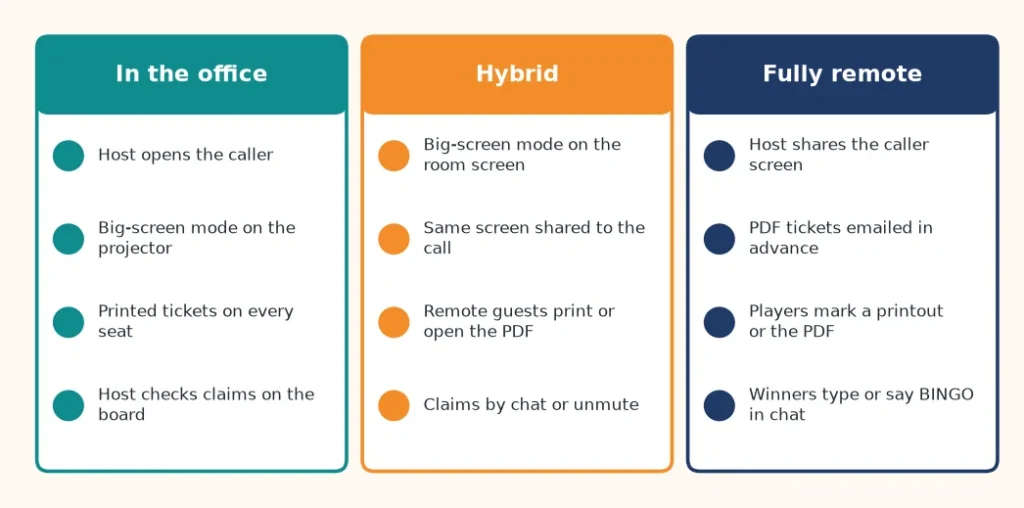
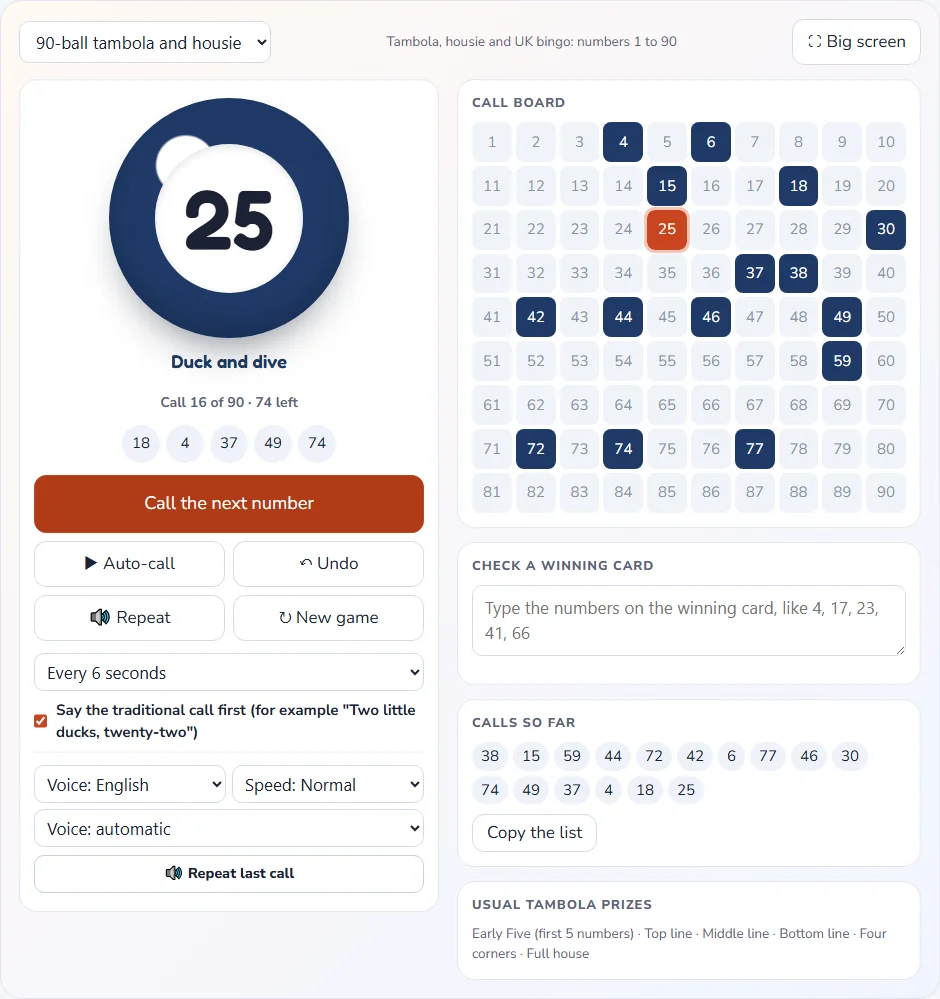
For tambola for corporate events with remote guests, three habits help. They also work for any hybrid office tambola game.
- Send tickets ahead. Email the PDF to each remote player, or one PDF per team. Players print it and mark the numbers with a pen.
- Slow the calls. Use 10 or 15 seconds between numbers online, since screen shares lag. The timing table below shows what that does to a round.
- Agree on how to claim. Ask remote players to type the prize name in the chat or unmute, and read the claim aloud so everyone hears it.
If you would rather have guests play on their own devices, the live tambola game on the tambola hub lets a host share a link that players open to join. For a virtual office party that also wants a lighter warm-up, see our Zoom bingo and meeting bingo cards.
Corporate tambola game ideas: 12 formats that work
These 12 corporate tambola game ideas cover most office occasions. Mix and match the corporate tambola game ideas, since a speed round can sit inside any other format. Each says who it suits, how many tickets to print and what makes it different.
1. Annual day tambola
100 to 300 people. Numbers-only tickets with the company name as the title and “Annual Day” and the year in the footer. Play one six-prize round in the interval between awards, with prizes donated by leaders.
2. Diwali office party tambola
50 to 200 people. Use the illustrated Diwali Dhamaka tickets, call the numbers in Hindi, and give diyas, dry-fruit boxes or sweets as prizes.
3. Farewell tambola
A team of 20 to 60. Put “Farewell to” and the leaver’s name in the footer, and ask the leaver to call the numbers. The full house prize can be a framed team photo.
4. Year-end party tambola
50 to 200 people. The New Year Countdown theme tickets suit a December party, and the six-prize format fits the end of a year of results.
5. Team lunch speed round
A team of 15 to 30. With 30 tickets and a call every 5 seconds, Early Five, one line and the full house take about 8 minutes including claims.
6. New joiner icebreaker
10 to 40 people. Print each new joiner’s name on a different ticket and let them find the ticket’s owner first. Then play one short round.
7. Town hall energizer
100 to 300 people. A 10-minute round on the big screen with a leader calling the numbers wakes up a long meeting. Two prizes are enough.
8. Client appreciation or dealer meet
30 to 150 guests. Put your logo as the title picture, hand out premium prizes from sponsors and let clients keep the tickets as a souvenir.
9. Hybrid team day
A team split between office and home. Show the caller on a shared screen, email the PDF tickets, call every 10 seconds and read every claim aloud.
10. Department league
4 to 8 departments. Make one colored batch per department with the department in the footer. The first claim of each prize scores points for the department, and the totals go on a whiteboard.
11. Awards gala interval game
100 to 300 guests. Tambola fills the gap between award categories while people wait. Use the speed round (Early Five, any line, four corners) with calls every 5 seconds.
12. Family day tambola
Adults and children together. Adults play tambola; children get picture bingo for kids cards that need no reading, and one caller can run both.
How long does each prize take? A simulation for 30 to 300 tickets
To plan a corporate tambola you need to know how long the game runs. We simulated 90-number tambola with random 3 by 9 tickets (15 numbers on each, rows of five, one to three numbers per column). For each ticket count we played 2,500 games, called all 90 numbers in a random order and recorded the call at which each prize was first claimed. The table shows the median, with the middle half of games in brackets. These are call counts, not minutes, so multiply by your call speed.
| Prize | 30 tickets | 60 tickets | 120 tickets | 300 tickets |
|---|---|---|---|---|
| Early Five | 12 (10-14) | 11 (9-12) | 10 (8-11) | 8 (7-9) |
| First line (any row) | 36 (31-41) | 31 (27-36) | 28 (24-31) | 24 (20-27) |
| Top line | 44 (38-51) | 39 (33-45) | 34 (29-39) | 29 (25-33) |
| Middle line | 44 (37-50) | 39 (33-44) | 34 (29-39) | 29 (24-33) |
| Bottom line | 45 (38-51) | 39 (33-44) | 34 (29-39) | 29 (25-33) |
| Four corners | 38 (30-45) | 32 (26-38) | 28 (22-33) | 22 (18-27) |
| Full house | 72 (68-75) | 69 (66-72) | 67 (63-69) | 63 (60-66) |
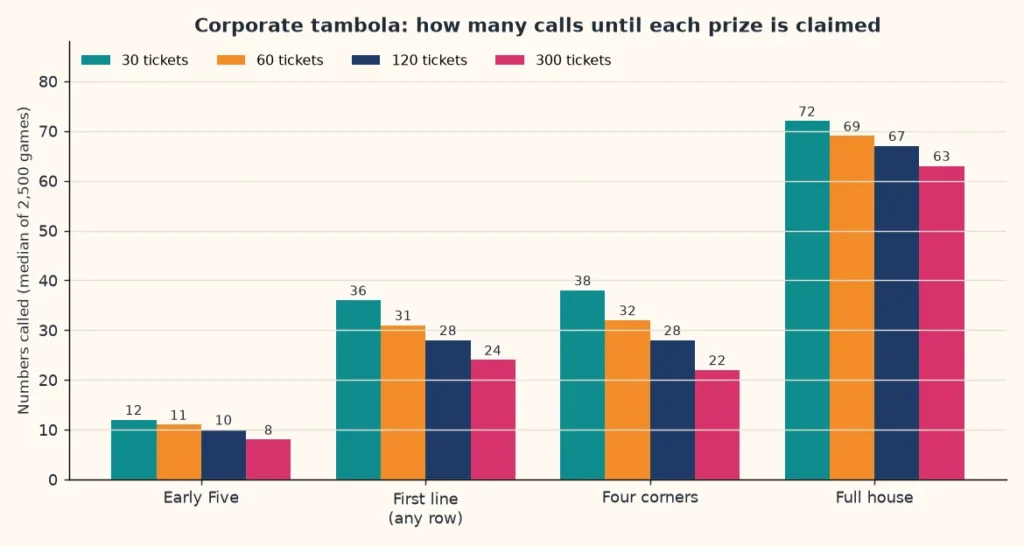
The pattern is clear. With 60 tickets, Early Five is usually claimed within 11 calls, the first line within 31, four corners within 32 and the full house within 69. With 300 tickets, Early Five comes after 8 calls and the full house after 63. Tickets in play matter most for the early prizes; the full house depends on the order of the 90 numbers more than on the number of players.
To turn calls into minutes, multiply by the seconds per call and add time for claims. The next table does that for one full round of six prizes with 0.75 minutes (45 seconds) allowed per claim, which is an assumption you can adjust.
| Tickets in play | Call every 5 seconds | Every 8 seconds | Every 10 seconds | Every 15 seconds |
|---|---|---|---|---|
| 30 | 10 min | 14 min | 16 min | 22 min |
| 60 | 10 min | 14 min | 16 min | 22 min |
| 120 | 10 min | 13 min | 16 min | 21 min |
| 300 | 10 min | 13 min | 15 min | 20 min |
So a six-prize round with 60 tickets takes about 14 minutes at 8 seconds per call, which is why the run sheet allows 14 minutes for each of the first two rounds. The speed round (Early Five, any line and four corners) ends around call 32, about 4 minutes at 8 seconds per call, and the run sheet allows 7 minutes once claims are added.
The model assumes tickets are random and independent, calls are uniformly random, and a prize is awarded to the first ticket to complete it. The card maker prints tickets in strips of six that use every number from 1 to 90 once, which the simulation does not copy, so real games can differ by a few calls. Real claims take longer when people miss a number, so keep the timings as a guide.
Fairness, claims and company policy
A game of chance in a workplace should be fair, transparent and consistent with your own rules. The number caller helps with the first two: it calls every number from 1 to 90 once, in an order shuffled by the browser’s secure random generator, keeps a list of calls so far (with a copy button), and has a “Check a winning card” box where you type the numbers on a claimed ticket and it tells you whether they were all called.
- Verify every claim. Read the numbers on the claimed ticket aloud and check each against the call board before you award the prize.
- Wrong claims. Say in advance what happens: a false claim usually means that player sits out the next prize.
- Ties. If two tickets complete a prize on the same call, split the prize or draw a name, and say which one before you start.
- One prize per person. A simple rule per round keeps prizes spread among more people.
- Free to play. Corporate tambola is normally played free, with prizes paid for by the company, rather than with entry fees.
- Check your company policy. Some workplaces and some places have rules about prizes, gifts, raffles or games of chance. Check your company policy, and if you are unsure, ask HR or your legal team before the event. This guide is not legal advice.
Frequently asked questions
11 quick answers
What is corporate tambola?
Corporate tambola is a company version of tambola (housie): staff get 3 by 9 tickets, the host calls the numbers 1 to 90, and prizes go to the first tickets to complete a pattern. It is usually run at office parties, annual days and festivals.
How many tickets do I need for an office tambola game?
One per person is enough, and two per person suits small groups. One batch in the card maker holds up to 100 different tickets, so print larger groups in batches.
Can I put my company name and logo on the tickets?
Yes, on numbers-only tickets. Use the title for the company name, or switch the title to a picture and upload your logo. The footer text and a name per ticket are also available.
Can I print a different name on every ticket?
Yes. Paste one name per line in the Setup tab, and name 1 goes on ticket 1, name 2 on ticket 2 and so on.
How long does a tambola for office party take?
With 60 tickets and a call every 8 seconds, a full round of six prizes takes about 14 minutes including claims, so a one-hour party fits two or three rounds.
What are good office party tambola prizes?
Small, useful office party tambola prizes: vouchers, desk gadgets, hampers and team lunches. Give the full house the best prize. The prize table above has ideas at three budget levels, and a simple split of the budget by difficulty.
Can I run tambola for corporate events online?
Yes. Show the number caller on a shared screen, email the PDF tickets to remote players and agree how claims are made in chat. The caller has a big-screen mode for sharing.
Is it legal to play tambola at work?
Rules differ by place and by company, and this guide cannot give legal advice. Check your company policy, keep play free and ask HR or legal if you are unsure.
How do I check a claim?
Type the numbers from the claimed ticket into the “Check a winning card” box of the caller. It tells you whether all of them were called. You can also read the “Calls so far” list.
Which corporate tambola game ideas work for a small team?
For a team of 15 to 30, the team lunch speed round and the new joiner icebreaker are the easiest corporate tambola game ideas to run, and either one fits in 20 minutes.
Is the ticket maker free?
Yes. The ticket maker and the number caller are free, need no sign-up, and nothing you type is uploaded. You can print up to 100 different tickets in one PDF.