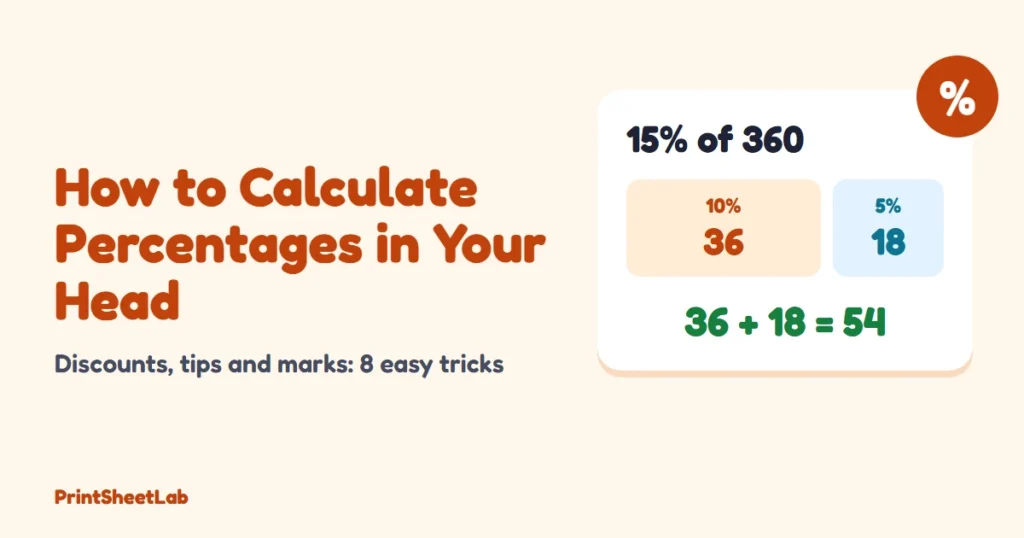
To calculate a percentage in your head, find 10% by dividing by 10, find 1% by dividing by 100, then build the percentage you need from those pieces: 15% of 360 is 36 + 18 = 54. This guide shows how to calculate percentages mentally with eight quick tricks, then uses them for exam marks, discounts, tips, VAT or GST and percentage change, with every example worked out.
A percentage is a number of parts per hundred, so 35% means 35/100 of something. When you need an exact answer to several decimal places, use our online percentage calculator with working. For shopping, restaurant bills and quick checks of marks, knowing how to calculate percentage mentally is faster than reaching for a phone.
How to calculate percentage of a number: the basic formula
Every percentage question comes from one idea: percentage × amount ÷ 100. So 12% of 250 = 12 × 250 ÷ 100 = 30. Going the other way, to find what percentage one number is of another, divide the part by the whole and multiply by 100: 42 out of 50 = 42 ÷ 50 × 100 = 84%.
The Common Core standards describe this exactly: in Grade 6 pupils learn that “30% of a quantity means 30/100 times the quantity” (6.RP.A.3c in the official Common Core mathematics PDF). Mental methods are simply smart ways of doing that multiplication without a calculator.
How to calculate percentage in your head: 8 easy tricks
Learn these in order. Each one is a building block for the next, and together they cover almost every everyday percentage.
1. Find 10% by dividing by 10
Move every digit one place to the right. 10% of 340 is 34; 10% of 75 is 7.5; 10% of £12.40 is £1.24. This is the most useful trick of all, because so many other percentages are built from it.
2. Find 1% by dividing by 100
Move every digit two places to the right. 1% of 2,500 is 25 and 1% of 640 is 6.4. Use 1% for awkward amounts such as 2%, 3% or 99%.
3. Find 50% by halving
50% is one half. 50% of 86 is 43. Halving is often easier than dividing by 10, so start here when the percentage is close to 50%.
4. Find 25% by halving twice
25% is one quarter. 25% of 360: half is 180, half again is 90. Then 75% is three of those quarters: 270.
5. Find 5% by halving 10%
5% of 180: 10% is 18, so 5% is 9. In the same way, 2.5% is half of 5%: 2.5% of 600 is 15.
6. Build any percentage from the pieces
Add or subtract the easy pieces. This is how to get percentages like 15%, 35% or 12% without writing anything down.
| Percentage | How to build it | Worked example |
|---|---|---|
| 15% | 10% + 5% | 15% of 360 = 36 + 18 = 54 |
| 20% | 10% × 2 | 20% of 45 = 4.5 × 2 = 9 |
| 35% | 30% + 5% | 35% of 80 = 24 + 4 = 28 |
| 12% | 10% + 1% + 1% | 12% of 250 = 25 + 2.5 + 2.5 = 30 |
| 17.5% | 10% + 5% + 2.5% | 17.5% of 240 = 24 + 12 + 6 = 42 |
| 90% | 100% − 10% | 90% of 70 = 70 − 7 = 63 |
| 75% | 50% + 25% | 75% of 360 = 180 + 90 = 270 |
The England national curriculum uses this very kind of example: Year 6 pupils should “solve problems involving the calculation of percentages [for example, of measures, and such as 15% of 360]”, according to the mathematics programmes of study.
7. The swap trick: x% of y = y% of x
Percentages can be turned around. 8% of 50 looks hard, but 50% of 8 is 4, and the answers are the same. It works because both mean 8 × 50 ÷ 100. Try 4% of 75 (= 75% of 4 = 3) or 18% of 50 (= 50% of 18 = 9).
8. Use fractions you already know
Some percentages are friendly fractions: 50% = 1/2, 25% = 1/4, 20% = 1/5, 12.5% = 1/8 and 10% = 1/10. So 12.5% of 64 is 64 ÷ 8 = 8. Our decimal and fraction converter and the fraction rules guide help if these links are new to you.

Percentage of marks in exams
Exam results in India, Pakistan, the UK and the US are often given as a percentage, so students search for how to calculate percentage of marks more than almost anything else. Divide the marks you scored by the total marks and multiply by 100.
Mental shortcut: scale the total to 100. Out of 50, double the marks: 42/50 = 84%. Out of 20, multiply by 5: 17/20 = 85%. Out of 25, multiply by 4. Out of 200, halve. Out of 500, divide by 5: 456/500 = 91.2%.
| Marks scored | Total marks | Quick method | Percentage |
|---|---|---|---|
| 42 | 50 | × 2 | 84% |
| 17 | 20 | × 5 | 85% |
| 36 | 40 | ÷ 4, then × 10 | 90% |
| 456 | 500 | ÷ 5 | 91.2% |
| 902 | 1,100 | ÷ 11 (902 ÷ 11 = 82) | 82% |
| 1,068 | 1,200 | ÷ 12 (1,068 ÷ 12 = 89) | 89% |
For several subjects, add all the marks first, then divide by the combined total. Scores of 78, 88 and 92, each out of 100, make 258 out of 300, which is 86%. Do not average percentages from papers with different totals; add the raw marks instead. To check grade boundaries or a weighted average, use the test grade calculator.
How to calculate discount percentage when shopping
For a sale price, find the discount and subtract it, or find what is left straight away. 30% off Rs 2,400: 10% is 240, so 30% is 720, and you pay Rs 1,680. Quicker still: you pay 70%, which is 7 × 240 = 1,680.
25% off a £36 jumper: a quarter of 36 is 9, so the price is £27. To work backwards from a sale price, divide by the part you paid: if a book costs 64 after 20% off, you paid 80%, so the original price was 64 ÷ 0.8 = 80.
Watch out for stacked discounts. “20% off, then an extra 10% off” is not 30% off. On a price of 100, 20% off leaves 80, and 10% off 80 leaves 72. That is 28% off in total. Our discount, tax and tip calculator handles stacked offers and splits bills.

Working out a restaurant tip
Tipping customs vary by country, but the maths is the same. Start from 10% and adjust.
- 15% of $48: 10% is 4.80, 5% is 2.40, so the tip is $7.20.
- 20% of $65: 10% is 6.50, doubled is $13.
- 18% of $40: 20% is 8, 2% is 0.80, so 8 − 0.80 = $7.20.
Adding and removing tax: VAT and GST
To add tax, find the tax and add it, or multiply by 1 plus the rate. The UK standard rate of VAT is 20%, as listed on GOV.UK’s VAT rates page. So £45 + 20% VAT = 45 + 9 = £54, or 45 × 1.2 = 54.
India’s GST works the same way. At an 18% rate, the tax on ₹1,500 is 10% (150) + 8% (120) = ₹270, so the bill is ₹1,770.
Removing tax is where people go wrong. To find the price before 20% VAT on £54, divide by 1.2 to get £45. Taking 20% off £54 gives £43.20, which is wrong, because the 20% was added to the smaller price, not the bigger one.
Finding the whole: reverse percentages
Sometimes you know the part and the percentage, and need the whole. Divide the part by the percentage, then multiply by 100. If 30% of a class is 9 pupils, then 1% is 9 ÷ 30 = 0.3, and 100% is 30 pupils.
The mental version is even quicker: 30% is 9, so 10% is 3, and 100% is 30. This is how to solve percentage problems “backwards”, and it is the same idea as removing VAT or finding a price before a discount.
Percentage change: rises, falls and percentage points
Percentage change compares a change with the starting value: (new − old) ÷ old × 100. If a bus fare rises from 80 to 92, the change is 12, and 12 ÷ 80 × 100 = a 15% increase. If a price falls from 250 to 200, the change is −50, and −50 ÷ 250 × 100 = a 20% decrease.
Always divide by the old value. That is why a 25% rise followed by a 25% fall does not get you back where you started: 100 rises to 125, then 25% of 125 comes off, leaving 93.75.
Percentage points are different. When a rate moves from 40% to 50%, it has risen by 10 percentage points, but by 25% in relative terms (10 ÷ 40 × 100). The UK’s Office for National Statistics explains in its guidance on writing about percentages that a percentage point is the difference between percentages.
Common mistakes to avoid
- Dividing by the new value in percentage change. Always use the starting value.
- Adding stacked discounts (20% + 10% is 28% off, not 30%).
- Taking tax off the total instead of dividing by 1.2 or 1.18.
- Averaging percentages from tests with different totals.
- Moving the decimal point the wrong way: 10% of 75 is 7.5, not 750. Ask whether the answer is sensible.
When children learn percentages
| Stage | What the curriculum says | Tricks to practise |
|---|---|---|
| England Year 5 (age 9 to 10) | Understand that per cent relates to “number of parts per 100” | 50%, 25%, 10%, 1% |
| England Year 6 / US Grade 6 | Find percentages of amounts, such as 15% of 360; 30% means 30/100 times the quantity (6.RP.A.3c) | Building percentages, swap trick, marks |
| US Grade 7 / England Key Stage 3 | Tax, markdowns, tips (“gratuities”), percent increase and decrease (7.RP.A.3); percentage change | Discounts, VAT/GST, percentage change |
Children who are secure with decimals find percentages much easier. Our decimals worksheets and the guide on how to multiply decimals build those skills, and quick times tables tricks speed up every step above.
Practise with printables
Knowing how to calculate percentage in your head only sticks when you use it daily. Print our percent worksheets for 10% and 25% warm-ups, then try percentage of amounts, discounts and percentage change. Check answers with the percentage calculator afterwards rather than before, so the thinking happens first.
A good routine for building speed: one 10% question, one built percentage, one swap trick and one real-life question (a price tag or a test score) each day for two weeks.
Related guides and printables
- Fractions of a number worksheets
- Final grade calculator for exam planning
- Tenths and hundredths worksheets
- Free online math games for kids
- Ratio calculator
Sources
Curriculum statements come from the Department for Education’s national curriculum in England: mathematics programmes of study and the Common Core State Standards for Mathematics (6.RP.A.3c and 7.RP.A.3). The VAT rate is from GOV.UK, and the definition of a percentage point is from the ONS Service Manual. Every example in this guide was checked with Python.
Frequently asked questions
6 quick answers
How to calculate percentage in your head the easy way?
Find 10% by dividing by 10, then build what you need from it. 20% is double 10%, 5% is half of 10%, and 15% is 10% plus 5%.
How do you calculate percentage of marks?
Divide the marks you scored by the total marks and multiply by 100. For example, 456 out of 500 is 456 ÷ 500 × 100 = 91.2%.
How to calculate percentage of a number quickly?
Multiply the number by the percentage and divide by 100, or use the swap trick: 8% of 50 is the same as 50% of 8, which is 4.
How to calculate discount percentage from a sale price?
Divide the amount saved by the original price and multiply by 100. If a Rs 2,400 item is sold for Rs 1,680, you save 720, and 720 ÷ 2,400 × 100 = 30% off.
How to calculate percentage change for an increase or decrease?
Subtract the old value from the new value, divide by the old value and multiply by 100. A rise from 80 to 92 is 12 ÷ 80 × 100 = 15%.
How do you remove 20% VAT from a price?
Divide the price by 1.2. A price of £54 including 20% VAT was £45 before VAT. Do not take 20% off the total.