This free decimal to fraction calculator turns a decimal like 0.375 into a fraction in simplest form, converts a fraction like 1/7 into a decimal that shows exactly which digits repeat, and handles repeating decimals and ruler readings in inches. Every answer comes with the working, so you can check homework, convert a measurement or learn the method at the same time.
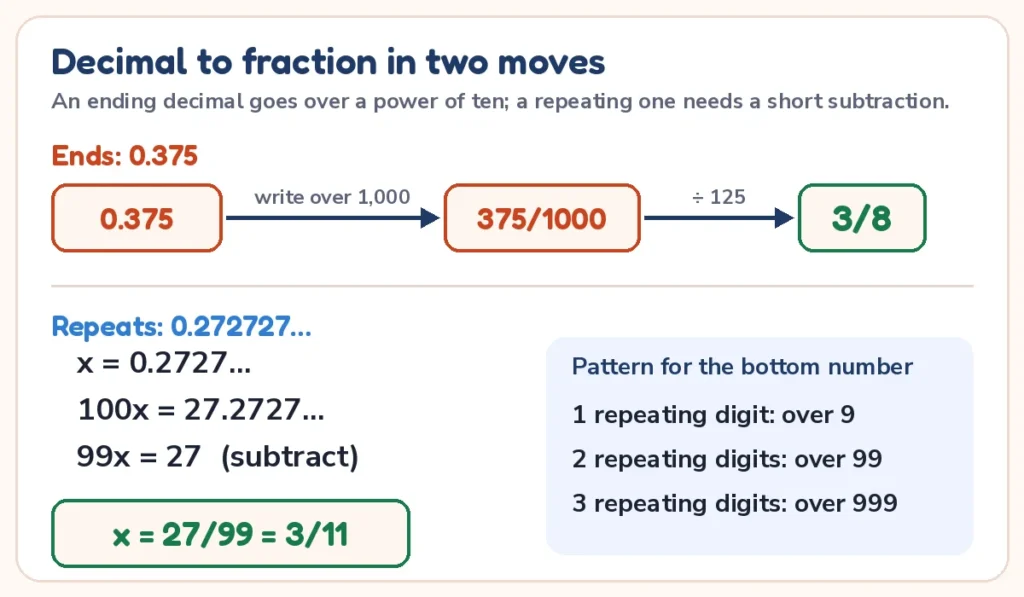
Quick answer: to change a decimal to a fraction, write the digits over 10, 100 or 1,000 (one zero for each decimal place) and simplify. For 0.375, that is 375/1000 = 3/8. To change a fraction to a decimal, divide the top number by the bottom number: 5 ÷ 8 = 0.625. A repeating decimal such as 0.272727… equals 27/99 = 3/11.
How to use the decimal to fraction calculator
- Choose Decimal to fraction, Fraction to decimal or Nearest ruler fraction in the first row.
- Type the number. Decimals can be negative or bigger than 1, such as 2.4 or -0.75. Fractions can be written as 5/8 or as a mixed number with a space, such as 1 3/4.
- For a repeating decimal, put the repeating digits in brackets, such as 0.(27) or 0.1(6), or end the number with three dots, such as 0.333…
- Read the answer and the steps. A fraction bigger than 1 is also shown as a mixed number, and a repeating decimal is shown with a bar over the repeating digits, so 1/7 appears as 0.142857 with the bar over all six digits.
| Mode | You type | You get |
|---|---|---|
| Decimal to fraction | 0.375, 2.4, 0.(27), 0.1(6) or 0.333… | The simplest-form fraction, the mixed number if it is above 1, the percent and the steps |
| Fraction to decimal | 5/8, 1 3/4 or 22/7 | The decimal, with the repeating block marked, the length of the repeat and the percent |
| Nearest ruler fraction | 0.3, 2.4375 or 0.7 plus 1/2, 1/4, 1/8, 1/16, 1/32 or 1/64 | The nearest mark on the ruler, the marks either side and how far off the answer is |
Step-by-step guides and a printable chart
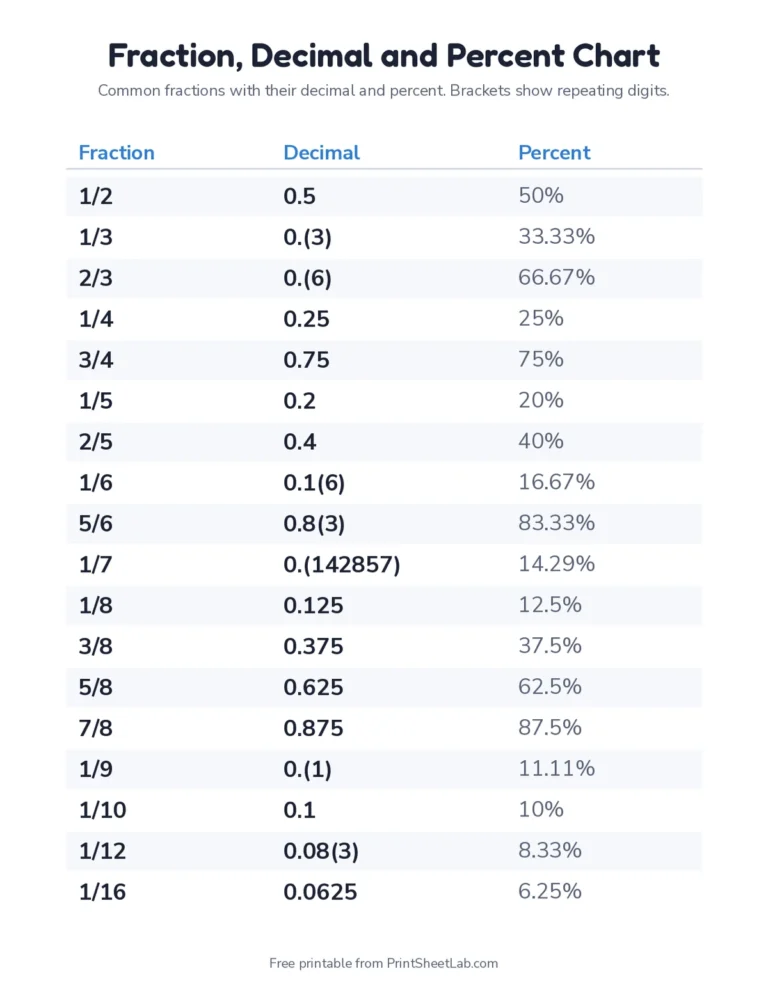
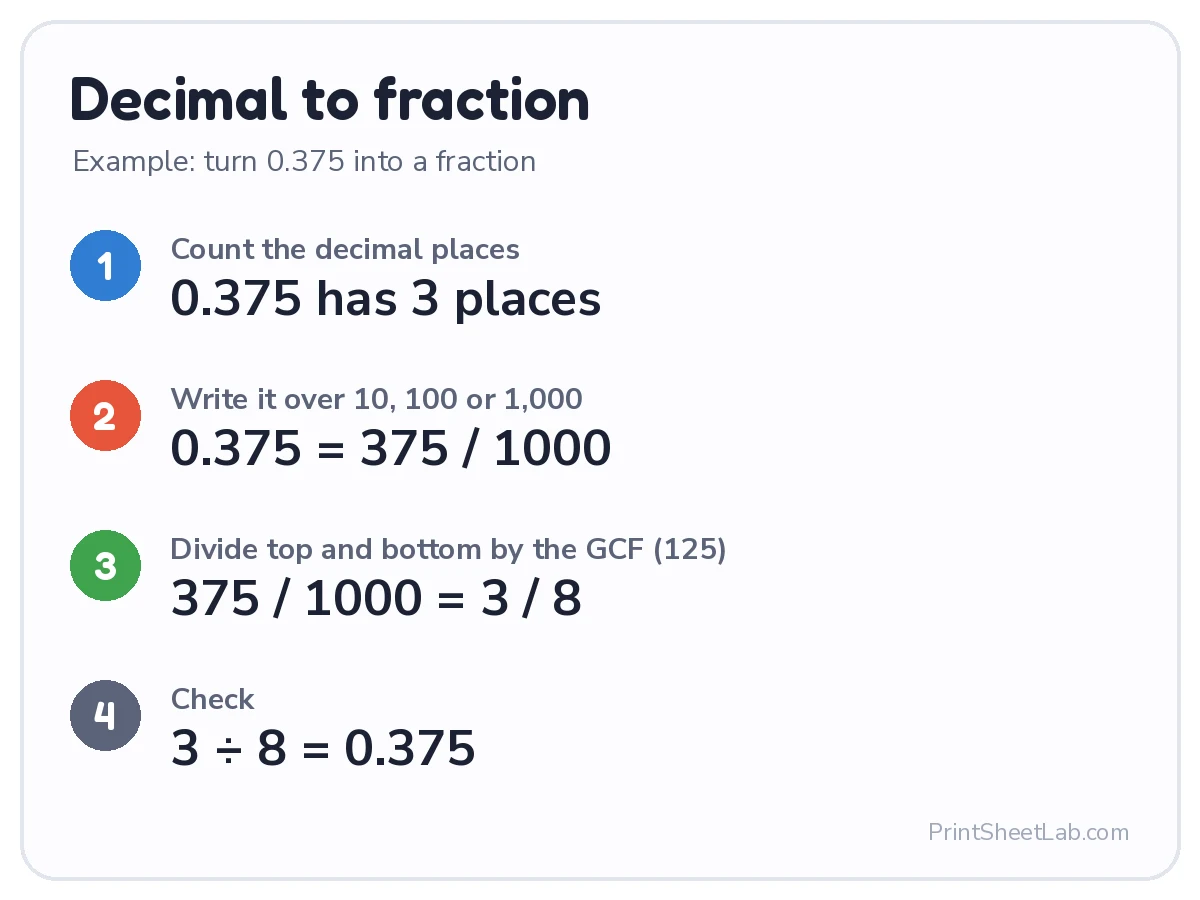
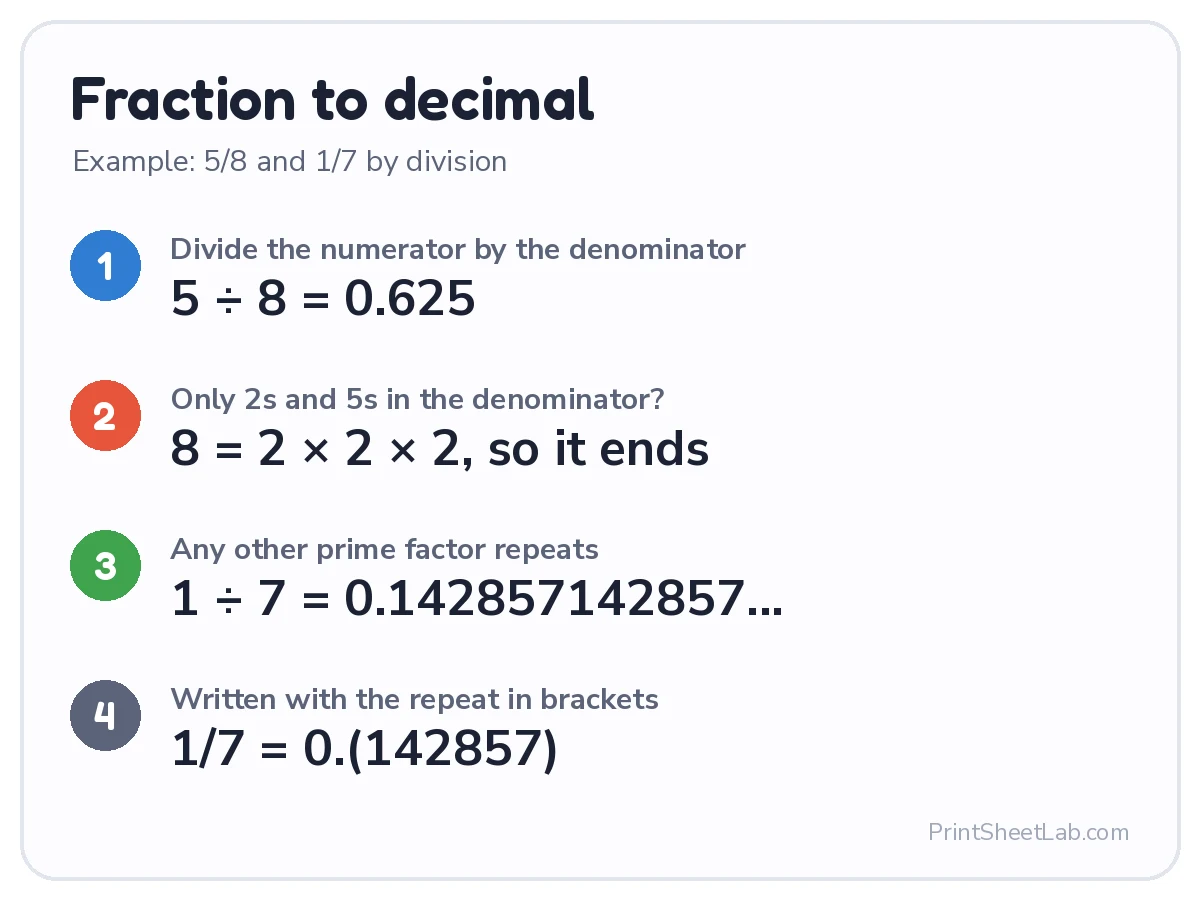
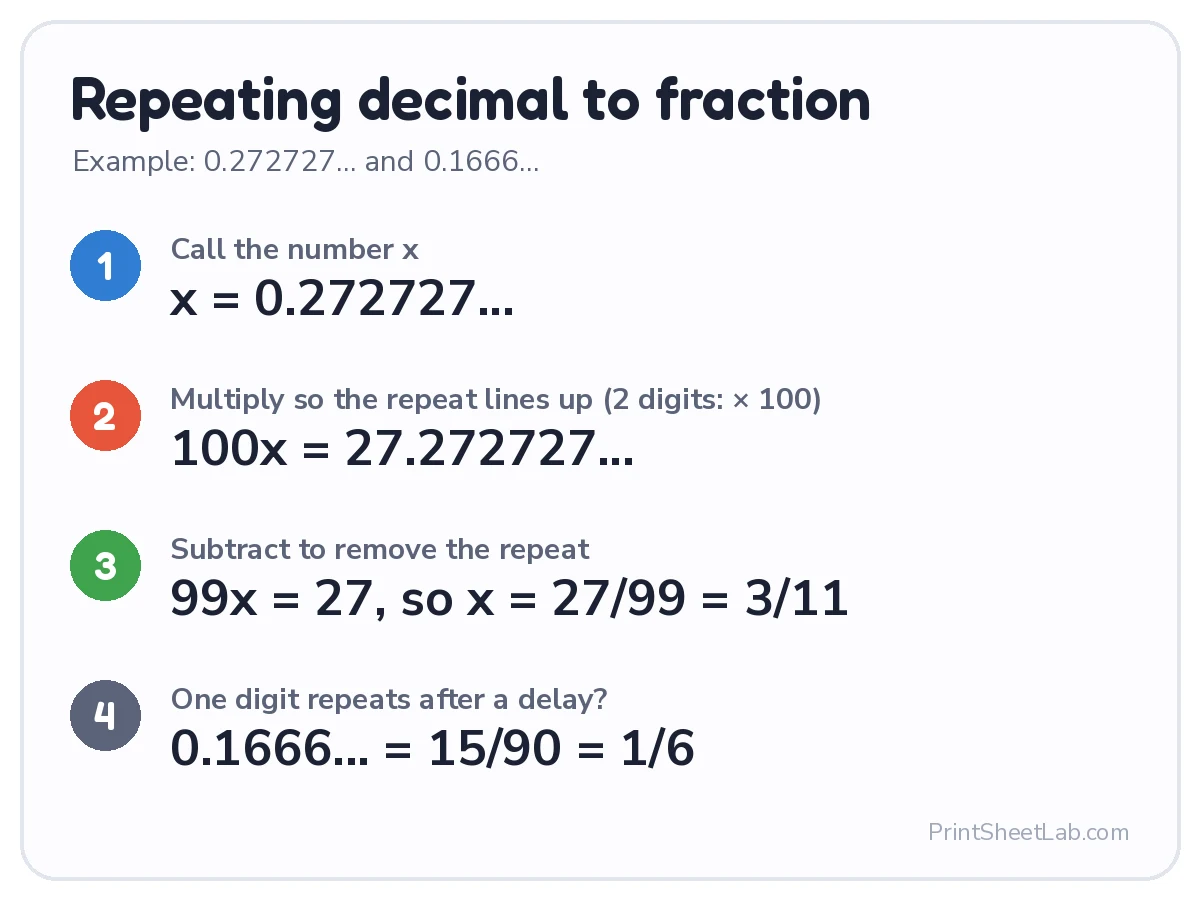
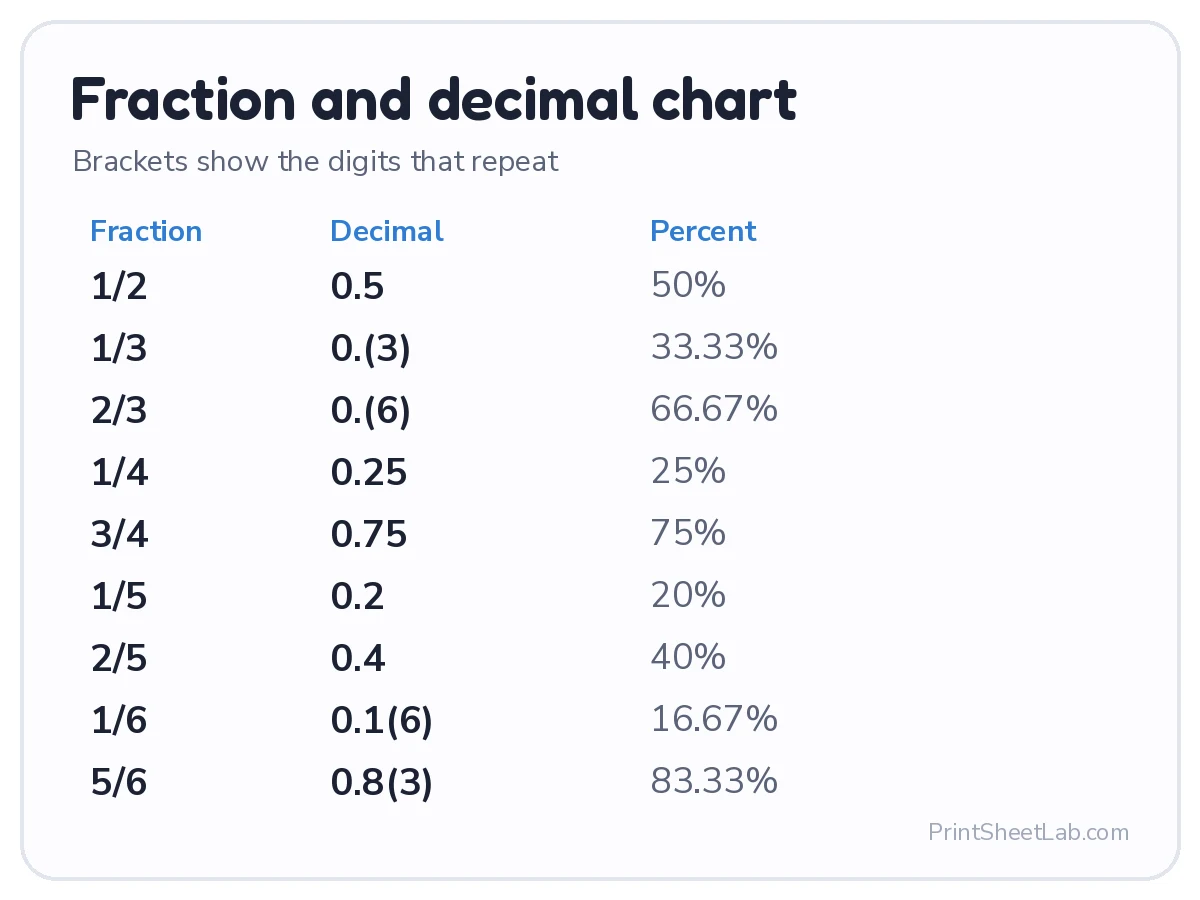
Each card walks through one decimal to fraction or fraction to decimal conversion with a worked example. The printable chart lists 18 common fractions with their decimals and percents, ready to stick in a math notebook.
How to convert a decimal to a fraction
Every decimal that ends can be written as a fraction with 10, 100, 1,000 or another power of ten on the bottom. Count the digits after the decimal point; that is how many zeros the denominator needs. Then simplify by dividing the top and bottom by their greatest common factor.
- 0.75 has two decimal places, so 0.75 = 75/100. The greatest common factor is 25, so the decimal to fraction answer is 3/4.
- 0.08 = 8/100 = 2/25.
- 0.0625 = 625/10,000 = 1/16, a common measurement in inches.
- 1.75 = 175/100 = 7/4, which is the mixed number 1 3/4.
The decimal to fraction calculator does exactly this, and the steps show the denominator it used and the number it divided by, so a student can follow the same working on paper.
How to convert decimal to fraction: the place value pattern
The number of decimal places decides the denominator. This table shows the pattern with one example for each length.
| Decimal places | Example | Denominator | Unreduced fraction | Simplest form |
|---|---|---|---|---|
| 1 | 0.6 | 101 = 10 | 6/10 | 3/5 |
| 2 | 0.35 | 102 = 100 | 35/100 | 7/20 |
| 3 | 0.125 | 103 = 1,000 | 125/1,000 | 1/8 |
| 4 | 0.0625 | 104 = 10,000 | 625/10,000 | 1/16 |
| 5 | 0.00025 | 105 = 100,000 | 25/100,000 | 1/4000 |
| 6 | 0.000125 | 106 = 1,000,000 | 125/1,000,000 | 1/8000 |
Decimal to fraction simplest form: always reduce
The unreduced fraction is correct, but most teachers and tests want decimal to fraction simplest form. Divide the top and the bottom by their greatest common factor, and stop when the only shared factor is 1. 50/100 is correct but not finished; 1/2 is the answer. The simplify fractions calculator shows that last step on its own.
| Decimal | Fraction | Decimal | Fraction | Decimal | Fraction |
|---|---|---|---|---|---|
| 0.1 | 1/10 | 0.2 | 1/5 | 0.25 | 1/4 |
| 0.3 | 3/10 | 0.4 | 2/5 | 0.5 | 1/2 |
| 0.6 | 3/5 | 0.7 | 7/10 | 0.75 | 3/4 |
| 0.8 | 4/5 | 0.9 | 9/10 | 0.05 | 1/20 |
| 0.15 | 3/20 | 0.35 | 7/20 | 0.45 | 9/20 |
| 0.125 | 1/8 | 0.375 | 3/8 | 0.625 | 5/8 |
Decimal to fraction calculator with steps: worked examples
These three examples show what the decimal to fraction calculator writes in its working, so the numbers on this page match the tool exactly. Try each one in the box above.
Example 1: 0.84. Two decimal places, so write 84/100. The greatest common factor of 84 and 100 is 4, so 84 ÷ 4 = 21 and 100 ÷ 4 = 25. The answer is 21/25, and the check 21 ÷ 25 = 0.84 confirms it.
Example 2: 3.125. Three decimal places, so write 3125/1000. The greatest common factor is 125, which gives 25/8. As a mixed number that is 3 1/8, because 25 ÷ 8 = 3 remainder 1.
Example 3: -0.45. Work with 0.45 = 45/100 = 9/20, then put the minus sign back: -9/20. Negative decimals never change the method, only the sign of the answer.
Quick decimal to fraction answers for popular decimals
Use this lookup when you only need the result. Every row was simplified with the greatest common factor, the same way the decimal to fraction calculator does it.
| Decimal | Fraction | Decimal | Fraction | Decimal | Fraction | Decimal | Fraction |
|---|---|---|---|---|---|---|---|
| 0.01 | 1/100 | 0.02 | 1/50 | 0.04 | 1/25 | 0.06 | 3/50 |
| 0.08 | 2/25 | 0.12 | 3/25 | 0.16 | 4/25 | 0.18 | 9/50 |
| 0.24 | 6/25 | 0.32 | 8/25 | 0.36 | 9/25 | 0.44 | 11/25 |
| 0.48 | 12/25 | 0.52 | 13/25 | 0.56 | 14/25 | 0.64 | 16/25 |
| 0.68 | 17/25 | 0.72 | 18/25 | 0.84 | 21/25 | 0.88 | 22/25 |
How to convert a fraction to a decimal
A fraction is a division waiting to happen: 5/8 means 5 ÷ 8 = 0.625. Long division works for any fraction, and the fraction to decimal calculator mode does the division for you. Whether the decimal ends or repeats depends only on the denominator in simplest form. If its prime factors are only 2s and 5s, the decimal ends (8 = 2 × 2 × 2, so 5/8 ends). Any other prime factor, such as 3 or 7, makes the decimal repeat forever.
That rule explains familiar results: 1/4 = 0.25 ends, while 1/3 = 0.333… and 1/6 = 0.1666… repeat. The decimal to fraction calculator states which case you have, then marks the repeating block with a bar.
Fraction to decimal calculator: does it end or repeat?
Use this table as a quick check before you open the fraction to decimal calculator. It lists 1 divided by each denominator from 2 to 16, whether the decimal ends, and the length of the repeating block.
| Denominator | Prime factors | 1 ÷ denominator | Type |
|---|---|---|---|
| 2 | 2 | 0.5 | ends |
| 3 | 3 | 0.(3) | repeats every 1 digit |
| 4 | 22 | 0.25 | ends |
| 5 | 5 | 0.2 | ends |
| 6 | 2 × 3 | 0.1(6) | repeats every 1 digit |
| 7 | 7 | 0.(142857) | repeats every 6 digits |
| 8 | 23 | 0.125 | ends |
| 9 | 32 | 0.(1) | repeats every 1 digit |
| 10 | 2 × 5 | 0.1 | ends |
| 11 | 11 | 0.(09) | repeats every 2 digits |
| 12 | 22 × 3 | 0.08(3) | repeats every 1 digit |
| 13 | 13 | 0.(076923) | repeats every 6 digits |
| 14 | 2 × 7 | 0.0(714285) | repeats every 6 digits |
| 15 | 3 × 5 | 0.0(6) | repeats every 1 digit |
| 16 | 24 | 0.0625 | ends |
The brackets show the repeating digits. Seven is the classic example: 1/7 repeats every 6 digits, and every sevenths fraction uses the same six digits in a different order, such as 2/7 = 0.(285714).
Repeating decimal to fraction: the algebra method
A repeating decimal to fraction conversion uses a short algebra trick. Type the repeating digits in brackets (0.(27)) or end with dots (0.2727…) and the decimal to fraction calculator does it for you. Here is the method on paper for 0.272727…:
- Call the number x: x = 0.272727…
- Count the repeating digits (here 2) and multiply by 10 for each one: 100x = 27.272727…
- Subtract the first line from the second so the repeating part cancels: 99x = 27.
- Divide and simplify: x = 27/99 = 3/11.
A quick pattern: one repeating digit goes over 9 (0.(4) = 4/9), two repeating digits go over 99 (0.(36) = 36/99 = 4/11), and three go over 999. When the repeat starts later, as in 0.1666…, multiply twice: 100x = 16.666… and 10x = 1.666…, so 90x = 15 and x = 1/6. You can check any answer with the fraction to decimal mode, which should give the same repeating digits back. Wikipedia’s repeating decimal article explains why every repeating decimal is a fraction.
Repeating decimals and their fractions
| Repeating decimal | Fraction in simplest form | Mixed number |
|---|---|---|
| 0.(3) | 1/3 | — |
| 0.(6) | 2/3 | — |
| 0.(12) | 4/33 | — |
| 0.(27) | 3/11 | — |
| 0.1(6) | 1/6 | — |
| 0.8(3) | 5/6 | — |
| 0.0(3) | 1/30 | — |
| 0.(142857) | 1/7 | — |
| 1.2(34) | 611/495 | 1 116/495 |
| 2.(45) | 27/11 | 2 5/11 |
One special case surprises many students: 0.999… repeats forever and is exactly 1, because 9/9 = 1. The decimal to fraction calculator reports 0.(9) as 1 and adds a note.
Decimal to fraction inches: reading a tape measure
Rulers and drill bits use sixteenths, thirty-seconds and sixty-fourths, but calipers and plans often give decimals. The nearest ruler fraction mode of the decimal to fraction calculator rounds a decimal to the nearest mark: 0.3 in is 4.8 sixteenths, so the nearest mark is 5/16 (0.3125 in), which is 0.0125 in too big. 0.7 in becomes 11/16 (0.6875 in). A value such as 2.4375 in lands exactly on 2 7/16, and the calculator says so.
An inch is defined as exactly 25.4 millimeters, which is how the millimeter column below was calculated. Pick the finest ruler you can actually read, and use the unit converter for other length units.
Decimal to fraction chart for inches in sixteenths
| Fraction of an inch | Decimal inches | Millimeters |
|---|---|---|
| 1/16 | 0.0625 | 1.5875 |
| 1/8 | 0.125 | 3.175 |
| 3/16 | 0.1875 | 4.7625 |
| 1/4 | 0.25 | 6.35 |
| 5/16 | 0.3125 | 7.9375 |
| 3/8 | 0.375 | 9.525 |
| 7/16 | 0.4375 | 11.1125 |
| 1/2 | 0.5 | 12.7 |
| 9/16 | 0.5625 | 14.2875 |
| 5/8 | 0.625 | 15.875 |
| 11/16 | 0.6875 | 17.4625 |
| 3/4 | 0.75 | 19.05 |
| 13/16 | 0.8125 | 20.6375 |
| 7/8 | 0.875 | 22.225 |
| 15/16 | 0.9375 | 23.8125 |
| 1 | 1 | 25.4 |
Fraction to decimal chart
This fraction to decimal chart lists the fractions that come up most, with the decimal and the percent. Percents are rounded to two decimal places. To turn any decimal into a percent, multiply by 100: 0.375 = 37.5%.
| Fraction | Decimal | Percent |
|---|---|---|
| 1/2 | 0.5 | 50% |
| 1/3 | 0.(3) | 33.33% |
| 2/3 | 0.(6) | 66.67% |
| 1/4 | 0.25 | 25% |
| 3/4 | 0.75 | 75% |
| 1/5 | 0.2 | 20% |
| 2/5 | 0.4 | 40% |
| 3/5 | 0.6 | 60% |
| 4/5 | 0.8 | 80% |
| 1/6 | 0.1(6) | 16.67% |
| 5/6 | 0.8(3) | 83.33% |
| 1/7 | 0.(142857) | 14.29% |
| 1/8 | 0.125 | 12.5% |
| 3/8 | 0.375 | 37.5% |
| 5/8 | 0.625 | 62.5% |
| 7/8 | 0.875 | 87.5% |
| 1/9 | 0.(1) | 11.11% |
| 1/10 | 0.1 | 10% |
| 1/12 | 0.08(3) | 8.33% |
| 1/16 | 0.0625 | 6.25% |
Decimal to fraction chart for common decimals
The same chart read the other way, as a decimal to fraction chart, is on the printable PDF above. Keep it in a notebook or print it from the card.
Where decimal to fraction conversions come up
- Measuring in inches: rulers and drill bits use sixteenths, so a reading of 0.5625 in is 9/16 in.
- Cooking: 0.25 cup is 1/4 cup and 0.33 cup is close to 1/3 cup.
- Money: $0.75 is three quarters of a dollar, 3/4.
- Homework: many math problems ask for an answer “as a fraction in simplest form”, which is exactly what the decimal to fraction mode gives.
For more practice, print the free decimals worksheets and fractions worksheets, both with answer keys.
Decimals and fractions in school
In the United States, the Common Core standards introduce decimal notation for fractions with denominators 10 and 100 in grade 4. Grade 7 adds converting a rational number to a decimal by long division, knowing that it terminates or eventually repeats. Grade 8 closes the loop by converting a repeating decimal back into a fraction, which is the algebra method above. Other countries order the topic differently, so check your own syllabus.
Common mistakes to avoid
These are the errors the decimal to fraction calculator helps you catch. Compare each wrong line with the correct one, then try the same decimal in the box.
| Mistake | Why it is wrong | Correct |
|---|---|---|
| 0.05 = 5/10 | The number of zeros must match the decimal places | 5/100 = 1/20 |
| 50/100 as the final answer | It is correct but not simplified | 1/2 |
| 0.33 = 1/3 | Only the repeating 0.333… equals 1/3 | 0.33 = 33/100 |
| 0.6 = 6/100 | One decimal place means tenths, not hundredths | 6/10 = 3/5 |
| Rounding 1/7 to 0.14 and converting back | It gives 14/100 = 7/50, which is not 1/7 | 0.(142857) = 1/7 |
Questions people ask about decimal to fraction conversion
What is 0.625 as a fraction?
0.625 = 625/1000 = 5/8. The greatest common factor of 625 and 1,000 is 125, and 625 ÷ 125 = 5 while 1,000 ÷ 125 = 8.
How do I convert a decimal to a fraction without a calculator?
Write the digits over a power of ten with one zero per decimal place, then divide the top and bottom by the same number until nothing more divides both. For 0.45, 45/100 divides by 5 to give 9/20.
Does the decimal to fraction calculator show steps?
Yes. It shows the place value step, the simplifying step, the mixed number and a division check, and for repeating decimals it shows the full algebra method with the subtraction.
Decimal to fraction calculator: frequently asked questions
How do I show a repeating decimal?
Put the repeating digits in brackets, such as 0.(142857), or end a number with three dots, such as 0.333… The answer shows a bar over the repeating digits. In books you may also see a bar written over them.
What is 0.375 as a fraction?
0.375 = 375/1000. Dividing both by 125 gives 3/8.
Can the decimal to fraction calculator convert 0.333…?
Yes. End the number with dots, 0.333…, or write 0.(3), and it returns 1/3. If you type 0.333 without dots, it converts exactly what you typed, 333/1000.
Can I enter a mixed number?
Yes, in fraction to decimal mode. Type the whole number, a space and the fraction, such as 2 1/4, and the calculator returns 2.25.
Why do some fractions give decimals that never end?
Our numbers are based on ten, which is 2 × 5. If the denominator has any other prime factor, the division never comes out exactly, so a block of digits repeats forever.
How do I turn a fraction into a percent?
Convert it to a decimal and multiply by 100: 3/8 = 0.375 = 37.5%. The percentage calculator can help with the next step.
How do I convert a decimal to a fraction in inches?
Choose Nearest ruler fraction, type the decimal and pick the ruler, such as 1/16. The calculator returns the nearest mark and how far off it is.
What is 0.5 as a fraction?
0.5 = 5/10 = 1/2.
Which numbers does the decimal to fraction calculator accept?
Decimals up to about 40 digits, negative numbers, numbers above 1, repeating decimals written as 0.(27) or 0.333…, fractions and mixed numbers. It uses exact whole-number arithmetic, so there is no rounding error in the fraction.
How do I check a decimal to fraction answer?
Divide the top by the bottom. 3 ÷ 8 = 0.375 confirms that 3/8 is the right fraction for 0.375, and the last line of the working does this check for you.
Is the decimal to fraction calculator free?
Yes, it is free with no sign-up, and the chart PDF is free to print.
More calculators
- Fraction calculator: add, subtract, multiply and divide
- Simplify fractions calculator
- Percentage calculator
- Rounding calculator
- Long division calculator
- All calculators
Sources and further reading
- Wikipedia: Repeating decimal
- Wikipedia: 0.999…
- Wikipedia: Inch
- Common Core State Standards: Grade 8, The Number System
Last updated: October 2026.