A grade calculator turns points earned and points possible into a score: percent = points earned ÷ points possible × 100. This free grade calculator gives your test score percentage and letter grade, shows how many points you missed, and works as a test grade calculator, a quiz grade calculator and a quick grader for teachers.
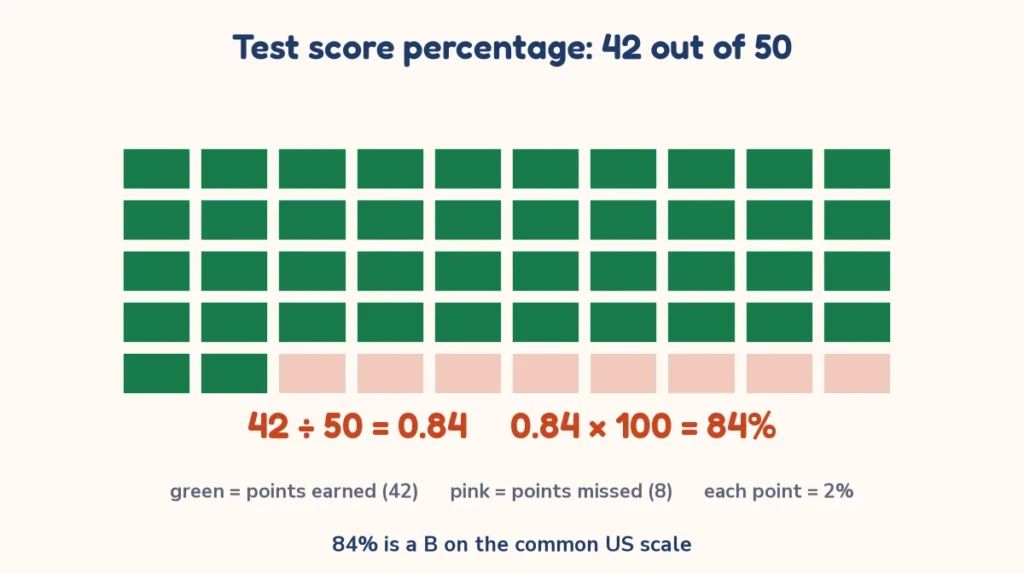
Quick answer: divide the points you earned by the points possible, then multiply by 100. On a 50-point test, 42 points gives 42 ÷ 50 = 0.84, so the test score percentage is 84%, a B on the common US scale.
How to use the grade calculator
- Type the points earned, or the number of questions right if every question is worth the same. If you only know how many you missed, choose Questions wrong instead.
- Type the points possible, or the total number of questions.
- Pick a grade scale: United States letters, a US 10-point scale, Ontario achievement levels, UK degree classes or Australian grades.
- Read the percent, the letter grade, the points missed and how many more points it takes to reach the next grade.
Teachers grading by questions wrong can switch to Questions wrong: on a 25-question test with 3 wrong, the grade calculator gives 22 out of 25, or 88%. The table next to the result shows the neighboring scores, so you can see what one more or one fewer mistake does.
| Box | What to enter | Example |
|---|---|---|
| Points earned or questions wrong | points scored, or the number you missed | 42 earned, or 8 wrong |
| Points possible | the total on the test or quiz | 50 |
| Extra credit (optional) | bonus points added to the points earned only | 3 |
| Grade scale | the scale your school or country uses | US letters |
Grading examples and a printable easy grader
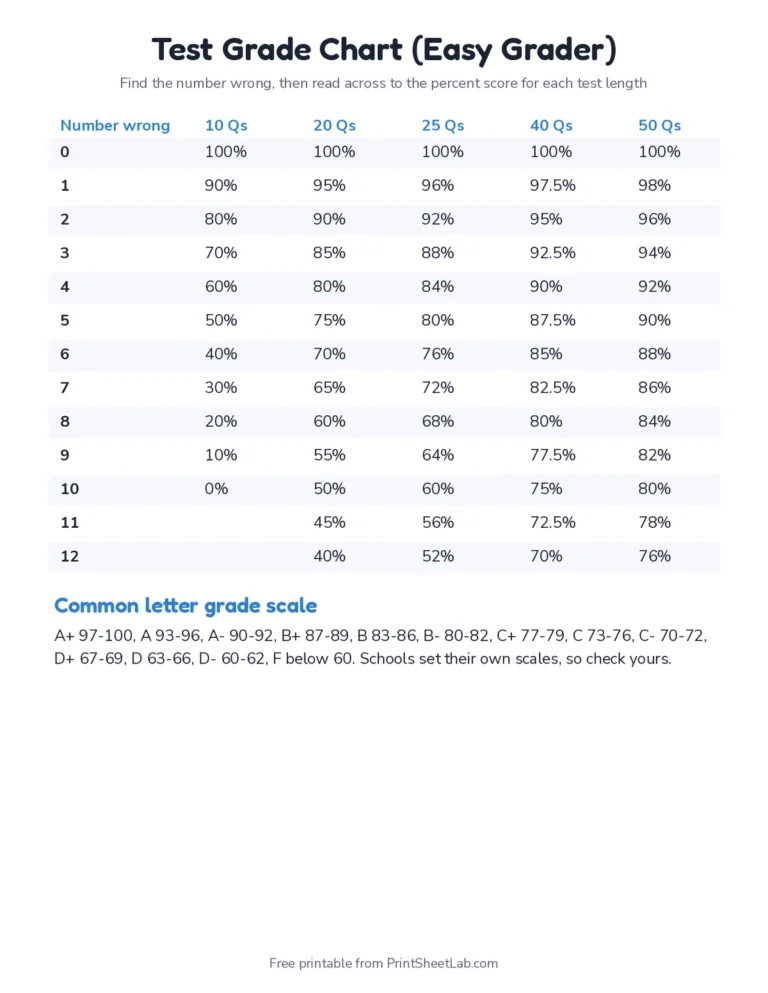
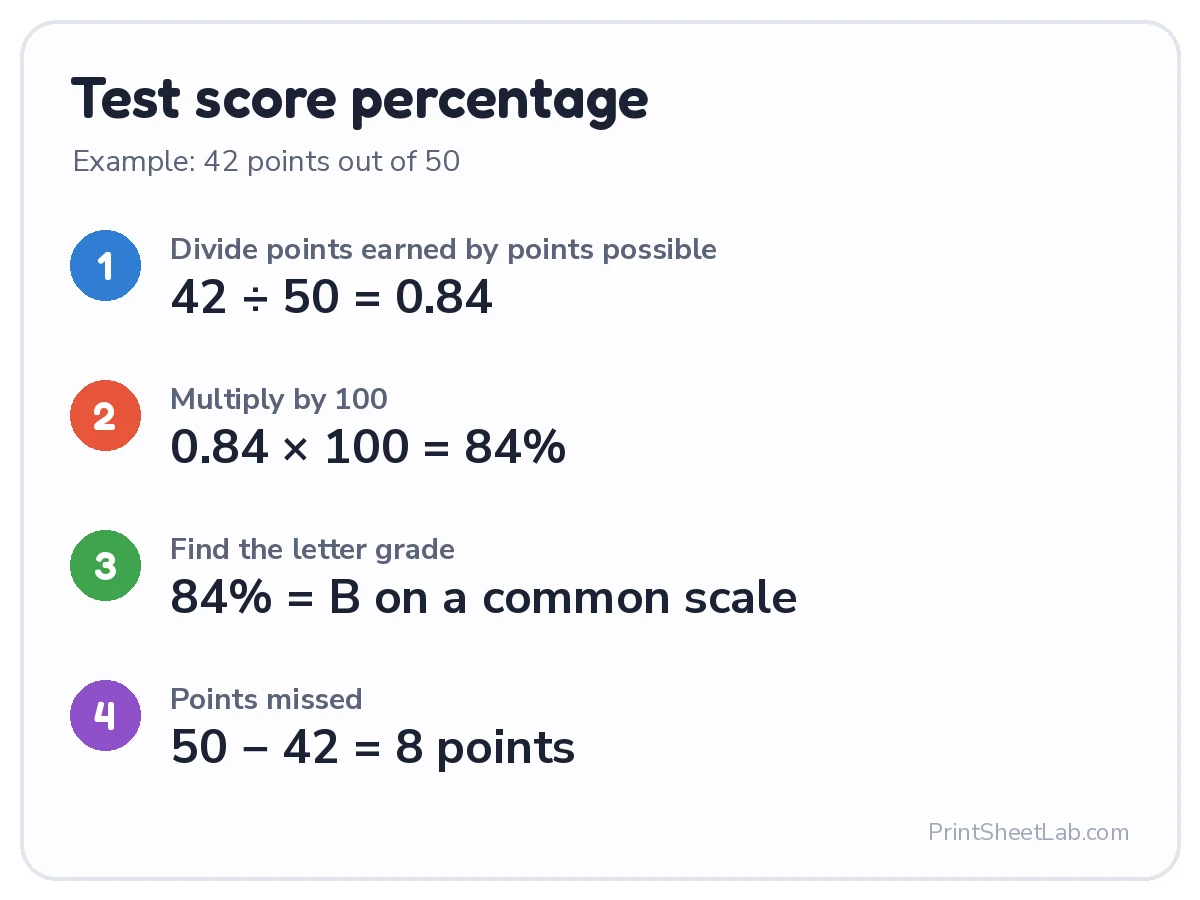
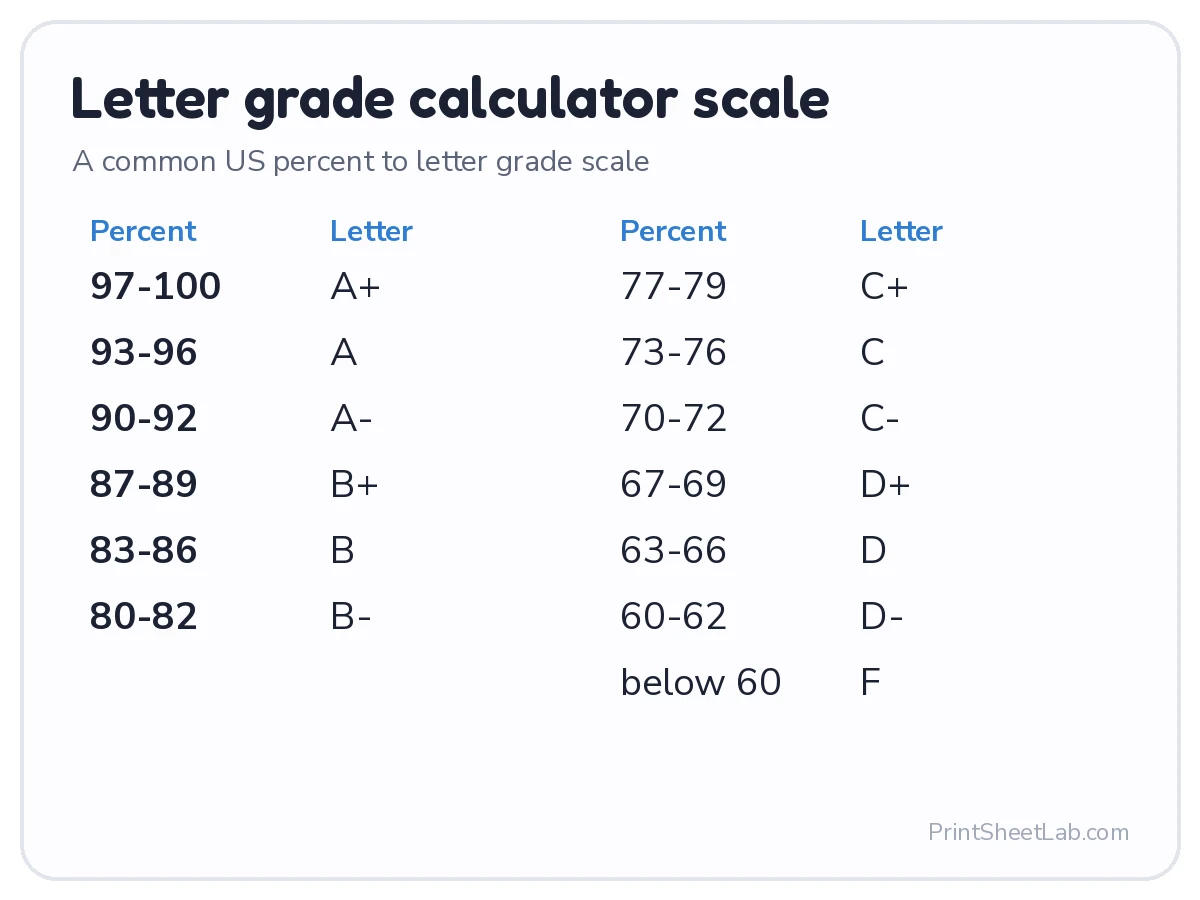
The cards show a test score percentage worked out step by step, a letter grade scale and how much each question is worth on tests of different lengths. The printable test grade chart (easy grader) lists the percent score for 0 to 12 wrong on 10, 20, 25, 40 and 50 question tests, so you can grade without a calculator.
Test grade calculator: how to work out a test score percentage
A test score percentage tells you what share of the available points you earned. Divide the points earned by the points possible and multiply by 100. On a 50-point test, 42 points gives 42 ÷ 50 = 0.84, so the score is 84%. On a 30-question quiz with 27 right, 27 ÷ 30 = 0.9, or 90%.
When questions are worth different amounts, add up the points rather than counting questions. A test with 10 one-point questions and 5 four-point questions has 30 points in total; a student who earns 8 and 16 points has 24 out of 30, which is 80%.
How to calculate a grade: the three steps
- Add up the points the student earned.
- Add up the points that were possible.
- Divide earned by possible and multiply by 100, then look up the letter on your grading scale.
The same three steps work for a quiz, a homework sheet, a lab report or a whole marking period. For a course grade made of several categories, work out the percent in each one first and then combine them, as in the weighted section below.
Percentage grade calculator: common scores
This percentage grade calculator table gives the percent and letter for scores people look up most often, using the common US scale.
| Score | Percent | Letter |
|---|---|---|
| 8 out of 10 | 80% | B− |
| 9 out of 10 | 90% | A− |
| 17 out of 20 | 85% | B |
| 18 out of 20 | 90% | A− |
| 22 out of 25 | 88% | B+ |
| 23 out of 25 | 92% | A− |
| 28 out of 35 | 80% | B− |
| 33 out of 40 | 82.5% | B− |
| 36 out of 40 | 90% | A− |
| 42 out of 50 | 84% | B |
| 45 out of 60 | 75% | C |
| 72 out of 80 | 90% | A− |
Letter grade calculator: the common US scale
The letter grade calculator uses the scale most US schools follow, with plus and minus grades. The calculator does not round before looking up the letter, so 89.5% is a B+ because the A− line starts at exactly 90. Your school may round first, which is why you should ask how it rounds.
| Percent | Letter | Percent | Letter |
|---|---|---|---|
| 97–100 | A+ | 77–79 | C+ |
| 93–96 | A | 73–76 | C |
| 90–92 | A− | 70–72 | C− |
| 87–89 | B+ | 67–69 | D+ |
| 83–86 | B | 63–66 | D |
| 80–82 | B− | 60–62 | D− |
| below 60 | F |
Some schools use a 10-point scale without plus and minus grades: 90 and above is an A, 80–89 a B, 70–79 a C, 60–69 a D and below 60 an F. Others use a 7-point scale, and colleges sometimes set their own cut-offs, so always check your syllabus. Wikipedia’s article on academic grading in the United States shows the most common variations.
Quiz grade calculator: what each question is worth
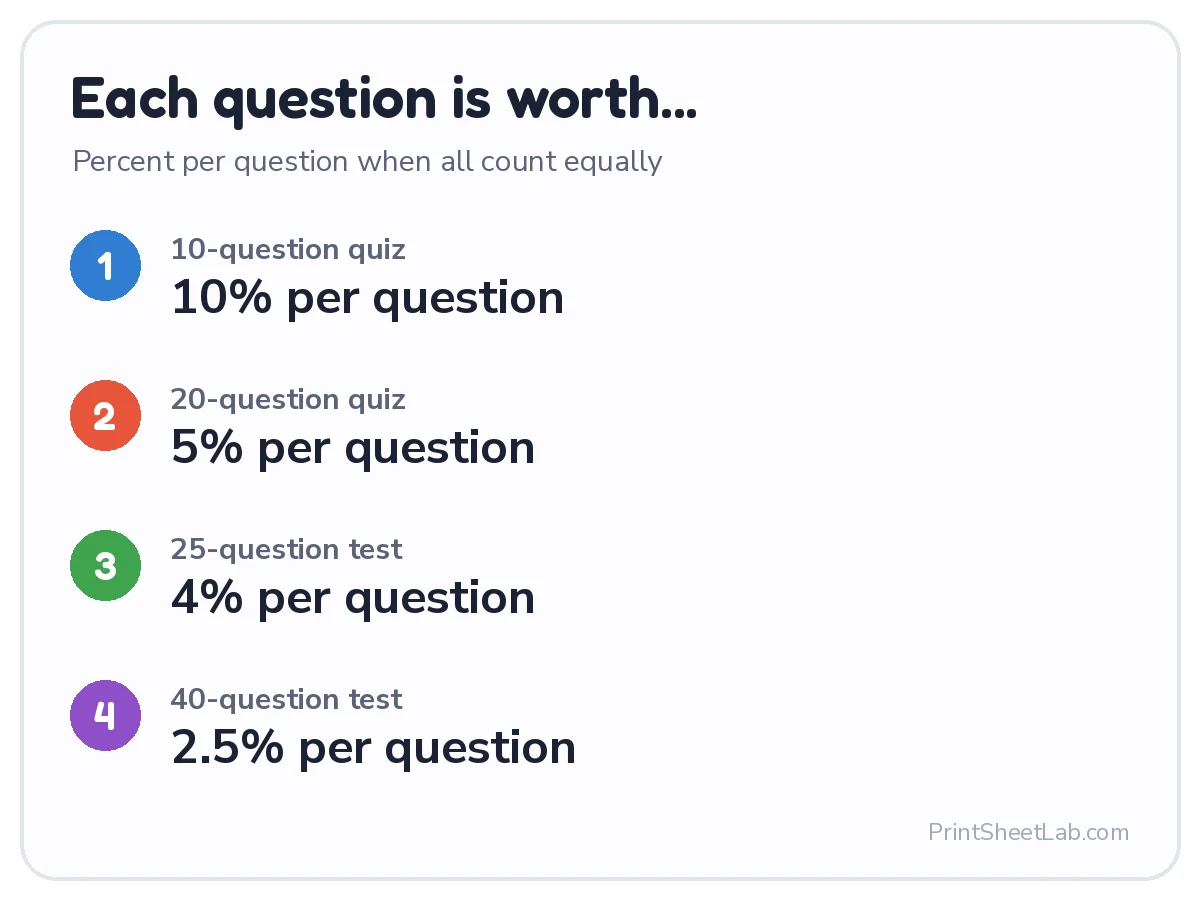
When every question counts the same, each one is worth 100 ÷ the number of questions. That makes short quizzes swing a lot: one wrong answer on a 10-question quiz costs 10%, while on a 50-question test it costs only 2%.
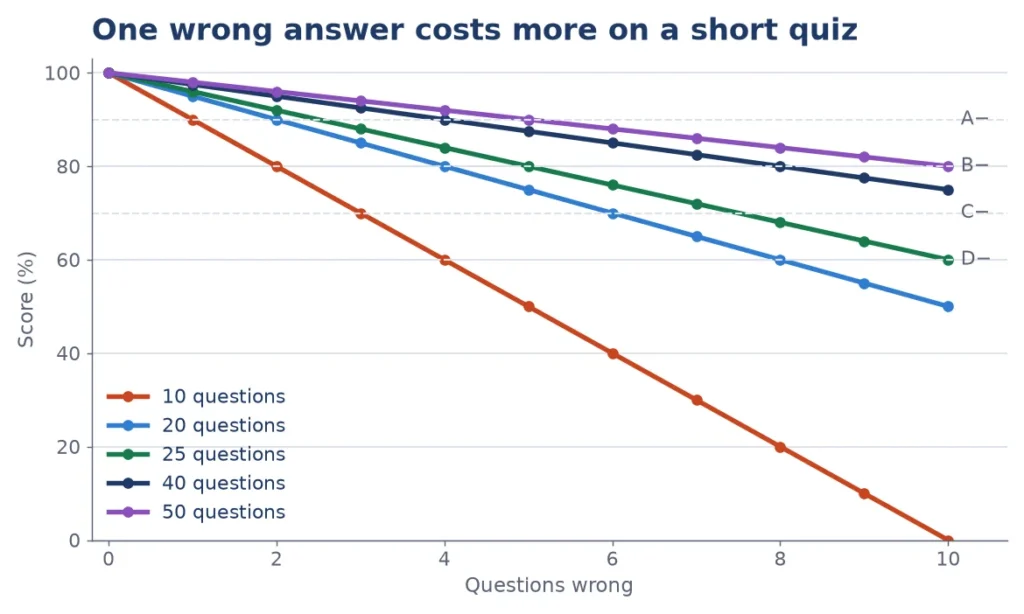
| Questions | Each is worth | 1 wrong | 2 wrong | 3 wrong | 5 wrong |
|---|---|---|---|---|---|
| 10 | 10% | 90% | 80% | 70% | 50% |
| 20 | 5% | 95% | 90% | 85% | 75% |
| 25 | 4% | 96% | 92% | 88% | 80% |
| 40 | 2.5% | 97.5% | 95% | 92.5% | 87.5% |
| 50 | 2% | 98% | 96% | 94% | 90% |
The quiz grade calculator handles any length, including odd ones like 13 or 37 questions, where the percent per question is not a round number. A 13-question quiz with 11 right is 11 ÷ 13 = 84.62%, and each question is worth 7.69%.
How many points do I need for an A, B or C?
You can turn the question around and ask how many points a grade takes. Multiply the points possible by the percent you want. For a B (80%) on a 40-point test you need 0.80 × 40 = 32 points. The table rounds up to the next whole point, because a score just under the line is the lower letter.
| Points possible | 90% (A−) | 80% (B−) | 70% (C−) | 60% (D−) |
|---|---|---|---|---|
| 10 | 9 | 8 | 7 | 6 |
| 20 | 18 | 16 | 14 | 12 |
| 25 | 23 | 20 | 18 | 15 |
| 40 | 36 | 32 | 28 | 24 |
| 50 | 45 | 40 | 35 | 30 |
| 60 | 54 | 48 | 42 | 36 |
| 100 | 90 | 80 | 70 | 60 |
Planning your study time with a test grade calculator
A test grade calculator is also a planning tool. Before a test, decide the letter you want, look up the points it takes, and see how many questions you can afford to miss. On a 40-point test, a B+ needs 87%, which is 34.8, so 35 points and at most 5 missed. Knowing the margin helps you spend revision time on the topics worth the most marks, and it keeps one hard question from feeling like a disaster.
After the test, enter the score and compare it with the goal. If the result is close to the next grade, the calculator shows how many more points it would have taken, which is useful feedback for the next quiz.
Grade scales in Canada, the UK and Australia
The percent is the same everywhere, but the label changes. Choose the grade scale that matches your school in the calculator, and remember that a single school can differ from the common pattern.
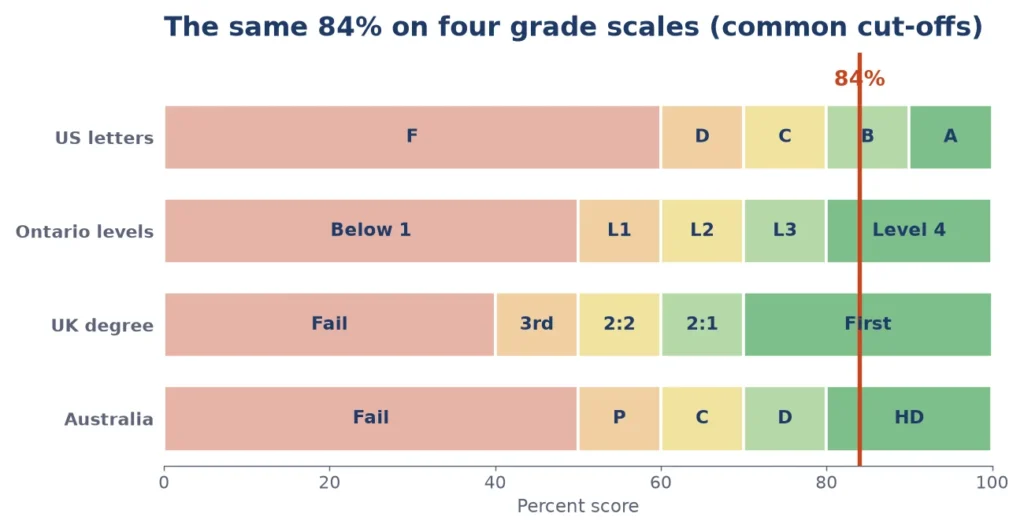
| Country | Common pattern (as of 2026) | Where to check |
|---|---|---|
| United States | A 90–100, B 80–89, C 70–79, D 60–69, F below 60, often with plus and minus | your syllabus or student handbook |
| Canada (Ontario schools) | Level 4 is 80–100%, Level 3 70–79%, Level 2 60–69%, Level 1 50–59% | Ontario Ministry of Education, Growing Success |
| Canada (Alberta and BC schools) | Alberta commonly A+ 90–100%; British Columbia A 86–100% and B 73–85% | your province and school board |
| Canada (University of Toronto) | A+ 90–100% and A 85–89% (4.0), A− 80–84% (3.7), B+ 77–79% (3.3), B 73–76% (3.0) | the university grading policy |
| United Kingdom (degrees) | First 70% and above, 2:1 60–69%, 2:2 50–59%, Third 40–49% | your university’s regulations |
| Australia (universities) | HD 80–100 or 85–100, D 70–79 or 75–84, C 60–69 or 65–74, P 50–59 or 50–64 | the university grading policy |
Ontario’s levels come from the ministry’s Growing Success policy, and the Toronto scale is on the university’s grading policy page. Queensland University of Technology, for example, sets 85–100% as a High Distinction and 50–64% as a Pass in its grading policy, while other Australian universities set the lines at 80, 70, 60 and 50.
UK school tests are usually marked in percent, but GCSEs are graded from 9 to 1, a scale in use in England since 2017, and Ofqual’s GCSE 9 to 1 guide explains that grade boundaries are set each year. A percent from a classroom test is therefore only a rough guide to a GCSE grade. When you pick a country in the grade calculator, the percent is exact and the label follows the common bands above.
Extra credit and bonus points
For extra credit, add the bonus points to the points earned but not to the points possible, so 48 points plus 3 bonus on a 50-point test is 51 ÷ 50 = 102%. Type the 3 in the extra credit box and the grade calculator does exactly that. For a dropped question, remove it from the points possible for everyone, so a 50-point test with one 2-point question dropped has 48 points possible. A student who earned 42 of those 48 points scores 42 ÷ 48 = 87.5%.
For teachers: grading faster and fairly
An easy grader chart speeds up marking a class set: find the number wrong in the first column and read the score across. The printable chart above covers the most common test lengths, and the grade calculator handles anything else. To combine several test scores into a course grade, add all the points earned and all the points possible, or use your gradebook’s category weights.
The final grade calculator then shows what a student needs on the last exam, and the GPA calculator turns letter grades into a grade point average. Whatever scale you use, tell students the cut-offs and the rounding rule before the first test, and apply them the same way to everyone.
Curving and rounding grades
Some teachers adjust scores after a hard test. Two common methods are adding the same number of points to everyone so the top score becomes 100%, and the square-root curve, where the new score is 10 × the square root of the old score (64% becomes 80%, 81% becomes 90%). The grade calculator gives the raw percent; apply your own curve afterwards.
| Raw score | Square-root curve | Add 10 points |
|---|---|---|
| 36% | 60% | 46% |
| 49% | 70% | 59% |
| 64% | 80% | 74% |
| 70% | 83.67% | 80% |
| 81% | 90% | 91% |
Schools also differ on rounding: some round 89.5% up to 90%, others do not, so 89.5% might be a B+ or an A−. When it matters, ask the teacher which rule they use, and use the test grade calculator to check the raw number they started from.
Grade calculator for weighted categories
Many classes weight categories differently, for example tests 50%, homework 30% and quizzes 20%. First use the grade calculator to find the percent in each category, then multiply each by its weight and add. With a test average of 82%, homework at 95% and quizzes at 88%: 0.5 × 82 + 0.3 × 95 + 0.2 × 88 = 41 + 28.5 + 17.6 = 87.1%, a B+ on the common scale.
A strong homework grade helps, but the heavily weighted tests decide most of the result. The weighted grade calculator does the whole calculation for any number of categories and also finds the score you need on the rest of the work for a target grade.
Grade calculator for a class or semester grade
For a points-based class, add every score and every possible point so far and divide. If you have 410 points out of 500 so far, you are at 82%. That grade calculator by points method works because bigger assignments simply have more points. To see what the final exam must be worth for a target, use the final grade calculator, which accepts a points system as well as percent weights.
Common grading mistakes
- Dividing by the wrong total. Use the points possible, not the number of questions, when questions have different values.
- Adding extra credit to both numbers. Bonus points go on the earned side only.
- Averaging percents of different-sized tests. A 9/10 quiz and a 40/50 test average 85%, but together they are 49/60 = 81.67%.
- Rounding before applying the scale. Check whether your school rounds 89.5% up.
Frequently asked questions
10 quick answers
What percent is 17 out of 20?
17 ÷ 20 = 0.85, so the score is 85%, which is a B on the common US scale. The same grade calculator works for any score out of any total.
How do I calculate my grade on a test?
Divide the points you earned by the points possible and multiply by 100. For 42 out of 50, that is 42 ÷ 50 × 100 = 84%. Then look up the letter on your school’s scale.
What is a passing grade?
Usually 60% or higher (a D−) in US schools, although many courses and programs require 70% (a C−) to pass or to move on. Check the course outline.
How do I grade a test with questions worth different points?
Add up the points the student earned and the total points available, then enter those two totals. The grade calculator does not need every question to be worth the same.
How do I calculate a grade by questions wrong?
Subtract the wrong answers from the total, then divide. On a 25-question test with 3 wrong, 22 ÷ 25 = 88%. Or choose Questions wrong and type the 3.
Does the grade calculator round the percent?
It shows up to two decimal places, such as 87.5% or 91.67%. Your school may round to a whole number before giving a letter.
Can I enter scores above the maximum?
Yes, for extra credit. The percent will be over 100%. Use the extra credit box to keep the bonus separate from the points possible.
Can I use it for homework or projects?
Yes. Any score out of a total works, from a 5-point homework to a 200-point project.
How do I calculate a course grade from several categories?
Find the percent in each category, multiply each by its weight, add the results and divide by the total weight. The weighted grade calculator does this for you.
Does it work for Canada, the UK and Australia?
Yes. The percent is the same everywhere, and the scale menu shows Ontario achievement levels, UK degree classes and Australian grades. Schools set their own cut-offs, so check your own.
Related calculators and worksheets
- Final grade calculator for the score you need on an exam
- Weighted grade calculator and GPA calculator
- Percentage calculator and mean, median and mode calculator
- Free printable worksheets and all calculators
Sources and further reading
- Academic grading in the United States (Wikipedia)
- Growing Success: assessment, evaluation and reporting in Ontario schools (Ontario Ministry of Education)
- University of Toronto grading scale
- GCSE 9 to 1 grade scale explained (Ofqual)
This calculator gives an estimate; your teacher or school decides the official grade. Last updated: October 2026.