Here is how to multiply decimals: estimate the answer, multiply the digits as if they were whole numbers, then count the decimal places in both numbers and give the answer that many decimal places. For 2.4 × 3, work out 24 × 3 = 72; there is one decimal place in total, so the answer is 7.2, which matches the estimate of about 2 × 3 = 6 to 3 × 3 = 9.
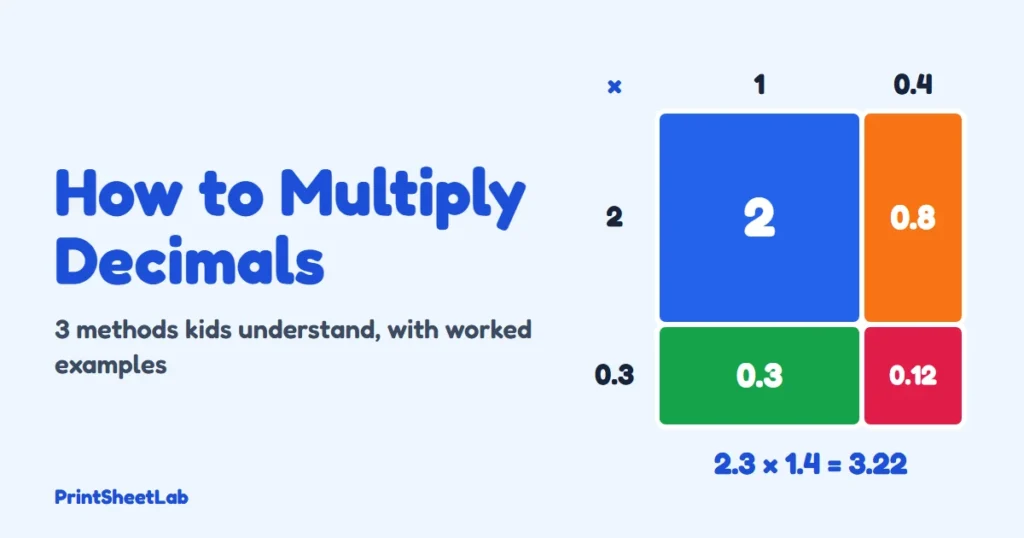
This guide shows children three ways to picture the multiplication: the whole-number method, the area (grid) model and the fraction method. Each one comes with worked examples, the special cases that trip children up, a mistakes table and 12 practice questions with answers. When your child is ready for more, print our multiplying decimals worksheet pages with answer keys, or browse every topic on the free printable maths worksheets hub.
What children need before learning how to multiply decimals
Decimal multiplication builds on three skills. If one is shaky, fix it first and the rest of this guide will feel easy.
- Times tables to 9 × 9 or 12 × 12. Every decimal product starts as a whole-number product.
- Decimal place value. Children should know that in 3.47 the 4 means four tenths and the 7 means seven hundredths. Our decimal place value worksheets and the place value anchor chart guide cover this.
- Multi-digit multiplication. 4.56 × 2.3 is really 456 × 23. If that looks hard, review our 2-digit by 1-digit multiplication guide before moving on.
Step 0: estimate first
Before using any method, round each number to something easy and multiply. The estimate tells you roughly where the decimal point belongs, and it catches most slips straight away.
| Problem | Round to | Estimate | Exact answer |
|---|---|---|---|
| 3.8 × 4.2 | 4 × 4 | about 16 | 15.96 |
| 4.56 × 2.3 | 5 × 2 | about 10 | 10.488 |
| 6.2 × 0.5 | 6 × a half | about 3 | 3.1 |
| 12 × 0.5 | half of 12 | 6 | 6 |
Notice the last two rows. Multiplying by a decimal less than 1 makes the answer smaller. Children who expect “multiplying makes bigger” need to see this early, so say it out loud: 0.5 of something is half of it.
Method 1: multiply as whole numbers, then count decimal places
This is the method most schools teach as the written method, and the quickest way to multiply decimals of any size.
- Ignore the decimal points and multiply the digits as whole numbers.
- Count the digits after the decimal point in both numbers and add them.
- Starting from the right of your answer, count back that many places and put the decimal point there.
- Check against your estimate.
You do not line up the decimal points as you would for addition. In decimal multiplication you line the numbers up on the right, exactly like whole numbers.

Worked example: 4.56 × 2.3
Multiply 456 × 23 = 10,488. There are two decimal places in 4.56 and one in 2.3, so three in total. Count three places from the right: 10.488. The estimate was about 10, so the answer makes sense.
Worked example: 1.25 × 0.6
Multiply 125 × 6 = 750. There are 2 + 1 = 3 decimal places, so the answer is 0.750. A zero at the end of a decimal adds nothing, so write 0.75. Always place the point before you remove any end zeros.
Worked example: 0.3 × 0.02
Multiply 3 × 2 = 6. There are 1 + 2 = 3 decimal places, but 6 has only one digit. Write zeros in front as placeholders until you can count back three places: 0.006.
Method 2: the area model (grid method)
The area model shows why the answer is what it is, which helps children who learn best from pictures. Split each number into its place value parts, draw a rectangle, multiply each part and add the pieces.
Worked example: 2.3 × 1.4
| × | 1 | 0.4 |
|---|---|---|
| 2 | 2 | 0.8 |
| 0.3 | 0.3 | 0.12 |
Add the four parts: 2 + 0.8 + 0.3 + 0.12 = 3.22. The estimate (2 × 1.5 = 3) agrees. The 0.12 corner is tenths times tenths, which is hundredths, and that is the idea Method 3 makes clear.
Worked example: 4.6 × 3
Split 4.6 into 4 and 0.6. Then 4 × 3 = 12 and 0.6 × 3 = 1.8, so 12 + 1.8 = 13.8. Multiplying decimals by whole numbers this way is easy to picture, and it uses the same partitioning children already know from whole-number multiplication.
Method 3: using fractions (tenths × tenths)
Every decimal is a fraction with 10, 100 or 1,000 underneath. Writing it that way shows how to multiply decimals with understanding: it explains the “count the decimal places” rule instead of just memorising it.
- 0.3 × 0.4 = 3/10 × 4/10 = 12/100 = 0.12. Tenths × tenths = hundredths.
- 0.7 × 0.05 = 7/10 × 5/100 = 35/1,000 = 0.035. Tenths × hundredths = thousandths.
- 1.5 × 0.8 = 15/10 × 8/10 = 120/100 = 1.2.
Ten times ten is a hundred, so one decimal place times one decimal place gives two. That is the whole reason the counting rule works. If fractions are new, our fraction rules guide explains multiplying fractions, and the decimal to fraction calculator converts any decimal for checking.
Which method should your child use?
| Method | Best for | Strength | Watch out for |
|---|---|---|---|
| Whole numbers, then count places | Grade 6 and up, long numbers | Fast and works for any size | Forgetting to count both numbers |
| Area (grid) model | Grade 5, decimals × whole numbers | Shows place value clearly | Slow with three-digit numbers |
| Fraction method | Tenths and hundredths, explaining why | Makes the rule make sense | Needs confident fraction skills |
In practice, many children learn how to multiply decimals with the area model or fractions first, then switch to the counting method once they trust it.
Special cases when multiplying decimals
Three situations come up again and again once children know the basic methods: powers of 10, zeros at the end of the answer, and money.
Multiplying decimals by 10, 100 and 1,000
Each digit moves one place to the left for every zero: 3.47 × 10 = 34.7, 3.47 × 100 = 347 and 3.47 × 1,000 = 3,470. With 0.06 × 100, the 6 moves from the hundredths place to the ones place, giving 6. The digits move; the decimal point does not really “jump”, although many classrooms describe it that way.
Avoid the “just add a zero” shortcut. It works for whole numbers but turns 3.5 × 10 into 3.50, which is still 3.5. The right answer is 35. The NRICH task “An Easy Way to Multiply by 10?” is a good way to talk this through with children.
Trailing zeros in the answer
0.5 × 0.8: multiply 5 × 8 = 40, count two decimal places to get 0.40, then simplify to 0.4. 7.25 × 4: 725 × 4 = 2,900, two places gives 29.00, which is 29. Count first, tidy up second.
Money
Money is the best real-life practice because prices have exactly two decimal places. Three items at $4.99 cost 499 × 3 = 1,497 cents, or $14.97. Six bus fares at £2.35 cost £14.10. In money we keep both decimal places, so write £14.10 rather than £14.1. Our money math worksheets give plenty of shopping problems.
Common mistakes in decimal multiplication
Most errors when children learn how to multiply decimals come from the decimal point, not from the times tables. These six are the ones to look for when marking.
| Mistake | Wrong answer | Right answer | Fix |
|---|---|---|---|
| Counting decimal places in only one number | 0.4 × 0.2 = 0.8 | 0.08 | Count places in both numbers: 1 + 1 = 2 |
| Leaving out placeholder zeros | 0.03 × 0.2 = 0.06 | 0.006 | Write zeros in front until you can count back 3 places |
| “Adding a zero” to multiply by 10 | 3.5 × 10 = 3.50 | 35 | Move each digit one place to the left |
| Removing end zeros before counting | 0.5 × 0.8 = 0.04 | 0.4 | Place the point in 40 first (0.40), then simplify |
| Lining up decimal points like addition | Misplaced partial products | Line up on the right | Set out as whole-number multiplication |
| Expecting the answer to be bigger | 12 × 0.5 = 60 | 6 | Estimate: half of 12 is 6 |

What grade learns how to multiply decimals?
In the US Common Core standards, Grade 5 introduces it with models and drawings, and Grade 6 expects fluency with the standard written method. In England, decimals × 10, 100 and 1,000 appear in Year 5, and multiplying decimals by whole numbers in Year 6.
| Grade or year | What the official document says | Try |
|---|---|---|
| US Grade 5 (5.NBT.A.2) | Explain patterns in the decimal point when multiplying by powers of 10 | 3.47 × 10, × 100, × 1,000 |
| US Grade 5 (5.NBT.B.7) | Multiply decimals to hundredths using models, drawings and place value strategies | Area model: 2.3 × 1.4 |
| US Grade 6 (6.NS.B.3) | Fluently multiply multi-digit decimals using the standard algorithm | 4.56 × 2.3 |
| England Year 5 | Multiply whole numbers and those involving decimals by 10, 100 and 1,000 | 0.06 × 100 |
| England Year 6 | Multiply one-digit numbers with up to 2 decimal places by whole numbers | 2.06 × 3 |
The US wording is summarised from the official Common Core State Standards for Mathematics (PDF). The England wording comes from the national curriculum mathematics programmes of study. Other countries teach decimal multiplication at a similar age; check your school’s syllabus for the exact year.
Practice: 12 questions with answers
Estimate each answer first, then use any method. Answers are under each question; cover them with a strip of paper.
- 0.6 × 7
Answer: 4.2 - 3.2 × 5
Answer: 16 (16.0) - 0.9 × 0.4
Answer: 0.36 - 1.8 × 2.5
Answer: 4.5 (450 with two decimal places is 4.50) - 0.07 × 6
Answer: 0.42 - 5.3 × 100
Answer: 530 - 0.48 × 1,000
Answer: 480 - 2.06 × 3
Answer: 6.18 - 1.2 × 1.2
Answer: 1.44 - 0.15 × 0.3
Answer: 0.045 - Four cinema tickets cost $7.25 each. What is the total?
Answer: $29.00 - 3.6 × 0.05
Answer: 0.18 (180 with three decimal places is 0.180)
Multiplying decimals worksheets, calculators and next steps
Once your child can explain how to multiply decimals with one method, short regular practice works better than long sessions. Ten questions a day for a week is plenty.
- Print a decimal multiplication worksheet with answers, from multiplying decimals by whole numbers up to decimals × decimals.
- Revise adding and subtracting decimals so children see why those need lined-up points and multiplication does not.
- Move on to dividing decimals worksheets, the natural next topic.
- Use the rounding calculator to check estimates, and the fraction calculator to check the fraction method.
- Build a custom set of questions with the math worksheet generator.
Related guides and printables
- Two-digit by one-digit multiplication: four methods
- Fraction rules cheat sheet
- How to make a place value anchor chart
- All decimals worksheets
- Multiplying fractions worksheets
Sources
Grade expectations: Common Core State Standards for Mathematics (standards 5.NBT.A.2, 5.NBT.B.7 and 6.NS.B.3) and the national curriculum in England: mathematics (Years 5 and 6). The multiply-by-10 misconception is discussed in NRICH, University of Cambridge. Every example and answer on this page was checked by computer.
Frequently asked questions
7 quick answers
What is the rule for multiplying decimals?
Multiply the numbers as if there were no decimal points, count the decimal places in both numbers together, and give the answer that many decimal places. Then check it against an estimate.
Do you line up the decimal points when multiplying decimals?
No. Lining up decimal points is for adding and subtracting. For decimal multiplication, line the numbers up on the right like whole numbers and place the point at the end.
How do you multiply decimals by whole numbers?
Multiply as whole numbers and keep the same number of decimal places as the decimal. For 0.07 × 6, work out 7 × 6 = 42 and give it two decimal places: 0.42.
What do you do when the answer has too few digits?
Write zeros in front as placeholders. For 0.3 × 0.02, 3 × 2 = 6 needs three decimal places, so the answer is 0.006.
What is the quickest way to check multiplying decimals by 10, 100 or 1,000?
Count the zeros and move every digit that many places to the left. 0.48 × 1,000 has three zeros, so the 4 moves from tenths to hundreds: 480.
What is the easiest way to teach how to multiply decimals?
Start with money or the area model, so children can see what the answer means, then move to the whole-number method and always estimate first.
What grade do kids learn how to multiply decimals?
In the US, Grade 5 under Common Core standard 5.NBT.B.7, with fluency expected in Grade 6 (6.NS.B.3). In England, Years 5 and 6.