This free prime factorization calculator breaks any whole number into its prime factors, shows each division step and writes the answer with exponents, such as 360 = 2³ × 3² × 5. Switch modes to list every factor of a number or to find out whether it is prime or composite.
Quick answer: Prime factorization writes a number as a product of prime numbers: divide by the smallest prime that goes in, repeat on the result, and stop when you reach 1. Example: 360 = 2 × 2 × 2 × 3 × 3 × 5 = 2³ × 3² × 5, and (3 + 1)(2 + 1)(1 + 1) = 24 factors.
How to use the prime factorization calculator
Type a whole number and pick what you want to see. The prime factorization calculator updates as you type, so there is no Calculate button. Tap an example chip such as 360, 97 or 999,999 to see how the answer changes.
- Type a whole number from 1 up to 1,000,000,000,000,000 (one quadrillion).
- Choose Prime factors for the factorization, All factors for every factor of the number, or Is it prime? for a yes or no with the reason.
- Read the boxes: type, number of factors, prime factors, sum of factors and the nearest primes.
- Open How it works for the division steps, then copy the result or the link.
| Mode | Headline answer | Example (360) |
|---|---|---|
| Prime factors | Prime factorization with exponents | 2³ × 3² × 5 |
| All factors | Every factor, smallest to largest | 1, 2, 3, 4, 5, 6, 8, 9, 10 … 360 |
| Is it prime? | Yes or no, with the reason | No, 360 is composite |
Prime factor examples and a printable prime chart
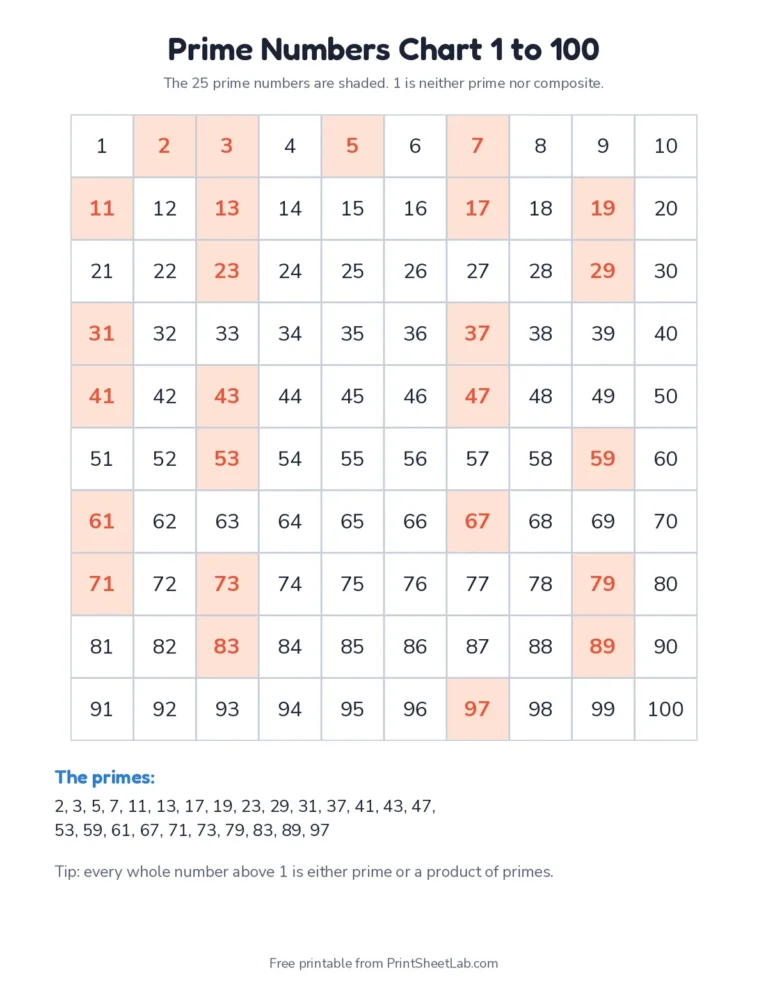
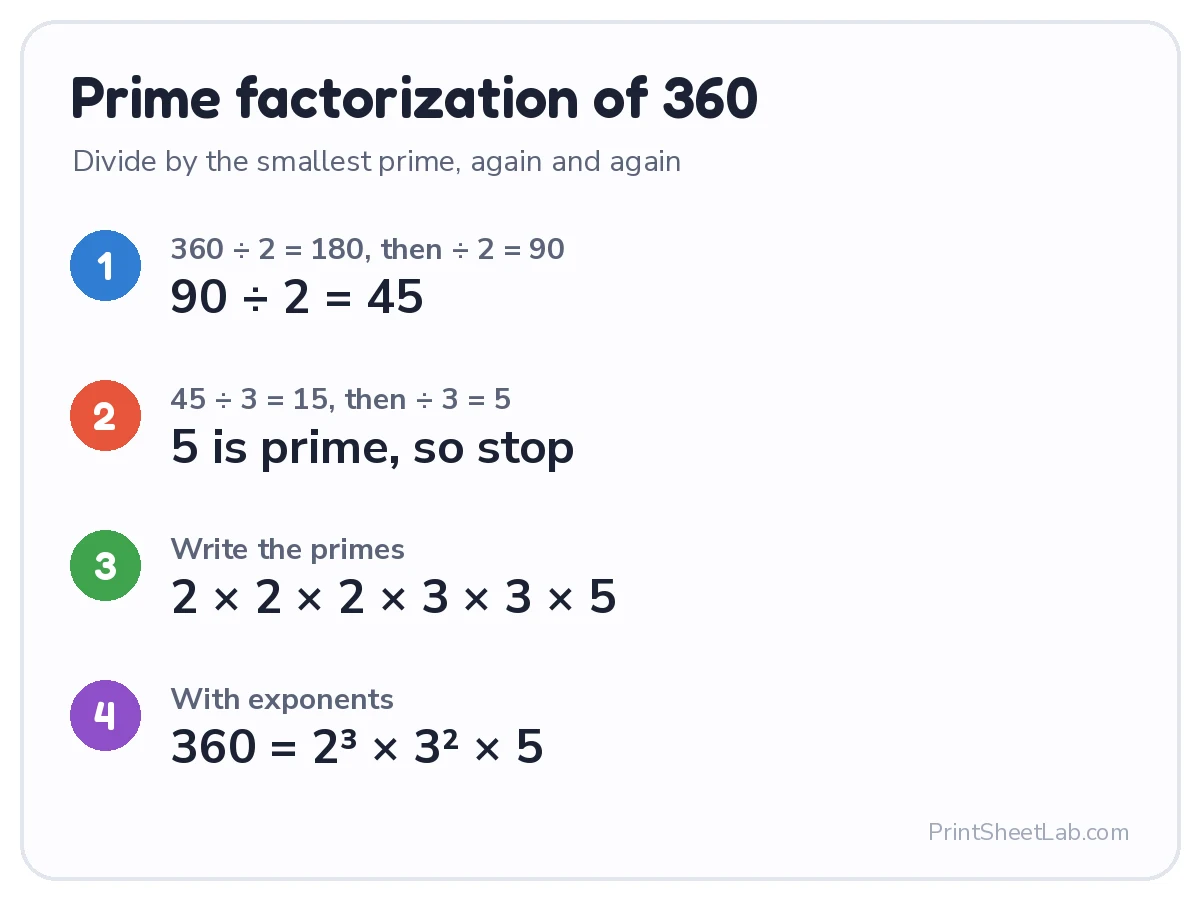
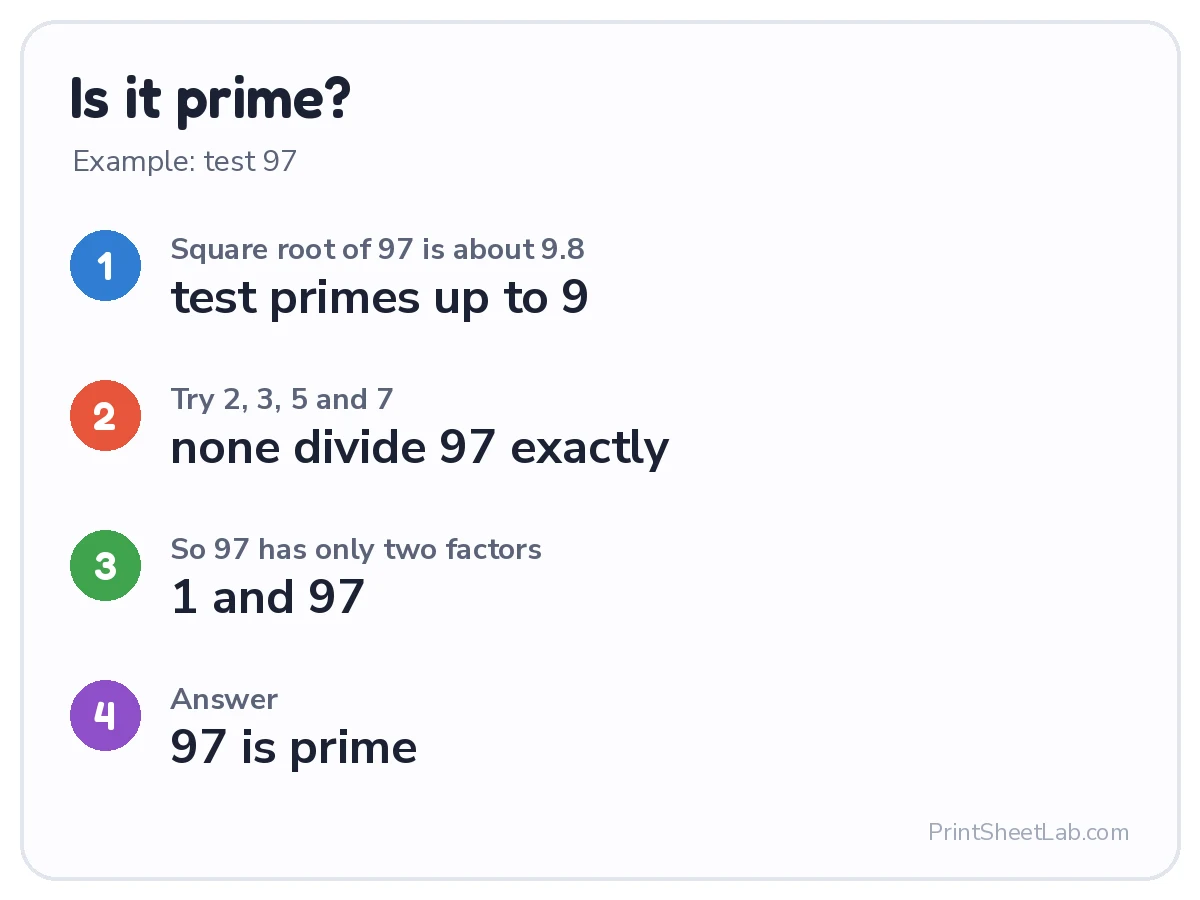
The cards show a full prime factorization, a quick prime test and how to list all the factors of a number. The printable chart shades the 25 prime numbers from 1 to 100 and lists them underneath.

How to find prime factors: the division method
The division method, sometimes drawn as a ladder, is the quickest way to find prime factors by hand. Divide by the smallest prime that goes in exactly, write the result underneath and repeat until you reach 1. The primes you divided by are the prime factors.
- 360 ÷ 2 = 180
- 180 ÷ 2 = 90
- 90 ÷ 2 = 45 (45 is odd, so 2 no longer works)
- 45 ÷ 3 = 15
- 15 ÷ 3 = 5
- 5 ÷ 5 = 1
The divisors are 2, 2, 2, 3, 3 and 5, so 360 = 2 × 2 × 2 × 3 × 3 × 5 = 2³ × 3² × 5. The prime factorization calculator prints exactly this list of divisions, so you can compare it line by line with your own ladder.
Factor tree: another way to find prime factors
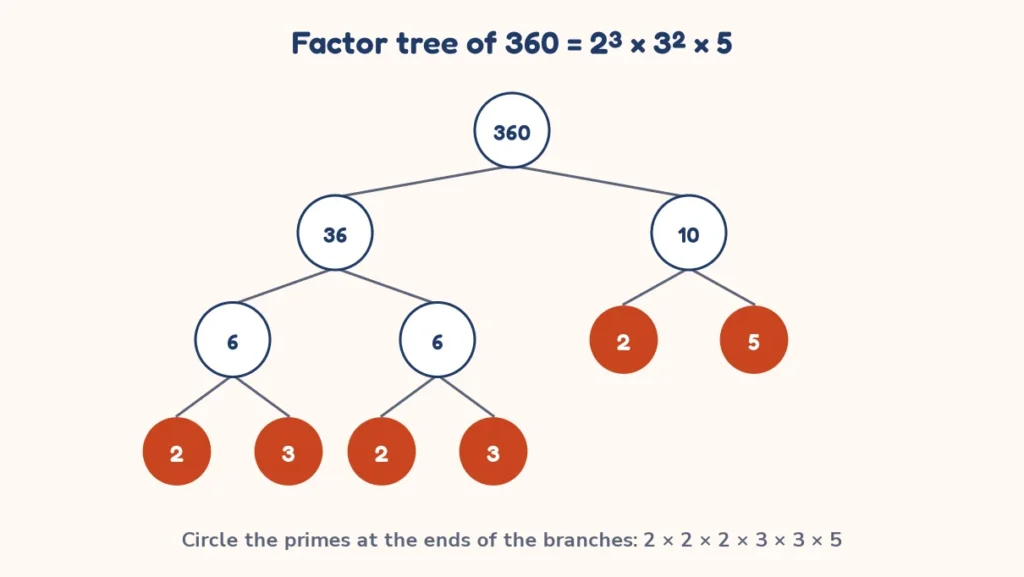
A factor tree draws the same idea as branches. Start with the number at the top and split it into any two factors, such as 360 = 36 × 10. Keep splitting each branch until every branch ends in a prime: 36 = 6 × 6 = (2 × 3) × (2 × 3), and 10 = 2 × 5. Circle the primes at the ends and you get 2 × 2 × 2 × 3 × 3 × 5 again.
You can start the tree with any pair of factors and the ends are always the same primes. That is the fundamental theorem of arithmetic: every whole number greater than 1 is prime or a product of primes in exactly one way, ignoring order.
Prime or composite? How to test a number
A prime number has exactly two factors, 1 and itself. A composite number has more than two. To decide whether a number is prime or composite, try dividing it by the primes 2, 3, 5, 7, 11 and so on, but only up to its square root. If none divides it exactly, the number is prime.
For 97 the square root is about 9.8, so you test only 2, 3, 5 and 7; none works, so 97 is prime. For 91 the test finds 7 × 13, so 91 is composite even though it looks prime. The number 1 is neither prime nor composite.
| Divisible by | Quick test | Example |
|---|---|---|
| 2 | Last digit is even | 3,148 ends in 8, so yes |
| 3 | Digit sum is a multiple of 3 | 4,521: 4 + 5 + 2 + 1 = 12, so yes |
| 5 | Last digit is 0 or 5 | 865 ends in 5, so yes |
| 7 | Double the last digit and subtract it from the rest; repeat | 343: 34 − 6 = 28, a multiple of 7, so yes |
| 11 | Alternating digit sum is 0 or a multiple of 11 | 2,728: 2 − 7 + 2 − 8 = −11, so yes |
Is it prime? Common numbers checked
These are the numbers people most often check. Each answer comes from the same test, trial division up to the square root, and the calculator gives the reason.
| Number | Prime or composite | Reason |
|---|---|---|
| 2 | Prime | 1 and 2 only |
| 29 | Prime | 1 and 29 only |
| 49 | Composite | 7² |
| 51 | Composite | 3 × 17 |
| 57 | Composite | 3 × 19 |
| 87 | Composite | 3 × 29 |
| 91 | Composite | 7 × 13 |
| 97 | Prime | 1 and 97 only |
| 111 | Composite | 3 × 37 |
| 119 | Composite | 7 × 17 |
| 143 | Composite | 11 × 13 |
| 221 | Composite | 13 × 17 |
| 251 | Prime | 1 and 251 only |
| 1001 | Composite | 7 × 11 × 13 |
Factor calculator: the factors of a number
Factors come in pairs that multiply to the number. To list the factors of a number, start at 1 and work up to its square root, writing each pair you find. For 36: 1 × 36, 2 × 18, 3 × 12, 4 × 9 and 6 × 6, so the factors of 36 are 1, 2, 3, 4, 6, 9, 12, 18 and 36. Square numbers have an odd number of factors because one pair repeats.
The prime factorization also gives the number of factors: add 1 to each exponent and multiply. For 360 = 2³ × 3² × 5¹, that is 4 × 3 × 2 = 24. The factor calculator mode of this page lists all 24.
| Factors of | Prime factorization | Number of factors | All factors |
|---|---|---|---|
| 12 | 2² × 3 | 6 | 1, 2, 3, 4, 6, 12 |
| 18 | 2 × 3² | 6 | 1, 2, 3, 6, 9, 18 |
| 24 | 2³ × 3 | 8 | 1, 2, 3, 4, 6, 8, 12, 24 |
| 36 | 2² × 3² | 9 | 1, 2, 3, 4, 6, 9, 12, 18, 36 |
| 48 | 2⁴ × 3 | 10 | 1, 2, 3, 4, 6, 8, 12, 16, 24, 48 |
| 60 | 2² × 3 × 5 | 12 | 1, 2, 3, 4, 5, 6, 10, 12, 15, 20, 30, 60 |
| 72 | 2³ × 3² | 12 | 1, 2, 3, 4, 6, 8, 9, 12, 18, 24, 36, 72 |
| 100 | 2² × 5² | 9 | 1, 2, 4, 5, 10, 20, 25, 50, 100 |
Some numbers have unusually many factors, which is why they appear in clocks, calendars and measurements. 12 has 6 factors, 60 has 12 and 360 has 24. Among the whole numbers up to 1,000, 840 = 2³ × 3 × 5 × 7 has the most, with 32 factors.
List of prime numbers up to 200
There are 25 primes below 100 and 46 below 200. 2 is the only even prime, because every other even number is divisible by 2. Here is the list of prime numbers by tens and the number in each group.
| Range | Primes | Count |
|---|---|---|
| 1 to 9 | 2, 3, 5, 7 | 4 |
| 10 to 19 | 11, 13, 17, 19 | 4 |
| 20 to 29 | 23, 29 | 2 |
| 30 to 39 | 31, 37 | 2 |
| 40 to 49 | 41, 43, 47 | 3 |
| 50 to 59 | 53, 59 | 2 |
| 60 to 69 | 61, 67 | 2 |
| 70 to 79 | 71, 73, 79 | 3 |
| 80 to 89 | 83, 89 | 2 |
| 90 to 99 | 97 | 1 |
| 100 to 109 | 101, 103, 107, 109 | 4 |
| 110 to 119 | 113 | 1 |
| 120 to 129 | 127 | 1 |
| 130 to 139 | 131, 137, 139 | 3 |
| 140 to 149 | 149 | 1 |
| 150 to 159 | 151, 157 | 2 |
| 160 to 169 | 163, 167 | 2 |
| 170 to 179 | 173, 179 | 2 |
| 180 to 189 | 181 | 1 |
| 190 to 199 | 191, 193, 197, 199 | 4 |
How many primes are there?
Primes thin out but never stop: Euclid proved there are infinitely many. This table counts the primes up to powers of ten, computed with a sieve.
| Up to | Number of primes | Share of numbers that are prime |
|---|---|---|
| 10 | 4 | 40.0% |
| 100 | 25 | 25.0% |
| 1,000 | 168 | 16.8% |
| 10,000 | 1,229 | 12.3% |
| 100,000 | 9,592 | 9.6% |
| 1,000,000 | 78,498 | 7.8% |
As of October 2026, the largest known prime is 2136,279,841 − 1, a number with 41,024,320 digits found in October 2024, according to Wikipedia’s page on the largest known prime number. The prime factorization calculator works up to one quadrillion.
Prime factorization calculator with steps: common numbers
These are the numbers students look up most. Each row is what the prime factorization calculator with steps returns, with the exponent form and the number of factors.
| Number | Prime factorization | Product form | Factors |
|---|---|---|---|
| 24 | 2³ × 3 | 2 × 2 × 2 × 3 | 8 |
| 36 | 2² × 3² | 2 × 2 × 3 × 3 | 9 |
| 48 | 2⁴ × 3 | 2 × 2 × 2 × 2 × 3 | 10 |
| 60 | 2² × 3 × 5 | 2 × 2 × 3 × 5 | 12 |
| 64 | 2⁶ | 2 × 2 × 2 × 2 × 2 × 2 | 7 |
| 72 | 2³ × 3² | 2 × 2 × 2 × 3 × 3 | 12 |
| 90 | 2 × 3² × 5 | 2 × 3 × 3 × 5 | 12 |
| 96 | 2⁵ × 3 | 2 × 2 × 2 × 2 × 2 × 3 | 12 |
| 100 | 2² × 5² | 2 × 2 × 5 × 5 | 9 |
| 120 | 2³ × 3 × 5 | 2 × 2 × 2 × 3 × 5 | 16 |
| 144 | 2⁴ × 3² | 2 × 2 × 2 × 2 × 3 × 3 | 15 |
| 150 | 2 × 3 × 5² | 2 × 3 × 5 × 5 | 12 |
| 180 | 2² × 3² × 5 | 2 × 2 × 3 × 3 × 5 | 18 |
| 200 | 2³ × 5² | 2 × 2 × 2 × 5 × 5 | 12 |
| 360 | 2³ × 3² × 5 | 2 × 2 × 2 × 3 × 3 × 5 | 24 |
| 1000 | 2³ × 5³ | 2 × 2 × 2 × 5 × 5 × 5 | 16 |
Prime factorization for bigger numbers
Large numbers often hide surprising prime factors. 1,001 looks prime but is 7 × 11 × 13. 1,024 is 2 multiplied by itself ten times, 2¹⁰. 999,999 is 3³ × 7 × 11 × 13 × 37, and 600,851,475,143 is 71 × 839 × 1,471 × 6,857. Finding these by hand takes many trial divisions, which is where the calculator saves time.
It tests each prime in order and stops as soon as what is left is prime, so a number with small factors is instant. A large prime such as 999,999,999,999,989 takes the longest, but the answer still arrives in a moment.
Why prime factors are useful
- Simplifying fractions: cancel the primes the numerator and denominator share. 360/840 = (2³ × 3² × 5) / (2³ × 3 × 5 × 7) = 3/7.
- GCF and LCM: shared primes give the greatest common factor and the highest powers give the least common multiple. The GCF and LCM calculator uses exactly this method.
- Square roots: pair up the primes. 144 = (2 × 2) × (2 × 2) × (3 × 3), so √144 = 2 × 2 × 3 = 12.
- Divisibility: a number is divisible by 6 exactly when its prime factors include both 2 and 3.
- Security: multiplying two large primes is easy but factoring the product is hard, which is the idea behind public-key encryption.
Where prime factors are taught
In the United States, Common Core has fourth graders find all factor pairs for a whole number from 1 to 100 and decide whether it is prime or composite (standard 4.OA.B.4). Sixth graders use factors for the GCF and LCM (6.NS.B.4). The Common Core fourth-grade standards give the full wording.
In England, the Year 6 program of study includes identifying common factors, common multiples and prime numbers. Teachers in every country use the same two pictures, the factor tree and the division ladder, so the working from this page fits any classroom.
Questions people ask about prime factors
What is the prime factorization of 100?
The prime factorization of 100 is 2 × 2 × 5 × 5, or 2² × 5² with exponents. 100 ÷ 2 = 50, 50 ÷ 2 = 25, 25 ÷ 5 = 5 and 5 ÷ 5 = 1. It has (2 + 1)(2 + 1) = 9 factors.
What are the factors of 36?
The factors of 36 are 1, 2, 3, 4, 6, 9, 12, 18 and 36. That is 9 factors, an odd number, because 36 is a perfect square (6 × 6). Its prime factorization is 2² × 3².
Is 91 a prime number?
No, 91 is composite because 7 × 13 = 91. It is a popular trap because it is not divisible by 2, 3 or 5. Testing primes up to the square root of 91, about 9.5, finds the factor 7.
Is 1 a prime number?
No. A prime has exactly two different factors, and 1 has only one, so it is neither prime nor composite. If 1 were prime, factorizations would not be unique, because 6 = 2 × 3 = 1 × 2 × 3 = 1 × 1 × 2 × 3.
How do you find the factors of a number quickly?
Find the prime factorization, then multiply the primes in every combination. For 12 = 2² × 3, the combinations give 1, 2, 4, 3, 6 and 12. Or test each whole number up to the square root and write each pair.
Prime factorization calculator: frequently asked questions
What is the difference between factors and prime factors?
Factors are all the numbers that divide exactly (12 has 1, 2, 3, 4, 6 and 12). Prime factors are only the primes that multiply to make the number (12 = 2 × 2 × 3).
Is 2 the only even prime?
Yes. Every other even number can be divided by 2, so it has more than two factors and is composite.
How large a number can the prime factorization calculator handle?
Up to 1,000,000,000,000,000 (one quadrillion). Numbers with small prime factors finish instantly; large primes take a moment longer.
How many prime numbers are there below 100?
There are 25: 2, 3, 5, 7, 11, 13, 17, 19, 23, 29, 31, 37, 41, 43, 47, 53, 59, 61, 67, 71, 73, 79, 83, 89 and 97.
Can I factor a negative number or a decimal?
No. Prime factorization is defined for whole numbers greater than 1. For a negative number, factor its absolute value and include a factor of −1; for a decimal, use the decimal to fraction calculator first.
Why does the prime test stop at the square root?
If a number n has a factor larger than its square root, it must also have a matching factor smaller than the square root. So if no prime up to the square root divides n, none above it will either.
Is the prime factorization of a number always the same?
Yes. Apart from the order of the factors, every whole number greater than 1 has exactly one prime factorization. That is the fundamental theorem of arithmetic.
Does the calculator send my numbers anywhere?
No. The calculation runs in your browser, so nothing is uploaded. Use Copy link to share a number with someone else.
Related calculators
- GCF and LCM calculator: common factors and common multiples of 2 or more numbers.
- Simplify fractions calculator: cancel shared prime factors.
- Long division calculator: divide with remainders and decimals.
- Decimal to fraction calculator: turn decimals into fractions to factor.
- Hundreds chart and multiplication chart to spot primes and multiples by sight.
- All calculators.
Sources and further reading
- Prime number on Wikipedia: definition, history and the list of the first primes.
- Fundamental theorem of arithmetic on Wikipedia: unique prime factorization.
- Common Core State Standards, Grade 4 Operations and Algebraic Thinking: standard 4.OA.B.4.
Last updated: October 2026.