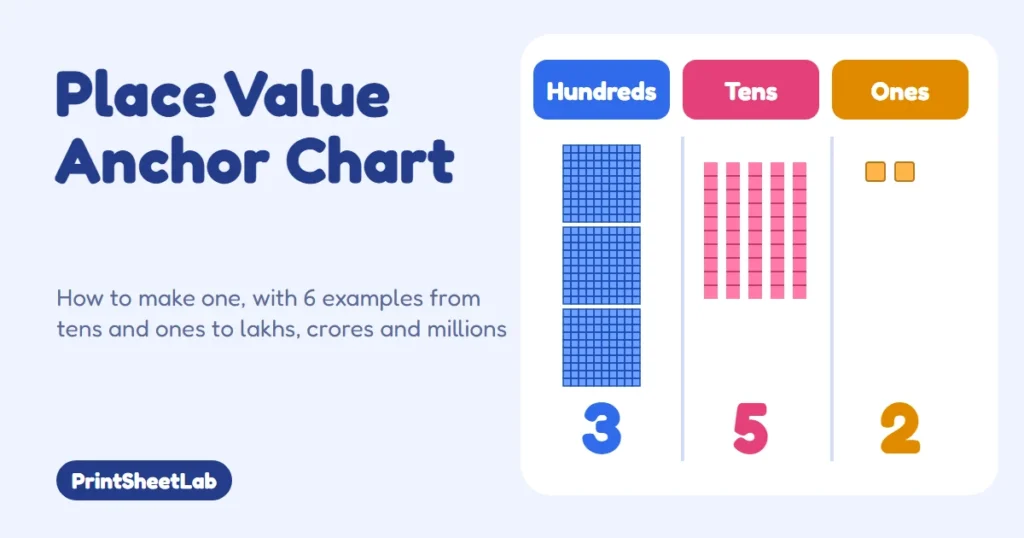
A place value anchor chart is a large poster, made with the class, that shows the name and value of each place in a number (ones, tens, hundreds and beyond) with a worked example children can look back at while they work. Keep one chart to one idea, color-code every place, build the example together and hang it where math happens. Below are six examples you can copy, from tens and ones up to lakhs, crores and millions.
What is a place value anchor chart?
A place value chart is a table with one column for each place: ones, tens, hundreds, thousands and so on. Put a digit in each column and the chart shows what that digit is worth. In 352, the 3 sits in the hundreds column, so it is worth 300.
A place value anchor chart takes that table and “anchors” a lesson to it. It records the key words, a model and one or two examples the class worked out together. Children use it as a reference, so it has to be big, clear and uncluttered. A printed chart is a tool for each child’s desk; an anchor chart is a shared memory for the room.
Both are useful. Many teachers pair a class anchor chart with a small printable place value chart that each child keeps in a folder.
What belongs on the chart
Choose only the parts your children need for the current unit. A crowded chart is hard to read from the back of the room.
| Part | What it looks like | Why it helps |
|---|---|---|
| Place names | Columns labeled ones, tens, hundreds…, written from right to left | Children see that places grow to the left |
| Color code | One color per place, matching blocks and mats | Links the digit to its value at a glance |
| Model | Base-ten drawings: a dot or small square for a one, a stick for a ten, a square for a hundred | Shows the size of each place |
| Forms of a number | Standard, word, expanded and model forms | One number seen four ways |
| Key words | Digit, place, value, period, zero as a placeholder | Shared vocabulary for explaining |
| Space for sticky notes | A blank corner or strip | Children add their own examples |
How to make one in 7 steps
You need a large sheet of chart paper (or a whiteboard at home), markers in three to five colors, sticky notes and, ideally, base ten blocks or printed block pictures.

- Pick one focus. “Tens and ones” or “Reading big numbers”, not both. A second idea means a second chart.
- Write the title as a question. “What is each digit worth?” invites children to answer it.
- Draw the columns before the lesson. Label them from right to left, starting with ones, and give each place its own color.
- Add the model. Under each heading, draw what one of that place looks like: a unit, a rod of ten, a flat of a hundred.
- Fill in the example together. Let the class choose a number, then write it in standard, expanded and word form as they explain it.
- Leave room to grow. Keep a corner for sticky notes where children post their own numbers.
- Hang it and use it. Put it at eye level near where math happens, point to it during lessons and take it down when the class no longer needs it.
Why build it live instead of printing a finished poster? Children who helped make a place value anchor chart know where everything on it is and what each part means, so it is easier for them to use on their own.
6 examples you can copy
Each example below lists the grade it usually suits, the number to build and what to write on it. Change the numbers to suit your class.
1. Tens and ones (Grade 1, Year 1 to 2)
Draw two columns: tens (one color) and ones (another). Build 47 with 4 rods and 7 units, then write it three ways: 4 tens and 7 ones, 40 + 7 and 47. Add a second example with a zero, 60, which is 6 tens and 0 ones. The key sentence for the chart: “10 ones make 1 ten.”
Practice with the tens and ones game and the tens and ones worksheets.
2. Hundreds, tens and ones: zero as a placeholder (Grade 2, Year 3)
Use 706: 7 hundreds, 0 tens and 6 ones. Write 700 + 0 + 6 = 706 under the columns, then show what happens if you leave out the zero: 76, a completely different number. Children often write “seven hundred and six” as 7006, so put that on the chart as a “not this” example with a cross.
Follow up with the hundreds, tens and ones worksheets.
3. Four ways to show a number (Grades 2 to 4)
Split the paper into four boxes around one number, such as 3,425:
- Standard form: 3,425
- Word form: three thousand, four hundred and twenty-five (in the US, often written without “and”)
- Expanded form: 3,000 + 400 + 20 + 5
- Model: 3 thousand cubes, 4 hundred flats, 2 ten rods and 5 units
This chart works well as a daily warm-up: change the number and ask children to redo all four boxes.
4. What is a digit worth? (Grades 3 to 5)
Write 5,555 and draw an arrow from each 5 to its value: 5,000, 500, 50 and 5. The same digit is worth ten times as much each time it moves one place to the left. Add the rule in words (“each place is 10 times the place to its right”) and one division check: 700 ÷ 70 = 10.
For older children, extend the chart to the right of the decimal point. In 3.45 the 4 is worth 4 tenths and the 5 is worth 5 hundredths; each place is one tenth of the place to its left. Our decimal place value worksheets continue from here.
5. International place value chart to millions
The international system groups digits in threes, called periods: ones, thousands, millions. Each period has its own hundreds, tens and ones. On the chart, write 45,807,312 across nine columns and read it period by period: forty-five million, eight hundred and seven thousand, three hundred and twelve.
6. Indian place value chart with lakh and crore
The Indian system groups the first three digits from the right, then every two digits: ones, thousands, lakhs, crores. The same number becomes 4,58,07,312, read as four crore, fifty-eight lakh, seven thousand, three hundred and twelve. One lakh is 100,000 and one crore is ten million, as the Cambridge Dictionary entry for lakh and its entry for crore confirm.
Families in India, Pakistan and Bangladesh use this system every day (prices, salaries, populations), so an Indian chart next to the international one helps children move between the two.
Indian and international place value compared
Put this comparison on a chart for Class 4 to 6 in South Asia, or for any class with families who use both systems.
| Indian name | Indian commas | International commas | International name |
|---|---|---|---|
| one thousand | 1,000 | 1,000 | one thousand |
| ten thousand | 10,000 | 10,000 | ten thousand |
| one lakh | 1,00,000 | 100,000 | one hundred thousand |
| ten lakh | 10,00,000 | 1,000,000 | one million |
| one crore | 1,00,00,000 | 10,000,000 | ten million |
| ten crore | 10,00,00,000 | 100,000,000 | one hundred million |
| one hundred crore (one arab) | 1,00,00,00,000 | 1,000,000,000 | one billion |

Two quick checks for children: ten lakh is one million, and one crore is ten million. The Indian numbering system article explains the 3-then-2 comma pattern and where it is used.
Indian place value chart: what is the digit 7 worth in each place?
An Indian place value chart and an international place value chart agree up to 99,999 and then split. To show where, we wrote the digit 7 in each place from ones to ten crores, with its value in both comma styles and both sets of words. We checked every row with a short program:
| The digit 7 in the place | International commas | International words | Indian commas | Indian words |
|---|---|---|---|---|
| ones | 7 | seven | 7 | seven |
| tens | 70 | seventy | 70 | seventy |
| hundreds | 700 | seven hundred | 700 | seven hundred |
| thousands | 7,000 | seven thousand | 7,000 | seven thousand |
| ten thousands | 70,000 | seventy thousand | 70,000 | seventy thousand |
| lakhs (hundred thousands) | 700,000 | seven hundred thousand | 7,00,000 | seven lakh |
| ten lakhs (millions) | 7,000,000 | seven million | 70,00,000 | seventy lakh |
| crores (ten millions) | 70,000,000 | seventy million | 7,00,00,000 | seven crore |
| ten crores (hundred millions) | 700,000,000 | seven hundred million | 70,00,00,000 | seventy crore |
For the first five places both charts give the same comma pattern and the same words, but at 700,000 the international chart says seven hundred thousand while the Indian chart says seven lakh. At ten lakhs (1,000,000 in the international system) the two names differ again: ten lakh against one million.
A place value anchor chart for a class that uses both systems can show this table in one strip along the bottom, so children can read a big number in either style. When you use a place value chart in class, ask which system the question uses before anyone writes a comma.
How far should the chart go in each grade?
Use the table to decide how far your place value anchor chart should go. Grades follow the US Common Core; Years follow the national curriculum in England.
| Grade / Year | Numbers | Focus for the chart |
|---|---|---|
| Kindergarten / Reception to Year 1 | 11 to 19 | A teen number is a ten and some ones (K.NBT.A.1) |
| Grade 1 / Year 2 | to 120 | Tens and ones; 10 ones make a ten (1.NBT.B.2; Year 2: place value in two-digit numbers) |
| Grade 2 / Year 3 | to 1,000 | Hundreds, tens and ones; zero as a placeholder (2.NBT.A.1; Year 3: three-digit numbers) |
| Grade 3 to 4 / Year 4 | to 10,000 | Thousands; four ways to show a number (Year 4: four-digit numbers) |
| Grade 4 / Year 5 | to 1,000,000 | Each place is 10 times the place to its right (4.NBT.A.1; Year 5: numbers to at least 1,000,000) |
| Grade 5 | decimals | Each place is one tenth of the place to its left (5.NBT.A.1) |
Ways to use the chart in class
- Number of the day. Write a number on a sticky note and ask a child to place it on the chart, read it and give its expanded form.
- Who am I? “I have 3 hundreds, 0 tens and 8 ones.” (308) “I have 2 thousands, no hundreds, 6 tens and 1 one.” (2,061) Children then write riddles for each other.
- Plus 10, plus 100. Point to a number and ask for 10 more and 100 more. Only one digit should change, which children can check against the chart. For 460, 10 more is 470 and 100 more is 560.
- Biggest number. Give four digit cards (such as 2, 9, 0, 5) and ask for the largest and smallest four-digit numbers: 9,520 and 2,059.
- Point, don’t tell. When a child is stuck, point to the chart instead of giving the answer.
Setting up a chart at home
A home place value anchor chart can be a sheet of A3 paper on the fridge. Draw the columns up to thousands (or lakhs), stick on a few numbers from daily life, such as house numbers, page numbers or prices on a receipt, and ask your child to say what each digit is worth.
For hands-on play, cut out paper blocks from our base ten blocks printable and build numbers on a place value mat. Counting to 100 on a hundreds chart is also good preparation, because each row is one more ten.
Place value anchor chart 2nd grade: how often does a zero placeholder appear?
When you plan a chart for 2nd grade, you may wonder how much of the chart to spend on zero as a placeholder. We counted how many numbers of each length contain at least one zero digit, using the fact that there are 9 choices for the first digit and 9 non-zero choices for each other digit:
| Digits | Numbers with that many digits | Numbers containing at least one zero | Share with a zero |
|---|---|---|---|
| 2 | 90 | 9 | 10.0% |
| 3 | 900 | 171 | 19.0% |
| 4 | 9,000 | 2,439 | 27.1% |
| 5 | 90,000 | 30,951 | 34.4% |
| 6 | 900,000 | 368,559 | 41.0% |
One in ten two-digit numbers has a zero (10, 20, up to 90), but 171 of the 900 three-digit numbers do, which is 19%. At four digits it is more than one number in four.
So a Grade 2 child who works with numbers to 1,000 meets a zero in about one number in five, and a Grade 3 or 4 child meets one in about three. That is why the zero example, such as 706, deserves its own panel on the Grade 2 chart, with the “not this” cross against 76 and 7006.
Common place value mistakes to show on the chart
- Digit versus value. In 348 the digit 4 is worth 40, not 4. Ask “what is it worth?” not “what is the digit?”.
- Missing placeholders. Three hundred and six written as 36 or 3006. Build it with blocks, then write it.
- Columns in the wrong order. Charts should start with ones on the right; children who start on the left mix up the places.
- Mixed commas. Writing 45,80,7312 mixes the two systems. Pick one system per number and stick to its comma pattern.
- Muddling ten lakh and one lakh. Check with the comparison table: one lakh has five zeros, ten lakh has six.
Place value also makes written addition easier to follow: “carrying” is really exchanging 10 ones for 1 ten. See our addition strategies guide for mental methods built on tens.
Free place value printables on PrintSheetLab
Pair the chart with these free resources:
- Place value chart: printable Indian and international charts, including decimals.
- Place value worksheets: tens and ones through to large numbers.
- Large number place value worksheets: expanded form and value of a digit.
- Number line: place numbers between hundreds and thousands.
- Rounding calculator: check rounding to the nearest 10, 100 or 1,000.
- Learning games: quick online practice once the chart is up.
Sources
Year group expectations come from the National Curriculum in England: mathematics programmes of study. US grade codes come from the Common Core State Standards for Mathematics (CCSSO). Lakh and crore values follow the Cambridge Dictionary entries for lakh and crore.
Frequently asked questions
8 quick answers
What is a place value chart?
A place value chart is a table with a column for each place in a number (ones, tens, hundreds, thousands and so on). Writing a number in it shows the value of every digit, so in 352 the 3 is worth 300.
What should a place value anchor chart include?
Place names from right to left, one color per place, a base-ten model, a worked example in standard, expanded and word form, and space for children to add their own numbers. Keep each chart to one idea.
How do you make a place value anchor chart for Grade 2?
Draw hundreds, tens and ones columns in three colors, add a flat, a rod and a unit as the model, and build a number with a zero such as 706 with the class. Show 700 + 6 and the word form beside it.
What is the difference between the Indian and international place value charts?
Both group the first three digits from the right. After that, the Indian system groups in twos (lakhs, crores) and the international system keeps grouping in threes (thousands, millions). So 1,00,000 (one lakh) is 100,000 (one hundred thousand).
How many zeros are in a lakh and a crore?
One lakh (100,000) has five zeros and one crore (10,000,000) has seven zeros. Ten lakh is one million, and one crore is ten million.
Can I use a place value anchor chart at home?
Yes. Draw the columns on A3 paper, stick it on the fridge and add numbers from daily life, such as prices, page numbers or house numbers. Ask your child what each digit is worth.
What is the digit 7 worth in an Indian place value chart?
It depends on the place: 7 in the lakhs place is 7,00,000 (seven lakh), and 7 in the crores place is 7,00,00,000 (seven crore). In the international system those are seven hundred thousand and seventy million.
How often does a number have a zero placeholder?
About 1 in 10 two-digit numbers, 19% of three-digit numbers and 27% of four-digit numbers contain a zero, so zero as a placeholder deserves its own example on the chart.