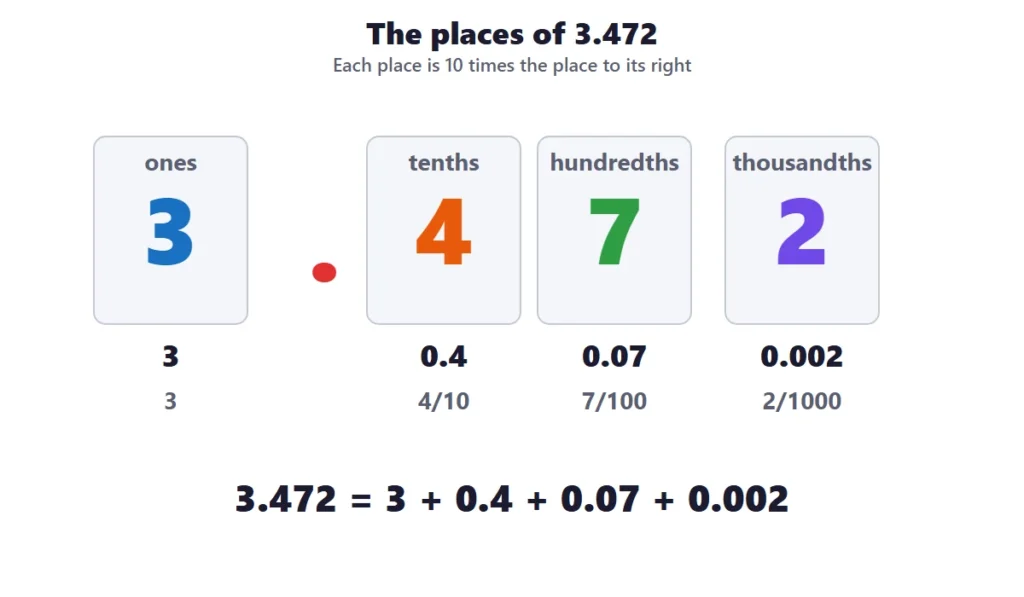
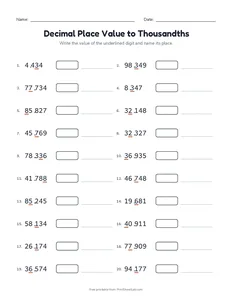
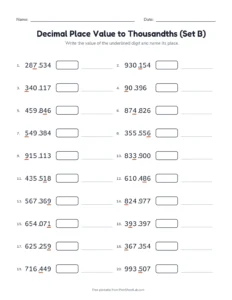
The places to the right of the point are tenths, hundredths and thousandths. There is no “oneths”: the first place after the point is tenths. In 4.27, the 2 is 2 tenths (0.2) and the 7 is 7 hundredths (0.07).
Decimal place value worksheets: what is in the set
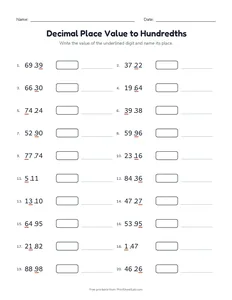
There are 3 decimal place value worksheets on this page, and every one has an answer key except for any cut-out games. The first set goes to the hundredths, and the other two go to the thousandths, with the value and the place of the underlined digit.
Worksheet
What children do
Standard
Decimal Place Value to Hundredths
Value and place of the underlined digit.
5.NBT.A.3
Decimal Place Value to Thousandths
Value and place, up to thousandths.
5.NBT.A.3
Decimal Place Value to Thousandths (Set B)
Name the value of digits in larger decimals.
5.NBT.A.3
Decimal place value: the places and their values
When children are learning decimal place value, the key idea is that each place is ten times the place to its right. The places left of the point are whole numbers, and the places to the right are parts of one. This table lists seven places with their values:
Place
Value
As a fraction
Where it is
hundreds
100
100
to the left of the tens
tens
10
10
to the left of the ones
ones
1
1
just left of the decimal point
tenths
0.1
1/10
first place right of the point
hundredths
0.01
1/100
second place right of the point
thousandths
0.001
1/1000
third place right of the point
ten-thousandths
0.0001
1/10,000
fourth place right of the point
There is no “oneths” place. The ones place is on the left of the point, and the first place to the right is tenths, so the places are not a mirror image. The Common Core asks grade 5 children to recognize that a digit in one place represents 10 times as much as in the place to its right (5.NBT.A.1), and to read, write and compare decimals to thousandths (5.NBT.A.3). The Common Core standards for grade 5 number and operations in base ten describe both.
Tenths hundredths thousandths: how big is each?
Tenths hundredths thousandths are three places, and each is one tenth of the place before it. This is why the digit 5 means different amounts in 5, 0.5, 0.05 and 0.005. The table shows what the 5 is worth in five numbers:
Number
The 5 is in the
Value of the 5
Compared with the one before
5
ones place
5
the starting point
0.5
tenths place
0.5
10 times less than 5
0.05
hundredths place
0.05
10 times less than 0.5
0.005
thousandths place
0.005
10 times less than 0.05
50
tens place
50
10 times more than 5
A tenth is bigger than a hundredth, and a hundredth is bigger than a thousandth. The values go down by a factor of 10 each time, in the same way that the values go up by 10 on the left. The place value chart tool prints a chart with all the places.
Value of a digit decimals: six examples
To find the value of a digit in a decimal, look at its place. The first digit after the point is tenths, the second is hundredths, and the third is thousandths. These six examples show how it works, and the worksheets on this page ask for the place and the value of the underlined digit:
Number
Digit
Place
Value of the digit
4.275
2
tenths
0.2
4.275
7
hundredths
0.07
4.275
5
thousandths
0.005
3.052
5
hundredths
0.05
16.804
8
tenths
0.8
0.639
9
thousandths
0.009
Decimal place value worksheets: expanded form and words
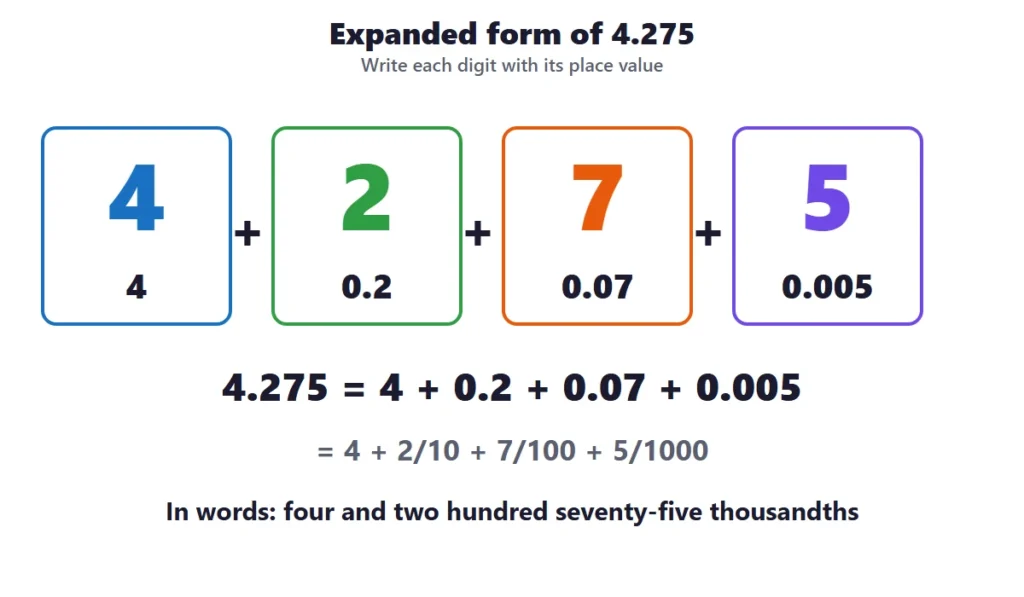
Expanded form shows the value of each digit as a sum. For decimals, the parts are a whole number and tenths, hundredths and thousandths. Reading the number aloud uses the place of the last digit: 4.275 is “four and two hundred seventy-five thousandths”. The table shows six numbers:
Decimal
Expanded form
In words
4.275
4 + 0.2 + 0.07 + 0.005
four and two hundred seventy-five thousandths
0.36
0.3 + 0.06
thirty-six hundredths
12.08
12 + 0.08
twelve and eight hundredths
3.405
3 + 0.4 + 0.005
three and four hundred five thousandths
0.007
0.007
seven thousandths
9.9
9 + 0.9
nine and nine tenths
Place value decimals grade 5: multiplying and dividing by 10
Place value decimals grade 5 work leads to multiplying and dividing by powers of 10. When a number is multiplied by 10, every digit moves one place to the left, and when it is divided by 10, every digit moves one place to the right. The decimal point does not move, the digits do:
Start
Operation
Result
What happens to the digits
3.472
× 10
34.72
every digit moves one place to the left
3.472
× 100
347.2
every digit moves two places to the left
3.472
÷ 10
0.3472
every digit moves one place to the right
3.472
÷ 100
0.03472
every digit moves two places to the right
0.5
× 10
5
tenths become ones
This is why a zero is added or taken away when a number is multiplied by 10, and it links decimals to the place value worksheets for whole numbers.
How many decimals are there with one, two or three places?
Each new decimal place gives ten times as many numbers in the same range. Between 0 and 10 there are 100 numbers with one decimal place, 1,000 with two and 10,000 with three. The table shows the counts and the smallest step in each case:
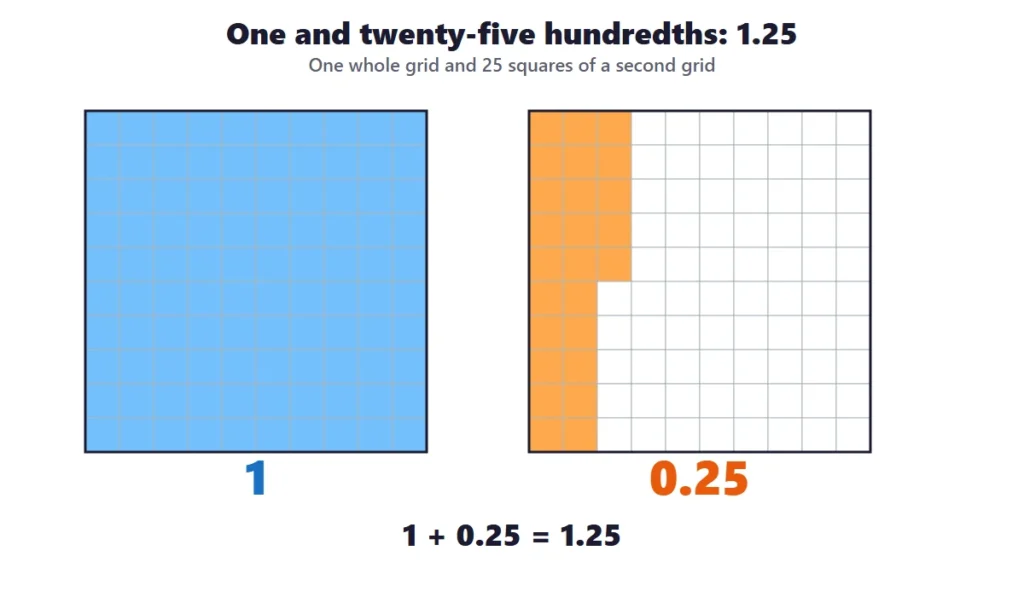
Grids. One whole and 0.25.
Numbers from 0 up to 10
How many
Smallest step
One decimal place (0.0 to 9.9)
100 numbers
tenths
Two decimal places (0.00 to 9.99)
1,000 numbers
hundredths
Three decimal places (0.000 to 9.999)
10,000 numbers
thousandths
Because each place gives ten times more numbers, there are many more decimals than whole numbers in any range. This idea returns when children round decimals on the page on comparing and rounding decimals.
Decimal place value and measurement: the metric system
The metric system is built on decimal place value, which is a good reason to learn the places well. A meter is divided into 10 decimeters, 100 centimeters and 1,000 millimeters, so the places of a decimal match the units. A length of 3.472 meters is 3 meters, 4 decimeters, 7 centimeters and 2 millimeters. Children who can read the places can convert between units by moving the decimal point, and the table shows five examples:
Length
In meters
In centimeters
In millimeters
A pencil
0.175
17.5
175
A door handle height
1.05
105
1,050
A fingernail width
0.012
1.2
12
A table length
1.8
180
1,800
A coin thickness
0.002
0.2
2
The same idea works for kilograms and grams, and for liters and milliliters. When a child converts 0.175 meters to centimeters, the digits move two places to the left, which is what happens when a number is multiplied by 100.
Why decimal place value is useful
Decimals make it easy to write, compare and calculate with parts of a whole, because they use the same place value system as whole numbers. A fraction such as 3/8 needs a different denominator for every number, but a decimal such as 0.375 always uses tenths, hundredths and thousandths. That is why decimals are used in money, in measurement, in sports times and in science, and why decimal place value is one of the most useful topics in the upper elementary grades. Children who understand the places can estimate, round and check their work with confidence.
Comparing digits in different places
A common question on decimal place value worksheets is which digit is worth more. A digit in a place further left is always worth more than the same digit in a place further right, and a digit is worth ten times as much as the same digit one place to its right. In 5.555 the three 5s have different values: 5, 0.5, 0.05 and 0.005, so the first is worth 1,000 times as much as the last. Asking children to say “how many times as much” helps them to use the idea of ten times in other topics, such as multiplication by 10 and by 100.
Common mistakes with decimal place value
These are the mistakes that teachers see most often, with the reason and the fix:
What the child does
Why
The fix
Reads 0.07 as “seven tenths”
7 is in the hundredths place
read it as seven hundredths
Says there is a “oneths” place
Thinks the places are symmetric around the point
the ones place is left of the point, and the first place right of it is tenths
Writes 3.05 as 3.5
Skips the zero placeholder
the zero holds the tenths place
Reads 4.27 as “four point twenty-seven”
Says it as a whole number after the point
read as four and twenty-seven hundredths, or four point two seven
Says the 5 in 0.005 is worth 5
Ignores the place
it is worth 5 thousandths, or 0.005
Decimal place value word problems
These questions ask children to use decimal place value in short problems. Ask them to name the place first, and then to write the value:
Word problem
Working
Answer
What is the value of the 7 in 3.472?
the 7 is in the hundredths place
0.07
Write 5 tenths and 3 thousandths as a decimal.
0.5 + 0.003
0.503
Which digit is in the hundredths place in 12.085?
12.085: tenths 0, hundredths 8
8
A ruler is 0.25 meters long. How many hundredths is that?
0.25 = 25/100
25 hundredths
Write forty-two and six hundredths as a decimal.
42 + 0.06
42.06
How many tenths are in 2.4?
2.4 = 24 tenths
24 tenths
Games and activities for decimal place value
Children learn decimal place value best when they play with it. These games use things that are found at home or in a classroom:
Expanded form. 4.275 in parts.
Place value cards: make cards with digits and a decimal point, and build the greatest and least decimal
Digit value hunt: write a decimal on the board and ask for the value of each digit
Say it right: read a decimal aloud with the place name, such as “three and four hundredths”
Move the point: multiply and divide by 10 with a place value chart, and watch the digits move
Decimal war: each player turns over cards to make a decimal, and the greater one wins
Expanded form puzzles: cut up an expanded form into cards and put it back together
A 20-minute lesson on decimal place value
A short lesson is the best way to introduce decimal place value. This 20-minute plan can be used in a classroom, at a tutoring session or at home, and it uses the worksheets at the end:
Minutes
Activity
What to say or ask
0 to 3
Write 3.472 in a place value chart
What is each digit worth? Which place is the 7 in?
3 to 8
Show 0.5, 0.05 and 0.005 on a chart
What happens to the value of the 5 each time?
8 to 13
Write 4.275 in expanded form together
Say the parts: four, two tenths, seven hundredths, five thousandths
13 to 18
Multiply 3.472 by 10 with the chart
Which way do the digits move?
18 to 20
Start a worksheet and check one answer
Did you name the place first?
Where decimal place value fits across the grades
No skill stands alone. This table shows what children learn before and after decimal place value, with the standard that goes with each step:
This page covers the center of the decimal sequence. Children who are secure here can compare, round, add and subtract decimals.
Helping at home with decimal place value
Parents do not need to be experts to help with decimal place value. These suggestions work well, and each takes only a few minutes:
Look at prices and ask for the value of each digit, such as the 9 in $3.95.
Measure with a ruler in centimeters and millimeters, and write the length as a decimal of a meter.
Play a game with a die: roll three times and put the digits in the tenths, hundredths and thousandths to make the greatest decimal.
Ask the child to read 0.36 as “thirty-six hundredths”.
Check the answers together, and let the child say why each digit has its value.
How to check progress in decimal place value
A teacher or parent can check progress with the answer key and a few questions. This table shows three common situations, what they mean and what to do next:
What you see
What it means
What to do next
The child names the places correctly but gives the wrong value
The child knows the order but not the size
Use a place value chart with the fractions, 1/10, 1/100, 1/1000
The child gets 9 of 10 right on every set
The skill is secure
Move on to comparing and rounding decimals
The child says the first place after the point is “oneths”
The child thinks the places are mirror images
Show the chart with the ones place on the left of the point
A five-day plan for decimal place value
Most children need about a week of short sessions for decimal place value. This plan follows the order of the worksheets on this page:
Day
What to do
Practice
Day 1
Name the places: ones, tenths, hundredths
10 numbers
Day 2
Value of the underlined digit to hundredths
1 worksheet
Day 3
Expanded form for numbers with tenths and hundredths
The ones place is to the left of the point. Places after the point are parts of one, starting with tenths.
What is the value of 5 in 3.005?
5 thousandths, which is 0.005.
What is the place value of the digit 7 in 0.074?
The 7 is in the hundredths place, so its value is 7 hundredths, or 0.07. The 4 is in the thousandths place, and it is worth 0.004.
Why do decimals use a point?
The decimal point shows where the whole number part ends and the part of one starts. In many countries a comma is used instead of a point.
How many thousandths are in one tenth?
There are 100 thousandths in one tenth, since one tenth is 0.1 = 0.100 and each thousandth is 0.001. This follows from each place being ten times the place to its right.