A rounding calculator rounds a number to the place you choose, such as the nearest ten, tenth, hundredth or whole number, and shows the two nearest values, the deciding digit and the rule. This free rounding calculator also rounds to decimal places, to a multiple like 5 or 0.25, and to significant figures.
Quick answer: To round a number, look at the digit just to the right of the place you are rounding to. If it is 5 or more, round up; if it is 4 or less, round down. So 3,456.789 rounds to 3,460 to the nearest ten and to 3,456.79 to the nearest hundredth.
How to use the rounding calculator
Type the number, then choose how to round it. Commas, decimals and a minus sign are fine. The answer updates as you type, with the two nearest values, the deciding digit and a table that rounds the same number to seven places at once.
| Round by | You choose | Example | Answer |
|---|---|---|---|
| Place value | million down to ten-thousandth | 3,456.789 to the nearest ten | 3,460 |
| Decimal places | 0 to 20 places | 3.14159 to 3 places | 3.142 |
| Nearest multiple | any step such as 5, 0.25 or 100 | 7.37 to the nearest 0.05 | 7.35 |
| Significant figures | 1 to 20 figures | 3,456.789 to 3 figures | 3,460 |
The Rounding method box defaults to the standard school rule. Switch it to compare half to even, always up, always down or truncation, then use Copy result to paste the answer or Copy link to share the exact setup with a student or a teammate. The rounding calculator keeps your numbers in the link, so nothing needs saving.
Rounding examples and a printable practice sheet
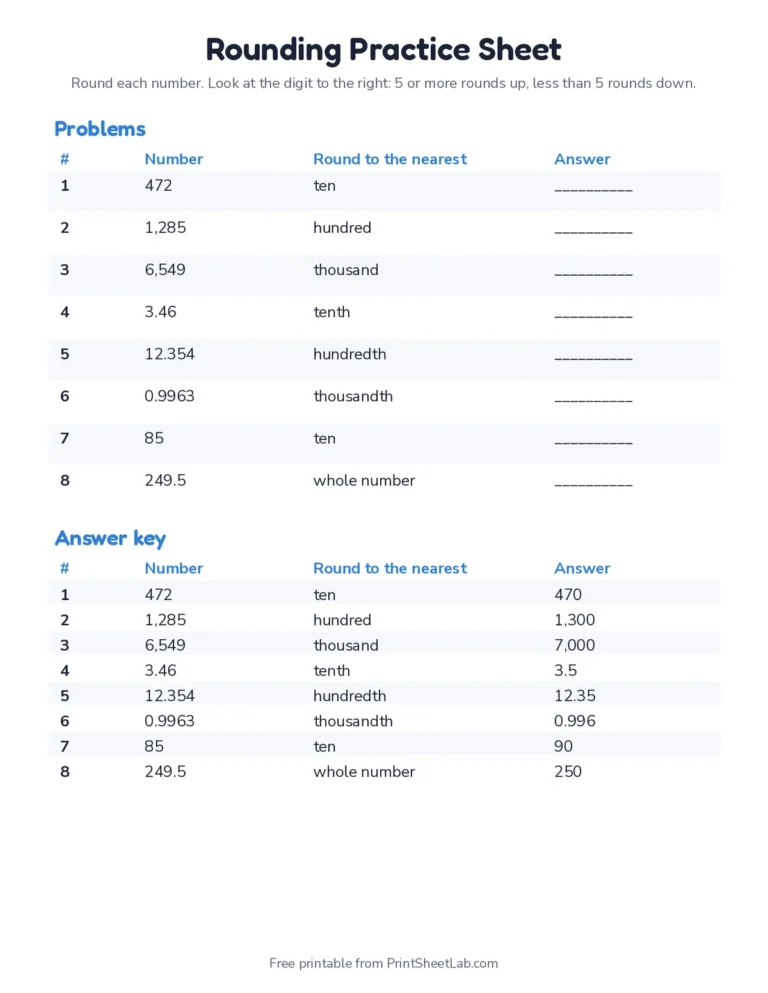
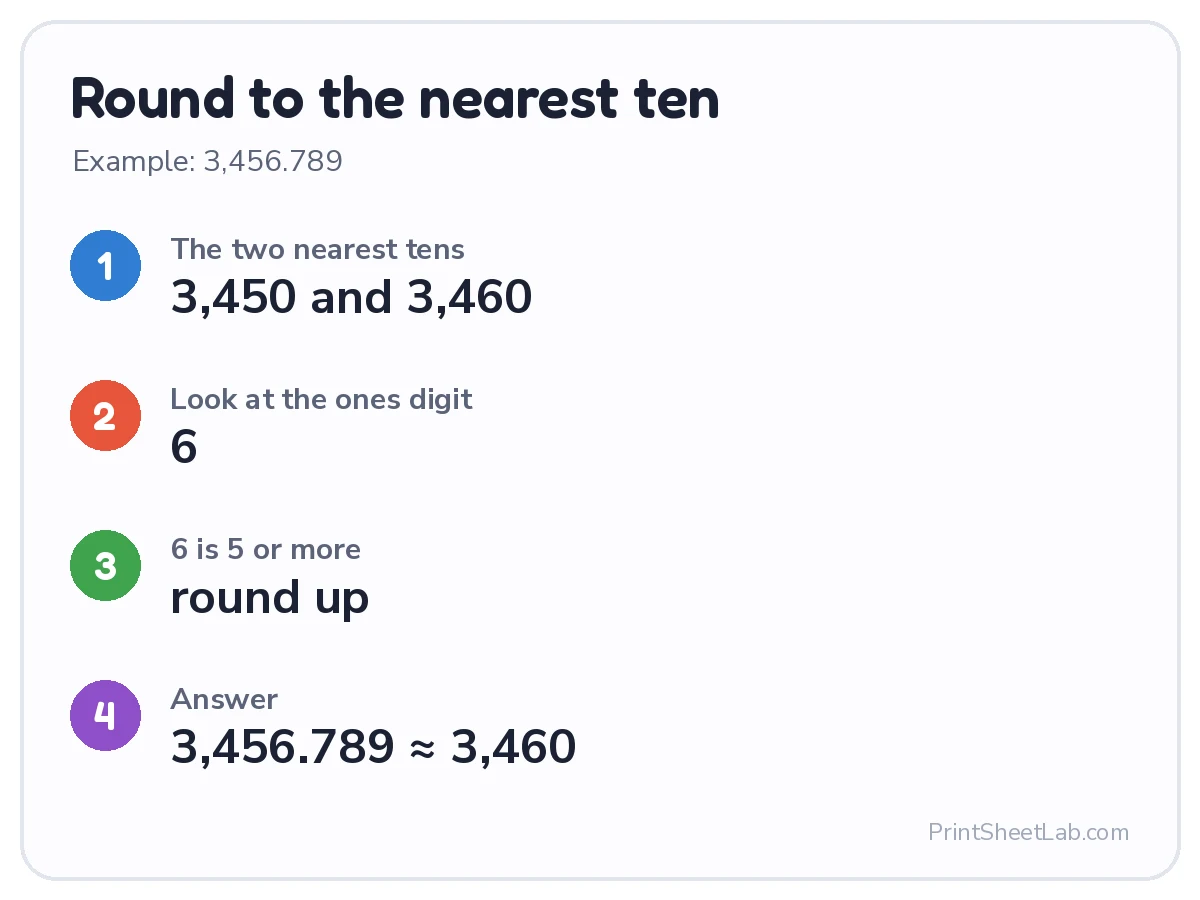
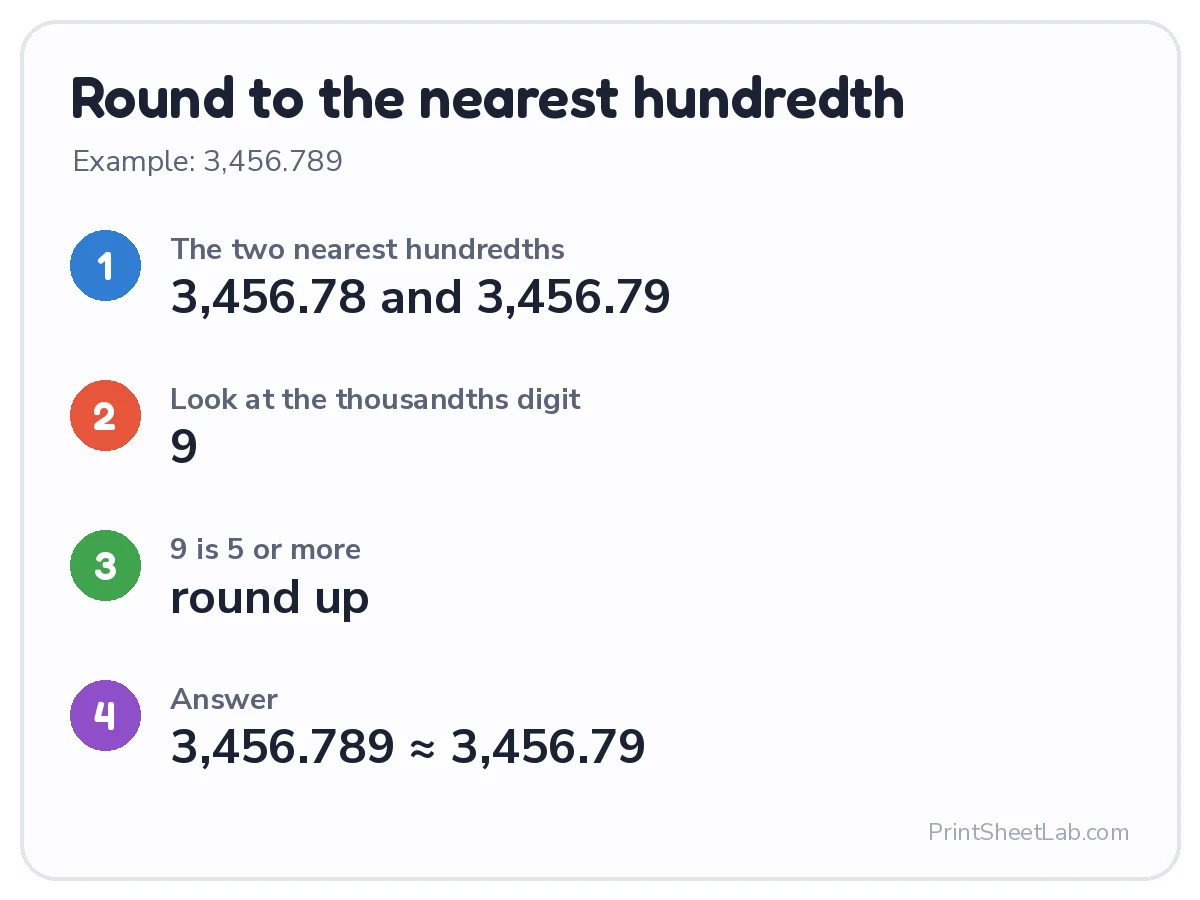
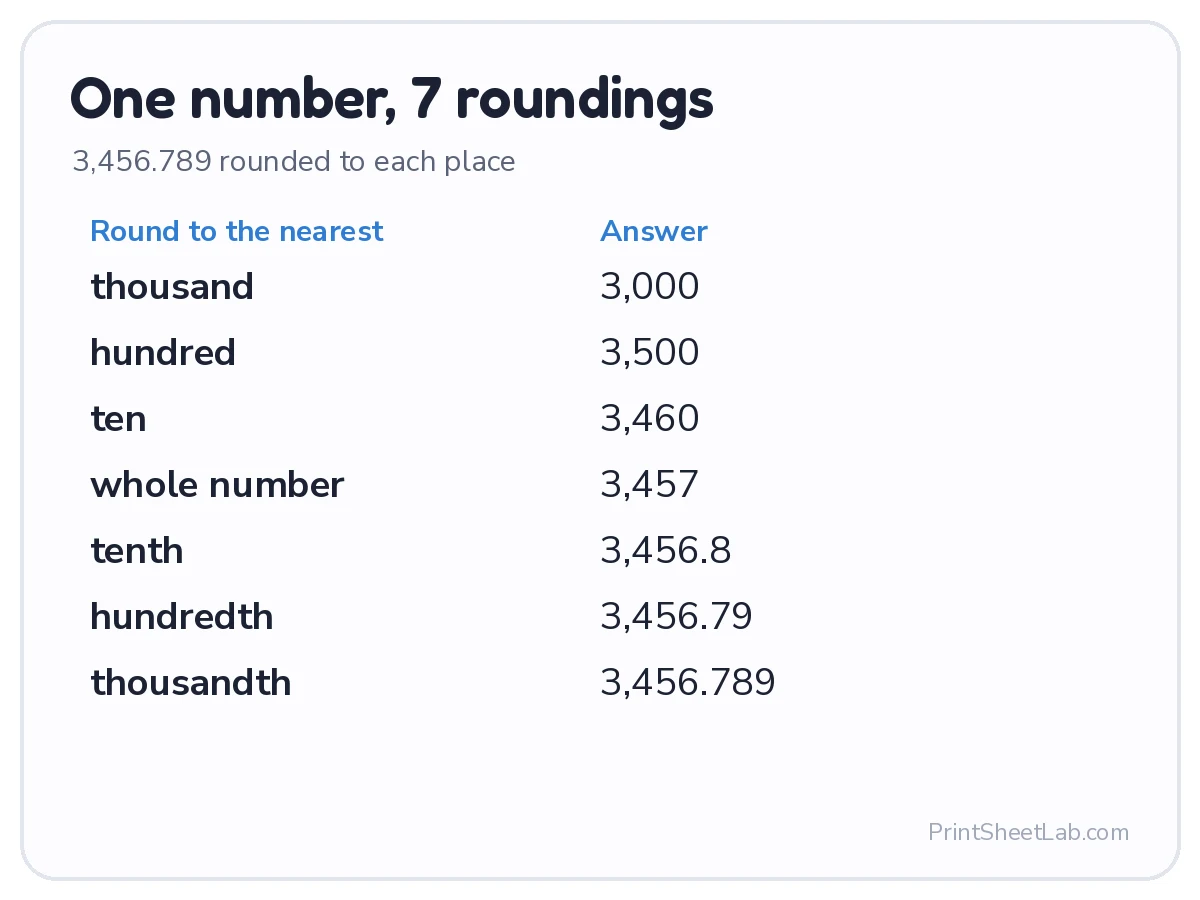
The cards show 3,456.789 rounded to the nearest ten and to the nearest hundredth, then the same number rounded to all seven places. The printable rounding practice sheet has eight problems across whole numbers and decimals, with an answer key at the bottom.
How rounding numbers works
Rounding replaces a number with a nearby, simpler one. Every place value has a unit: 10 for the tens place, 1 for the ones place, 0.01 for the hundredths place. The rounded answer is the multiple of that unit that is closest to your number. Two multiples surround it, a smaller and a larger, and the number goes to whichever is nearer.
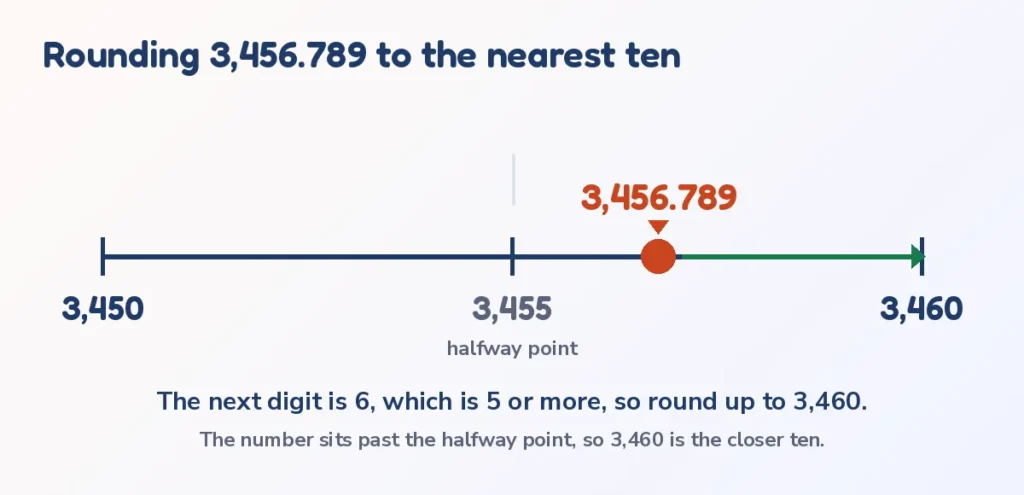
Worked example 1. Round 3,456.789 to the nearest ten. The surrounding tens are 3,450 and 3,460. The digit in the ones place is 6, which is 5 or more, so the number is closer to 3,460.
Worked example 2. Round 0.9963 to the nearest thousandth. The thousandths place holds 6 and the next digit is 3, which is 4 or less, so the 6 stays: 0.996.
| Round 3,456.789 to the nearest | Result |
|---|---|
| thousand | 3,000 |
| hundred | 3,500 |
| ten | 3,460 |
| whole number | 3,457 |
| tenth | 3,456.8 |
| hundredth | 3,456.79 |
| thousandth | 3,456.789 |
How to round to the nearest ten
To round to the nearest ten, find the two tens your number sits between, then look at the ones digit. For 472, the tens on either side are 470 and 480. The ones digit is 2, which is less than 5, so 472 rounds down to 470. For 85, the ones digit is 5, so it rounds up to 90.
A number line makes this visual: mark 470 and 480, place 472 on the line and see which end is closer. A number exactly halfway, such as 475, rounds up by convention. The rounding calculator shows both nearby tens in its first step so students can picture the number line.
| Number | Nearest ten | Why |
|---|---|---|
| 472 | 470 | ones digit 2 rounds down |
| 85 | 90 | ones digit 5 rounds up |
| 1998 | 2,000 | ones digit 8 rounds up and carries |
| 1204 | 1,200 | ones digit 4 rounds down |
| 34.6 | 30 | ones digit 4 rounds down, whatever the decimals |
Rounding numbers to the nearest hundred or thousand
Rounding numbers to bigger places works the same way, but the deciding digit moves. To round to the nearest hundred, look at the tens digit: 1,285 has an 8 in the tens place, so it rounds up to 1,300. To round to the nearest thousand, look at the hundreds digit: 6,549 has a 5 in the hundreds place, so it rounds up to 7,000, even though the digits after the 5 are small. Only the one digit to the right of the rounding place matters.
Rounding big numbers in the rounding calculator, or in your head, is useful for estimating: 4,872 + 3,129 is about 5,000 + 3,000 = 8,000, which is a quick way to check an exact answer of 8,001. The place value chart helps students find the right digit.
How to round decimals
To round decimals, count the places after the decimal point. Tenths are one place, hundredths two and thousandths three. Then look one place further right:
- 3.46 to the nearest tenth: the hundredths digit is 6, so round up to 3.5.
- 12.354 to the nearest hundredth: the thousandths digit is 4, so round down to 12.35.
- 0.9963 to the nearest thousandth: the next digit is 3, so round down to 0.996.
- 249.5 to the nearest whole number: the tenths digit is 5, so round up to 250.
The rounding calculator handles decimals down to ten-thousandths. Drop every digit after the rounding place; do not replace them with zeros as you would in a whole number. Money is usually rounded to the nearest hundredth, which is the nearest cent: $4.6789 becomes $4.68.
Round to the nearest tenth
To round to the nearest tenth, keep one digit after the decimal point and look at the hundredths digit. 7.84 becomes 7.8 and 7.85 becomes 7.9. A tenth is one place, so 0.249 to the nearest tenth is 0.2.
Round to the nearest whole number
To round to the nearest whole number, look at the tenths digit. 12.5 rounds up to 13 and 12.49 rounds down to 12. Use the Place value button and choose whole number, or use Decimal places and type 0.
Round to the nearest hundredth: a closer look
When you round to the nearest hundredth, the answer has exactly two decimal places. For 3,456.789 the two nearest hundredths are 3,456.78 and 3,456.79. The thousandths digit is 9, so the number rounds up to 3,456.79. Watch for a chain of nines: 2.996 to the nearest hundredth becomes 3.00, because rounding up the 9 in the hundredths place carries into the ones. Writing 3.00 rather than 3 shows that the answer was rounded to hundredths.
| Number | Nearest tenth | Nearest hundredth | Nearest thousandth |
|---|---|---|---|
| 3.14159 | 3.1 | 3.14 | 3.142 |
| 2.71828 | 2.7 | 2.72 | 2.718 |
| 0.0449 | 0 | 0.04 | 0.045 |
| 12.9995 | 13.0 | 13.00 | 13.000 |
| 5.005 | 5.0 | 5.01 | 5.005 |
Rounding to the nearest cent, dollar, 5 or 0.25
The Nearest multiple button rounds to any step. Type 0.01 for the nearest cent, 1 for the nearest dollar, 5 for the nearest 5, 0.5 for the nearest half or 0.25 for the nearest quarter. 7.37 to the nearest 0.05 is 7.35, because 7.37 is 0.02 above 7.35 and 0.03 below 7.40.
| Number | Nearest 0.05 | Nearest 0.25 | Nearest 5 | Nearest 25 |
|---|---|---|---|---|
| 7.37 | 7.35 | 7.25 | 5 | 0 |
| 12.5 | 12.50 | 12.50 | 15 | 25 |
| 48.62 | 48.60 | 48.50 | 50 | 50 |
| 103 | 103.00 | 103.00 | 105 | 100 |
Shops in some countries round cash totals to the nearest 5 cents because the smallest coins were withdrawn. Canada has done this since 2013 for cash only, and Australia has rounded cash to 5 cents since the 1c and 2c coins left circulation in 1992. Card payments are still charged to the cent. The details are in Wikipedia’s cash rounding article, and local rules can change.
Rounding methods compared
Not every system rounds a halfway number the same way. The calculator offers five methods so you can match your class, your spreadsheet or your accountant. Here is each one applied to a few numbers, rounded to a whole number.
| Method | Rule | 2.4 | 2.5 | 3.5 | -2.5 | 2.6 |
|---|---|---|---|---|---|---|
| Standard | halves go away from zero | 2 | 3 | 4 | -3 | 3 |
| Half to even | halves go to the even neighbor | 2 | 2 | 4 | -2 | 3 |
| Always up | the larger neighbor | 3 | 3 | 4 | -2 | 3 |
| Always down | the smaller neighbor | 2 | 2 | 3 | -3 | 2 |
| Truncate | cut off toward zero | 2 | 2 | 3 | -2 | 2 |
Pick the method by the question. Use standard rounding for school math and everyday numbers. Use always up when you need enough: 7.2 boxes of tile means buying 8. Use always down when you count only whole things: 7.8 boxes fill 7 shelves. Truncation is common in programming and for ages, where 9 years and 11 months is still 9.
Half to even, also called banker’s rounding, avoids a steady upward drift when many halves are rounded, which is why it is the default in some programming languages and statistics software. Python’s round(2.5) returns 2, while Excel’s ROUND(2.5, 0) returns 3. Wikipedia’s rounding article compares the methods in detail.
Rounding to significant figures
Significant figures count digits from the first non-zero digit, whatever the place. 3,456.789 to 3 significant figures is 3,460 (3.46 × 10³), and 0.00456 to 2 figures is 0.0046. Choose the Significant figures button for this, and it also prints the scientific notation. For a dedicated tool with counting rules, see the significant figures calculator or the scientific notation calculator.
Rounding rules and special cases
- Exactly 5: the standard setting uses the school rule of rounding 5 up. Some scientific and banking systems use round half to even instead, so 2.5 becomes 2 and 3.5 becomes 4.
- Negative numbers: standard rounding treats the size of the number, so −3.46 to the nearest tenth is −3.5 and −2.5 to the nearest whole number is −3.
- Round once: always round from the original number. Rounding 1.449 to 1.45 and then to 1.5 gives the wrong answer; to the nearest tenth it is 1.4.
- Exact answers: the rounding calculator works with the digits you type, not with floating point, so 1.005 to two places is 1.01.
The last point matters in code. In JavaScript, 1.005.toFixed(2) gives 1.00 because 1.005 cannot be stored exactly in binary. The calculator avoids this by rounding the decimal digits directly.
Rounding in real life: estimates, totals and percentages
Rounding numbers is how people estimate. A shopping basket of $4.89, $12.35 and $7.10 rounds to $5 + $12 + $7 = $24 in your head, close to the exact $24.34. Rounding population to the nearest thousand, a race time to the nearest tenth of a second or a recipe amount to the nearest quarter cup all trade a little accuracy for a number that is easier to say and remember.
Rounded parts do not always add up to a rounded total. Three items of 2.4 total 7.2, which rounds to 7, but rounding each item first gives 2 + 2 + 2 = 6. Percentages in a report can likewise add up to 99% or 101%. Keep the full numbers for the calculation, round only the final answer and, when parts must add up, say that figures are rounded.
How to round in Excel and Google Sheets
| Goal | Formula | Result |
|---|---|---|
| Round to 2 decimal places | =ROUND(3456.789,2) | 3456.79 |
| Round to the nearest ten | =ROUND(3456.789,-1) | 3460 |
| Always round up | =ROUNDUP(3.21,1) | 3.3 |
| Always round down | =ROUNDDOWN(3.79,1) | 3.7 |
| Round to a multiple | =MROUND(7.37,0.05) | 7.35 |
| Cut off decimals | =TRUNC(3.79) | 3 |
A negative second argument rounds to the left of the decimal point: -1 is tens, -2 is hundreds. These formulas use the standard half-away-from-zero rule, so they match the calculator at its default setting.
Rounding practice
Round each number, then check with the rounding calculator: 638 to the nearest ten (640), 2,451 to the nearest hundred (2,500), 7.08 to the nearest tenth (7.1) and 15.555 to the nearest hundredth (15.56). For more printed practice, use the free rounding worksheets and the decimals worksheets, both with answer keys. Students can also practice with money worksheets, where rounding to the cent comes up all the time.
Rounding questions people ask
How do I round to the nearest 5?
Choose Nearest multiple and type 5. 47 is 2 above 45 and 3 below 50, so it rounds to 45. 48 rounds to 50, and 12.5 is exactly halfway between 10 and 15, so the standard rule gives 15.
How do I round to the nearest cent?
Round to the hundredths place. $4.6789 becomes $4.68, and $0.005 becomes $0.01. Use Place value and choose hundredth, or Decimal places and type 2.
How do I round to the nearest dollar?
Round to the ones place and look at the cents. $48.62 becomes $49, $48.49 becomes $48 and $48.50 becomes $49 with the standard rule. In the rounding calculator, choose Place value and then whole number.
How do I round to the nearest even number?
Use Nearest multiple with a step of 2. 7.3 rounds to 8, because 7.3 is closer to 8 than to 6. Do not confuse this with half to even rounding, which only affects numbers exactly halfway.
Rounding calculator: frequently asked questions
Does 5 round up or down?
In school math, 5 rounds up. 45 to the nearest ten is 50, and 2.35 to the nearest tenth is 2.4. Banker’s rounding is the exception.
What does round to the nearest hundredth mean?
Keep two digits after the decimal point. 7.4862 to the nearest hundredth is 7.49.
How do I round to the nearest whole number?
Look at the tenths digit. 12.5 rounds up to 13, and 12.49 rounds down to 12.
Why do we round numbers?
To make numbers easier to work with, to estimate answers quickly and to report measurements with a sensible level of precision.
Can the rounding calculator round negative numbers?
Yes. Standard rounding keeps the minus sign and rounds the size of the number, so −2.5 to the nearest whole number is −3.
What is the difference between rounding and truncating?
Truncating just cuts off digits, so 3.79 truncated to one decimal place is 3.7. Rounding looks at the next digit, so 3.79 rounds to 3.8.
How do I round to 2 decimal places?
Look at the third decimal digit. If it is 5 or more, add 1 to the second digit. 3.14159 to 2 decimal places is 3.14, and 2.675 is 2.68.
How do I round to the nearest tenth?
Keep one decimal digit and look at the hundredths digit. 5.67 is 5.7 and 5.64 is 5.6.
What is 3,456.789 rounded to the nearest hundred?
3,500. The tens digit is 5, so the number rounds up from 3,400 to 3,500.
Is rounding to 3 significant figures the same as 3 decimal places?
No. Significant figures count from the first non-zero digit, decimal places count after the decimal point. 0.004567 has 3 decimal places in 0.005 but 3 significant figures in 0.00457.
Related calculators
- Scientific notation calculator
- Significant figures calculator
- Percentage calculator
- Long division calculator
- Decimal to fraction calculator
- Place value chart
- All calculators
Sources and further reading
- Rounding (Wikipedia)
- Cash rounding (Wikipedia)
- Common Core 4th grade number and operations in base ten
Last updated: October 2026.