Tens and ones are the two places of every two-digit number: 47 is 4 tens and 7 ones. The seven PDFs on this page have base-ten blocks, expanded form, the value of a digit and number names to 100, and every sheet has an answer key. They follow standard 1.NBT.B.2 of the Common Core standards for grade 1 number and operations in base ten, and the notes below show how to teach the tens and ones, with tables of the teen numbers, the tens words and the ways to build a number.
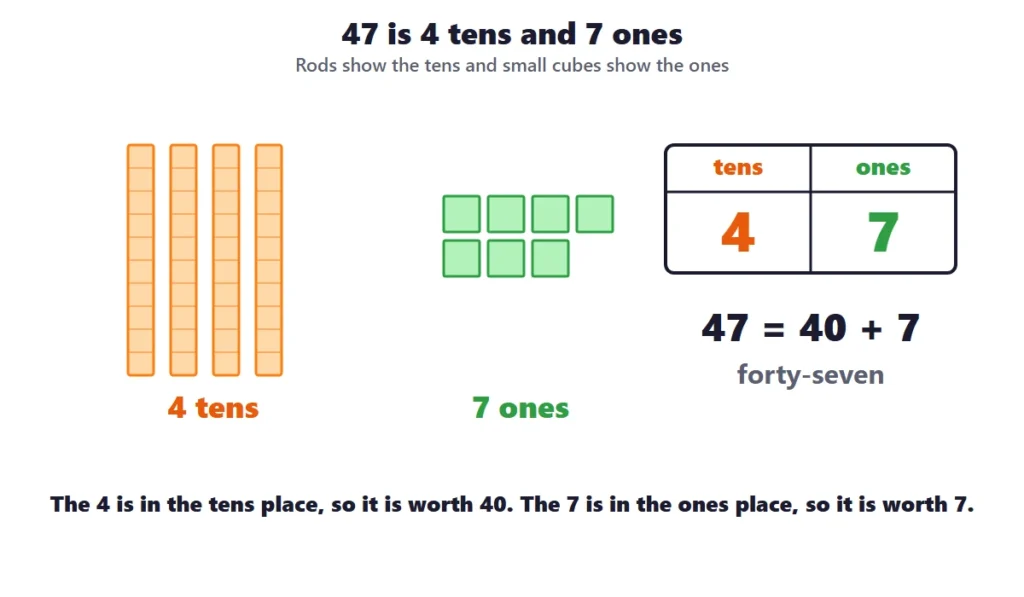
Tens and ones blocks. 47 is 4 tens and 7 ones.
Quick answer: Tens and ones are the two places of a two-digit number: 47 is 4 tens and 7 ones, or 40 + 7. This page has 7 free printable tens and ones worksheets with answer keys for grade 1: base-ten blocks, expanded form, the value of a digit and number names to 100. Updated October 2026.
About tens and ones
A two-digit number is a group of tens and some ones. 47 is 4 tens and 7 ones, or 40 + 7. Grade 1 children learn to see numbers this way (Common Core 1.NBT.B.2), which is the first step towards adding and subtracting with regrouping.
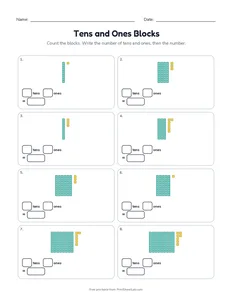
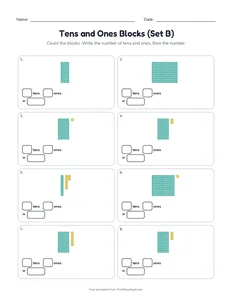
Base-ten blocks: count the rods (tens) and cubes (ones), then write the number.
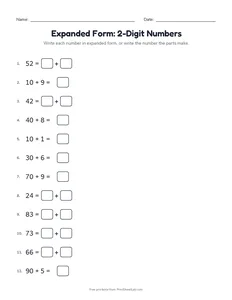
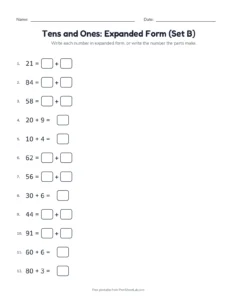
Expanded form: 63 = 60 + 3, and back again.
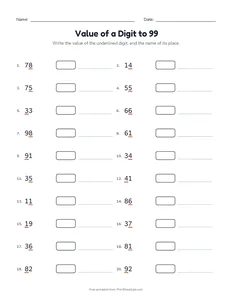
Value of a digit: in 58, the 5 is worth 50.
Number names: write the number for “sixty-four”.
Tens and ones worksheets: what is in the set
There are 7 tens and ones worksheets on this page, and every one has an answer key except for any cut-out games. Two sheets use base-ten blocks, two use expanded form, one is about the value of a digit, and two are about number names.
Worksheet
What children do
Standard
Tens and Ones Blocks
Count the rods and cubes and write the number.
1.NBT.B.2
Tens and Ones Blocks (Set B)
Eight more numbers to build from blocks.
1.NBT.B.2
Expanded Form: 2-Digit Numbers
Write each number as tens plus ones.
1.NBT.B.2
Value of a Digit to 99
Write the value and place of the underlined digit.
1.NBT.B.2
Tens and Ones: Expanded Form (Set B)
Write two-digit numbers in expanded form and back.
1.NBT.B.2
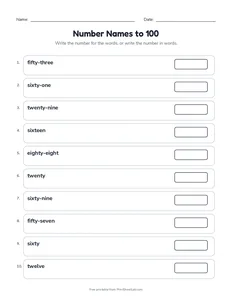
Number Names to 100
Write the number for each number name.
1.NBT.B.2
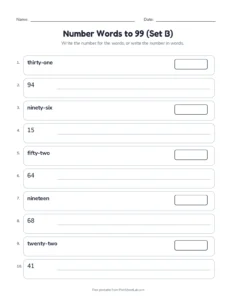
Number Words to 99 (Set B)
Write numbers as words and words as numbers.
1.NBT.B.2
Tens and ones worksheets: what the two places mean
The tens and ones worksheets teach that a two-digit number is a group of tens and some ones. The left digit tells how many tens there are, and the right digit tells how many ones. Wikipedia’s article on positional notation explains that this idea, in which a digit’s value depends on its place, is what makes our number system so useful. This table shows how the numbers from 11 to 19 are built from a ten and some ones, and how their names are made:
Number
In tens and ones
Name
About the name
11
1 ten and 1 one
eleven
eleven has no “one” or “ten” in the name
12
1 ten and 2 ones
twelve
twelve has no “two” in the name
13
1 ten and 3 ones
thirteen
thir- is a form of three
14
1 ten and 4 ones
fourteen
four + teen (ten more)
15
1 ten and 5 ones
fifteen
fif- is a form of five
16
1 ten and 6 ones
sixteen
six + teen
17
1 ten and 7 ones
seventeen
seven + teen
18
1 ten and 8 ones
eighteen
eigh- is a form of eight
19
1 ten and 9 ones
nineteen
nine + teen
The names from 11 to 19 are the hardest to read, since the sound of the ones comes before the sound of the ten. A good way to help is to build each number from a rod and cubes, and to say “1 ten and 3 ones is thirteen”. This table shows the numbers 20 to 90 and their names:
Number
Tens
Ones
Name
A number between
20
2
0
twenty
21 and 29
30
3
0
thirty
31 and 39
40
4
0
forty
41 and 49
50
5
0
fifty
51 and 59
60
6
0
sixty
61 and 69
70
7
0
seventy
71 and 79
80
8
0
eighty
81 and 89
90
9
0
ninety
91 and 99
Each of these has no ones, so the ones digit is a zero. The numbers between, such as 47, are named by the tens word and the ones word, as in forty-seven.
Base ten blocks tens and ones: building a number
Base ten blocks tens and ones are the first model of place value. A rod is one ten, and a cube is one one. Children build a number, count the rods, count the cubes, and write both. The base ten blocks tool lets them build a number on the screen. This table shows six numbers, with the pieces for each, and the number of pieces that cubes alone would need:
Number
Tens (rods)
Ones (cubes)
Pieces with rods and cubes
Pieces with cubes only
Pieces saved
14
1
4
5
14
9
23
2
3
5
23
18
47
4
7
11
47
36
58
5
8
13
58
45
86
8
6
14
86
72
99
9
9
18
99
81
Using rods saves many pieces. For 99 there are 9 rods and 9 cubes, which is 18 pieces, and 81 fewer than 99 cubes. That is the reason why we group in tens: it makes big numbers easy to see and to count.
Place value worksheets grade 1: tens and ones in many ways
For place value worksheets grade 1, the standard 1.NBT.B.2 asks children to understand that the two digits of a two-digit number stand for tens and ones. It also asks them to see 10 as a bundle of ten ones, and the numbers 10 to 90 as tens with no ones. A good activity is to build a number in different ways. This table shows the ways to build 47 with rods and cubes:
Tens
Ones
Total
How to say it
4
7
47
4 tens and 7 ones
3
17
47
3 tens and 17 ones
2
27
47
2 tens and 27 ones
1
37
47
1 ten and 37 ones
0
47
47
0 tens and 47 ones
The first row, 4 tens and 7 ones, is the normal way, and the other rows are regrouped ways. The same number can be shown with fewer tens and more ones, which is the idea behind regrouping in addition and subtraction. The 2-digit subtraction with regrouping page uses this idea.
2 digit place value: patterns in the numbers 10 to 99
When children study 2 digit place value, they can look for patterns in the 90 numbers from 10 to 99. This table counts some of them:
Two-digit numbers (10 to 99)
How many
Share
Examples
Tens digit bigger than the ones digit
45
50%
31, 52, 90
Tens digit smaller than the ones digit
36
40%
12, 47, 89
Both digits the same
9
10%
11, 44, 99
A zero in the ones place
9
10%
10, 40, 90
Digits that add up to 10
9
10%
19, 46, 91
In 45 of the 90 numbers the tens digit is bigger than the ones digit, and in 36 it is smaller. Only 9 numbers have two digits the same. These counts help to show that the order of the digits matters: 47 and 74 are different numbers, and so are 12 and 21.
Expanded form 2 digit: writing a number as tens plus ones
For expanded form 2 digit numbers, children write each digit with its value: 63 = 60 + 3. The first number is the tens, written as a multiple of ten, and the second is the ones. This table shows six numbers in expanded form, with their names:
Number
Tens
Ones
Expanded form
Name
47
4
7
40 + 7
forty-seven
63
6
3
60 + 3
sixty-three
58
5
8
50 + 8
fifty-eight
95
9
5
90 + 5
ninety-five
40
4
0
40
forty
72
7
2
70 + 2
seventy-two
A number such as 40 has no ones, so it is written 40 + 0, or simply 40. The sheet with expanded form also asks children to go the other way and to write the number that 60 + 3 makes. Say each number name aloud for the best learning, as the Common Core standards for grade 1 number and operations in base ten suggest.
Ten more, ten less: patterns of tens
When children know the tens, they can add or subtract ten in their heads. Ten more than 47 is 57, because the tens digit goes up by one and the ones digit stays the same. Standard 1.NBT.C.5 asks for this. This table shows six numbers with one more, one less, ten more and ten less:
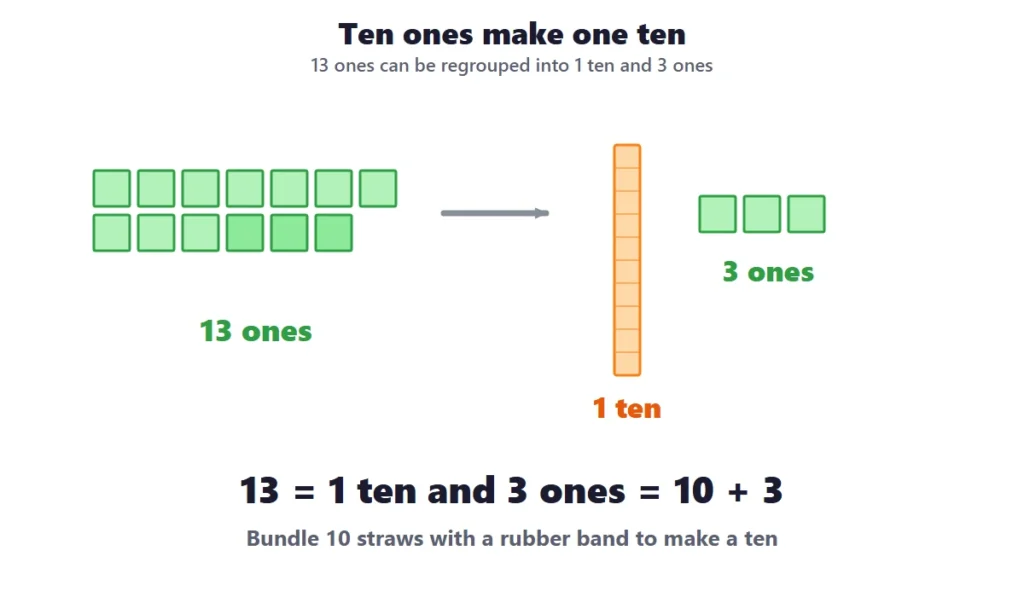
Regrouping. 13 ones make 1 ten and 3 ones.
Number
1 more
1 less
10 more
10 less
47
48
46
57
37
63
64
62
73
53
28
29
27
38
18
90
91
89
100
80
55
56
54
65
45
82
83
81
92
72
The ones digit does not change when ten is added or taken away, and only the tens digit changes. The hundreds charts page shows this as columns on a chart, since each column has the same ones digit, and the skip counting worksheets page practices counting by tens.
Comparing numbers by their tens and ones
The tens and ones are also the way to compare two-digit numbers. Compare the tens first. If they are different, the number with more tens is bigger. If they are the same, compare the ones. This table shows six pairs:
The most common mistake is to mix up the two places. This table shows five mistakes, what went wrong and the fix:
What the child writes or says
What went wrong
The fix
47 is 40 and 7 tens
mixes up the tens and the ones
47 is 4 tens and 7 ones, or 40 + 7
The 5 in 58 is worth 5
ignores the place of the digit
the 5 is in the tens place, so it is worth 50
40 + 7 = 407
puts the numbers side by side
40 + 7 = 47: the 7 goes in the ones place
The number after 29 is 210
forgets that ten ones make a ten
29 + 1 = 30: the ones are regrouped
thirteen is written 31
writes the digits in the order of the sounds
thirteen is 1 ten and 3 ones: 13
Tens and ones word problems
Tens and ones come up with boxes, bundles and packs. Ask children to say the number as tens and ones before they write it:
Word problem
Working
Answer
A box has 3 rods of ten blocks and 4 loose cubes. How many blocks are there?
30 + 4
34 blocks
There are 47 straws. How many bundles of ten can you make, and how many are left over?
47 = 4 tens and 7 ones
4 bundles and 7 straws
Mia has 5 tens and 8 ones. What is her number?
50 + 8
58
A number has 6 tens and 0 ones. What is it?
60 + 0
60
Ben has 63 stickers. How many tens and how many ones is that?
63 = 60 + 3
6 tens and 3 ones
A farmer packs eggs in boxes of ten. There are 95 eggs. How many full boxes are there?
95 = 9 tens and 5 ones
9 boxes
Games and activities for tens and ones
Children learn tens and ones best when they play with it. These games use things that are found at home or in a classroom:
Straw bundles: bundle 10 straws with rubber bands, and make 34 from 3 bundles and 4 straws
Rods and cubes: draw a number card, and build it with rods and cubes
Place value bingo: a bingo card with numbers, and calling cards that say tens and ones
Roll and build: roll two dice for the tens and the ones, and write the number
Ten more, ten less: say a number, and have a partner say ten more or ten less
Number detective: give clues: “my tens digit is 5 and my ones digit is 2 more”
Extra support and extra challenge with tens and ones
For children who need more support: use real straws, craft sticks or base-ten blocks, and make the number with the child. Always say “tens and ones”: for 47, say “4 tens and 7 ones”. Start with the numbers 11 to 19 and the tens 20, 30 and so on. Use the answer key to check, and let the child fix any block count.
For children who need more challenge: ask for the biggest number with 5 tens, for all the numbers whose digits add up to 10, and for the number that is 3 tens and 14 ones. Sorting a set of numbers by the number of tens, and then by the ones, is a good challenge.
How to tell that a child is ready to move on from tens and ones
Before moving on from tens and ones, check that the child can do all four of these things:
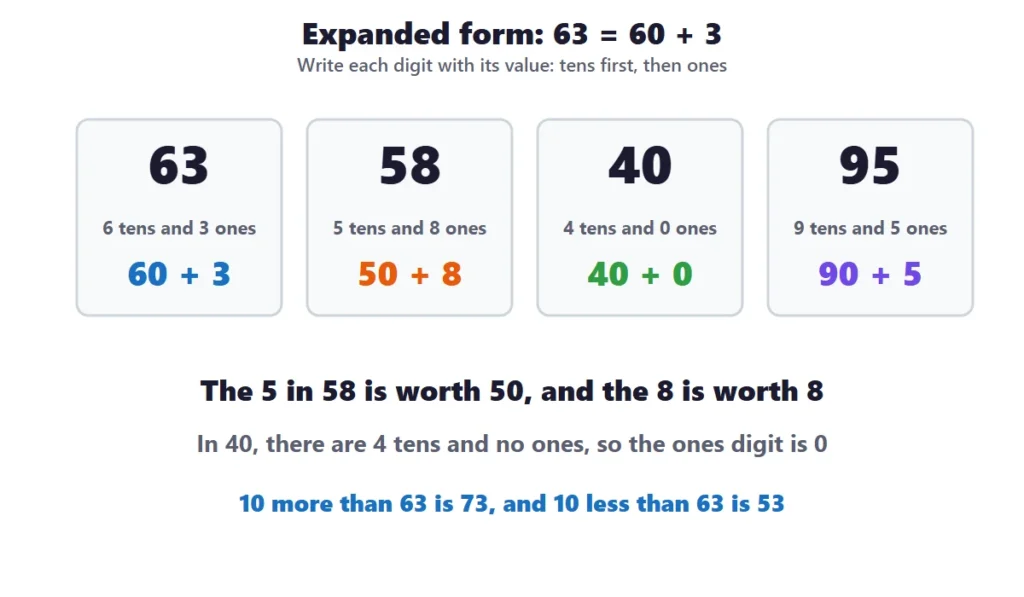
Expanded form. 63 = 60 + 3.
The child counts rods and cubes and writes the number.
The child writes a number in expanded form.
The child says the value of a digit, such as 50 for the 5 in 58.
The child writes the number for a number name, and the name for a number.
A short lesson is the best way to introduce tens and ones. This 20-minute plan can be used in a classroom, at a tutoring session or at home, and it uses the worksheets at the end:
Minutes
Activity
What to say or ask
0 to 3
Show 34 straws, and bundle them in tens
How many bundles? How many loose straws?
3 to 8
Build 34 with 3 rods and 4 cubes, and write it
Which digit is the tens?
8 to 13
Write 34 as 30 + 4
What is the value of the 3?
13 to 18
Build 47 in different ways with rods and cubes
How many ones can you have?
18 to 20
Start a worksheet and check one answer
Say it as tens and ones.
Where tens and ones fits across the grades
No skill stands alone. This table shows what children learn before and after tens and ones, with the standard that goes with each step:
This page is the start of the place value sequence. The whole sequence is on the place value worksheets page.
Helping at home with tens and ones
Parents do not need to be experts to help with tens and ones. These suggestions work well, and each takes only a few minutes:
Bundle straws or craft sticks into tens at home.
Ask “how many tens and ones?” when you see a number on a sign.
Count by tens with the child on a hundreds chart.
Use coins: dimes are tens and pennies are ones.
Check the answers with the answer key, and ask the child to explain one.
How to check progress in tens and ones
A teacher or parent can check progress in tens and ones with the answer key and a few questions. This table shows three common situations, what they mean and what to do next:
What you see
What it means
What to do next
The child mixes up the tens and the ones
The places are not yet linked to the digits
Use rods and cubes, and say “tens and ones” aloud
The child gets 9 of 10 right in every set
Tens and ones are secure
Move on to hundreds, tens and ones
The child cannot name the teen numbers
The names of 11 to 19 are irregular
Build each number with a rod and cubes and say the name
A five-day plan for tens and ones
Most children need about a week of short sessions for tens and ones. This plan follows the order of the worksheets on this page:
Day
What to do
Practice
Day 1
Make bundles of ten with straws, and count the tens and the ones
Tens and ones worksheet PDFs, sheets and printables
People search for this page as a tens and ones worksheet, a tens ones worksheet, a tens and ones sheet, tens and ones printables or tens and ones worksheets pdf. All are the same: seven free PDFs in this set, each with an answer key on the last page. Choose a sheet, pick US Letter or A4 and print or save it. No account is needed. Start with the base-ten blocks sheet if your child is new to the idea, and use the expanded form sheet once they can say how many tens and ones are in a number.
Adding tens and ones worksheets
Adding tens and ones worksheets, also called adding with tens and ones, are the next step after naming the places. A first grader adds a two-digit number and a multiple of ten by adding the tens, and the standard asks children to do this within 100 (1.NBT.C.4). Tens and ones addition works because the places are separate: the tens never change the ones. Here are six examples with no regrouping:
Problem
Add the tens
Add the ones
Total
34 + 25
30 + 20 = 50
4 + 5 = 9
59
47 + 32
40 + 30 = 70
7 + 2 = 9
79
56 + 41
50 + 40 = 90
6 + 1 = 7
97
63 + 24
60 + 20 = 80
3 + 4 = 7
87
72 + 15
70 + 10 = 80
2 + 5 = 7
87
58 + 31
50 + 30 = 80
8 + 1 = 9
89
Once children are comfortable, they can try problems where the ones add up to 10 or more, which is where regrouping starts in grade 2. Our addition worksheets have sets for both stages, and a tens and ones addition page is a good warm-up for them.
Tens and ones manipulatives and interactive tools
Tens and ones manipulatives let children build a number before they write it. You can use bundles of ten sticks and loose ones, linking cubes in towers of ten, or printed base-ten blocks. Our base ten blocks tool is a free tens and ones interactive: click to add a rod (ten) or a cube (one) and see the number change. Use it after the worksheet to check answers, and practice counting by ones and tens on a hundreds chart (see the hundreds chart page for a counting by ones and tens worksheet and interactive chart).
Frequently asked questions
7 quick answers
How do you explain tens and ones?
Bundle 10 straws with a rubber band to make one ten. 34 straws are 3 bundles and 4 loose straws: 3 tens and 4 ones.
Is 40 + 7 the same as 47?
Yes. Writing 47 as 40 + 7 is called expanded form, and it shows the value of each digit.
How do you teach tens and ones to a first grader?
Start with real bundles: make a ten from 10 straws, and show that 34 is 3 bundles and 4 loose straws. Then use rods and cubes, and write the digits. Always say “3 tens and 4 ones”.
What is expanded form for a two-digit number?
Expanded form shows the value of each digit. For 63, it is 60 + 3, because the 6 is in the tens place and the 3 is in the ones place.
Why are the teen numbers hard?
Their names do not follow the pattern of the other numbers. Eleven and twelve are irregular, and in thirteen to nineteen the ones sound comes before the ten sound. Building each with a rod and cubes helps.
Where can I download free tens and ones worksheets?
Open any worksheet above, choose US Letter or A4, and print or save the PDF. All seven sheets are free and have an answer key.
How do you add tens and ones?
Add the tens to the tens and the ones to the ones. For 34 + 25, 30 + 20 = 50 and 4 + 5 = 9, so the total is 59.