Change the numbers, layout and number of problems, then download a new PDF with its answer key.
Multiplication arrays and equal groups are the two pictures that show what multiplication means. An array puts objects in rows and columns, and equal groups put the same number of objects in each of several groups. The six PDFs on this page have arrays, equal groups, skip counting lines and story problems, and every sheet has an answer key. They follow standards 2.OA.C.4 and 3.OA.A.1 of the Common Core standards for grade 2 operations and algebraic thinking, and the notes below show how the pictures, repeated addition and skip counting all lead to the same product.
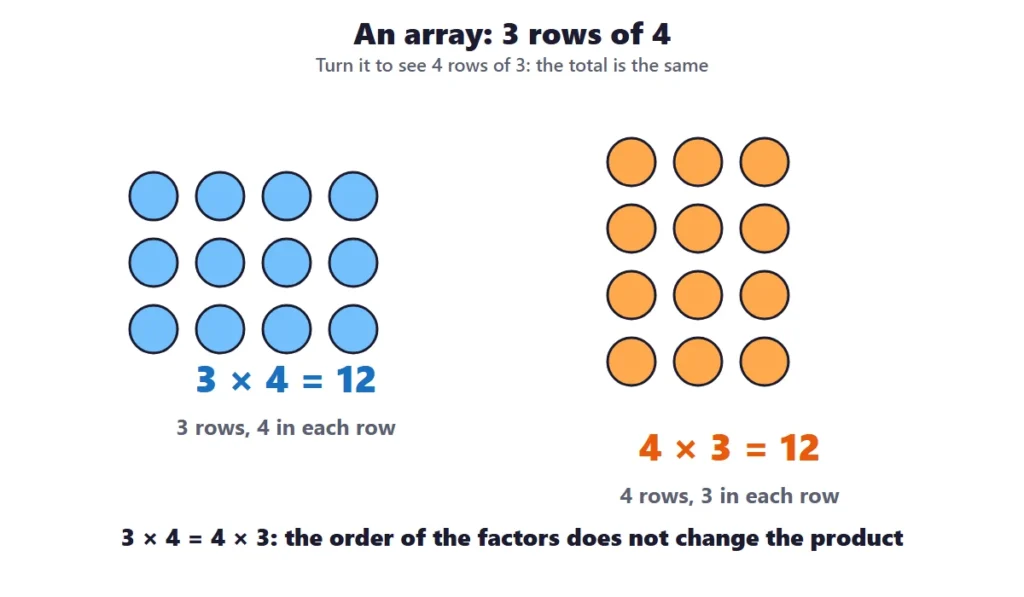
An array. 3 rows of 4 and 4 rows of 3.
Quick answer: Multiplication arrays and equal groups are the two pictures of multiplication: an array shows rows and columns, and equal groups show the same number of things in each group, as in 3 groups of 4 = 12. This page has 6 free printable worksheets with answer keys for grades 2 and 3. Updated October 2026.
What multiplication means
Multiplication is a quick way to count equal groups. Three bags with four apples in each bag is 4 + 4 + 4, which is 3 × 4 = 12. Before children memorize times tables, they need to see this idea, and these worksheets show it three ways.
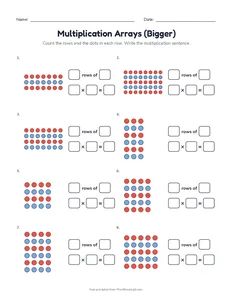
Arrays: dots in rows and columns. 3 rows of 4 dots is 3 × 4. Turning the page sideways shows 4 rows of 3, the same total, which is why 3 × 4 = 4 × 3.
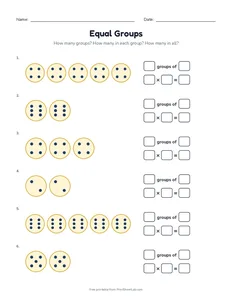
Equal groups: circles with the same number of dots inside. Children write how many groups, how many in each, and the total.
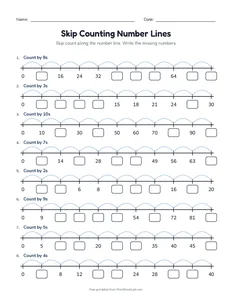
Skip counting: hopping along a number line by 2s, 3s, 5s or 10s builds the times tables before children learn them as facts.
A good order
Start with equal groups, where the groups are easy to see.
Move to arrays, which lead to the area model used later for bigger numbers.
Use skip counting lines to connect counting with multiplication facts.
Finish with story problems about bags, rows and packs.
Multiplication arrays and equal groups worksheets: what is in the set
There are 6 multiplication arrays and equal groups worksheets on this page, and every one has an answer key except for any cut-out games. Two sheets are arrays, two are equal groups, one is skip counting number lines, and one is story problems.
Worksheet
What children do
Standard
Multiplication Arrays
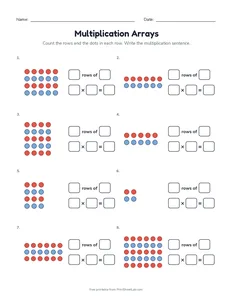
Count the rows and columns of dots and write the multiplication sentence.
3.OA.A.1
Multiplication Arrays (Bigger)
Arrays with up to 6 rows and 8 columns.
3.OA.A.1
Equal Groups
How many groups, how many in each, how many in all?.
3.OA.A.1
Equal Groups (Set B)
Six more equal-group pictures to write as multiplication.
3.OA.A.1
Skip Counting Number Lines
Count by 2s to 10s and fill in the missing numbers.
3.OA.A.1
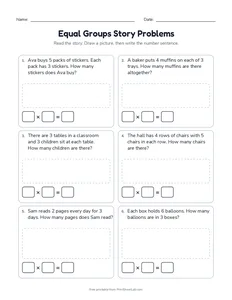
Equal Groups Story Problems
Six stories about bags, rows and packs.
3.OA.A.1
Multiplication arrays and equal groups: what multiplication means
Multiplication is a quick way to count equal groups. Three bags with four apples in each bag make 4 + 4 + 4, which is written 3 × 4 = 12. Wikipedia’s article on multiplication explains that this is the oldest meaning of the idea. Before children learn the times tables, they need to see that the first number is the number of groups and the second is the size of each group. This table shows six pictures and how they are written:
Equal groups
Repeated addition
Multiplication sentence
Total
Say it as
3 groups of 4
4 + 4 + 4
3 × 4
12
3 times 4 is 12
4 groups of 5
5 + 5 + 5 + 5
4 × 5
20
4 times 5 is 20
2 groups of 8
8 + 8
2 × 8
16
2 times 8 is 16
5 groups of 6
6 + 6 + 6 + 6 + 6
5 × 6
30
5 times 6 is 30
6 groups of 3
3 + 3 + 3 + 3 + 3 + 3
6 × 3
18
6 times 3 is 18
7 groups of 2
2 + 2 + 2 + 2 + 2 + 2 + 2
7 × 2
14
7 times 2 is 14
Every row of the table can be read in four ways: a picture, a repeated addition, a multiplication sentence and a sentence in words. The worksheets on this page ask children to move between the four.
Multiplication arrays worksheets: all the arrays for a total
The multiplication arrays worksheets show dots in rows and columns, and children write the multiplication sentence. An array is a good picture because both factors can be seen: the number of rows and the number in each row. The same total can usually be made into several different arrays. This table shows the arrays for seven totals:
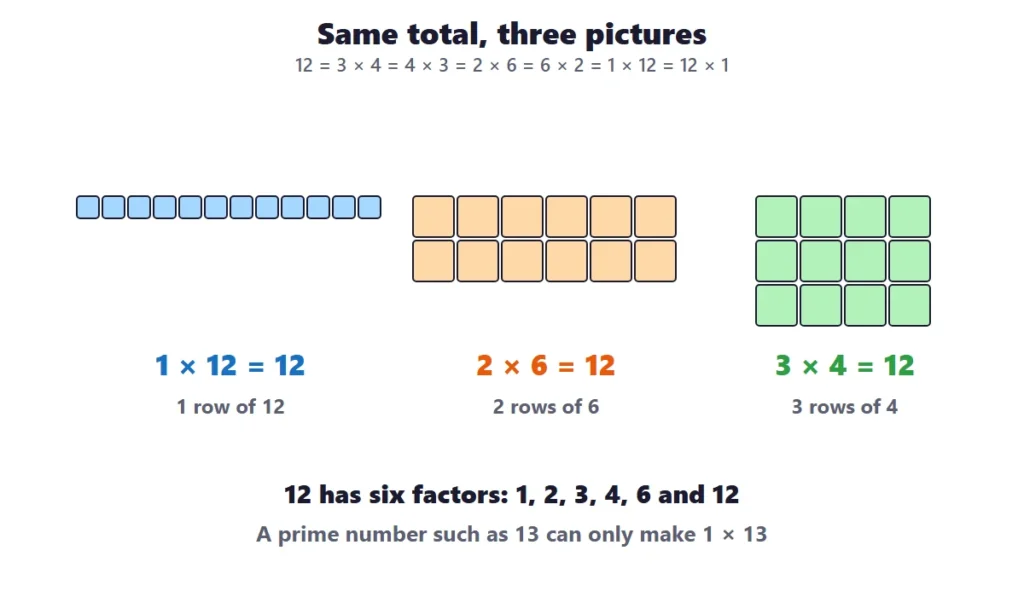
The number 12 has six factors and so can make six arrays, or three if an array and its turned copy are counted as one. A prime number such as 13 can only make one array, a single row. A square number such as 16 has one array that is the same when it is turned. The area and perimeter worksheets page uses arrays in the form of rectangles on a grid.
Equal groups worksheets: groups, size and total
The equal groups worksheets show circles with the same number of dots inside, and children write how many groups there are, how many dots in each, and how many in all. This is the idea that the multiplication and division word problems page uses in stories. This table shows eight examples, with the repeated addition and the number of additions it needs:
Number of groups
In each group
Total
Repeated addition
Number of additions needed
2
6
12
6 + 6
1
3
5
15
5 + 5 + 5
2
4
4
16
4 + 4 + 4 + 4
3
5
3
15
3 + 3 + 3 + 3 + 3
4
6
2
12
2 + 2 + 2 + 2 + 2 + 2
5
8
3
24
3 + 3 + 3 + …
7
10
4
40
4 + 4 + 4 + …
9
9
5
45
5 + 5 + 5 + …
8
Each row shows that the total is the number of groups times the size of a group. The last column shows that the more groups there are, the more additions are needed, which is why multiplication is useful.
Repeated addition worksheets: from adding to multiplying
The repeated addition worksheets are a bridge from addition to multiplication. Adding the same number again and again is slow, and children soon see that a multiplication sentence says the same thing in a short way. This table shows how groups of 5 grow:
Groups of 5
Repeated addition
Additions
Multiplication
Total
2
5 + 5
1
2 × 5
10
3
5 + 5 + 5
2
3 × 5
15
4
5 + 5 + 5 + 5
3
4 × 5
20
6
5 + 5 + 5 + 5 + 5 + 5
5
6 × 5
30
8
5 + 5 + … (8 fives)
7
8 × 5
40
10
5 + 5 + … (10 fives)
9
10 × 5
50
Ten groups of 5 need nine additions, but only one multiplication. The standard 2.OA.C.4 asks grade 2 children to write an equation that expresses the total of an array as a sum of equal addends, and it is the first step toward 3.OA.A.1, where they write the product.
Skip counting worksheets: counting by 2s to 10s
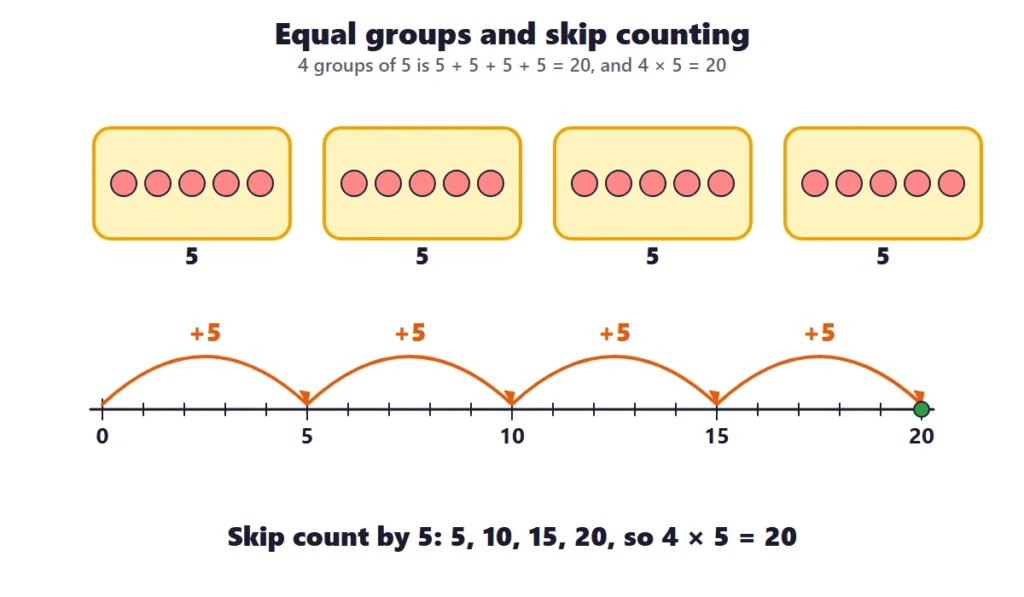
The skip counting worksheets use number lines on which children hop in equal steps. Hopping by 3 four times lands on 12, so 4 groups of 3 is 12. The numbers that are landed on are the multiples. This table shows the first ten multiples of each number from 2 to 10, with the last digits that they use:
Skip counting. 4 groups of 5.
Count by
The first ten numbers
Last digits
Fact
2
2, 4, 6, 8, 10, 12, 14, 16, 18, 20
0, 2, 4, 6, 8
10 × 2 = 20
3
3, 6, 9, 12, 15, 18, 21, 24, 27, 30
0, 1, 2, 3, 4, 5, 6, 7, 8, 9
10 × 3 = 30
4
4, 8, 12, 16, 20, 24, 28, 32, 36, 40
0, 2, 4, 6, 8
10 × 4 = 40
5
5, 10, 15, 20, 25, 30, 35, 40, 45, 50
0, 5
10 × 5 = 50
6
6, 12, 18, 24, 30, 36, 42, 48, 54, 60
0, 2, 4, 6, 8
10 × 6 = 60
7
7, 14, 21, 28, 35, 42, 49, 56, 63, 70
0, 1, 2, 3, 4, 5, 6, 7, 8, 9
10 × 7 = 70
8
8, 16, 24, 32, 40, 48, 56, 64, 72, 80
0, 2, 4, 6, 8
10 × 8 = 80
9
9, 18, 27, 36, 45, 54, 63, 72, 81, 90
0, 1, 2, 3, 4, 5, 6, 7, 8, 9
10 × 9 = 90
10
10, 20, 30, 40, 50, 60, 70, 80, 90, 100
0
10 × 10 = 100
The multiples of 5 end in 0 or 5, the multiples of 2 are all even, and the multiples of 10 all end in 0. Spotting these patterns helps children to check their counting. The skip counting worksheets page has more number lines, and the times tables worksheets page has the facts.
Introduction to multiplication: the order rule
An introduction to multiplication is incomplete without the order rule, which is the idea that 3 × 8 and 8 × 3 have the same answer. This is easy to see with an array: turn it on its side, and the rows become columns. Wikipedia’s article on the commutative property gives the general rule. This table shows six arrays and their turned copies:
Array
Turn it
Same total?
Both facts
3 rows of 8
8 rows of 3
yes: 24
3 × 8 = 8 × 3 = 24
4 rows of 7
7 rows of 4
yes: 28
4 × 7 = 7 × 4 = 28
5 rows of 9
9 rows of 5
yes: 45
5 × 9 = 9 × 5 = 45
6 rows of 7
7 rows of 6
yes: 42
6 × 7 = 7 × 6 = 42
2 rows of 9
9 rows of 2
yes: 18
2 × 9 = 9 × 2 = 18
8 rows of 6
6 rows of 8
yes: 48
8 × 6 = 6 × 8 = 48
The order rule halves the number of facts that children have to learn. This table shows how many facts there are in three parts of the times table, and how many are different once the rule is used:
Times table
Facts
Different facts when the order rule is used
Facts saved
1 to 10
100
55
45
2 to 9
64
36
28
1 to 5
25
15
10
Common mistakes with multiplication arrays and equal groups
The most common mistake is to add the two numbers. This table shows five mistakes, what went wrong and the fix:
What the child writes or says
What went wrong
The fix
3 groups of 4 is 3 + 4 = 7
adds the number of groups and the size of a group
add the group size as many times as there are groups: 4 + 4 + 4 = 12
An array with 3 rows of 4 has 3 + 4 dots
counts the rows and columns, not the dots
count the dots, or multiply: 3 × 4 = 12
The groups are different sizes, so the answer is 12
does not check that the groups are equal
only equal groups can be written as a multiplication
3 × 4 and 4 × 3 are different answers
does not see the array turned
turn the array: the total stays 12
Skip counts by 3 but starts at 3 for 0 groups
miscounts the hops
count the hops, not the numbers: 4 hops of 3 land on 12
Multiplication arrays and equal groups word problems
Equal groups and arrays come up in cookies, flowers and eggs. Ask children to draw the groups or the array, and to write the multiplication sentence:
Word problem
Working
Answer
There are 3 plates with 4 cookies on each plate. How many cookies are there?
3 × 4
12 cookies
A garden has 5 rows of 6 flowers. How many flowers are there?
5 × 6
30 flowers
There are 4 bags with 5 apples in each bag. How many apples?
4 × 5
20 apples
Mia puts 2 shoes in each of 8 boxes. How many shoes is that?
8 × 2
16 shoes
A box of eggs has 2 rows of 6. How many eggs are in 3 boxes?
2 × 6 × 3
36 eggs
A pack has 7 stickers on each of 3 sheets. How many stickers are there?
3 × 7
21 stickers
Games and activities for multiplication arrays and equal groups
Children learn multiplication arrays and equal groups best when they play with it. These games use things that are found at home or in a classroom:
Make an array: use 24 counters to make as many different arrays as possible
Egg carton arrays: find the array in an egg carton, a muffin tray or a window
Group it: roll a die for the number of groups and another for the size, and draw the groups
Hop and count: hop along a number line on the floor by 2s, 3s, 5s and 10s
Turn it: make an array with cubes, and turn it to show that the order does not matter
Multiplication bingo: a bingo card with products, and calling cards with arrays
Extra support and extra challenge with multiplication arrays and equal groups
For children who need more support: use real objects, such as counters in plates. Make the groups with the child, and write the repeated addition before the multiplication sentence. Start with groups of 2, 5 and 10, which are easy to skip count, and use the answer key to check each picture.
For children who need more challenge: ask for all the arrays that make 24, for a story that fits 6 × 4 and 4 × 6, and for the missing number in ☐ × 5 = 30. Finding the totals that have only one array is a good challenge, and so is the skip counting of 7s and 9s.
How to tell that a child is ready to move on from multiplication arrays and equal groups
Before moving on from multiplication arrays and equal groups, check that the child can do all four of these things:
Arrays for 12. Three arrays, one total.
The child makes equal groups and writes the repeated addition.
The child writes a multiplication sentence for an array.
The child skip counts by 2s, 3s, 5s and 10s.
The child knows that 3 × 4 and 4 × 3 have the same answer.
A 20-minute lesson on multiplication arrays and equal groups
A short lesson is the best way to introduce multiplication arrays and equal groups. This 20-minute plan can be used in a classroom, at a tutoring session or at home, and it uses the worksheets at the end:
Minutes
Activity
What to say or ask
0 to 3
Show 3 plates with 4 cookies on each
How many groups? How many in each?
3 to 8
Write 4 + 4 + 4 and then 3 × 4
How are the two the same?
8 to 13
Make the array of 3 rows of 4, and turn it
How many now? What has changed?
13 to 18
Skip count by 4 on a number line
Where do we land after 3 hops?
18 to 20
Start a worksheet and check one answer
Check by drawing.
Where multiplication arrays and equal groups fits across the grades
No skill stands alone. This table shows what children learn before and after multiplication arrays and equal groups, with the standard that goes with each step:
Grade
What children do
Standard or page
Grade 2
Arrays with up to 5 rows and 5 columns, and repeated addition
This page is the first of the multiplication pages. The whole sequence is on the multiplication worksheets page.
Helping at home with multiplication arrays and equal groups
Parents do not need to be experts to help with multiplication arrays and equal groups. These suggestions work well, and each takes only a few minutes:
Find multiplication arrays and equal groups at home: an egg carton, a muffin tray, a chocolate bar.
Put equal groups on the table and ask “how many in all?”.
Skip count by 2s, 5s and 10s on the stairs.
Ask the child to turn an array and say what is the same.
Use the answer key to check the pictures, and not only the numbers.
How to check progress in multiplication arrays and equal groups
A teacher or parent can check progress in multiplication arrays and equal groups with the answer key and a few questions. This table shows three common situations, what they mean and what to do next:
What you see
What it means
What to do next
The child adds the two numbers in a multiplication
The idea of equal groups is not yet clear
Draw the groups and write the repeated addition first
The child gets 9 of 10 right in every set
Multiplication arrays and equal groups are secure
Move on to the times tables
The child counts the dots one by one
The child does not yet see the groups
Cover the rows and ask “how many in each row?”
A five-day plan for multiplication arrays and equal groups
Most children need about a week of short sessions for multiplication arrays and equal groups. This plan follows the order of the worksheets on this page:
Day
What to do
Practice
Day 1
Make equal groups with counters, and write the repeated addition
Equal Groups
Day 2
Make arrays with cubes, and write the multiplication sentence
Multiplication Arrays
Day 3
Bigger arrays with up to 6 rows and 8 columns
Multiplication Arrays (Bigger)
Day 4
Skip count on number lines, and fill in the missing numbers
Skip counting is repeated addition in a row, so it is the bridge from equal groups to the times tables. This page is also searched as skip counting worksheets, free skip counting worksheets, skip counting sheets, skip counting sheet, skip counting practice, skip counting by 3 worksheet and skip counting worksheets 2nd grade. The table below is a skip counting chart printable for the five most used steps; copy it, or open our skip counting worksheets for more:
Skip count by
First ten numbers
2
2, 4, 6, 8, 10, 12, 14, 16, 18, 20
3
3, 6, 9, 12, 15, 18, 21, 24, 27, 30
4
4, 8, 12, 16, 20, 24, 28, 32, 36, 40
5
5, 10, 15, 20, 25, 30, 35, 40, 45, 50
10
10, 20, 30, 40, 50, 60, 70, 80, 90, 100
Children can use this printable skip counting chart as a first multiplication table: the third number in the skip counting by 3 chart row is 3 × 3 = 9. Practice with the skip counting by twos worksheet, the skip counting by 3 worksheet and the 4 skip counting row, then try the arrays on this page.
Frequently asked questions
8 quick answers
What is an array in multiplication?
An array is a set of objects arranged in equal rows. The number of rows times the number in each row gives the total.
When do children start multiplication?
Grade 2 children work with arrays and repeated addition (2.OA.C.4). Grade 3 children learn that multiplication means equal groups (3.OA.A.1) and start learning the facts.
Is multiplication the same as repeated addition?
For whole numbers, yes: 4 × 5 means 5 + 5 + 5 + 5. Arrays and equal groups show this and also make the order rule (4 × 5 = 5 × 4) easy to see.
What is the difference between an array and equal groups?
In an array the objects are in rows and columns, so the rows are the equal groups. In equal groups the objects are in separate groups, such as plates or bags. Both show multiplication, and both are used on these worksheets.
Why do children learn multiplication as repeated addition first?
It connects the new idea to something they know. 4 groups of 5 is 5 + 5 + 5 + 5, so they can solve a multiplication by adding. Once they see the pattern, they replace the adding with the times tables.
Does the order matter in multiplication?
No. 3 × 4 = 4 × 3. An array of 3 rows of 4 turns into 4 rows of 3, and the total stays 12. The order rule means children only need to learn about half of the facts.
How long do multiplication arrays and equal groups take to learn?
Most children need two or three weeks of short sessions to be comfortable with multiplication arrays and equal groups, as long as they use real objects first. The sheets on this page go from groups and arrays to skip counting and stories, so they can be done in any order.
Where can I download free skip counting worksheets?
Open any worksheet on this page or the skip counting worksheets page, choose US Letter or A4, then print or save the PDF. They are free.