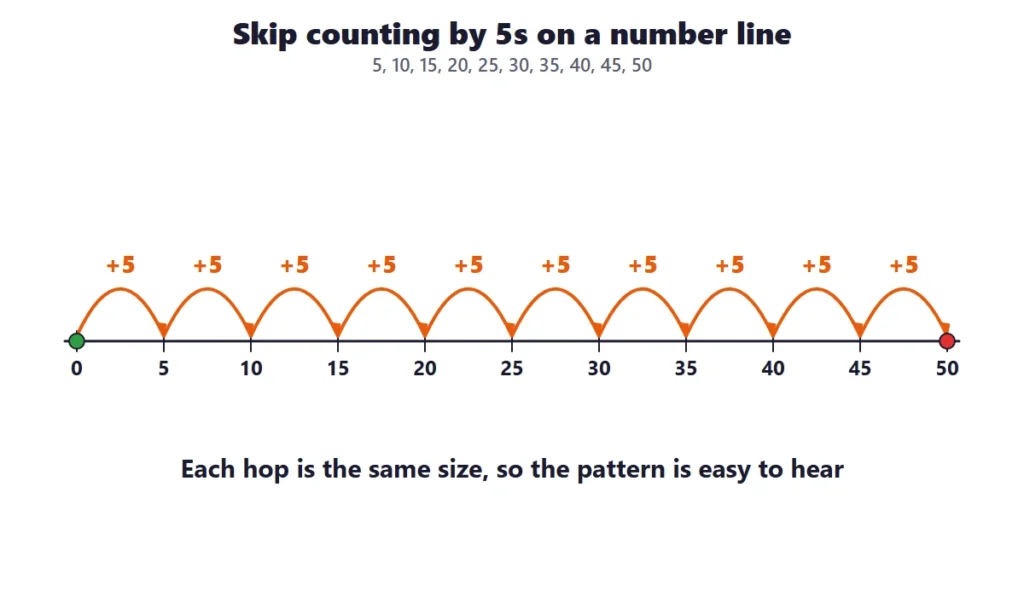
Skip counting means counting forward by the same amount each time: 5, 10, 15, 20. It is faster than counting by ones, it shows patterns in numbers, and it is the first step towards the times tables: counting by 5s five times lands on 25, which is 5 × 5.
What is on this page
Counting by 2s, 5s and 10s in number sequences with gaps.
Counting by 10s from any number, like 23, 33, 43, which shows that only the tens digit changes.
Counting by 100s within 1,000 (Common Core 2.NBT.A.2).
Counting back by 2s, 5s and 10s.
Hundreds charts to color: shading every 2nd, 5th or 10th number shows the pattern.
Number lines with hops of the same size.
Skip counting worksheets: what is in the set
There are 8 skip counting worksheets on this page, and every one has an answer key except for any cut-out games. The sequences go from 2s, 5s and 10s to 100s, then backwards, and the last sets use number lines and hundreds charts to show the patterns.
Worksheet
What children do
Standard
Skip Counting by 2s, 5s and 10s
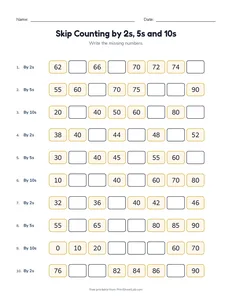
Ten sequences to complete, counting by 2s, 5s and 10s.
2.NBT.A.2
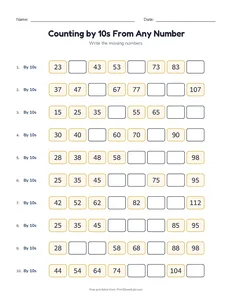
Counting by 10s From Any Number
Sequences like 23, 33, 43: only the tens digit changes.
2.NBT.A.2
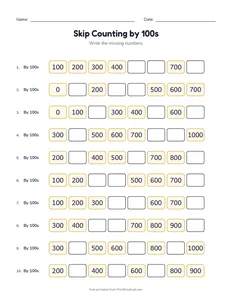
Skip Counting by 100s
Count by 100s within 1,000.
2.NBT.A.2
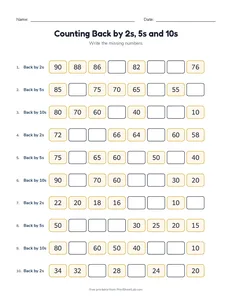
Counting Back by 2s, 5s and 10s
Count backwards by 2s, 5s and 10s.
2.NBT.A.2
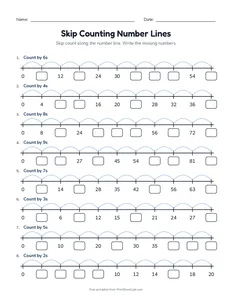
Skip Counting Number Lines
Hop along number lines by 2s up to 10s.
2.NBT.A.2
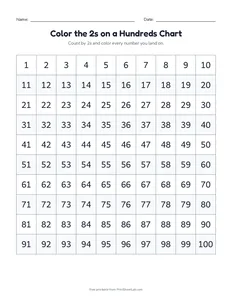
Color the 2s on a Hundreds Chart
Count by 2s and color each number you land on.
2.NBT.A.2
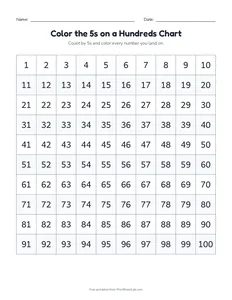
Color the 5s on a Hundreds Chart
Count by 5s and color each number you land on.
2.NBT.A.2
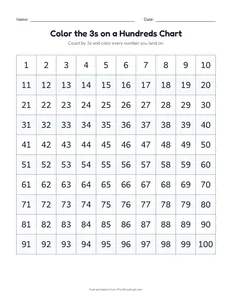
Color the 3s on a Hundreds Chart
Count by 3s and color the pattern.
2.NBT.A.2
Skip counting: the sequences children learn
When children are doing skip counting, they count forward by the same amount each time. This table shows the six steps that children learn, with the first numbers of each sequence and the number of hops from 0 to 100:
Count by
The first numbers
Numbers to 100
Hops
2
2, 4, 6, 8, 10, 12, 14, 16, …
50
about 50 hops from 0 to 100
3
3, 6, 9, 12, 15, 18, 21, 24, …
33
about 33 hops from 0 to 100
4
4, 8, 12, 16, 20, 24, 28, 32, …
25
about 25 hops from 0 to 100
5
5, 10, 15, 20, 25, 30, 35, 40, …
20
about 20 hops from 0 to 100
10
10, 20, 30, 40, 50, 60, 70, 80, …
10
about 10 hops from 0 to 100
100
100, 200, 300, 400, 500, 600, 700, 800, …, 1,000
10 (to 1,000)
10 hops from 0 to 1,000
Counting by 2s takes 50 hops to 100, and counting by 10s takes only 10, which is why 10s are learned first. Grade 2 children skip count by 5s, 10s and 100s within 1,000 (2.NBT.A.2), as described by the Common Core standards for grade 2 number and operations in base ten.
Skip counting by 2s 5s and 10s: patterns in the ones digit
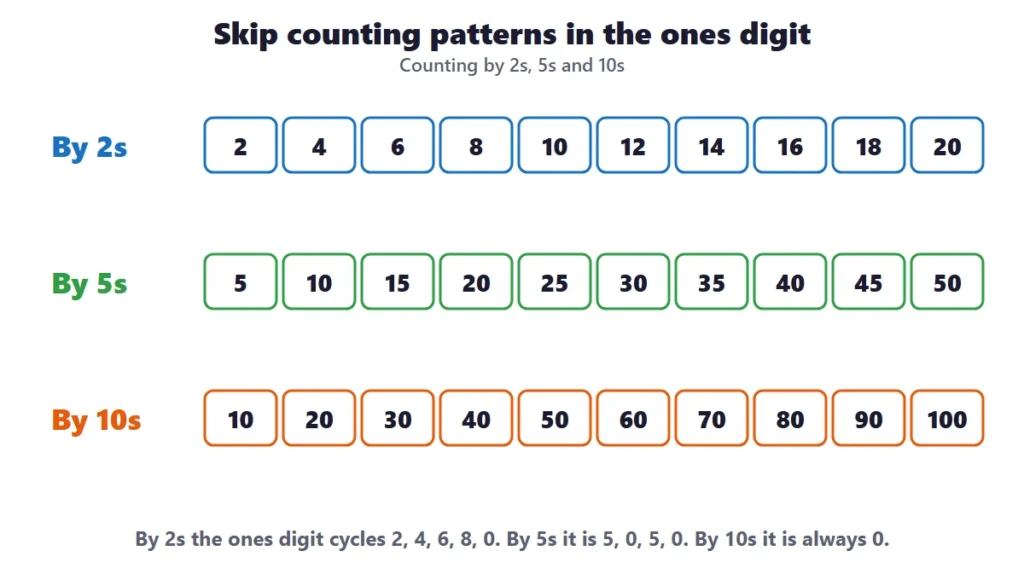
Skip counting by 2s 5s and 10s is easy to learn because the ones digit follows a pattern. The table shows the ones digits of the first ten numbers in each count. A child who knows the pattern can check a sequence without counting:
Count by
Ones digits of the first ten numbers
The pattern repeats every
2
2, 4, 6, 8, 0, 2, 4, 6, 8, 0
5 steps
3
3, 6, 9, 2, 5, 8, 1, 4, 7, 0
10 steps
4
4, 8, 2, 6, 0, 4, 8, 2, 6, 0
5 steps
5
5, 0, 5, 0, 5, 0, 5, 0, 5, 0
2 steps
10
0, 0, 0, 0, 0, 0, 0, 0, 0, 0
1 step
The 5s alternate between 5 and 0, the 10s are always 0, and the 2s repeat 2, 4, 6, 8, 0. Counting by 3s and 4s has longer patterns, and the 3s use every digit before they repeat.
Counting by 5s worksheet: from hops to multiplication
A counting by 5s worksheet is a first look at multiplication. Counting by 5s four times lands on 20, which is 4 × 5. Each hop is one group, and the landing number is the product:
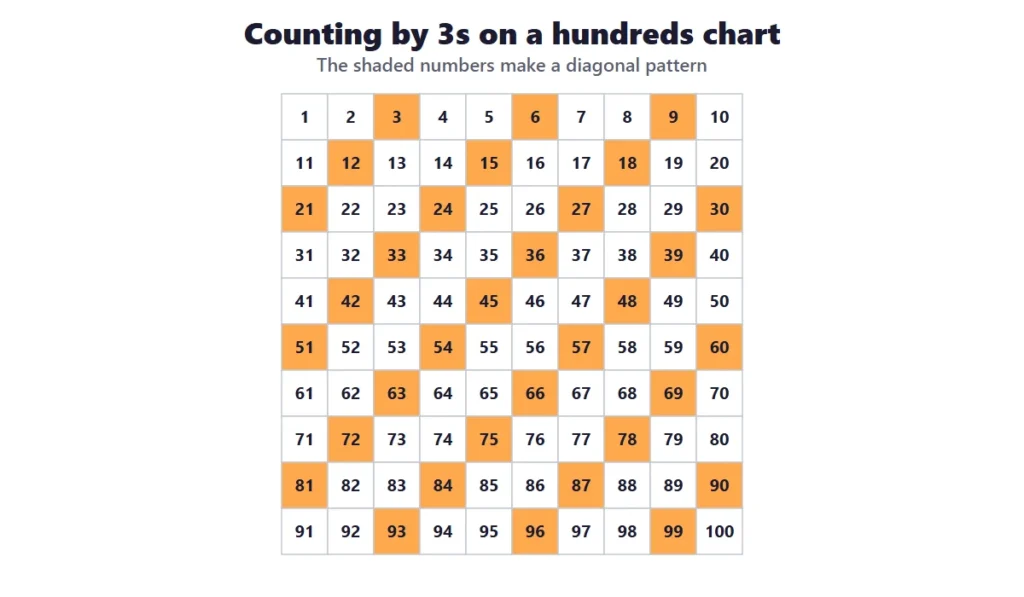
Hundreds chart. Counting by 3s.
Skip count
Number of hops
Where you land
Multiplication fact
by 5s
3
15
3 × 5 = 15
by 5s
4
20
4 × 5 = 20
by 5s
6
30
6 × 5 = 30
by 5s
8
40
8 × 5 = 40
by 5s
10
50
10 × 5 = 50
by 3s
4
12
4 × 3 = 12
by 2s
7
14
7 × 2 = 14
This is why skip counting is a good start for the times tables worksheets. A child who can count by 5s, 2s and 10s has already learned most of three times tables.
Counting by 10s worksheet: starting from any number
A counting by 10s worksheet that starts from a number such as 23 shows that adding 10 changes only the tens digit. This is a key idea of place value, and it makes mental addition faster. Here are five sequences:
Count by 10s from
The sequence
What changes
3
3, 13, 23, 33, 43
only the tens digit goes up by 1
23
23, 33, 43, 53, 63
only the tens digit goes up by 1
47
47, 57, 67, 77, 87
only the tens digit goes up by 1
68
68, 78, 88, 98, 108
only the tens digit goes up by 1
91
91, 101, 111, 121, 131
only the tens digit goes up by 1
Skip counting by 100s
Skip counting by 100s works the same way: only the hundreds digit changes. It extends place value to 1,000 and is used for rounding and for adding hundreds:
Count by 100s from
The sequence
What changes
0
0, 100, 200, 300, 400, 500
only the hundreds digit goes up by 1
100
100, 200, 300, 400, 500, 600
only the hundreds digit goes up by 1
237
237, 337, 437, 537, 637, 737
only the hundreds digit goes up by 1
450
450, 550, 650, 750, 850, 950
only the hundreds digit goes up by 1
Skip counting on a hundreds chart
When children color the numbers they land on, skip counting makes a pattern on the chart. The three coloring worksheets on this page show the 2s, 5s and 3s. This table shows how many numbers are shaded and what the pattern looks like:
Count by
Numbers shaded on a hundreds chart
Shape of the pattern
2
50
every second square, in stripes down the columns
3
33
a diagonal pattern that shifts one square each row
4
25
stripes that repeat every two rows
5
20
two columns (the 5s and the 10s)
10
10
one column (the 10s)
The 3s pattern is the one that surprises children, since it makes a diagonal that moves one square to the left in each row. The hundreds chart tool can shade any step.
Counting back by 2s, 5s and 10s
Counting back is the opposite of skip counting forward, and it is the first step to subtraction by counting down. These four sequences show the idea:
Count back by
From
The sequence
2
20
20, 18, 16, 14, 12, 10
5
50
50, 45, 40, 35, 30, 25
10
100
100, 90, 80, 70, 60, 50
3
30
30, 27, 24, 21, 18, 15
Skip counting word problems
Skip counting is used to solve problems about equal groups. Ask children to count by the size of each group and to say what they have counted:
Word problem
Working
Answer
Ana puts 5 stickers on each page. How many stickers are on 6 pages? Skip count by 5s.
5, 10, 15, 20, 25, 30
30 stickers
There are 2 shoes in a pair. How many shoes are in 8 pairs?
2, 4, 6, 8, 10, 12, 14, 16
16 shoes
A pack has 10 pencils. How many pencils are in 7 packs?
10, 20, 30, 40, 50, 60, 70
70 pencils
Each box holds 100 books. How many books are in 4 boxes?
100, 200, 300, 400
400 books
A bike has 2 wheels. How many wheels do 9 bikes have?
2, 4, 6, 8, 10, 12, 14, 16, 18
18 wheels
A hand has 5 fingers. How many fingers are on 5 hands?
5, 10, 15, 20, 25
25 fingers
Games and activities for skip counting
Children learn skip counting best when they play with it. These games use things that are found at home or in a classroom:
Patterns. Look at the ones digit.
Clap and say: clap on every number but say the 5s aloud: 1, 2, 3, 4, FIVE
Skip counting stairs: count by 2s as you climb the stairs, and by 10s on the landing
Hop and count: hop along a number line on the floor by 5s or 10s
Counting coins: count nickels by 5s and dimes by 10s
Pass the number: players take turns to say the next number in a count by 3s or 4s
Bingo by 10s: call numbers in tens and let children cover them on a card
Extra support and extra challenge with skip counting
For children who need more support: start with 10s, then 5s, then 2s. Use a hundreds chart so the child can see the pattern, and say each number aloud while pointing. Do not start counting by 3s or 4s until the others are secure.
For children who need more challenge: ask the child to count by 25s, to count by 7s using a hundreds chart and to continue a sequence from any number, such as 14, 19, 24, 29. The questions about the next number in a sequence also work well as a challenge.
How to tell that a child is ready to move on from skip counting
The child counts by 10s from any number to 100 without a chart.
The child counts by 5s and 2s to 100.
The child counts by 100s to 1,000.
The child can use skip counting to find 6 × 5 and 4 × 3.
Usually 10s, then 5s, then 2s, because the patterns are easiest to hear and see. Grade 2 adds 100s.
How does skip counting help with multiplication?
Skip counting by 3s four times gives 12, which is 4 × 3. Children who can skip count can work out any times table fact.
What is the difference between skip counting and multiplication?
Skip counting is a way to find a product. Counting by 5s six times is 30, which is 6 × 5. Multiplication is the faster way to write this once the facts are known.
Why does skip counting by 2s have a pattern?
The ones digit of a multiple of 2 is always 0, 2, 4, 6 or 8. After five numbers the digits repeat, and the tens digit goes up every five steps.
At what age do children skip count?
Many children skip count by 10s and 5s in grade 1, and by 2s, 5s, 10s and 100s in grade 2. Counting by 3s and 4s comes in grade 3 with the times tables.