Bingo patterns are the shapes players must complete on their card to win a round. Instead of always playing for a single line, a host can announce a pattern such as four corners, the letter X or a heart, and the game changes completely. This guide shows 25 bingo patterns with pictures, the number of squares each one needs and, from simulated games, how many calls each takes to win, so you can pick the right pattern for your group.
In short: the easiest patterns need 4 squares (a line, four corners or a postage stamp) and finish around call 40 or earlier with a room of cards, while the hardest, blackout, needs all 24 numbers and usually takes more than 60 calls. Mix a few quick patterns with one long finale to fill a whole evening.
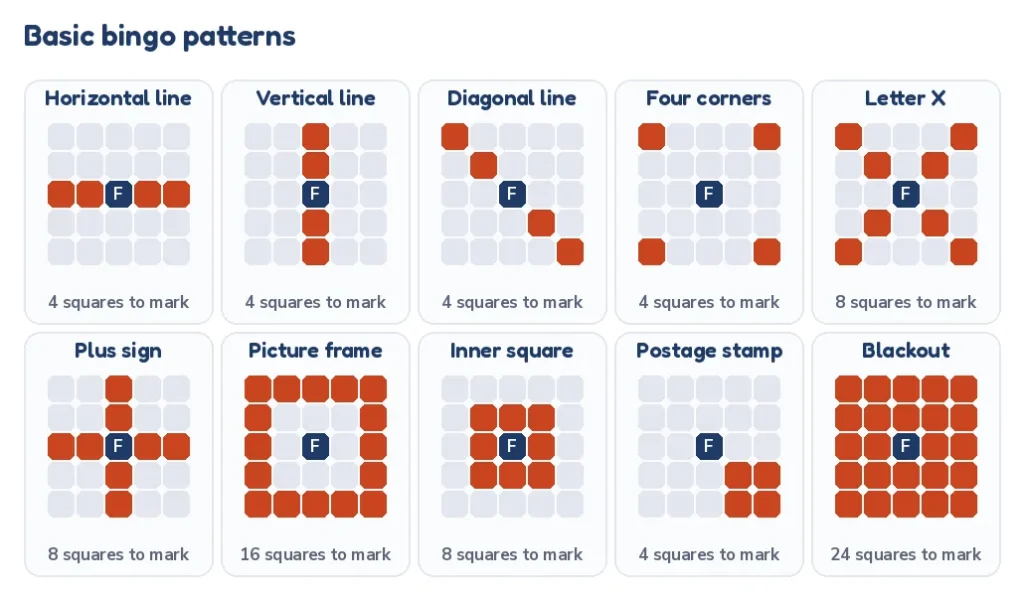
Bingo patterns with pictures: how to read the diagrams
Every pattern on this page is drawn on a 5 by 5 grid that matches a real 75-ball card. A light gray square is a square you do not need to mark, an orange square is a number you must have marked, and the navy square with an F is the free space, which counts as marked from the start. The caption under each picture tells you how many squares you must mark, not counting the free space.
Reading the diagrams is easier if you remember that the card is five columns wide: B, I, N, G and O from left to right. A pattern drawn on the left edge uses the B column, and a pattern on the right edge uses the O column. Hosts who show the picture at the start of a round avoid most arguments about what counts as a win.
What are bingo patterns and how do you use them?
A bingo pattern is the arrangement of marked squares that wins the round. The classic game awards a prize to the first complete row, column or diagonal, but many halls and parties play a different pattern each round. The host announces the pattern before the first call, often by holding up a picture of it, and players mark their cards as usual until someone completes the shape.
All of the patterns on this page are drawn on a standard 75-ball card, where the center square is free. A pattern that passes through the middle therefore needs one fewer called number. The pictures below mark the free space with a navy F and the squares you must mark in orange.
How to announce a bingo pattern clearly
- Say the name of the pattern and show its picture: “This round is the letter X.”
- Mention whether the free space counts. In the pictures on this page it always does.
- Write the pattern on a board or show it on a screen so latecomers can see it.
- Repeat the pattern after every few calls in a long round.
- State whether the winner must complete the pattern exactly or may mark extra squares (extra marks are normally allowed).
Basic bingo winning patterns
These ten bingo winning patterns are the ones every caller should know. The table gives the number of squares to mark and the median call on which the first card completes that exact shape, from our simulation of thousands of games. A “median” means half of all games finish sooner and half later.
| Pattern | Squares to mark | Median calls, 1 card | 10 cards | 30 cards | Best used for |
|---|---|---|---|---|---|
| Horizontal line | 4 | 64 | 39 | 30 | First round of any game |
| Vertical line | 4 | 64 | 42 | 35 | Easy warm-up round |
| Diagonal line | 4 | 64 | 41 | 31 | Quick round that uses the free space |
| Four corners | 4 | 64 | 40 | 31 | A fast, exciting round |
| Letter X | 8 | 69 | 55 | 49 | Mid-game favorite |
| Plus sign | 8 | 70 | 55 | 49 | Middle-of-the-evening round |
| Picture frame | 16 | 73 | 65 | 62 | A long round for big groups |
| Inner square | 8 | 70 | 56 | 49 | A change from the outer frame |
| Postage stamp | 4 | 64 | 40 | 32 | Very fast bonus round |
| Blackout | 24 | 74 | 69 | 66 | The grand finale |
Notice how much faster the line patterns are than the larger shapes. A fixed row needs only four numbers plus the free center, yet a single card still takes a median of 64 calls to complete one specific row. That is much longer than the roughly 41 calls that an “any line” game needs, because any line allows 12 different rows, columns and diagonals.
Patterns by difficulty, from quick to long
If you are building an evening’s program, order the bingo winning patterns from quick to long. The chart compares nine of them for one card, ten cards and thirty cards. The more cards in play, the earlier a round ends, and the gap between easy and hard shapes grows.
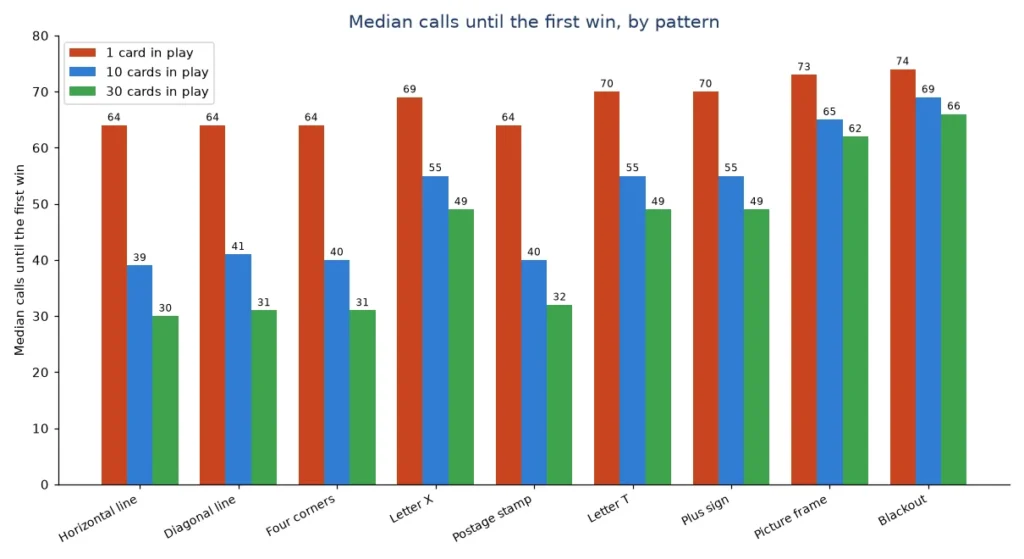
With 30 cards, a postage stamp or four corners ends near call 31 to 32, a letter X near 49, and a picture frame near 62. A full blackout takes about 66 calls, so keep it for last.
Letter shapes: easy to explain, easy to check
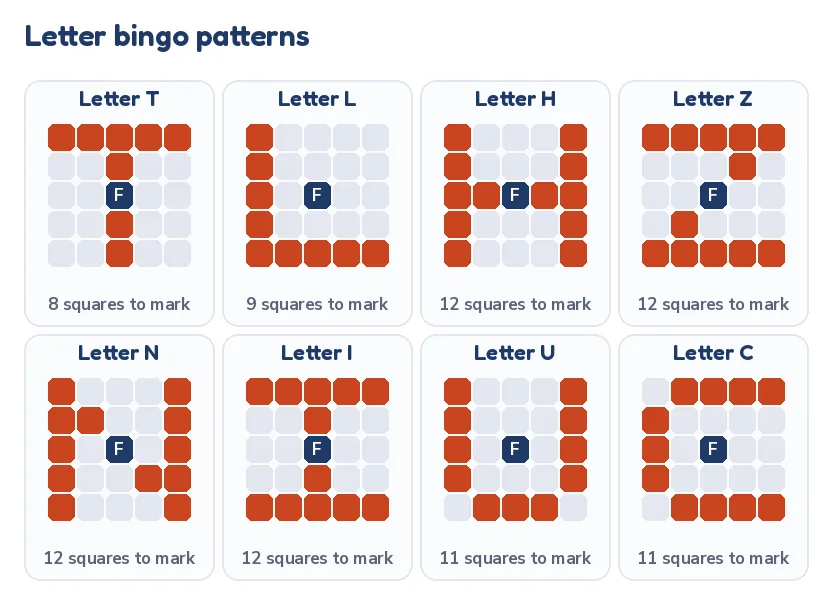
Letter shapes are some of the most popular special bingo patterns, because they are easy to explain and easy to check. Players can see at a glance whether they are close to completing a T or an L.
| Pattern | Squares to mark | Median calls, 1 card | 10 cards | 30 cards | Best used for |
|---|---|---|---|---|---|
| Letter T | 8 | 70 | 55 | 49 | Spelling themes and classrooms |
| Letter L | 9 | 70 | 58 | 52 | Easy letter round for kids |
| Letter H | 12 | 72 | 62 | 58 | Hearts and holiday letters |
| Letter Z | 12 | 72 | 62 | 57 | A tricky diagonal shape |
| Letter N | 12 | 72 | 62 | 58 | Name or initial rounds |
| Letter I | 12 | 72 | 62 | 57 | A tidy pattern that matches the B-I-N-G-O header |
| Letter U | 11 | 71 | 61 | 56 | Team rounds with a curve |
| Letter C | 11 | 71 | 60 | 55 | Alphabet and classroom games |
Use letters to tie the game to a theme. A class can play the first letter of each spelling word, a family can spell a name over several rounds, and a birthday host can play the initials of the guest of honor. Spelling a word letter by letter makes a nice multi-round game.
Bingo pattern ideas: fancy shapes
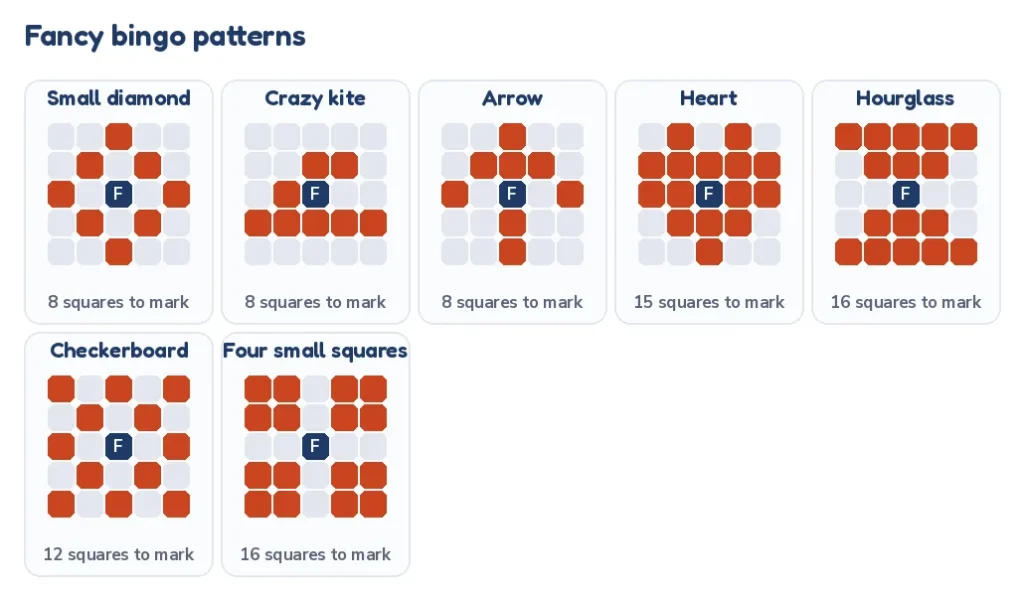
When the basic shapes feel familiar, these bingo pattern ideas add surprise. They are harder to complete because they need more squares, so they work best late in the evening or with large groups.
| Pattern | Squares to mark | Median calls, 1 card | 10 cards | 30 cards | Best used for |
|---|---|---|---|---|---|
| Small diamond | 8 | 70 | 55 | 50 | Elegant mid-game shape |
| Crazy kite | 8 | 70 | 55 | 48 | A playful surprise shape |
| Arrow | 8 | 70 | 55 | 49 | Direction and travel themes |
| Heart | 15 | 72 | 64 | 61 | Valentine and wedding games |
| Hourglass | 16 | 73 | 65 | 61 | Long rounds near the end of the evening |
| Checkerboard | 12 | 71 | 61 | 57 | A longer round with a visual twist |
| Four small squares | 16 | 73 | 65 | 62 | A special blackout alternative |
The diamond, kite and arrow are the quickest of these, at about 8 squares each, and they finish around call 49 to 55 when many cards are in play. The heart, hourglass and four small squares need 15 or 16 squares and often take longer than 60 calls.
Matching patterns to a party theme
The best bingo pattern ideas connect to the occasion. A pattern that looks like something from the party feels like part of the decorations, and guests remember it. These themed ideas use the shapes from the pictures above:
| Occasion | Bingo pattern idea | Why it fits |
|---|---|---|
| Valentine’s Day, wedding or anniversary | Heart | The shape itself is the theme; save it for the grand prize |
| Road trip or travel night | Arrow | Points the way and matches the journey |
| Classroom spelling week | Letter T, L, H or any letter from the word list | Spell a vocabulary word one pattern at a time |
| Christmas or winter party | Plus sign or checkerboard | A cross for the holiday, a checkerboard for a snowy blanket |
| Baby shower | Small diamond or postage stamp | Small, gentle shapes for quick gift rounds |
| Office or team event | Picture frame | A longer round that keeps a big room involved |
When you want a shape that nobody has seen before, combine two simple ones. For example, “both diagonals plus the four corners” is an easy-to-explain special pattern that takes longer than an X and keeps strong players guessing.
How to make your own special bingo patterns
- Sketch a 5 by 5 grid and shade the squares you want, up to about 16 for a big-group round.
- Count the squares you must mark, not counting the free space, and compare that number with the table above to estimate the length of the round.
- Give it a short name that players can remember, such as “lightning” or “crown”.
- Test it once with friends so you know whether the round is quick or slow.
- Show the picture on a poster or screen at the start of the round.
How the squares map to B-I-N-G-O on a 75-ball card
All the pictures here are bingo patterns for 75 ball bingo, where the five columns are B, I, N, G and O. Column N has only four numbers because its middle square is the free space, so the N column is always the shortest to complete. Patterns made from the outer ring use B, O and the top and bottom rows; the plus sign and letter I rely heavily on the N column and the free space.
| Pattern group | Columns it uses most | What that means for the game |
|---|---|---|
| Corners and frame | B and O | Players watch the two outer columns; calls in B and O decide the round |
| Plus sign, letter T and letter I | N and the middle row | The free space helps, so the round finishes earlier than the square count suggests |
| X and diagonals | All five columns, one square each | Every call has the same chance to help, so progress feels steady |
| Blackout | All columns, all squares | Needs nearly every number, so the last few calls decide the game |
Showing the patterns to your players
A printable set of the shapes is useful because players love to see the shape before the round starts. The pictures on this page print cleanly from your browser: use the print command, or save an image and enlarge it on a poster. For cards to play on, the bingo card generator makes up to 100 different cards per set.
- Print the pattern pictures on one sheet, cut them apart and hold up the one for each round.
- Show the picture on a TV or projector beside the call board.
- Draw the pattern on a whiteboard and tick it off as rounds are played.
- Give each player a small card with the program of rounds, such as line, four corners, X and blackout.
The free bingo caller has a pattern picker with eight of the shapes on this page: any line, four corners, X, letter T, letter L, postage stamp, picture frame and blackout. Pick one before a round and the picture stays on screen for your players.
How to choose a bingo pattern for your group
The right pattern depends on how many cards are in play and how long you want each round to last. Use this table as a starting point. The times assume one call every 10 seconds and use the median calls from our simulation.
| Round | Calls with 10 cards | Time at 10 s per call | Calls with 30 cards | Time at 10 s per call |
|---|---|---|---|---|
| Single line | 26 | 4.3 min | 21 | 3.5 min |
| Four corners | 40 | 6.7 min | 33 | 5.5 min |
| Letter X | 55 | 9.2 min | 48 | 8.0 min |
| Blackout | 69 | 11.5 min | 66 | 11.0 min |
A balanced one-hour evening with 30 cards could run a single line, four corners, a letter X, a picture frame and a final blackout, with a short break after round three. Allow about a minute between rounds to verify winners and hand out prizes.
Patterns for kids, classrooms and parties
- Young children: stay with a single line, four corners or the postage stamp, and use smaller grids such as 3 by 3 from the card maker.
- Classrooms: letters that spell the lesson topic or the first letters of the vocabulary words.
- Baby showers and weddings: a heart or small diamond for the main prize. See baby shower bingo.
- Holidays: a plus sign for a cross, an arrow for a road trip, a checkerboard for a winter game. Try Christmas bingo.
To learn the rules behind these shapes, read our beginner guide on how to play bingo, and browse the full printable bingo cards library for themed sets. A detailed history of the game is in the Wikipedia article on American bingo.
Frequently asked questions
10 quick answers
What are bingo patterns?
Bingo patterns are the shapes of marked squares that win a round, such as a line, four corners, an X or a letter. The host announces the pattern before the first call.
What is the easiest bingo pattern to win?
Any single line is the easiest, because there are 12 possible lines on a card. Among fixed shapes, the postage stamp, four corners and a single row or column need only four numbers plus the free space.
How many bingo winning patterns are there?
There is no official limit. This page shows 25 common bingo winning patterns, and hosts invent more all the time, from letters to hearts and arrows.
Are there bingo patterns printable for free?
Yes. The pattern pictures on this page print from your browser, and the bingo card generator makes free printable cards to play on.
Do the free space and corners count?
The free space counts as marked for every pattern. The four corners do not include the center square, so that pattern needs four called numbers.
Which patterns take the longest?
Blackout takes the longest, because it needs all 24 numbers. The frame, hourglass, heart and four small squares are also long rounds, usually finishing after call 60.
What are good special bingo patterns for kids?
Letters such as T, L and I, the postage stamp, and the small diamond are easy to see and complete. Start with a single line and add one shape at a time.
Can I use the same pattern on different card sizes?
Patterns are drawn for a 5 by 5 card. On a 3 by 3 or 4 by 4 card, use lines, corners or a diagonal, and keep the shapes simple.
How do I show a pattern to my players?
Print the picture, show it on a screen next to the call board, or use the pattern picker in the free bingo caller. Say the pattern name aloud before every round.
Do I need special cards for each pattern?
No. The same card works for every pattern. Only the squares you must mark change from round to round.