Bingo calls are the words a caller says when a number is drawn: in 75-ball bingo a letter and a number such as “B 7”, and in the traditional British 90-ball game a rhyming nickname such as “two little ducks, twenty-two”. This guide gives you both sets. You get the 75-ball calls, all 90 traditional nicknames with an explanation of how each one works, a glossary of the shouts and phrases that go with them, and practical tips for calling clearly.
In short: in 75-ball bingo, say the letter first, then the number (B is 1 to 15, I is 16 to 30, N is 31 to 45, G is 46 to 60, O is 61 to 75). In 90-ball bingo, tambola and housie, say the number and, if you like, its nickname. The free bingo caller and the tambola number caller speak every call for you and can show the nickname on screen.
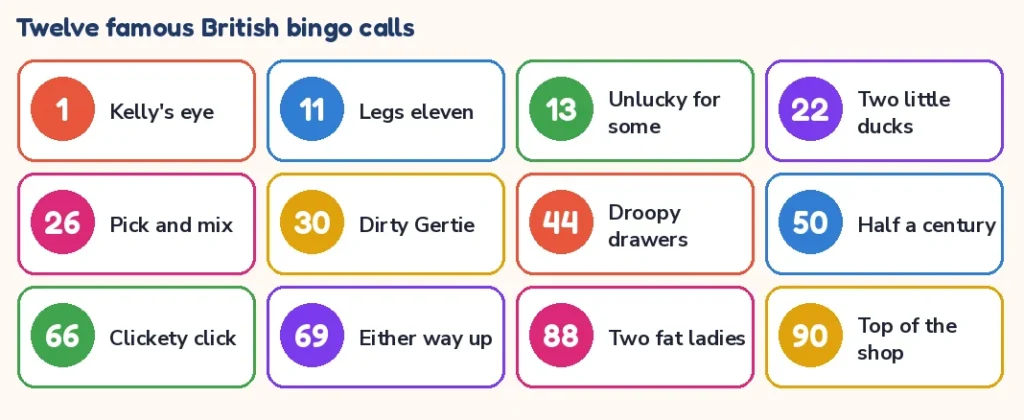
What bingo calls are and why callers use them
Bingo calls matter because a game only works if every player hears the same number at the same moment. They solve that problem in two ways. First, the call names the number in a fixed format so nobody has to guess what was said. Second, in a noisy hall or a busy living room, a longer, more memorable call is easier to catch than a bare number. “Fifty-one” and “fifteen” sound alike across a room, but “tweak of the thumb” and “young and keen” do not.
The calls fall into two families. The first is the letter-and-number call used in 75-ball bingo, the version played in the United States, Canada and most classrooms. The second is the family of nicknames, also known as call-outs, used in British 90-ball bingo and borrowed by tambola and housie in India and elsewhere. You can use either family with any game. Many hosts at kitty parties and birthday parties mix them: they say the number plainly and add the nickname for fun.
The English nicknames are sometimes called bingo lingo. Wikipedia notes that there is a rhyme for every number from 1 to 90, that some are many decades old, and that in some clubs the caller says the number and the players chant the rhyme back, while in others the caller says the rhyme and the players answer with the number.
It also notes that electronic random number generators have made the nicknames less common in big commercial halls. At home, at school and at parties they are as popular as ever, because they make the game feel like a game.
The letters and numbers in 75-ball bingo
Every 75-ball bingo number belongs to one of five letters, and the letter tells players which column to look in. That cuts the search on a card from 24 squares to about 5. Here are the 75 ball bingo calls broken down by letter, with an example of how the caller says each one.
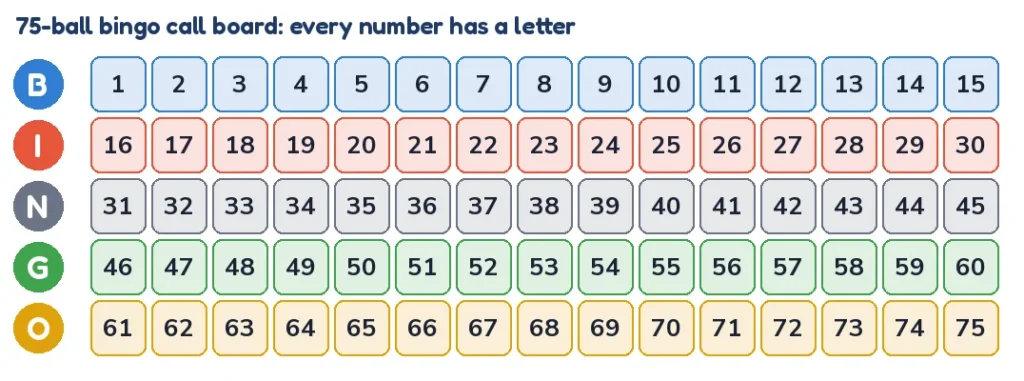
| Letter | Numbers | How many | Example call | What the caller says |
|---|---|---|---|---|
| B | 1 to 15 | 15 | B 7 | B, seven |
| I | 16 to 30 | 15 | I 22 | I, twenty-two |
| N | 31 to 45 | 15 | N 38 | N, thirty-eight |
| G | 46 to 60 | 15 | G 52 | G, fifty-two |
| O | 61 to 75 | 15 | O 69 | O, sixty-nine |
Callers usually add a second, slower pronunciation for double digits, because “B 14” and “B 40” are easy to mix up. The usual habit is to say it once as a number and once as separate digits: “I 22, two-two”. If you use the free bingo caller, the spoken call, the big ball and the call board all update together, so players who miss the audio can read the screen.
Bingo caller phrases for a 75-ball game
A few standard bingo caller phrases keep a 75-ball game moving and make it easy to run for beginners. You do not need all of them, but a short script helps new hosts feel confident:
- Opening: “Welcome to the game. Today’s pattern is a single line. The free space in the center counts. Good luck.”
- Each call: “N, forty-one. N 41.” Say it twice at a steady pace.
- Checking: “The last number called was G 52. Is anyone close?”
- A claim: “We have a bingo. Please read out the numbers on your winning line.”
- Closing: “That is the end of round one. Clear your cards for the next game.”
The patterns the caller announces are covered in the guide to bingo patterns, and the full rules are in how to play bingo. A printable master list of all 75 numbers is on the bingo number chart page, which helps when you call by hand and need to track what has been drawn.
Bingo calls 1 to 90: the complete list with nicknames
This is the full list of bingo calls 1 to 90 used by the tambola number caller on this site. Learn these once and you can run a game anywhere. Regional versions vary, and the same number may have two or three nicknames depending on the hall, the decade and the caller. The right-hand column does not claim a documented history. It explains how each call works, which is usually the easiest way to remember it.
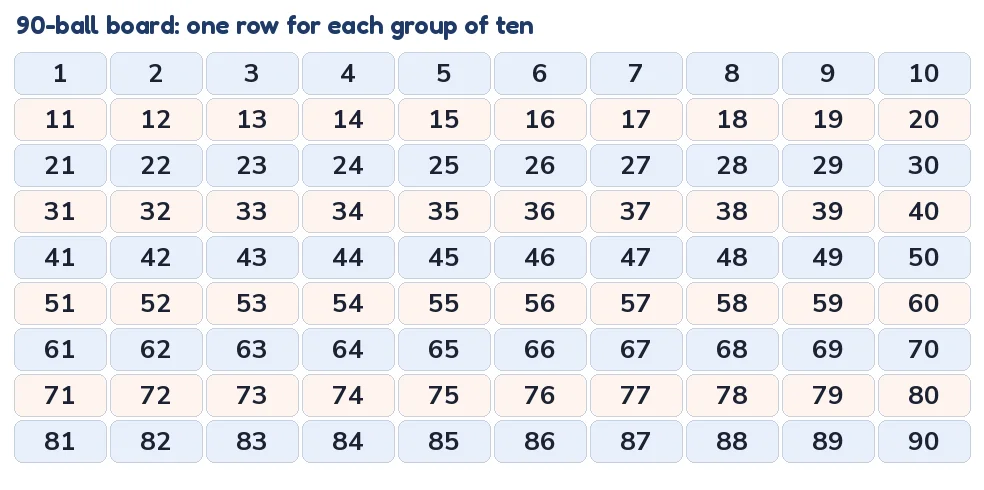
Bingo call nicknames from 1 to 90, ten at a time
The bingo call nicknames are grouped below by ten, so you can find a number quickly while you are calling. If you want the Hindi and Indian-English versions that tambola and housie hosts use, the housie number calls guide covers them.
Numbers 1 to 10
| Number | Traditional call | How the call works |
|---|---|---|
| 1 | Kelly’s eye | Origin disputed; one of the oldest calls |
| 2 | One little duck | Shape: the numeral looks like a swimming duck |
| 3 | Cup of tea | Rhyme: three and tea |
| 4 | Knock at the door | Sound: four and door |
| 5 | Man alive | Rhyme: five and alive |
| 6 | Tom Mix | Rhyme: six and Mix, after the cowboy film star Tom Mix |
| 7 | Lucky seven | Superstition: seven is lucky |
| 8 | Garden gate | Rhyme: eight and gate |
| 9 | Doctor’s orders | Cultural: commonly traced to the Number 9 pill given for minor ailments |
| 10 | Boris’s den | Cultural: the prime minister’s home at 10 Downing Street, so the name changes with the occupant |
Numbers 11 to 20
| Number | Traditional call | How the call works |
|---|---|---|
| 11 | Legs eleven | Shape: two straight legs |
| 12 | One dozen | Counting: twelve make a dozen |
| 13 | Unlucky for some | Superstition: thirteen is unlucky |
| 14 | Valentine’s day | Date: February 14 |
| 15 | Young and keen | Rhyme: fifteen and keen |
| 16 | Sweet sixteen | Age: a sweet sixteenth birthday |
| 17 | Dancing queen | Pop culture: the ABBA song |
| 18 | Coming of age | Age: the age of adulthood in the UK |
| 19 | Goodbye teens | Age: the last teenage year |
| 20 | One score | Counting: a score is twenty |
Numbers 21 to 30
| Number | Traditional call | How the call works |
|---|---|---|
| 21 | Key of the door | Age: the traditional key to the door on a 21st birthday |
| 22 | Two little ducks | Shape: two swimming ducks |
| 23 | Thee and me | Rhyme: three and me |
| 24 | Two dozen | Counting: two dozen |
| 25 | Duck and dive | Rhyme: twenty-five and dive |
| 26 | Pick and mix | Rhyme: six and mix |
| 27 | Gateway to heaven | Rhyme: seven and heaven |
| 28 | In a state | Rhyme: eight and state |
| 29 | Rise and shine | Rhyme: nine and shine |
| 30 | Dirty Gertie | Rhyme: thirty and Gertie |
Numbers 31 to 40
| Number | Traditional call | How the call works |
|---|---|---|
| 31 | Get up and run | Rhyme: one and run |
| 32 | Buckle my shoe | Nursery rhyme: one, two, buckle my shoe |
| 33 | Dirty knee | Rhyme: three and knee |
| 34 | Ask for more | Rhyme: four and more |
| 35 | Jump and jive | Rhyme: five and jive |
| 36 | Three dozen | Counting: three dozen |
| 37 | More than eleven | Rhyme: seven and eleven |
| 38 | Christmas cake | Traditional; no agreed origin |
| 39 | Steps | Cultural: The 39 Steps, the famous thriller |
| 40 | Naughty forty | Alliteration: naughty forty |
Numbers 41 to 50
| Number | Traditional call | How the call works |
|---|---|---|
| 41 | Time for fun | Rhyme: one and fun |
| 42 | Winnie the Pooh | Rhyme: two and Pooh |
| 43 | Down on your knees | Rhyme: three and knees |
| 44 | Droopy drawers | Rhyme: four and drawers |
| 45 | Halfway there | Counting: halfway to 90 |
| 46 | Up to tricks | Rhyme: six and tricks |
| 47 | Four and seven | Spoken digits: four and seven |
| 48 | Four dozen | Counting: four dozen |
| 49 | PC | Cultural: a police constable known as PC 49 |
| 50 | Half a century | Counting: half of one hundred |
Numbers 51 to 60
| Number | Traditional call | How the call works |
|---|---|---|
| 51 | Tweak of the thumb | Rhyme: one and thumb |
| 52 | Danny La Rue | Cultural: the British entertainer Danny La Rue |
| 53 | Stuck in the tree | Rhyme: three and tree |
| 54 | Clean the floor | Rhyme: four and floor |
| 55 | Snakes alive | Rhyme: five and alive; two fives look like snakes |
| 56 | Was she worth it | Money: five and six, an old price for a marriage license |
| 57 | Heinz varieties | Advertising: the 57 varieties slogan |
| 58 | Make them wait | Rhyme: eight and wait |
| 59 | Brighton line | Traditional; a railway reference |
| 60 | Five dozen | Counting: five dozen |
Numbers 61 to 70
| Number | Traditional call | How the call works |
|---|---|---|
| 61 | Baker’s bun | Rhyme: one and bun |
| 62 | Tickety-boo | Rhyme: two and boo |
| 63 | Tickle me | Rhyme: three and me |
| 64 | Red raw | Traditional; no agreed origin |
| 65 | Old age pension | Age: the traditional pension age |
| 66 | Clickety click | Sound: the rhythm of the words |
| 67 | Made in heaven | Rhyme: seven and heaven |
| 68 | Saving grace | Rhyme: eight and grace |
| 69 | Either way up | Shape: reads the same upside down |
| 70 | Three score and ten | Age: threescore years and ten |
Numbers 71 to 80
| Number | Traditional call | How the call works |
|---|---|---|
| 71 | Bang on the drum | Rhyme: one and drum |
| 72 | Six dozen | Counting: six dozen |
| 73 | Queen bee | Rhyme: three and bee |
| 74 | Candy store | Rhyme: four and store |
| 75 | Strive and strive | Rhyme: five and strive |
| 76 | Trombones | Cultural: the song from The Music Man |
| 77 | Sunset strip | Cultural: the TV series 77 Sunset Strip |
| 78 | Heaven’s gate | Rhyme: eight and gate |
| 79 | One more time | Rhyme: nine and time |
| 80 | Eight and blank | Spoken digits: eight and zero |
Numbers 81 to 90
| Number | Traditional call | How the call works |
|---|---|---|
| 81 | Stop and run | Rhyme: one and run |
| 82 | Straight on through | Rhyme: two and through |
| 83 | Time for tea | Rhyme: three and tea |
| 84 | Seven dozen | Counting: seven dozen |
| 85 | Staying alive | Pop culture: the Bee Gees song |
| 86 | Between the sticks | Rhyme: six and sticks |
| 87 | Torquay in Devon | Rhyme: seven and Devon |
| 88 | Two fat ladies | Shape: two ladies side by side |
| 89 | Nearly there | Counting: one short of 90 |
| 90 | Top of the shop | Counting: the top of the board |
Bingo numbers and nicknames: how the calls are built
Once you look at the bingo numbers and nicknames in the tables above, a few patterns appear. They also make the calls easy to learn, because you can guess many of them. About half of the 90 are rhymes: the nickname ends with a word that rhymes with the number, such as “man alive” for 5, “cup of tea” for 3 or “tickety-boo” for 62.
Another group are shapes. The numeral 2 looks like a duck, 11 looks like two legs, and 88 looks like two ladies standing side by side. A third group are counting calls, which use dozens, scores and halves: “one dozen” for 12, “one score” for 20, “half a century” for 50. The remaining calls are cultural references to songs, films, products and ages, such as “sweet sixteen” and “old age pension”.
The reason this matters for a host is practical. If you forget one of the bingo calls, you can invent a rhyme for it in the same style, and your players will usually enjoy it. At a kitty party or a classroom game, a home-made call for a number the group cares about is often the funniest moment of the afternoon.
Bingo lingo: the words and shouts that go with the numbers
Bingo calls are only half of bingo lingo. The rest is the vocabulary that tells players where the game is. Here is a compact glossary you can use as a script or print for a new host.
| Term | What it means |
|---|---|
| Eyes down | The call that says the game is about to begin; players stop talking and look at their cards |
| Full house | Every number on the card is covered; in 90-ball bingo this is usually the final and biggest prize |
| House | The traditional shout in British and Commonwealth halls when a full house is complete; many players also say “bingo” |
| Line | One complete row; in 90-ball bingo the card has three rows, so a game can have one-line, two-line and full-house stages |
| Bingo | The word players shout when their pattern is complete |
| Blackout or cover-all | Every square on a 75-ball card is covered |
| Free space | The center square of a 75-ball card, which counts as already called |
| Dabber or marker | A fat ink pen or chip used to mark numbers |
| Flash board | A display of the numbers called so far; in the caller tool this is the call board |
| Check | The caller reads back a claimed card and compares it with the numbers called |
| Pattern | The shape players must complete to win, such as four corners or an X |
| Early bird | A short game played before the main session, often for a small prize |
You can mix this vocabulary with the calls to give any game a bingo-hall feel. For a game of tambola at home, the dividends and prize names are listed in the guide on how to play tambola, and the differences between the three games are in tambola vs bingo vs housie.
How to deliver the calls like a good caller
Good delivery of bingo calls is mostly about pace and clarity. Players should never have to ask you to repeat a number, and nobody should feel rushed. These are the habits that work in classrooms, living rooms and community halls.
Pace, volume and pauses
Start slower than you think you need to. Five seconds between calls suits most mixed groups, children usually need eight to ten, and a group of experienced players can handle three. Speak a little louder than normal, face the group and pause for a beat before each new number so the room can settle. The chart below shows how long a whole game takes at each pace, which helps you plan the length of a party.
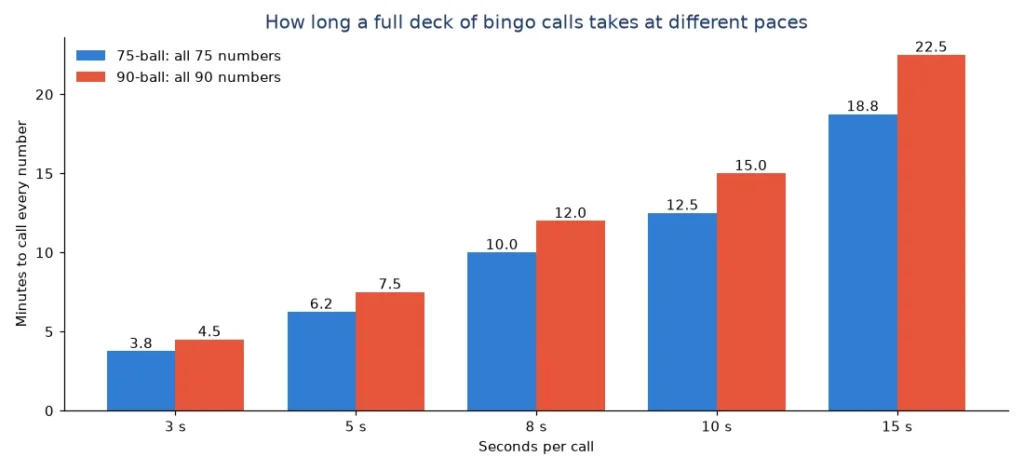
| Seconds per call | 75 numbers | 90 numbers | Good for |
|---|---|---|---|
| 3 | 3.75 minutes | 4.5 minutes | Experienced players and online speed rounds |
| 5 | 6.25 minutes | 7.5 minutes | Mixed groups and most parties |
| 8 | 10 minutes | 12 minutes | Children and first-time players |
| 10 | 12.5 minutes | 15 minutes | Seniors and care homes, with large-print cards |
| 15 | 18.75 minutes | 22.5 minutes | Classroom games where the call is also a question |
In practice a game ends before every number is called. Once players are close to a winning pattern, in simulations a single-line 75-ball game ends after a median of 41 calls with one card, 26 with ten cards and 15 with a hundred cards, while a full house on a 90-ball ticket takes more than 70 calls. Real game lengths are in the how-to-play guide and the patterns guide.
Say each call twice, keep a record, check every claim
Say each call twice, or once as a number and once as nickname plus number. Track what you have called on a board or a list, never from memory. When someone calls bingo, ask them to read out the numbers on their winning line and compare each with your record before you announce a winner.
The caller tool does this for you through its Check a winning card box: type the numbers from the card, and it says whether they were all called. A wrong claim wastes the whole room’s time, and checking calmly is fairer than guessing.
Using the free callers to read out the numbers
Both callers on this site work in the browser, need no sign-up and keep the game in your browser so a reload does not lose it. The bingo caller defaults to 75-ball bingo with letters, and the tambola number caller defaults to 90-ball with the traditional nicknames. Each one has the same set of controls.
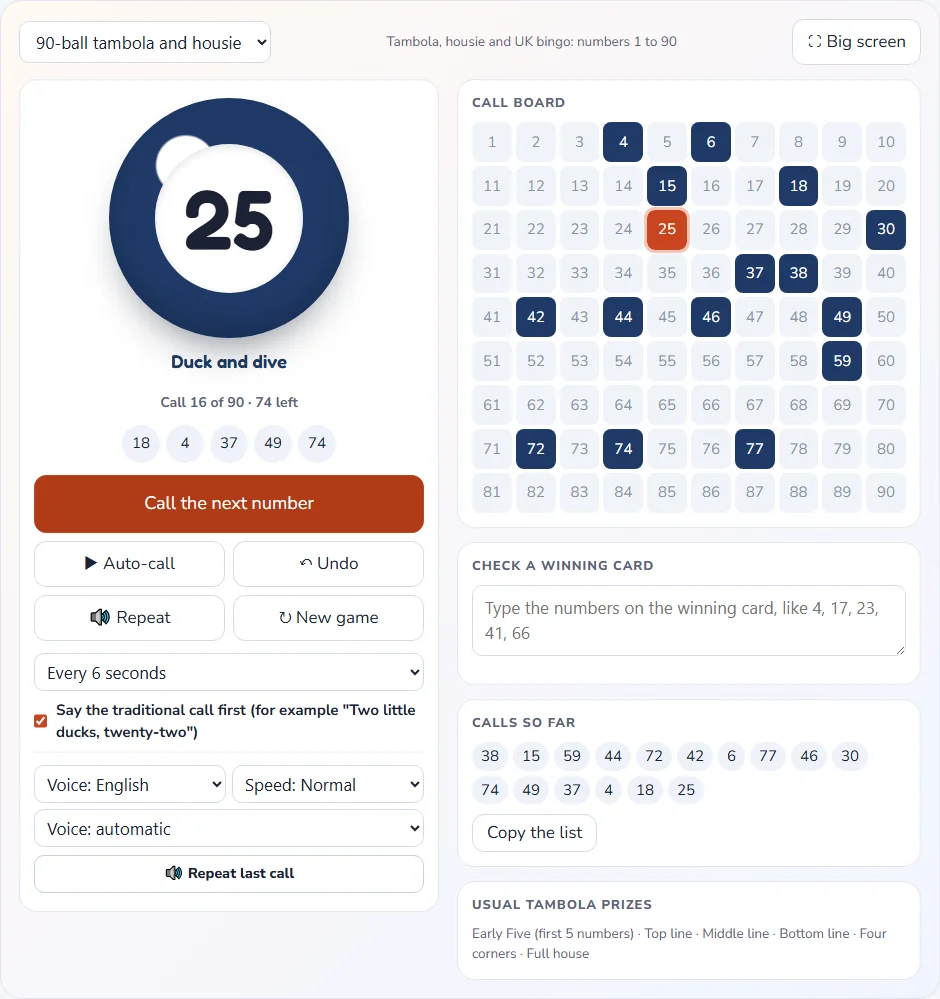
- Next call and auto-call: press the button, or let it call every 3, 4, 5, 6, 8, 10, 15, 20 or 30 seconds with a pause button.
- Voice: spoken calls in English or Hindi, or off, with a choice of speed and device voice. The traditional nicknames are spoken in the 90-ball game when you turn them on.
- Undo and repeat: take back the last call or hear it again.
- Big-screen mode: a full-screen view for a TV, projector or video call. Press Esc to leave.
- Check a winning card: type the numbers on a card and see whether every one was called.
- Call list: every call so far with a copy button, useful for settling a dispute.
For guests who play from their own phones, send them to the online bingo game for 75-ball games or the tambola games on the party games hub. To print cards that match the numbers you call, use the bingo card generator for 75-ball cards or the tambola ticket generator for 1 to 90 tickets. The 90-ball bingo cards page explains the 3 by 9 ticket layout.
Make your own calls and nicknames
The traditional bingo calls are only one possible set. A custom game with words, pictures or names can have its own call phrases too. A classroom game can call the clue (“a word that rhymes with cat”) and ask players to find the answer on their card, and a baby shower can call the gift (“something blue and soft”).
Wedding hosts often invent a nickname for each guest’s table. The pattern is always the same: say the thing, give a clue or a rhyme, then let players find it. Template cards for such games are on the printable bingo cards hub, and the classroom bingo page shows how a call-and-clue game works with words.
If you write your own nicknames, a simple recipe works every time: pick a word that rhymes with the number (“nine, shine”), add a verb or a place, and keep it under four words. Short calls are easier to repeat and are more likely to become a running joke over the evening.
Common questions about calling bingo
Should I always use nicknames with my calls?
No. Nicknames are an extra layer. Always say the number first, plainly, because players mark their cards by number. Add the nickname after it when the group knows the calls, and drop it when you have newcomers who would be confused.
Do the nicknames change?
Yes, and that is part of the fun. Number 10 follows the name of whoever lives at 10 Downing Street, 80 has several versions, and each region has its own favorites. The list above is the one the tool uses; feel free to replace any of them in your own games.
Can I use the 90-ball calls in 75-ball bingo?
You can, for the numbers 1 to 75, but the nickname does not tell players which column to look in. If you do it, say the letter too, for example “G 52, Danny La Rue”.
Frequently asked questions
10 quick answers
What are bingo calls?
Bingo calls are the words a caller says when a number is drawn: the letter and number in 75-ball bingo, such as “B 7”, and often a rhyming nickname in 90-ball bingo, such as “two little ducks, twenty-two”.
What are the 75 ball bingo calls?
In 75-ball bingo the letter B covers 1 to 15, I covers 16 to 30, N covers 31 to 45, G covers 46 to 60 and O covers 61 to 75. The caller says the letter and the number, for example “O 69”.
Where can I find bingo calls 1 to 90?
The complete list of bingo calls 1 to 90, with a nickname for each number and a note on how it works, is on this page. The tambola number caller also shows and speaks them.
What does bingo lingo mean?
Bingo lingo is the traditional set of rhyming nicknames and shouts used by British callers, from “eyes down” to “top of the shop”. The phrase is also used for the vocabulary of the game in general.
What is the call for 88 in bingo?
Two fat ladies. The two 8s look like two ladies standing side by side.
What is the call for 22?
Two little ducks, because the numeral 2 looks like a swimming duck.
How fast should a bingo caller go?
About five seconds per call suits most mixed groups. Use eight to ten seconds for children and seniors, and three to four seconds for experienced players.
Can I use these calls for tambola and housie?
Yes. Tambola and housie use the same 90-ball numbers, and the same nicknames are popular in India and in other countries. See the guide on housie number calls for the Hindi and Indian versions.
Do I need a caller to play bingo at home?
You need someone or something to draw numbers at random. A free online caller works well because it never repeats a number and it can speak each call for the whole room.
Can I make my own bingo call nicknames?
Yes. Pick a rhyme or a shape for each number, keep it under four words and share the list with players before you start so they can join in.