Bingo activities for the classroom work because they turn review into a listening game: you call a clue, every student searches a personal card, and the whole room practices recall without a worksheet in sight. This guide gives you 25 bingo activities for the classroom, grouped by grade and subject, each with a setup, a call-out and a variation, plus the card sizes, exact card counts, game-length numbers and management habits that decide whether a round runs smoothly.
In short: choose a list of 24 to 40 words or answers, type it into the card maker’s Items tab, print one different card per student and call clues instead of the words themselves. That is the whole method behind all 25 bingo activities for the classroom below, and behind every bingo vocabulary game you will ever run. It is free, needs no sign-up, and nothing you type leaves your browser.
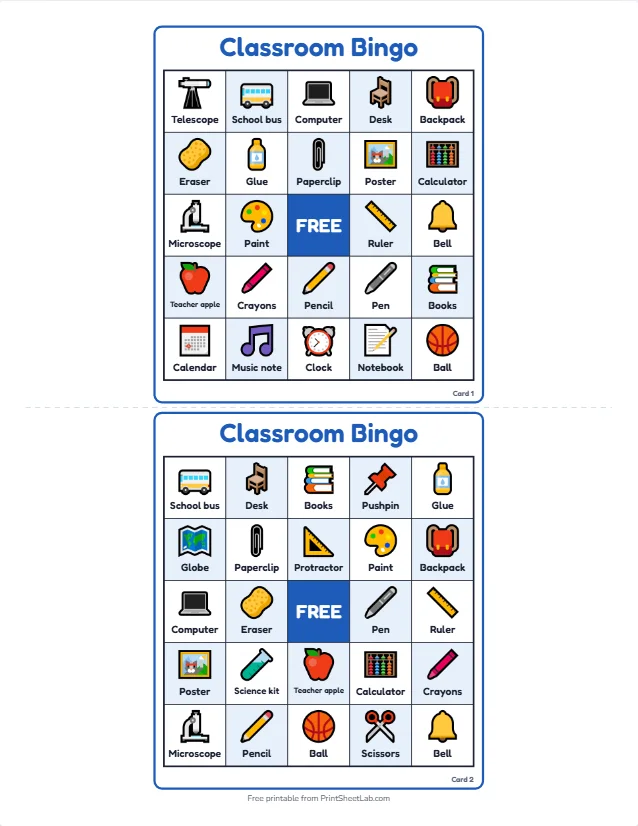
Why bingo activities for the classroom work for review
Most review tasks ask students to look at information again. Bingo asks them to find it from a spoken clue, which is closer to how they will be tested. Psychologists call the effect the testing effect: trying to retrieve something from memory helps it stick better than reading it again. Bingo activities for the classroom turn that retrieval into a game that every student plays at the same moment, and the best of them double as an educational bingo game that teaches while it entertains.
- Low prep. One list and one print job. You can reuse the list next term.
- Everyone works at once. In question-and-answer review one student answers while 29 wait. In bingo every student listens to every clue.
- Cards differ, content does not. Each card is a different arrangement of the same list, so copying a neighbor does not help.
- It tolerates mixed levels. A student who is a little behind still has a real chance to win.
The games also give you live information. A hesitation on a call tells you which idea needs reteaching, something no worksheet shows while it is happening. That is why many teachers keep a bingo review game for students in reserve for the day before a quiz.
Bingo for teaching: what it does well and where it stops
Be clear about the job. Bingo for teaching is a retrieval and recognition tool: vocabulary, facts, definitions and procedures with a single answer, in any subject. It is not the right format for open-ended reasoning, extended writing or a first introduction to a hard idea. Use it after you have taught the material, as a way to rehearse it. Used that way, bingo for teaching is one of the cheapest review tools there is.
Keep rounds to ten or fifteen minutes with a clear goal. Where the content is rich, add an explain-it step: the winner says one sentence about each word on the winning row. That turns bingo for teaching from recognition into understanding.
Bingo games for the classroom: set one up in five minutes
Every one of the bingo games for the classroom below uses the same five steps. The tools are the free bingo card generator and the ready-made classroom bingo template, and both run in your browser.
- Open the card maker and choose Custom on the Setup tab. Pick a grid from 3×3 to 7×7.
- Type your list in the Items tab. Use Add item for a few words, or Paste a list with one word per line. Add emoji or your own pictures for pre-readers.
- Add more words than squares. A 5×5 card with a free center takes 24 words, and a list of 30 means different words land on different cards.
- Design it. Type a title such as “Unit 4 vocabulary”, set the text size, and print names on the cards if you want them back in the right hands.
- Print. Choose 1 to 100 different cards, 1, 2, 4 or 6 per page, Letter or A4. Turn on the caller sheet and calling cards if you want a ready-made call list.
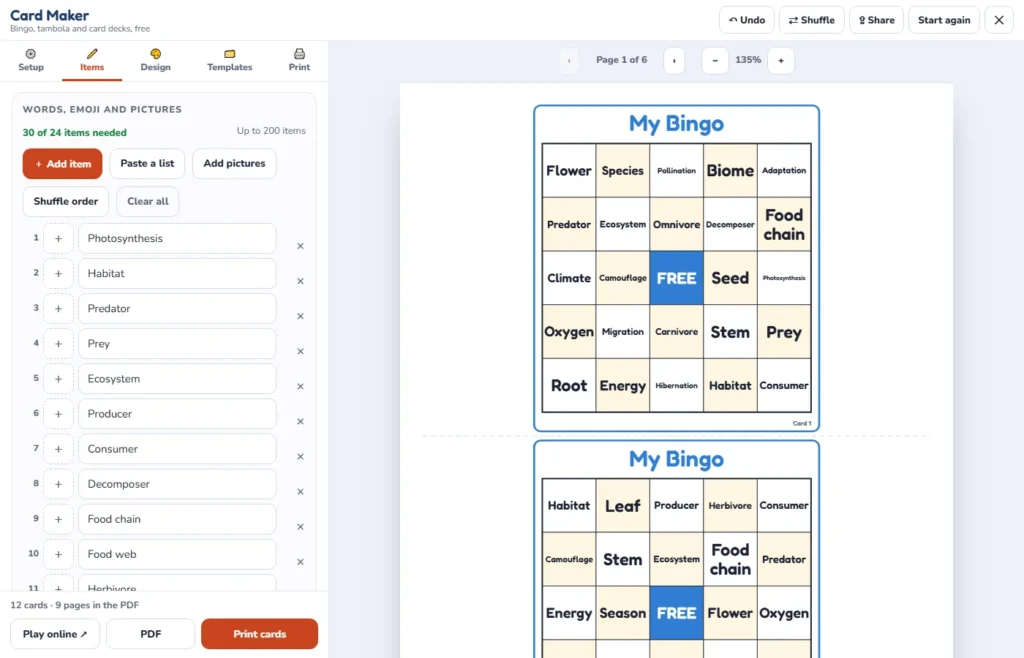
The Share button makes a link that holds the words only, handy for a lesson plan or a colleague. Nothing is uploaded and no account is needed. For a card with no list on it at all, start from the blank bingo cards and write the words by hand, or have students do it.
Which grid size and how many words? An exact guide
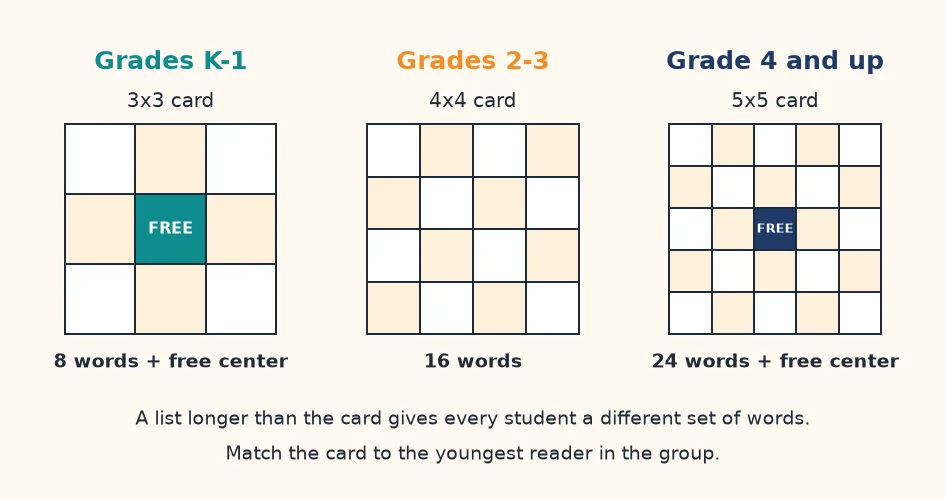
Match the grid to the youngest reader in the group when you plan bingo games for the classroom. A 3×3 card has 9 squares and, with a free center, needs only 8 words, which suits kindergarten and grade 1. A 4×4 card needs 16 words and fits grades 2 and 3. Bingo games for the classroom rarely need anything bigger than 5×5. From grade 4, the classic 5×5 card with a free center and 24 words is the norm.
The size of your list decides how different the cards are in bingo activities for the classroom. Put k of your N words on each card and the number of different sets of words is C(N, k). Each set can be arranged in many orders, so the number of different cards is P(N, k), with a free center fixed in place. The last column is the chance that two cards in a class of 30 come out identical, if each card is a uniformly random arrangement.
| Grade | Grid | Words per card (k) | Your list (N) | Different word sets, C(N, k) | Different cards, P(N, k) | Chance two of 30 cards match |
|---|---|---|---|---|---|---|
| K-1 | 3×3, free center | 8 | 10 | 45 | 1,814,400 | 1 in 4,200 |
| K-1 | 3×3, free center | 8 | 12 | 495 | 19,958,400 | 1 in 45,900 |
| 2-3 | 4×4 | 16 | 16 | 1 | 2.1 x 10¹³ | 1 in 48 billion |
| 2-3 | 4×4 | 16 | 20 | 4,845 | 1.0 x 10¹⁷ | less than 1 in a trillion |
| 4 and up | 5×5, free center | 24 | 24 | 1 | 6.2 x 10²³ | less than 1 in a trillion |
| 4 and up | 5×5, free center | 24 | 30 | 593,775 | 3.7 x 1029 | less than 1 in a trillion |
| 4 and up | 5×5, free center | 24 | 40 | 6.3 x 10¹⁰ | 3.9 x 1034 | less than 1 in a trillion |
| 4 and up | 5×5, free center | 24 | 50 | 1.2 x 10¹⁴ | 7.5 x 1037 | less than 1 in a trillion |
A 5×5 card with exactly 24 words has only one set of words, so all cards share the same words and differ only in order. With 30 words there are 593,775 sets, and with 40 words about 6.3 x 10¹⁰. For a 3×3 card, a list of 12 is the practical choice: 495 sets and about 20 million orderings, so a class of 30 almost never gets a repeat.
Ways to use bingo in the classroom: 25 ideas at a glance
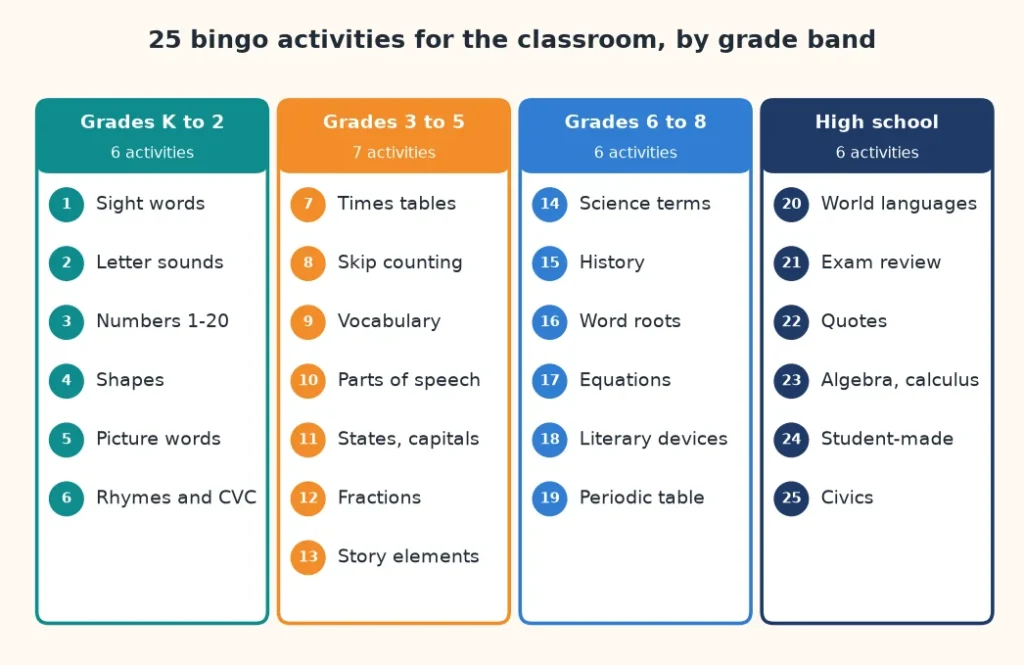
The map lists all 25 ways to use bingo in the classroom, grouped by the grade band they suit best. Most stretch one band up or down: change the list, keep the method. Whichever of the ways to use bingo in the classroom you start with, pick the band closest to your own students.
Classroom bingo for kindergarten to grade 2
Young learners need small grids, large text and pictures wherever possible. These six bingo activities for the classroom build early reading and number skills, and they are the easiest ways to use bingo in the classroom with pre-readers. Play a full card rather than a single line: on a 3×3 card a line can appear after two calls, as the game-length table shows.
1. Sight word bingo
Grid: 3×3, 8 words plus a free center. Setup: Type the 12 high-frequency words you are teaching this week, such as the, and, said, was, you, they. Start from the sight words bingo template, and see our guide to sight words for choosing a list.
Call-out: Say the word, then use it in a short sentence. Children find it and cover it with a chip. Variation: Say the sentence with the word missing (“I ___ a big dog”) and let children work out which word fits.
2. Alphabet and letter-sound bingo
Grid: 3×3 or 4×4. Setup: Fill the squares with capital or lowercase letters. A 4×4 card takes 16 of the 26 letters, so every card differs. The alphabet bingo cards are a ready starting point.
Call-out: Say the sound, not the name: “/m/, as in moon.” Children cover the letter. Variation: Put lowercase letters on the cards and call the capital, or call a picture word and ask for the first sound.
3. Number recognition bingo
Grid: 4×4, 16 of the numbers 1 to 20. Setup: List all 20 numbers and the maker leaves out four on each card. Use large digits so children can see them from the carpet.
Call-out: Say the number word (“fourteen”) or a clue such as “one more than thirteen.” Variation: Show a ten-frame or tally marks instead of speaking, or call the sum of two dice.
4. Shape and color bingo
Grid: 3×3 with pictures. Setup: Add shape pictures or emoji (circle, square, triangle, rectangle, star, heart, diamond, oval) with the Add pictures button in the Items tab.
Call-out: Describe the shape: “I have three sides and three corners.” Variation: Ask children to find the same shape somewhere in the room before they cover it.
5. Picture vocabulary bingo
Grid: 3×3, pictures only. Setup: Pick a topic (farm animals, fruit, community helpers) and fill the card with pictures. No reading is needed, so it is the easiest game to run with a substitute. Ready-made cards are on our picture bingo for kids pages.
Call-out: Describe the picture without naming it: “I live in the sea and I have eight arms.” Variation: Ask children to say the word before covering it, so English learners hear it several times.
6. Rhyming and CVC word bingo
Grid: 4×4. Setup: List 20 short words such as cat, hat, bat, sit, sun, bug, pin, hop. Sixteen go on each card.
Call-out: Call a clue: “find the word that rhymes with bat.” Several squares may fit, so let children cover any one. Variation: Say the three sounds separately (“/s/ /u/ /n/”) and let children blend them.
Educational bingo games for grades 3 to 5
Students in grades 3 to 5 can read their own cards, follow a definition and track a longer game. These seven educational bingo games cover reading, math, social studies and writing. Each educational bingo game fits a 10-minute slot at the end of a lesson.
7. Multiplication facts bingo
Grid: 5×5, 24 of up to 42 products. Setup: Put the answers on the cards. The 10 x 10 table has 100 facts but only 42 different products (59 up to 12 x 12), so many facts share an answer: 12 is both 2 x 6 and 3 x 4. Type the products you want to practice.
Call-out: Say the problem (“six times seven”). Children cover 42. Variation: Call division facts (“forty-two divided by six”) or ask for a pair of factors before the square is covered.
8. Skip counting bingo
Grid: 4×4 or 5×5. Setup: Fill the cards with multiples of 3, 4, 6 or 7. Our skip counting guide lists the patterns by step size.
Call-out: Say the start of a pattern: “twelve, fifteen, eighteen…” Children cover 21. Variation: Ask for the fourth multiple of six, or the number three steps before a given one.
9. Bingo vocabulary game
Grid: 5×5, 24 of 30 words. Setup: List the 30 to 36 target words for the unit and let the maker deal 24 to each card. Use words from your reading unit, so that every call is a mini-review. This bingo vocabulary game works for any subject.
Call-out: Read a definition, a synonym or a sentence with a blank: “the opposite of ancient.” Variation: Ask the winner to use each word of the winning row in a sentence, or flip it: call the word and let students cover its definition.
10. Parts of speech bingo
Grid: 5×5. Setup: Fill the cards with 30 words of mixed types: run, quickly, beautiful, under, because, teacher.
Call-out: Read a sentence and name a role: “In ‘the dog barked loudly,’ find the adverb.” Variation: Call “a noun that is a person” and let students cover any match, then explain one to a partner.
11. US states and capitals bingo
Grid: 5×5, 24 of 50. Setup: List all 50 capitals and let the maker choose 24 for each card. With 50 items there are more than 120 trillion different sets of 24, so no two cards match.
Call-out: Say the state and let students cover its capital, or read a clue about a flag, shape or landmark. Variation: Add a region round, such as only the Southwest, or ask for the state before the capital.
12. Fractions and decimals bingo
Grid: 4×4. Setup: Put decimals on the cards (0.5, 0.25, 0.75, 0.1, 0.2, 0.4, 0.6, 0.8) and call the matching fractions. Equivalent forms need thought, not recall.
Call-out: Say “three quarters” or write 3/4 on the board. Students cover 0.75. Variation: Add percentages to the list, or call “one half plus one quarter” in grade 5.
13. Story elements bingo
Grid: 5×5. Setup: After a read-aloud, put characters, settings, objects and key events from the book on the cards.
Call-out: Read a line or describe a scene without naming it: “who said this?” Variation: Ask for a prediction before the square is covered, or call the problem and solution for a retelling round.
Bingo for middle school classes
Middle schoolers enjoy the game more when the clues are a little tricky and the rounds are quick. These six bingo activities for the classroom work for science, history, language arts and pre-algebra, each with a variation that asks for understanding.
14. Science terms bingo
Grid: 5×5. Setup: Use a unit’s vocabulary; for cells that means nucleus, mitochondria, chloroplast, membrane, ribosome. Fill the cards with 30 terms.
Call-out: Give a function (“the powerhouse of the cell”) or show a diagram with the label hidden. Variation: Describe a factory job (“this is the packaging department”) and ask for the organelle.
15. History “Who am I?” bingo
Grid: 5×5. Setup: Put people, events and places from the unit on the cards, such as Paul Revere, Boston Tea Party, Valley Forge, Yorktown.
Call-out: Give first-person clues that get easier: “I rode through the night to warn the militia.” Variation: Put dates on the cards and call the event, or the reverse.
16. Prefix, root and suffix bingo
Grid: 5×5. Setup: Fill the cards with 30 word parts: bio, geo, spect, port, un-, re-, -ology, -ment.
Call-out: Say the meaning (“life”) and let students cover bio. Variation: Call a whole word (biology) and ask students to cover the root they hear inside it.
17. Equation answers bingo
Grid: 5×5, answers on the cards. Setup: Write 30 answers on the cards and put the problems on the board. Choose problems so that every answer is on the list.
Call-out: Read an equation (“3x + 5 = 20”). Students solve on scratch paper and cover 5. Variation: Ask students to write the equation that has that answer, which turns a worksheet into a game.
18. Literary devices bingo
Grid: 4×4. Setup: List 20 devices: simile, metaphor, personification, hyperbole, alliteration, idiom, irony, imagery. Sixteen go on each card.
Call-out: Read an example (“the wind whispered through the trees”). Students cover the device. Variation: Ask students to write their own example for any square they cover, and use the best as calls.
19. Periodic table bingo
Grid: 5×5. Setup: Fill the cards with 24 element symbols from a list of 40: Fe, Au, Na, Cl, He, Ag, Pb. There are 118 known elements, so widen the list as the course goes on.
Call-out: Say the name (“iron”) or a property: “the lightest noble gas.” Variation: Call the atomic number or the group, or put names on the cards and call the symbol.
Bingo for high school classes
High school classes tend to play bingo as review before a test, which is a good fit. These six ideas include exam review, language practice and a student-made version in which the review becomes the activity.
20. World language vocabulary bingo
Grid: 5×5. Setup: Put 30 target-language words on the cards: foods, family members, verbs in the infinitive.
Call-out: Say the English word, show a picture, or give a definition in the target language. Variation: Call a conjugated form (“ella habla”) and let students cover the infinitive (hablar).
21. Exam review blackout
Grid: 5×5, play to a full card. Setup: Pull 40 terms from the unit and print one card per student. Announce a blackout, so every term gets called.
Call-out: Read definitions and keep the called words in a pile. When time runs out, the pile shows what you covered. Variation: Tally the clues that made students hesitate. Those are your reteach list for tomorrow.
22. Quote-and-author bingo
Grid: 5×5. Setup: Put authors, characters or titles on the cards: for a novel unit, the main characters and ten key objects or places.
Call-out: Read a quote or short passage without a name. Students cover the speaker or the title. Variation: Call a theme (“betrayal”) and let students cover any linked character, then argue their case in pairs.
23. Algebra and calculus answer bingo
Grid: 5×5 or 7×7. Setup: Answers go on the cards: derivatives, factored forms, function values. A 7×7 card gives advanced classes a longer game.
Call-out: Show a problem on the board. Students solve it on a whiteboard and cover the answer. Variation: Ask each student to write one new problem for any answer they covered, and use a few as calls.
24. Student-made bingo cards
Grid: Any size, blank cards. Setup: Give each student a blank grid from our blank bingo cards and let them choose 24 words from their notes. Writing the card is retrieval practice in itself.
Call-out: Swap cards with a partner and take turns calling clues from your own list. Variation: Collect the word lists. They show what students think matters, which is useful before a test.
25. Civics and government terms bingo
Grid: 5×5. Setup: Cards hold terms such as veto, amendment, filibuster, judicial review, checks and balances, impeachment.
Call-out: Read a scenario: “the president refuses to sign a bill.” Students cover the term. Variation: Ask students to name the branch that acts and a second branch that can respond.
Bingo vocabulary game: a 15-minute lesson plan
The bingo vocabulary game is the one most teachers run most often, so here is a complete plan you can adapt to any subject. It uses 30 words from the current unit on 5×5 cards.
- Minutes 0-2. Hand out cards and chips. Say the goal for round one: the first full line.
- Minutes 2-4. Model two calls out loud. Read a definition, think aloud, then cover the matching word.
- Minutes 4-9. Play round one with definitions. If many students hesitate on a call, restate it and note the word for reteaching.
- Minutes 9-13. Clear the cards and play round two with sentences that have a blank, so students meet each word in context.
- Minutes 13-15. Exit check: every student writes one sentence using a word they covered. Collect them as you leave.
Run the same bingo vocabulary game again a week later with the same list. The second round is a cold retrieval check, and the words that students now match quickly are the ones that stuck. Teachers who plan educational bingo games this way get a review activity and an assessment from one print job.
Run the call-out: six ways to give the clue
In every one of these bingo games for the classroom the call-out is where the teaching happens, which makes it the most important skill in running bingo activities for the classroom. The same card works with any method below, so you can switch partway through a round.
| Method | What you say or show | Best for |
|---|---|---|
| Read the definition | “A tool that measures angles.” Students cover protractor. | Vocabulary, science terms, social studies |
| Show the picture | Hold up a calling card or a photo; students find the matching word. | Early readers, English learners |
| Say the problem | “Six times seven.” Students cover 42. | Math facts, skip counting, equations |
| Fill in the blank | “The ___ is the powerhouse of the cell.” | Reading comprehension, science |
| Mystery clues | Three clues that get easier, read one at a time. The sooner you cover, the more you know. | History, literature, geography |
| Student caller | A student draws the next calling card and reads it. You check the answer. | Confident readers, a change of pace |
In the Print tab, turn on the caller sheet and calling cards to cut out. Shuffle them, draw one at a time and set each called card aside in a face-up pile. The pile is your proof when a student calls bingo.
For number answers on classic 1 to 75 cards, use the bingo caller on the projector. It calls every number once in random order, keeps a call board, can repeat the last call and has a “Check a winning card” box, so a claim is settled in seconds. Its pattern picker covers any line, four corners, an X, letter T and L, a postage stamp, a picture frame and blackout, and our guide to bingo patterns explains each. New to the game? Read how to play bingo.
How long does a round take? A simulation for classes of 12, 24 and 30
The length of a game is the thing teachers ask about first when they plan bingo activities for the classroom. We simulated bingo games for the classroom with 12, 24 and 30 students on 5×5 cards with a free center, words called in random order (5,000 games per cell). A “call” is one word or clue. The table shows the median call at which the first student has a line, and the median call at which the first student has a full card.
| Words on the list | First line: 12 students | 24 students | 30 students | Blackout: 12 students | 24 students | 30 students |
|---|---|---|---|---|---|---|
| 24 | 9 | 8 | 8 | 24 | 24 | 24 |
| 30 | 11 | 10 | 9 | 29 | 28 | 28 |
| 40 | 14 | 12 | 12 | 38 | 37 | 37 |
| 50 | 17 | 15 | 14 | 46 | 45 | 45 |
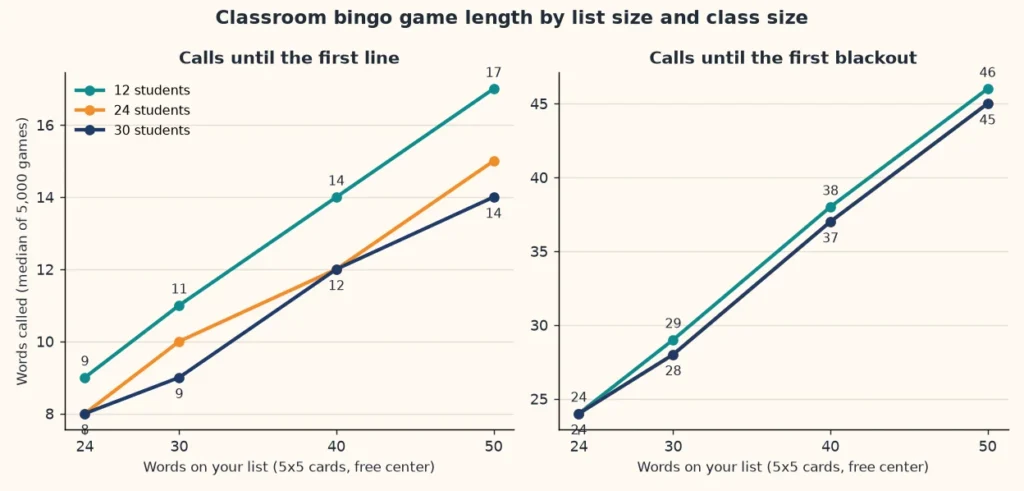
Two things stand out. The size of the list drives the length of a game; the size of the class barely does. With a 30-word list, a class of 12 sees a first line after 11 calls and a class of 30 after 9. A blackout needs almost the whole list: about 28 calls for 30 words. At 20 seconds per call, a first line in a class of 24 arrives after about 3 minutes and a blackout after about 9 minutes.
Smaller grids end much sooner. Medians for a class of 24:
| Card and list | First line (median call) | First blackout (median call) |
|---|---|---|
| 3×3 with free center, 10 words | 2 | 9 |
| 3×3 with free center, 12 words | 2 | 10 |
| 4×4, 16 words | 5 | 16 |
| 4×4, 20 words | 6 | 18 |
On a 3×3 card with a free center, a line through the middle needs only two words, so the first line comes after about 2 calls. For kindergarten and grade 1, play for a full card or four corners. The numbers assume random card contents and calls and no missed squares; real classes are lumpier, so allow a few extra calls.
Bingo review game for students: keep it fair and calm
A bingo review game for students falls apart for three reasons: arguments about whether a word was called, noise, and the same three students winning every round. These habits prevent all three.
- Fair play. Keep the calling cards in a pile and put each called card face up. When a student says bingo, have them read their row aloud while you check each word against the pile. For number bingo, use the “Check a winning card” box in the bingo caller.
- Reusable cards. Slide cards into clear sleeves and use bingo chips, buttons or dry-erase markers. A class set then lasts the school year.
- Speed rounds. Set a goal before you start: any line within 12 calls, then four corners, then blackout. Three short rounds hold attention better than one long one.
- Team bingo. Put students in teams of four who share one card. Rotate the marker so every student covers squares.
- Student callers. Let a confident reader run the calling pile. The caller practices reading aloud and you are free to walk the room.
- Spread the wins. Play on for second and third place, or reward “the last person to complete a line” to keep quieter players engaged.
Print two or three spare cards for late arrivals and turn on names so cards return to the right desks. If you teach several sections, print each class on a different paper color.
Assessment ideas: using bingo to see what students know
Bingo activities for the classroom are also a quick formative check, provided you collect the evidence while the game happens.
| Move | What you learn |
|---|---|
| Tally the clues that made students hesitate | The ideas to reteach tomorrow, as a ranked list. |
| Play to a blackout and collect the covered cards | Which students matched every call, and which squares stayed empty. |
| Ask winners to explain each word on the winning row | Whether the match came from understanding or luck. |
| Have students write one clue for a covered square | Whether they can reverse the relationship, a deeper skill than matching. |
| Run the same list again a week later | What students retained, since the second round is a cold retrieval check. |
Treat the results of any bingo review game for students as one signal among many, not a grade. A student who matches slowly may have a reading difficulty rather than a gap in knowledge, so offer picture versions where that is the case.
Differentiate educational bingo games for every learner
One list can serve a mixed-ability room if you vary the card, not the content. That is what makes educational bingo games fair for everyone.
| Need | Adjustment |
|---|---|
| Early readers | Use a 3×3 card, large text, a picture on every square and a call-out that shows the picture. |
| English learners | Put emoji or images next to each word. Say the word twice and let students point first. |
| Students who need a challenge | Use a 5×5 or 7×7 card, call definitions instead of the word, and ask for a sentence before the square is covered. |
| Students who need more time | Slow the calls, repeat each one, or let a partner share a card. |
| Mixed-level classes | Print the same list on three card sizes and let each student choose. |
For example, print a 3×3 sight words bingo card for some students and a 4×4 for others, with the same call list, and everyone plays the same game at their own level.
Accessibility: picture bingo, large print and quiet games
Every educational bingo game should include every student, so build access into the card from the start.
- Picture bingo. Cards with pictures and no words suit pre-readers and English learners. Our picture bingo for kids pages have ready-made sets.
- Large print. The Design tab has a text size slider, a font choice and an ALL CAPS switch. Use fewer words per square when text must be big.
- High contrast. Set the Card and Text colors to dark on light, or turn on the black and white option, which also saves ink.
- Do not rely on color. Tell squares apart by word or picture, not by color alone.
- Motor skills. Chips and dry-erase markers are easier for small hands than a pencil mark, and a partner can cover squares.
- Quiet play. Show the clue on a screen instead of speaking it for students who find noise hard.
Online, projected and remote options
Bingo does not need printing, and these bingo activities for the classroom adapt to a screen. The play bingo online page lets you host a 75-ball game that guests join by link and whose cards mark themselves, and custom bingo online does the same with your own word list. Both suit a remote class, and all of these ways to use bingo in the classroom carry over to a screen. Our guide to playing bingo online with friends explains how a group joins.
The best way to start with bingo for teaching is small: take one list from this week’s unit, print a class set and try a ten-minute round at the end of a lesson. Browse the full set of printable bingo cards for other themes, then change the list to fit your subject.
Frequently asked questions
10 quick answers
What are the best bingo activities for the classroom?
The best bingo activities for the classroom review content you have just taught: sight words and letter sounds in K-2, multiplication facts and vocabulary in grades 3 to 5, science terms and word roots in middle school, and exam review in high school. Bingo activities for the classroom work best right after you teach the material.
How do I use bingo for teaching without wasting time?
Bingo for teaching works best in rounds of ten to fifteen minutes with words from the current unit and an explain-it step: the winner says one sentence about each word on the winning row.
How many words do I need for bingo games for the classroom on 5×5 cards?
A 5×5 card with a free center needs 24 words. For bingo games for the classroom, a list of 30 to 40 words is better, because different words land on different cards.
How many different cards can I make from a word list?
From N words with k squares per card there are C(N, k) different sets of words and P(N, k) different cards. With 30 words on a 5×5 card, that is 593,775 sets.
Can I use a bingo vocabulary game for any subject?
Yes. A bingo vocabulary game is the most popular use: put the target words on the cards and call definitions, synonyms or sentences with a blank. It works as well for science terms as for spelling words.
How long do bingo activities for the classroom take?
With a 30-word list and 24 students, our simulation gives a first line after about 10 calls and a blackout after about 28. At 20 seconds per call, that is 3 and 9 minutes.
Which grid size works best for bingo games for the classroom?
Use 3×3 for kindergarten and grade 1, 4×4 for grades 2 and 3, and 5×5 from grade 4. A 7×7 card makes a long blackout game for older students.
Can students make their own bingo cards?
Yes, and it makes a strong bingo review game for students. Give each student a blank grid, let them choose 24 words from their notes, then swap cards with a partner.
What are other ways to use bingo in the classroom besides printing?
You can project a card or host a live round that students join on their own devices. Printing is useful when you want a card in each pair of hands.
Is the card maker free for teachers?
Yes. It is free for educational bingo games of any kind, needs no sign-up and nothing you type is uploaded. You can make up to 100 different cards in one PDF.