Bingo for large groups works when you plan five things before the first call: a different card for every player, numbered cards so a claim can be checked in seconds, a caller everyone can see and hear, a rule for ties that you announce in advance, and a winning pattern that is hard enough for the size of the crowd. This guide covers bingo for large groups of 50 to 500 players, with the card counts, the room layout and a simulation of 20,000 games that shows how often two players win on the same number.
In short: with 200 cards in play, a single line is completed after a median of 14 calls, and in 20% of rounds two or more players shout bingo on the very same number. With 500 cards the median is 12 calls and the share of tied rounds rises to 27%. Pick a harder pattern, number the cards, keep two checkers at the front and agree on a tie rule before round one.
What changes when you run bingo for large groups
A family game of bingo with eight people forgives almost any mistake. Bingo for large groups, such as a hall with 200 players, does not. The same rules apply, but five things behave differently in large group bingo, and each one gets its own section below.
- Rounds end sooner. More cards means that some card gets lucky early, so a single line arrives after about 19 calls with 50 cards and after about 12 with 500.
- Ties become normal. In bingo for big groups, two cards finishing on the same number is an everyday event, not a freak accident, and bingo tie rules matter.
- Claims need a system. One person cannot walk to every table. You need numbered cards, checkers and a way to freeze the game while a claim is verified.
- Logistics grow. Printing, cutting and handing out the cards for bingo for 500 people takes a plan, and the room needs a clear view of the called number.
- Noise and fairness matter more. A shout from the back of a big room must be heard, and every player needs to feel the process is fair.
The table below gives a planning view for four typical sizes of bingo for large groups. It assumes one card per player and 75-ball bingo with a free center, which is the version most halls, schools and company events use. The card counts are simple arithmetic, the helper numbers are suggestions, and the last two columns come from the simulation described later in this guide.
| Group size | Card sets of 100 | Sheets (4 / 6 cards per page) | Helpers on top of the caller | Median calls to a line | Rounds with a tied line |
|---|---|---|---|---|---|
| 50 players | 1 | 13 / 9 | 1 checker, caller | 19 | 14% |
| 100 players | 1 | 25 / 17 | 2 checkers, 1 runner | 16 | 16% |
| 200 players | 2 | 50 / 34 | 2 checkers, 2 runners | 14 | 20% |
| 500 players | 5 | 125 / 84 | 3 checkers, 4 runners | 12 | 27% |
The rest of this guide goes through the table from left to right: how many cards to print, how to number and check them, what the ties really look like, and how to build rounds and prizes around the numbers.
How many bingo cards do you need for a big crowd?
The honest answer to “how many bingo cards do you need?” for bingo for big groups is one per player for the first night, plus about 10 percent spare. Every extra card a person plays is another card to scan on each call, and in a noisy room that is when mistakes and missed bingos happen. Two cards each is a sensible limit for experienced players. Give beginners and children one.
Spare cards cover latecomers, torn cards and the helper who wants to play too. If you want a longer evening of large group bingo, it is better to add rounds than to add cards, because added rounds keep every player at a pace they can follow.
Printing cards for bingo for 100 people and more: sets, pages and sheets
The bingo card generator prints from 1 to 100 different cards in one set, at 1, 2, 4 or 6 cards per page, on Letter or A4 paper, in portrait or landscape. Bingo for 500 people therefore needs five sets, and bingo for 100 people needs one. Each set is shuffled independently, which keeps the cards varied across the room. Open the Print tab, choose the number of cards, choose numbered cards (“Card 1”, “Card 2” and so on), and add cut guides if you plan to trim four or six cards per page.
Each set is numbered on its own, so a stack of 100 runs from Card 1 to Card 100 and the next set starts at 1 again. Keep the stacks apart and write the set letter on the back of every card in a stack (A, B, C…) or use a different card color per set. That way “Card 37, blue” points at exactly one card in the room. The card maker does not track which set is which, so this labeling is a job for your team.
| Players | Cards each | Cards to print (+10% spare) | Sets of 100 | Sheets at 4 per page | Sheets at 6 per page |
|---|---|---|---|---|---|
| 50 | 1 | 56 | 1 | 14 | 10 |
| 100 | 1 | 111 | 2 | 28 | 19 |
| 100 | 2 | 221 | 3 | 56 | 37 |
| 200 | 1 | 221 | 3 | 56 | 37 |
| 300 | 1 | 330 | 4 | 83 | 55 |
| 500 | 1 | 550 | 6 | 138 | 92 |
| 500 | 2 | 1,100 | 11 | 275 | 184 |
Printing on both sides is not needed. For a large night, a copy shop can print and cut the sheets from the PDF files, and the cut guides help the shop trim the cards. Paper and toner are the only costs: the card maker is free, runs in the browser and uploads nothing.
Could two players hold the same card in large group bingo?
It is possible, though very unlikely. There are about 5.5 × 1026 ways to fill a 75-ball card when the order of numbers within each column matters, and about 1.1 × 10¹⁷ if you ignore that order.
Even with the smaller figure, the chance that any two of 500 randomly made cards match is on the order of one in 890 billion. The card maker does not promise that cards in different sets never overlap, so treat a duplicate as a rule question, not a mystery: two identical cards simply win on the same call, which your tie rule already covers.
Numbered cards and fast claim checking for large group bingo
In a small game the caller reads the winning card aloud. In bingo for large groups that does not scale, because the person with the card may be 40 yards from the stage. The fix is a short routine that every helper repeats the same way, and numbered cards are the heart of it.
The claim routine for bingo for big groups in six steps
- Shout and stand. A player calls “Bingo!” and stands or raises a hand, holding the card up. The caller says “Hold on, checking” and stops calling.
- A runner takes the card number. The runner reads out the card number and the stack color to the checker desk, then walks the card to the front.
- The checker writes the claim down. A claim list with time, card number and pattern is the record if two players dispute who shouted first.
- The numbers are verified. Type the numbers on the card into “Check a winning card” in the bingo caller, which tells you whether all of them were called. Then check the pattern on the card by eye, and confirm the card is from your sets.
- The caller announces the result. “Card 137 is a valid bingo” or “Not a bingo, we continue.” Use the same words every time.
- Play resumes or the round closes. After a false claim the caller continues from the same call, with the Undo and Repeat buttons covering any slip.
Two checkers are the minimum for bingo for large groups above 100 players: one verifies and one writes down. A third person with the claim list resolves ties. The caller stays on the microphone and never leaves the stage, since the caller owns the call order, and the call order is the proof.
The late shout problem in large group bingo
A claim that arrives one call late is the second most common dispute in a big hall, after the tie. The simulation counted rounds where a second card completes the pattern on the winning call or on the next one. With 200 cards that is 42% of single-line rounds, and with 500 cards it is 51%. So add a cut-off to your bingo tie rules: a claim counts only if the player shouts before the caller says the next number. The caller then stops after each number and listens for a beat.
If the caller keeps a steady pace, the cut-off is easy to enforce. The caller has an auto-call timer (every 3, 4, 5, 6, 8, 10, 15, 20 or 30 seconds, with pause), and for a big crowd 6 to 8 seconds is a good start. It leaves time to find each number on a card without making the round drag. Pause it as soon as anyone shouts.
Simulation: how often do two players win at the same time?
The most useful number for anyone planning large group bingo is the rate of ties, and it is easy to get wrong by intuition. We simulated it. For each crowd size we dealt random 75-ball cards with a free center, shuffled the 75 numbers, called them one at a time and recorded the call on which the first card completed the pattern and how many cards completed it on that same call. Every figure below comes from 20,000 games per crowd size.
Cards were dealt independently, as if every one came from a fresh shuffle. That matches a set made by the card maker, where every card is a different random arrangement. A printed pack in which cards follow a pattern would behave differently, and so would a game with duplicates on purpose. The simulation does not count players who win on a later call.
| Cards in play | Median call of first line | Middle half of games | Games with 2 or more winners | Games with 3 or more | Average winners per round | Second card within one call |
|---|---|---|---|---|---|---|
| 50 | 19 | 16 to 22 | 14% | 2% | 1.16 | 31% |
| 100 | 16 | 14 to 19 | 16% | 3% | 1.20 | 36% |
| 200 | 14 | 12 to 16 | 20% | 5% | 1.27 | 42% |
| 500 | 12 | 10 to 14 | 27% | 9% | 1.41 | 51% |
| 1,000 | 11 | 9 to 13 | 34% | 14% | 1.60 | 59% |
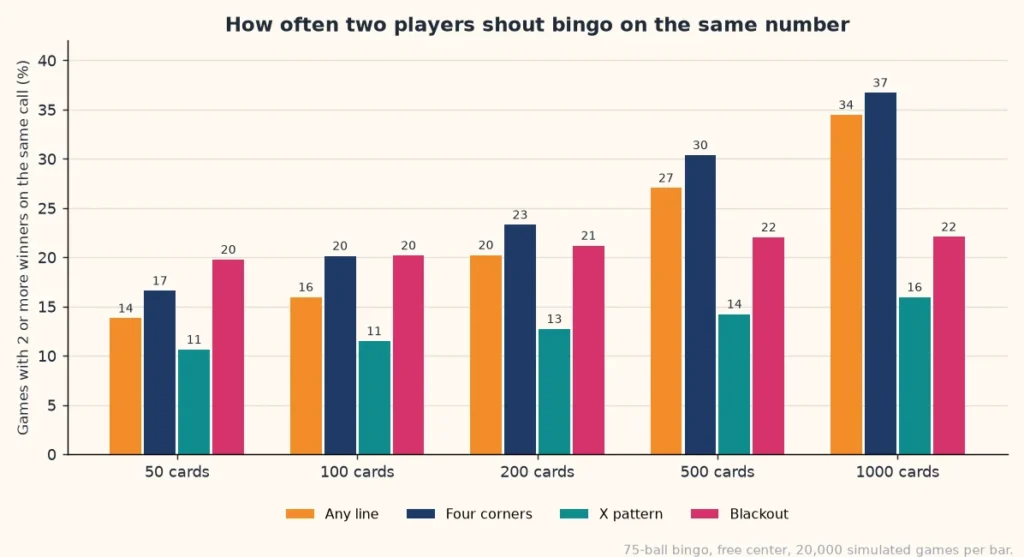
The first line of the table is a useful reality check. With 50 cards, about one round in seven ends in a tie. With 200 cards it is one in five, and with 500 cards it is more than one in four. At 1,000 cards, a third of rounds have a tie, and the average round has about 1.6 winners. Four corners behaves the same way, and is slightly worse, because a single four-number pattern is easier to complete on the same call.
The tie rate for blackout hardly moves with crowd size. It stays near 20 to 22 percent whether you have 50 or 1,000 cards, probably because most cards finish only when the last few balls arrive, so many of them finish together. That is useful to know: a bigger crowd will not make a blackout tie more likely, though it makes a line tie much more likely.
How many players win together in bingo for large groups?
It is not only pairs. The chart shows how the winners split when a single line round ends. At 500 cards, 73% of rounds have one winner, 18% have two, 6% have three and 3% have four or more. A round with five winners is a real event, and the largest tie we saw in the simulated games was 11 cards on one call.
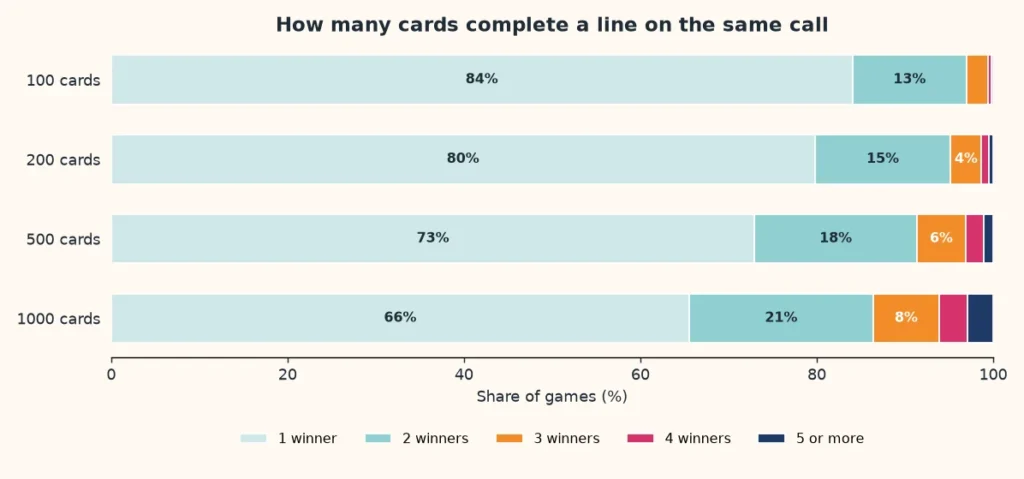
Plan the prizes around these shares. If you hold only one prize per round, then in roughly one round in four of bingo for 500 people you will need a tie rule. If you hold a pile of identical small prizes, a tie costs you almost nothing, and the whole question of bingo tie rules disappears. The next section covers both approaches to bingo tie rules.
Bingo tie rules: six ways to settle a shared win
Good bingo tie rules for large group bingo are short, announced before round one and applied the same way to everybody, whether the winners are the host’s friends or strangers. Here are six workable options for a crowd. Pick one, write it on the prize sheet and read it out loud.
| Rule | How it works | Best for | Watch out for |
|---|---|---|---|
| Split the prize | Tied players share the prize, or each gets one of equal value. | Cash or gift cards that divide evenly. | Prizes that cannot be split, such as a single gift. |
| Duplicate prizes | Every tied winner gets the same prize, so keep 2 or 3 spares of each. | Small gifts, vouchers, treats. | Running out: with 500 cards about one round in ten has three winners or more. |
| Play-off call | Each tied player secretly picks a number from 1 to 75. The caller makes one new call, and the closest number wins. | A single big prize. | Two players can be equally close. Add a second call. |
| Play on | The tied players keep their cards. The caller continues, and the first of them to complete a second line wins. | Fast single-line rounds. | Takes a few more calls and can confuse the room. |
| Card-number draw | Put the tied card numbers in a hat. The host draws one. | Quick settle, no extra calls. | Feels like luck on top of luck, which some players dislike. |
| Prize ladder | The tied winners take the current prize and the next one, so a tie never delays the round. | Prize tables with a clear order. | Needs enough prizes on the table, and one winner may feel cheated. |
Whichever of these bingo tie rules you choose, make it depend on something that cannot be argued about afterwards. The claim list with card numbers answers who shouted first only if the caller stopped immediately, so it is better not to make the first shout the tiebreaker. Same-call ties are decided by the number called, and a shout that comes a fraction of a second later does not break the tie.
A play-off call is the most satisfying rule for a stage prize and takes under a minute: ask each tied player to say a number between 1 and 75 into the microphone, press the call button once and compare. The caller keeps the call order inside the game, so run the play-off with the number that comes up next, then continue the game for the next round after a fresh shuffle with New game.
Choose a winning pattern that suits a large group of bingo players
The pattern is your pacing tool in bingo for large groups. A single line finishes quickly even in a small game, and in a crowd it ends in a flash: the median first line arrives after 12 calls with 500 cards, and a quarter of rounds end by call 10. That is too short for a room that has just spent ten minutes on registration. Use harder patterns later in the evening, and keep the easy line for warm-up and for rounds with a small prize.
| Pattern | Median call, 100 cards | Median call, 200 cards | Median call, 500 cards | Tie rate, 100 cards | Tie rate, 200 cards | Tie rate, 500 cards |
|---|---|---|---|---|---|---|
| Any line | 16 | 14 | 12 | 16% | 20% | 27% |
| Four corners | 25 | 22 | 19 | 20% | 23% | 30% |
| X (both diagonals) | 43 | 40 | 36 | 11% | 13% | 14% |
| Picture frame | 58 | 56 | 53 | 18% | 19% | 20% |
| Blackout (full card) | 64 | 62 | 61 | 20% | 21% | 22% |
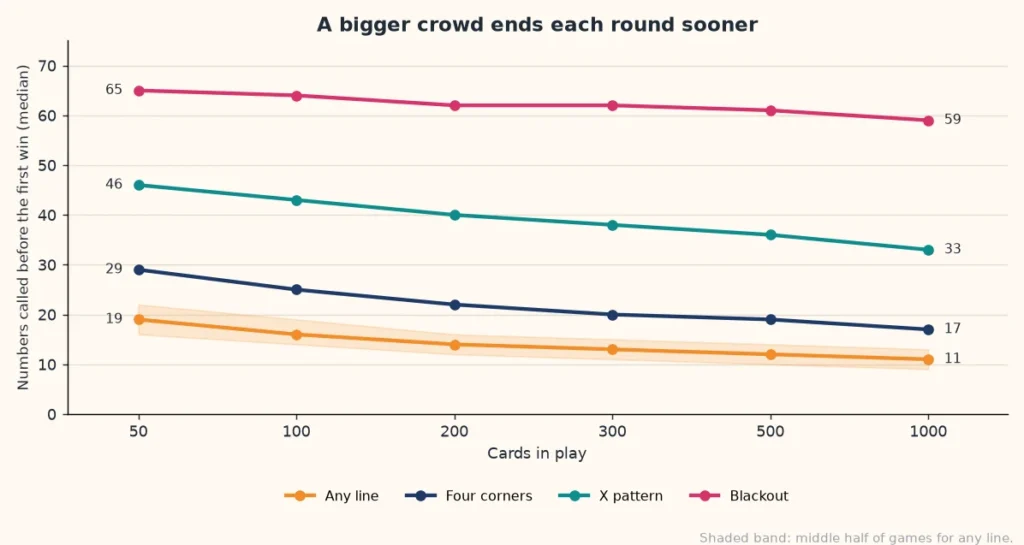
The caller has a winning pattern picker with small diagrams for any line, four corners, X, letter T, letter L, postage stamp, picture frame and blackout. Put the pattern on the big screen before every round so nobody has to ask. If you want drawings of the shapes, the guide to bingo patterns has them with the odds for a single card.
The X pattern is the most reliable for bingo for big groups. It takes a median of 40 calls with 200 cards, which is long enough for the room to follow, and it has the lowest tie rate (13%), so you will rarely need your tie rule. Four corners is quick and also the most tie-prone, so avoid it for your biggest prize. Blackout fits a closing round, and it needs about 62 calls whatever the crowd size.
Plan the rounds: a timed run sheet for 200 and 500 players
With a median call count per pattern from the simulation, you can build a realistic schedule. The table assumes one call every 6 seconds, 2 minutes to check a claim and award the prize, and 1 minute to clear cards and announce the next pattern. Medians mean half of the rounds run longer, so keep a buffer of about 20 percent.
| Round | Pattern | Median calls (200 cards) | Minutes (200 cards) | Median calls (500 cards) | Minutes (500 cards) |
|---|---|---|---|---|---|
| 1 | Any line | 14 | 4.4 | 12 | 4.2 |
| 2 | Four corners | 22 | 5.2 | 19 | 4.9 |
| 3 | X (both diagonals) | 40 | 7.0 | 36 | 6.6 |
| 4 | Picture frame | 56 | 8.6 | 53 | 8.3 |
| 5 | Blackout (full card) | 62 | 9.2 | 61 | 9.1 |
| Total | 194 | 34 | 181 | 33 |
Five rounds fit in about 34 minutes for 200 players and 33 minutes for 500, before the welcome and any break. A one-hour slot with a break is comfortable, and a game night with ten rounds needs two hours. The numbers will shift if you call faster or slower, so check the pace in a rehearsal with the caller running on auto.
Rounds also give you a natural way to keep large group bingo moving. A short line round for the first prize, a medium round for the second, then a long X or blackout round as the finale, with the largest prize last. Players who have not won yet stay hopeful, and winners are glad to watch the end.
The room: screen, caller and tables for bingo for 500 people
Bingo for 500 people needs a room that people can see and hear, and bingo for large groups of any size needs the same. The best layout puts the caller and the big screen at the front, a checker desk to one side of the aisle and tables in blocks of 100 cards, so a runner knows which area to run to. The figure shows a plan you can adapt for a hall, a gym or a cafeteria.
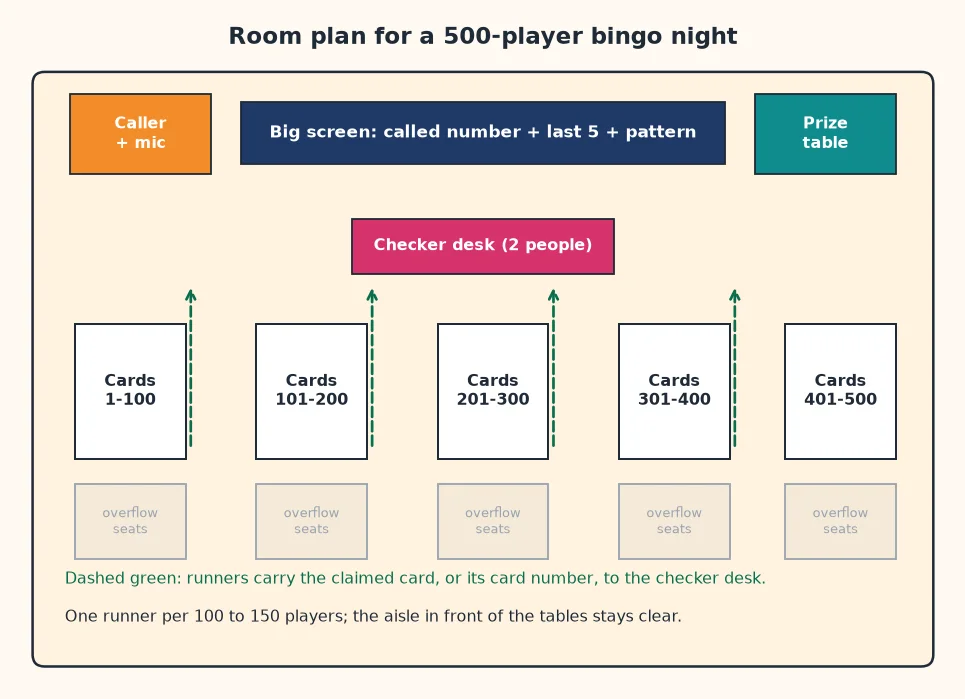
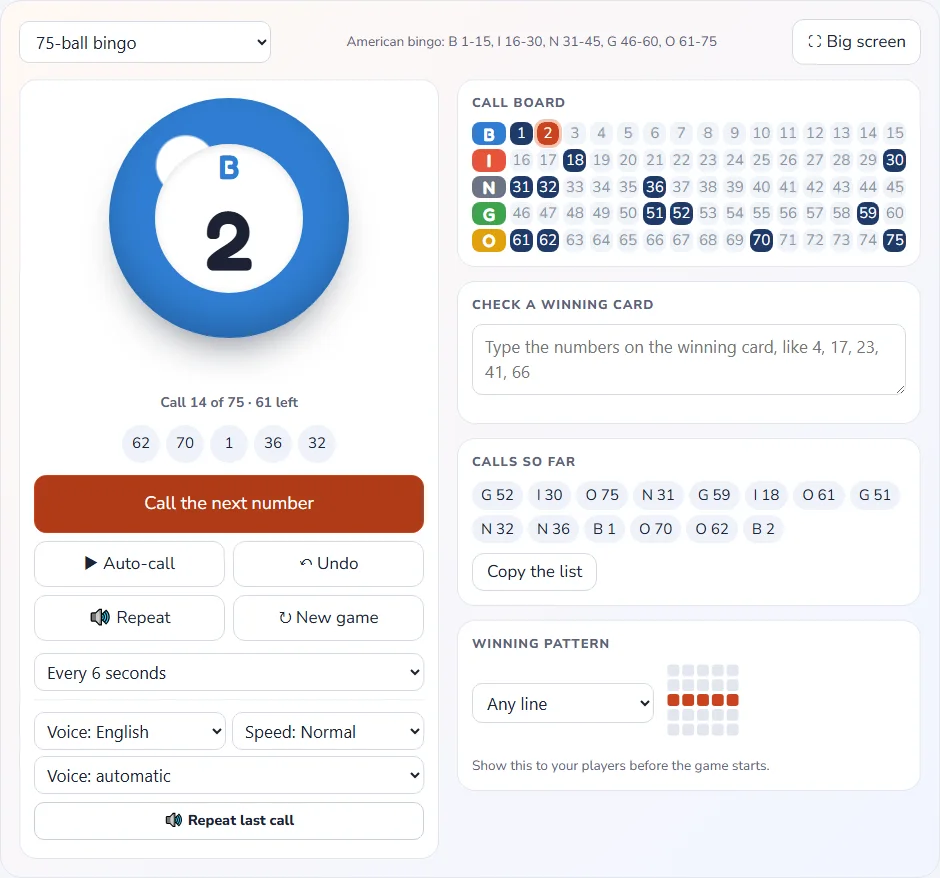
The free bingo caller has a big-screen mode for a TV, a projector or a screen share. It shows the last number in a large ball with the call board beside it, and Esc leaves the mode. Connect it to the projector, speak the numbers into a microphone as well, and the room both sees and hears every call. For a hall, put a second screen halfway back, or the back rows will miss the board.
The caller can also speak the numbers aloud in English or Hindi, using the voice of the device. Test the voice through the hall speakers during setup. Many hosts prefer a human voice for a big crowd and use the spoken call as a backup, since the human caller can add rhythm and fun. The guide to bingo calls and nicknames has the traditional nicknames and the B-I-N-G-O ranges if you want some patter for the stage.
The keyboard shortcuts that keep bingo for 500 people flowing
A caller running a crowd should not hunt for buttons. Space or Enter calls the next number, P pauses or restarts the auto-call, U undoes the last call and R repeats it. Practice them once with the screen on. If the caller says a number twice by mistake or calls the wrong one, Undo puts the board back, and Repeat helps the back of the room. The game is saved in the browser, so a reload does not lose the called numbers.
Prizes for bingo for big groups
In bingo for big groups, a prize table needs to match the round plan and the bingo tie rules. Aim for at least one prize per round plus a spare for ties, and give the big prize to the last round. Small prizes for early rounds keep the energy up and make the first winners feel rewarded without draining the budget.
| Round | Pattern | Prizes to hold for 500 cards | Prize idea |
|---|---|---|---|
| 1 | Any line | 2 | Small prize with 2 or 3 spares |
| 2 | Four corners | 2 | Small prize with 2 or 3 spares |
| 3 | X (both diagonals) | 2 | Medium prize, play-off call for a tie |
| 4 | Picture frame | 2 | Medium prize, play-off call for a tie |
| 5 | Blackout (full card) | 2 | Grand prize, play-off call for a tie |
The prize count column takes the simulated average number of winners per round (about 1.3 to 1.4 at 500 cards), rounds it up and adds a spare, so it covers an ordinary tie but not the rare four-way finish. If the prize can be split or replaced with a voucher, you never run short.
Rules about bingo, raffles and prizes differ by country, state and venue, and nothing in this guide is legal advice. If you charge for cards or give cash prizes, check the local requirements first. Many organizers play for free with donated gifts, and a school night or a company party often needs no more than a fun prize table.
Noise, fairness and keeping a big room calm
Large group bingo sounds nothing like a game of 30. People talk between numbers, and a missed call can lead to a missed bingo. These habits keep the room manageable.
- Call each number twice. Say it, pause for a heartbeat and say it again, or press Repeat. The Repeat button on the caller exists for this reason.
- Use a quiet signal. A bell, a clap pattern or a raised hand brings the room to attention before you announce a pattern or a claim.
- Keep a visible board. The call board on the screen lets a player who missed a number verify it without asking the caller to repeat.
- Set expectations on shouting. Ask players to shout “Bingo!” clearly and stay seated until a runner arrives, so nobody cuts across the aisle.
- Announce a pause rule. The caller says “Hold on” and everyone stops marking until the claim is settled.
- Share the check results. Say whether the claim was valid and why. Fairness in a crowd comes from visible process.
It also helps to open with a two-minute practice round before the first prize, where the caller calls five numbers and the players find them. A practice game teaches the call format and the claim routine, and it brings the room to order.
Accessibility: making large group bingo work for everyone
Bingo for large groups always includes someone who sees poorly, hears poorly or finds fast calling hard. Most of the fixes are cheap, and they make the game better for the whole room.
- Large print cards. The card maker lets you raise the text size and pick high-contrast colors. The large print bingo for seniors template is a 4 by 4 card with 125% text, one card per page.
- See and hear every number. Show the call board on a screen as well as speaking the number, so a player who cannot hear a call can read it.
- A slower pace for some rounds. Use 10 or 15 seconds per call for a round that is meant to be relaxed, and say so.
- Helpers on the floor. A volunteer per block of tables can mark a card for a player who asks, or read the last five calls from the screen.
- Seats near the front. Set aside a block of seats with a clear view of the screen and speakers.
- Plain words. Say “B 12” the same way every time and avoid jokes that depend on fast listening.
The caller offers English or Hindi spoken calls and a choice of voice and speed, so you can match the language of the room. Read the rules aloud as well as printing them, and never ask players to prove disability or anything personal. A game with options for everyone is good large group bingo.
Online and hybrid rooms
If part of the crowd is remote, an online game is easier than any paper plan: guests join a live game by link and their cards mark themselves. The play bingo online page runs a live 75-ball game with a host console, a TV view and spoken calls, and the custom bingo online game does the same for your own words. The live game suits dozens of guests at home, though bingo for 500 people in a hall should rely on printed cards, as above.
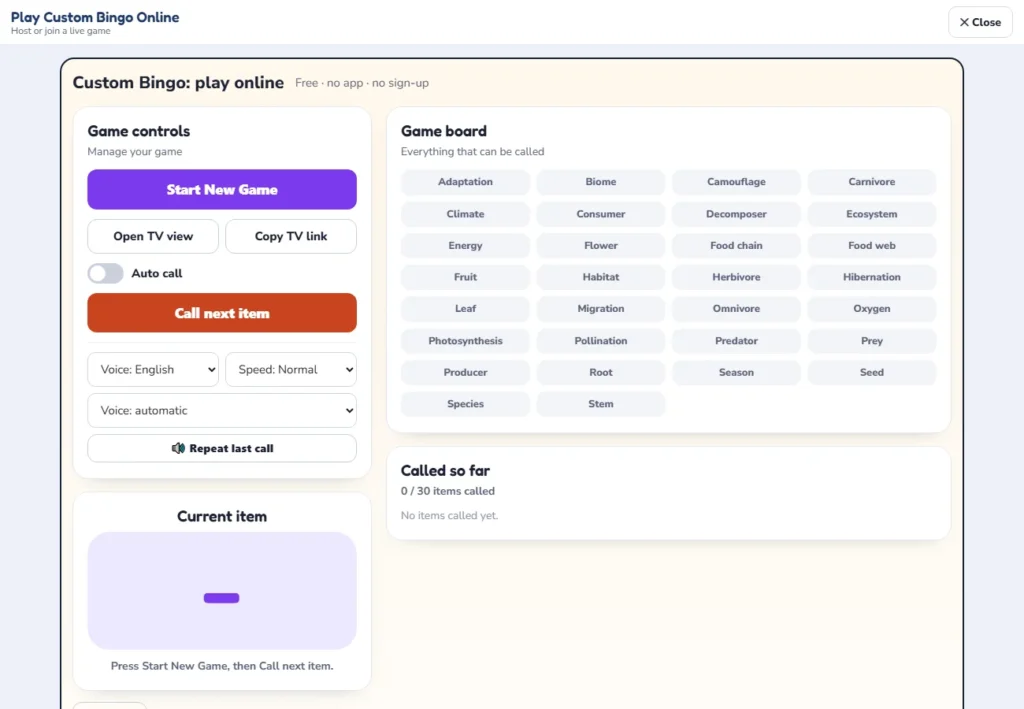
For a hybrid event, run the in-person game from the bingo caller and read the numbers into the meeting for the remote players, who play on the shared game. Keep the two games in step by calling the same number on both. If you need ideas for a smaller online group, the guide to playing bingo online with friends covers that.
A preparation timeline
Bingo for large groups fails on small details, and almost all of them can be fixed before the day. Work backwards from the event with this timeline, adjusting for how many people you expect.
| When | Task | Who |
|---|---|---|
| Two weeks before | Count the expected players and decide the number of rounds, patterns and prizes. Choose the tie rule and write the prize sheet. | Organizer |
| One week before | Make the cards in the bingo card generator, print every set with numbered cards, and cut and stack them by set. | Organizer, one helper |
| Three days before | Recruit checkers, runners and a caller. Run a practice game with the caller on auto-call at your chosen pace. | Caller, helpers |
| One hour before | Set up tables by card block, put the checker desk in the aisle and lay out the prize table. | All helpers |
| During the event | Run the rounds. Log every claim with card number, set and pattern. | Checkers |
If you run a school or workplace night for the first time, start smaller than you think: bingo for 100 people with four rounds teaches you more than a perfect plan. The same plan scales to bingo for 500 people once your helpers know their jobs. For game ideas for a class, see the guide to bingo activities for the classroom.
75-ball or 90-ball for a big crowd?
The numbers in this guide are for 75-ball bingo, the U.S. style with a 5 by 5 card, and the Wikipedia article on American bingo describes the same game and its B-I-N-G-O columns. Many groups in India and the UK play 90-ball instead, where each ticket holds 15 numbers on three rows, and prizes go to the first line, two lines and the full house.
The same ideas carry across to large group bingo in that style: numbered tickets, a visible caller, checkers and a tie rule. The tambola number caller calls 1 to 90 for that style, and the tambola ticket generator prints the tickets. Tie rates for 90-ball games differ from the 75-ball figures above, so run a rehearsal before you rely on any numbers from this guide for that format.
Mistakes that sink large group bingo
- No tie rule. In bingo for 500 people, more than one line round in four ends in a tie, so the argument arrives sooner or later.
- Unnumbered cards. A checker cannot find the card in a stack of 500 without a number.
- Patterns that are too easy. A line round lasts about 12 calls with 500 cards. The crowd just settled in, and the round is over.
- One checker for everything. Claims queue up, the game stalls and the room gets restless.
- A screen nobody can read. Check the text size from the back row at setup time.
- Calling too fast. The rhythm of 3 or 4 seconds suits a small online game, not a hall full of people with pens.
- Too few prizes. Hold spares for ties, or use a split or play-off rule that needs only one prize.
Fix those and a first-time organizer can run bingo for large groups smoothly. The printable bingo cards hub has ready-made themes if you want the cards to match the occasion, from holiday nights to fundraisers, and every one prints numbered cards in sets of up to 100.
Frequently asked questions
10 quick answers
How do you run bingo for large groups?
Give every player a different numbered card, show the called numbers on a big screen, choose a pattern that suits the crowd, and use two or more checkers and runners for claims. Announce your tie rule before round one. A hall of 200 to 500 players runs smoothly with five rounds and a prize table.
How do you play bingo for 100 people?
Print one set of 100 numbered cards, add 10 spares, and use a caller with a screen. Two checkers and one runner are enough. With 100 cards a line takes a median of 16 calls, and about 16% of rounds end in a tie, so have a rule ready.
Can you play bingo for 500 people?
Yes. You need five sets of cards (up to 100 per set), a projector and speakers, three checkers and about four runners. A line takes a median of 12 calls with 500 cards, so use harder patterns such as X or blackout for the main prizes.
How many bingo cards do you need for 200 players?
One per player plus about 10 percent spare, so 220 cards, which is three sets of 100 in the card maker. If players hold two cards each, plan 440 cards. Fewer cards per player means fewer missed bingos.
What happens if two people win bingo at the same time?
Apply the tie rule you announced: split the prize, give each winner the same prize, run a play-off call or play on. About 20% of single-line rounds with 200 cards have two or more winners on the same call.
What are fair bingo tie rules?
A fair rule is announced before the game, applies to everyone and does not depend on who shouted first. Splitting the prize, duplicate prizes and a play-off call are the three most common. Pick the one that matches your prize.
Is large group bingo different from regular bingo?
The rules are the same. What changes is the planning: more cards, numbered cards, helpers for claims, a big screen, a harder pattern and a tie rule. These make a big game run as smoothly as a small one.
Which winning pattern is best for a big crowd?
The X pattern. It takes a median of 40 calls with 200 cards and has the lowest tie rate of the patterns we tested, at about 13%. Use a line for warm-up and blackout for the final round.
How fast should the caller go in a big hall?
About one number every 6 to 8 seconds. The caller has an auto-call timer from 3 to 30 seconds and a pause button. Slow down for older players or new players, and call each number twice for a noisy room.
How do you check a bingo claim in a large room?
A runner reads the card number to a checker, who types the numbers from the card into the Check a winning card box of the caller. It says whether all the numbers were called. Then the checker confirms the pattern and the caller announces the result.