To learn how to play bingo, you only need three things: a card with a grid of numbers, a caller who draws numbers at random, and a pen or chips to mark what is called. The caller announces numbers one at a time, players mark any number that is on their card, and the first player to complete the winning pattern shouts “Bingo!”. This guide covers the bingo rules for the classic 75-ball game, step by step, with free cards and a free caller you can use today.
In short: each player gets a 5 by 5 card with a free center square. The caller draws a number, such as “B 7” or “G 52”, and players mark it if it is on their card. The first card with five marked squares in a row, column or diagonal wins, unless the host has chosen a different pattern for the round.
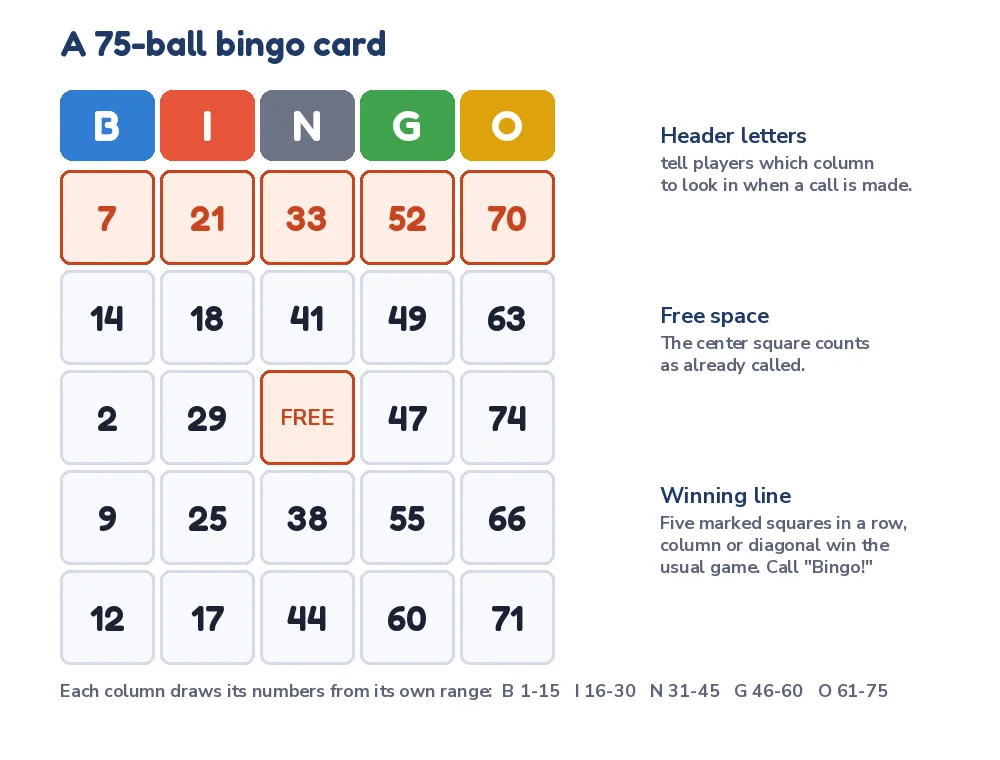
How to play bingo in 7 simple steps
Whether you are hosting a family game or learning how to play bingo for the first time at a party, the order of play is the same. These seven steps are the whole game, and the sections below explain each one in more detail.
- Give every player a card. Print cards with the bingo card generator or pick a ready-made set from the printable bingo cards hub.
- Choose the winning pattern. A single line is the usual first round. Tell everyone the pattern before the first call.
- Pick a caller. One person (or the free bingo caller) draws numbers one at a time and says them clearly.
- Call a number. The caller says the letter and the number, for example “N 38”, and the number is out of play.
- Mark your card. If the number is on your card, cover it with a chip or cross it out. The center square is free.
- Call “Bingo!” when the pattern is complete. Shout it right away so the caller can stop the game.
- Check the card and award the prize. The caller reads the winning numbers back and compares them with the numbers called. If they all match, the player wins and everyone clears their cards for the next round.
That is how to play bingo from start to finish. A single round of 75-ball bingo with a handful of players usually ends within 20 to 40 calls, so a game rarely feels long. You will find exact figures in the game-length section further down.
What you need before the first call
Bingo needs very little equipment, which is part of why it works at home, in a classroom and in a community hall. This table lists the essentials for learning how to play bingo, and an easy way to get each one.
| Item | What it is for | Easy way to get it |
|---|---|---|
| Bingo cards | One grid of numbers per player; each card has a different arrangement | Print free cards from the bingo card generator (up to 100 different cards per set) |
| Number source | Something that draws numbers 1 to 75 at random without repeating | The free bingo caller, a bingo cage, or numbered slips in a bag |
| Markers | Chips, coins, dried beans, stickers, or a pen to cross out numbers | Pens for paper cards; reusable chips if you laminate the cards |
| A caller | Reads each number out and checks winning cards | The host, a volunteer, or the caller on a screen |
| Prizes | Something for each round (optional) | Small gifts, stickers, or bragging rights |
| A call record | A board or list of numbers already called, used to check a claim | The caller’s call board, or a printed bingo number chart |
Bingo rules: understanding the 75-ball card
The most common version in the United States and in many classrooms is 75-ball bingo, and it is the version most guides start with. Each card is a 5 by 5 grid with the letters B, I, N, G and O across the top. Every column draws its numbers from its own range, which is why a call always includes a letter: it tells you which column to look in.
| Column | Numbers it can contain | Squares on the card | Example call |
|---|---|---|---|
| B | 1 to 15 | 5 numbers | B 7 |
| I | 16 to 30 | 5 numbers | I 22 |
| N | 31 to 45 | 4 numbers and the free space | N 38 |
| G | 46 to 60 | 5 numbers | G 52 |
| O | 61 to 75 | 5 numbers | O 69 |
A card holds 24 numbers plus the free space. Because every column has only 15 possible numbers, but just five squares to fill, a column is never the same twice in a set of good cards. Counting the order of the numbers inside each column, there are about 5.5 × 1026 different 75-ball cards, which is why a printed set of 100 never repeats.
The free space in the middle
The center square of a classic card is free. It counts as already called, so it helps any pattern that passes through the middle: the middle row, the middle column and both diagonals. This is a core part of the bingo game rules, and it is the reason the free space makes a card a little quicker to complete.
How to play 75 ball bingo: a round from start to finish
Here is a worked example of how to play 75 ball bingo, so you can picture a real round before you host one. The pattern for this round is a single line.
- The caller announces: “This round is a single line. Rows, columns or diagonals all count. Good luck!”
- The first number is “O 66”. Players look in the O column. Anyone with 66 marks it.
- The caller keeps drawing: “B 4”, “G 51”, “I 19”. After each call, a quick pause gives players time to find the number.
- A player has marked four numbers in a row and the free space in a diagonal. They shout “Bingo!” as soon as the line is complete.
- The caller says “Hold on, checking.” The player reads their five winning numbers. The caller confirms each one was called.
- The player wins the round. Everyone clears their cards, and the next round begins with a new pattern or the same one.
Calling clearly and keeping a steady pace matters more than speed. If you use a screen caller, the bingo caller shows the last five calls so nobody has to ask “What was that last number?”.
Bingo game rules for winning: patterns and claiming a bingo
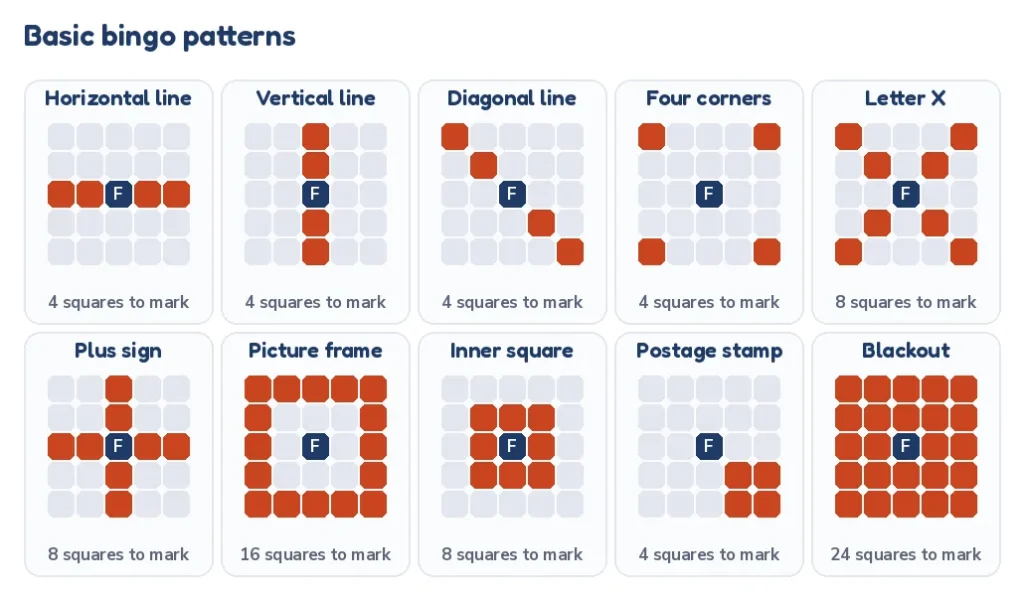
The standard bingo game rules say that the first card to complete the chosen pattern wins. Any single line is the classic pattern, but many games add shapes to keep an evening interesting. Here are the ten patterns used most often. For the full picture sheet and the odds of each, see our guide to bingo patterns.
How to claim a bingo
Claiming correctly is the part new players forget. Shout “Bingo!” clearly as soon as your pattern is complete, and keep your card untouched. The caller then pauses the game and checks the numbers. In most games a claim made after the next number is called does not count unless the host decides otherwise, so it pays to watch your card closely.
House rules to agree before you start
- Ties. If two players call “Bingo” on the same number, they either split the prize or play a short tie-break round.
- False bingo. If a claim turns out to be wrong, the player is out for that round but keeps playing the next one. Say this out loud before the first round.
- Late calls. Decide whether a claim must come before the next call. A simple rule is: before the next number is spoken.
- Free space. Confirm that the center square is free, and say whether it counts for corner patterns (it does not, because the corners are far from the middle).
- One card or many. Allow one card per player for fairness, or let players buy more cards and accept that they are more likely to win.
How to win at bingo: what helps and what does not
Bingo is a game of chance, so there is no secret system, but a few things do change your odds. If you are wondering how to win at bingo or simply how to play bingo better, the honest answer is that the number of cards you hold and the pattern being played matter most.
More cards means a faster win
Each extra card is another chance to complete the pattern earlier. We simulated thousands of games of 75-ball bingo with free-center cards like those the generator prints and recorded the call on which the first single line appeared. The table shows the median number of calls, with the middle half of games in brackets:
| Pattern | 1 card | 10 cards | 30 cards | 100 cards |
|---|---|---|---|---|
| Any single line | 41 (34 to 48) | 26 (22 to 30) | 21 (17 to 23) | 15 (13 to 18) |
| Four corners | 64 (54 to 70) | 40 (32 to 47) | 33 (26 to 39) | 24 (19 to 29) |
| Letter X | 70 (65 to 73) | 55 (50 to 59) | 48 (44 to 53) | 42 (39 to 46) |
| Blackout (every square) | 74 (72 to 75) | 69 (67 to 70) | 66 (64 to 68) | 64 (62 to 65) |
A lone card needs around 41 calls to complete a single line, but a room with 30 cards in play usually has a winner after about 21. Holding two or three cards instead of one therefore improves your chance noticeably. Giving every player the same number of cards keeps things fair.
What does not help
- Lucky numbers. Every number is equally likely to be called, so no number is “due” and none is luckier than another.
- Choosing a particular card. A random card is as good as any hand-picked one, because each card is a random arrangement.
- Marking faster. You only need to mark accurately and keep up with the caller. Speed does not change who wins, but missing a number does.
The odds for a single card
The chart shows the chance that one card has completed a particular fixed pattern after a given number of calls. The fixed shapes are harder than “any line”, which is why a game that accepts any line ends so much sooner.
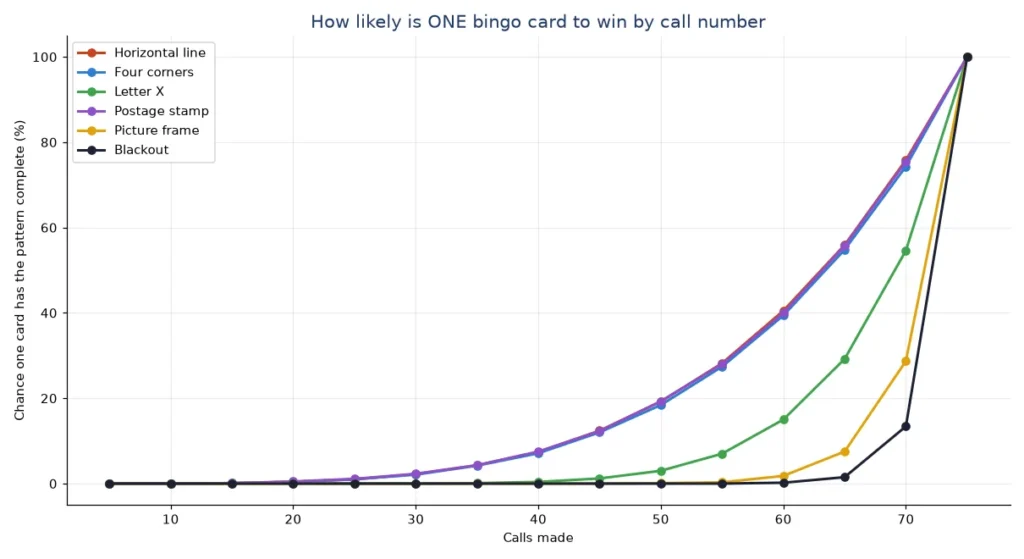
For example, after 45 calls a single card has completed the middle row with a probability of about 12.4%, and completed the four corners about 12.0% of the time. By call 70 these odds have climbed to 75.8% and 74.3%. Blackout is rarely finished before the last few calls: only about 13.4% of single cards have it by call 70.
How long does a game of bingo take?
You can plan an evening with the table above. If the caller makes a call every 10 seconds, 21 calls (a single line with 30 cards in play) take about 3.5 minutes, while a blackout at 66 calls takes about 11 minutes. Add a minute between rounds to check cards and award prizes. A good rule of thumb is to start with short rounds, such as a single line or four corners, and finish with the long ones.
| Seconds between calls | 21 calls (typical line round) | 40 calls (X round) | 66 calls (blackout) |
|---|---|---|---|
| 5 | 1.8 min | 3.3 min | 5.5 min |
| 8 | 2.8 min | 5.3 min | 8.8 min |
| 10 | 3.5 min | 6.7 min | 11.0 min |
| 15 | 5.2 min | 10.0 min | 16.5 min |
| 20 | 7.0 min | 13.3 min | 22.0 min |
Setting up bingo night with friends and family
Learning how to play bingo at home takes about five minutes, and the game works with two players or twenty. Because every guest only needs a card and something to mark with, you can set up an evening of bingo around the dinner table or in the living room without buying anything. If you know the game with printed cards, you also know it with word cards, picture cards and online cards, because the rules do not change.
A simple plan for a family bingo night
- Print one card per person from the bingo card generator and add a few spares. Giving every child their own card keeps the game friendly.
- Decide the plan for the evening: a single line for the first round, then four corners and a letter X.
- Put the call board where everyone can see it, or open the free bingo caller on a TV so the called numbers stay visible.
- Agree the rules for ties and late claims out loud, so nobody feels cheated.
- Play 4 or 5 rounds with small prizes such as stickers, snacks or choosing the next film.
Hosts often ask how to make bingo work for younger and older players equally. The answer is to use shorter patterns for little ones and let them mark with stickers. An adult can sit beside a child and help scan the column, which turns the game into a number-recognition lesson.
Mistakes beginners make, and easy fixes
Even when people understand how to play bingo, a few small mistakes slow the game down. These are the ones to watch for, along with an easy fix for each:
- Not checking the column letter. If a call is “G 52”, look only in the G column. Searching the whole card wastes time.
- Marking the wrong number. Marking 25 instead of 52 can lead to a false bingo. Say each number back quietly to yourself.
- Forgetting the free space. New players sometimes wait for a number in the center. The free square is already marked.
- Calling bingo too early. Check your pattern before shouting. A false claim removes you from the round in most games.
- Calling too fast. Hosts who rush lose players. A relaxed pace is part of running a good game.
- No record of called numbers. Without a board, a disputed claim is hard to settle. Use a call board every time.
With these points covered, learning the game is really just a matter of practice. After one or two rounds, most beginners are marking numbers as quickly as experienced players.
How to play bingo for beginners: tips for your first game
If you are new to the game, these tips on how to play bingo for beginners will help you feel confident in the first round, whether you are playing or hosting.
Tips for new players
- Look at the column letter first: it narrows your search to 15 numbers.
- Mark with something you can see clearly. Bright chips beat tiny crosses.
- Keep your card in front of you and do not stack cards on top of each other.
- Read your winning numbers back slowly when you are asked to confirm.
- Ask the caller to repeat a number rather than guessing.
Advice for first-time hosts
- Start with one simple pattern and add shapes in later rounds.
- Use a call board or the screen caller so you can prove which numbers were called.
- Keep prizes small and fun. The cheers are the point.
- Do a practice call so everyone hears how the letters and numbers sound.
- Break after an hour: bingo is best in short, lively sessions.
Bingo for beginners: other versions of the game
Bingo for beginners usually means the 75-ball game above, but it is useful to know the main versions, because you will meet them at parties and in other countries.
| Version | Card layout | Numbers | Typical prize | Where to start |
|---|---|---|---|---|
| 75-ball bingo | 5 by 5 grid with a free space | 1 to 75, with B-I-N-G-O letters | Line, shape or blackout | Bingo card generator |
| 90-ball bingo and tambola | 3 rows by 9 columns, 15 numbers | 1 to 90 | Line prizes and a full house | How to play tambola |
| 80-ball bingo | 4 by 4 grid | 1 to 80 | Line or full card | Bingo caller |
| Junior 30-ball bingo | 3 by 3 grid | 1 to 30 | Any line (fast games) | Junior cards in the card maker |
| Word and picture bingo | 3 by 3 to 7 by 7 with words or pictures | Your own list | Line or full card | Picture bingo for kids |
Bingo with kids, at parties and in the classroom
The same bingo rules work with any list of words or pictures, which makes the game flexible. Teachers use word cards for reading, parents use picture cards for toddlers and party hosts use custom squares so guests mark moments as they happen. Here are good starting points:
- Classroom bingo for review games and vocabulary.
- Baby shower bingo where guests mark gifts as the parent opens them.
- Christmas bingo for family dinners and school parties.
- Human bingo to get a group talking.
- Road trip bingo for the car.
- Blank bingo cards when you want to fill every square yourself.
When your group is not in the same room, the same rules work online. Our play bingo online game gives every guest a self-marking card on their phone, and the guide to playing bingo online with friends explains the setup.
Free bingo tools to use with this guide
Everything below is free and runs in your browser. Use them together to put what you learned into practice.
- Bingo card generator: make custom cards with numbers, words or pictures and print a PDF.
- Free bingo caller: draw and announce numbers with a board, voice and winner checker.
- Bingo number chart: a printed master board of all 75 numbers.
- Printable bingo cards: the full library of themed bingo sets.
- Tambola number caller: for the 90-number version.
For the story and variations of the game, the Wikipedia article on American bingo is a good overview.
Frequently asked questions
11 quick answers
How do you play bingo for beginners?
Here is how to play bingo in one sentence: give everyone a card, pick a winning pattern and have a caller draw numbers one at a time. Players mark each called number that is on their card, and the first to complete the pattern shouts “Bingo!” and has the card checked.
What are the basic bingo rules?
Each card has a grid of numbers with a free center square. The caller draws numbers without repeating them, players mark matches, and the first card to finish the agreed pattern wins. The caller verifies the win before awarding the prize.
How many numbers are in 75-ball bingo?
There are 75 numbers, split into five columns: B has 1 to 15, I has 16 to 30, N has 31 to 45, G has 46 to 60 and O has 61 to 75. A card uses 24 of them plus the free space.
How do you win at bingo?
You win by completing the chosen pattern before anyone else. Since bingo is a game of chance, the best things you can do are play more cards if the rules allow it, mark carefully so you do not miss a number, and call “Bingo” as soon as you complete the pattern.
What is the free space on a bingo card?
The free space is the center square. It counts as already marked, so it helps lines and shapes that pass through the middle.
What happens if two people win at the same time?
They share the prize or play a tie-break round. Decide which one you will use before the game starts, and tell everyone.
How long does a bingo game last?
A single-line round with a room of 30 cards usually ends after about 21 calls, which is a few minutes at a call every 10 seconds. A blackout takes around 66 calls.
Can I play bingo without a caller?
Yes, and you can still follow the same steps. Use a free online bingo caller, a bingo cage, or numbered slips drawn from a bag. Keep a record of the called numbers so you can check a winning card.
Is bingo the same as tambola or housie?
They are close relatives. Tambola and housie use 90 numbers and a 3 by 9 ticket, while American bingo uses 75 numbers and a 5 by 5 card. Read our how to play tambola guide for the 90-number version.
How do I teach children how to play bingo?
Start with a 3 by 3 card and a single line, call numbers slowly and let children mark with stickers. After a round or two they understand the game, and you can move to 4 by 4 and 5 by 5 cards.
Where can I get free bingo cards to print?
Once you know how to play bingo, use the bingo card generator to make a set of up to 100 different cards, or browse the printable bingo cards library for themed sets.