Cumulative GPA is your grade point average across every graded term at your school: total quality points divided by total graded credits. It differs from your term GPA, which covers a single semester, and from other numbers on a transcript. This guide shows the arithmetic, a four-term example, and how rounding and repeats change the number.

What is cumulative GPA?
It is the running average of all your grades at one school. The University of Maryland registrar describes it as the calculation of all grades earned there through the most recent graded term, while the semester GPA covers one term only. Each course counts in proportion to its credits, so a 4 credit class affects the number more than a 1 credit class.
Wikipedia notes that it is also written CGPA, and that students may be required to keep a certain GPA to stay in a program, and that grades are used in decisions about financial aid and scholarships. Those rules are set by the school, which is why it pays to know exactly how yours is calculated.
Which GPAs appear on a transcript?
Transcripts often show several averages. The University of Illinois registrar lists four, which makes a good example of the differences.
| GPA name | What it covers | Used for |
|---|---|---|
| Term (semester) GPA | Grades from one term | Dean’s list, probation checks, spotting a trend |
| Total institution (cumulative) GPA | All courses completed at that school | Graduation requirements and academic standing checks |
| Total transfer GPA | Courses taken outside the school | Shown separately; usually not mixed into the school GPA |
| Overall GPA | Institution and transfer courses combined | Applications that ask for every college course |
Some departments also compute a major GPA from courses in your field. That number is not standard, so ask your department how it is defined before you plan around it.
How to calculate cumulative GPA, step by step
- For every graded course, multiply its grade points by its credits to get quality points.
- Add the quality points from all terms.
- Add the graded credits from all terms.
- Divide total quality points by total graded credits and apply your school’s rounding rule.
Courses without a letter grade, such as pass/fail, audit or withdrawn, are usually left out. At Georgia Tech, for example, courses taken pass/fail or audit are not part of the average, and the registrar’s example leaves a 3 hour pass/fail course out of an 11 hour schedule.
Here is a four-term example. The last column is the running cumulative GPA after each term.
| Term | Credits | Term GPA | Quality points | Total credits | Cumulative GPA |
|---|---|---|---|---|---|
| Fall year 1 | 15 | 3.60 | 54.0 | 15 | 3.60 |
| Spring year 1 | 12 | 2.80 | 33.6 | 27 | 3.24 |
| Fall year 2 | 18 | 3.20 | 57.6 | 45 | 3.23 |
| Summer year 2 | 6 | 4.00 | 24.0 | 51 | 3.32 |
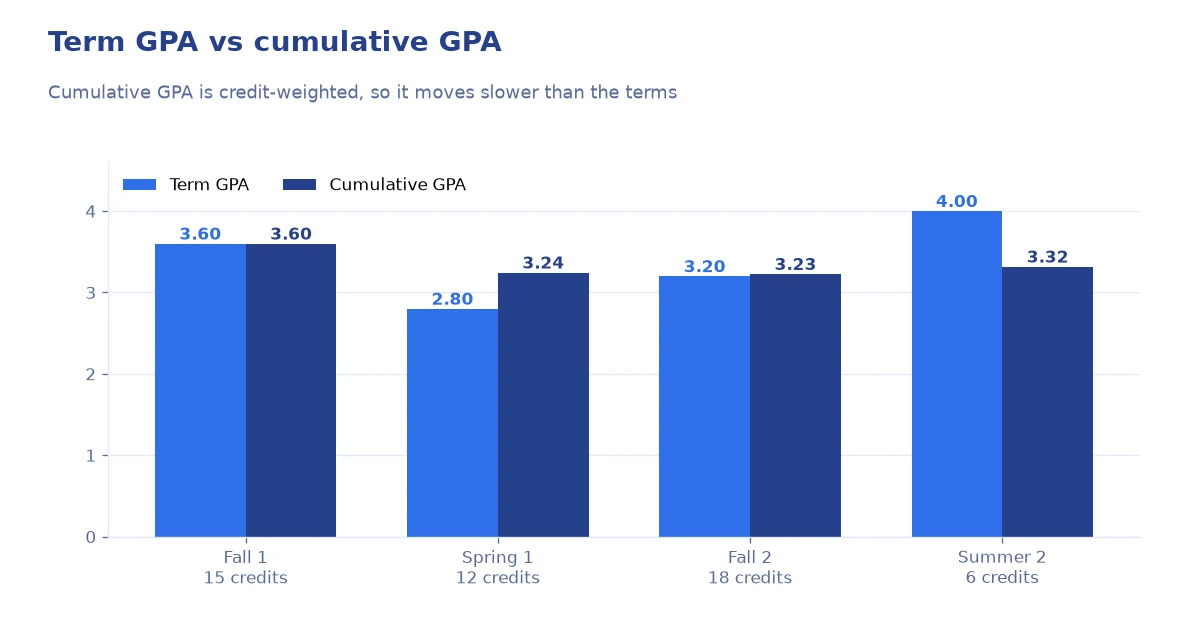
The final cumulative GPA is 169.2 ÷ 51 = 3.32. Averaging the four term GPAs instead gives 3.40, which is wrong because it treats a 6 credit summer term as equal to an 18 credit semester. Always weight by credits.
You can enter your own terms in our college GPA calculator, which adds a previous GPA and credits if you are partway through your degree.
Why your GPA moves slowly as credits add up
The more credits you have, the less one term can change the average. The table adds one 15 credit term of straight As to a 3.00 GPA, and one term of straight Cs to it.
| Credits before the term | After a 4.0 term | Change | After a 2.0 term | Change |
|---|---|---|---|---|
| 15 | 3.50 | +0.50 | 2.50 | -0.50 |
| 30 | 3.33 | +0.33 | 2.67 | -0.33 |
| 60 | 3.20 | +0.20 | 2.80 | -0.20 |
| 90 | 3.14 | +0.14 | 2.86 | -0.14 |
| 120 | 3.11 | +0.11 | 2.89 | -0.11 |
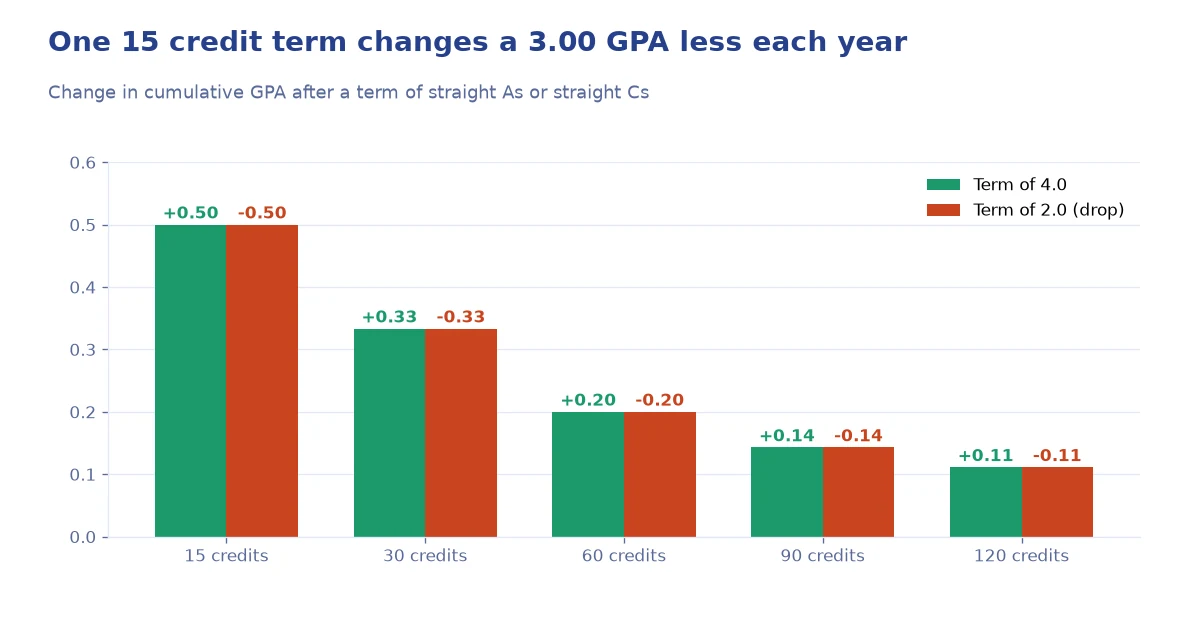
This works in both directions. Early on, a rough semester hurts more and a strong one helps more. Late in a degree, recovery takes more credits than most students have left, so the best time to act is early.
How GPA is calculated at different schools: rounding and repeats
Two schools can compute the same grades into slightly different numbers. Illinois shows quality points of 35 over 16 GPA hours, which is 2.1875, and reports it as 2.18 because the transcript GPA is truncated, not rounded. Georgia Tech also truncates after two decimals. Standard rounding would give 2.19 for the same numbers.
| Policy | Example from a registrar | Effect |
|---|---|---|
| Truncate after two decimals | Illinois and Georgia Tech | 2.1875 shows as 2.18 |
| Both attempts count | Georgia Tech: later grade does not replace the earlier one | A retake adds a second grade, so the old low grade keeps weighing on the average |
| Grade replacement | University of Cincinnati: only the newest approved attempt counts, up to 18 semester credit hours | The old grade stays on the transcript but leaves the GPA |
| Non-graded marks excluded | Maryland: I, P, S, W and NGR marks are not in the GPA | Credits earned but GPA unchanged |
Take 60 credits at a 3.00, then add a 3 credit D (1.0). Your GPA falls to 2.90. If you retake it and earn a B (3.0) and both attempts count, the average is 2.91. If your school replaces the D with the B, it is 3.00. Check which rule applies before you plan a retake. The calculator has a “Not counted” option for the old attempt when your school replaces it.
How is GPA calculated for transfer and pass/fail courses?
Transfer credit often counts toward your degree without counting toward your GPA. Georgia Tech states that transfer grades do not apply toward its GPA. If you plan to apply to graduate or professional school, application services may recalculate your GPA including every college course, so the school GPA is not always the one a program sees.
Attempted, earned and GPA credits: which ones count
Schools use three credit totals, and only one of them is in the GPA denominator. Attempted credits are what you registered for, earned credits are what you passed, and GPA credits are the graded courses that carry grade points. An F counts in the GPA as zero, while a withdrawal normally does not.
| Course | Attempted credits | Grade | GPA credits | Earned credits | Quality points |
|---|---|---|---|---|---|
| Calculus | 4 | A | 4 | 4 | 16.0 |
| English | 3 | B | 3 | 3 | 9.0 |
| Biology | 3 | C | 3 | 3 | 6.0 |
| Art history | 3 | F | 3 | 0 | 0.0 |
| Elective | 3 | W | 0 | 0 | 0 |
Quality points are 16.0 + 9.0 + 6.0 + 0 = 31.0 over 13 GPA credits, a GPA of 2.38. The same schedule shows 16 attempted credits and 10 earned credits. The withdrawal changes neither the GPA nor the quality points, but the F does, and it also leaves earned credits below attempted credits. Policies on withdrawals and failing grades vary, so use this as a pattern and not as a rule.
Free tools for tracking your GPA
- College GPA calculator: add terms and get cumulative and target GPA
- GPA calculator: high school and weighted GPA
- Final grade calculator: what you need on the final to hold a course grade
- Weighted grade calculator: a course grade from weighted categories
- Percentage calculator: convert scores before they become grades
- Homework planner printable: schedule the work behind the grades
Related guides: Good GPA in college (what counts as good for standing, honors and graduate school); GPA conversion chart (letter, percent and 4.0 scale lookups).
Sources
University of Maryland Registrar: GPA Calculation; University of Illinois Registrar: Calculate Your GPA; Georgia Tech Registrar: Grade Point Average Calculation; University of Cincinnati: Grade Replacement Policy; Wikipedia: Grade point average. Rules differ by school, so check your own catalog.
Frequently asked questions
7 quick answers
What does cumulative GPA mean?
It is the average of all your grades at one school, weighted by credits: total quality points divided by total graded credits. It differs from the term GPA, which covers a single semester.
How do I work out the overall average from my semesters?
Multiply each course’s grade points by its credits, add the quality points from every term, and divide by the total graded credits. Do not average semester GPAs, because terms with more credits should count more.
What is the difference between term GPA and the running average?
Term GPA covers one semester, and the running average covers all graded terms at your school. Schools often check the term number for probation or the dean’s list and the running average for graduation, but each school sets its own rules.
How is GPA calculated at my school?
Most schools use quality points divided by credits, but details differ: plus/minus values, rounding or truncating, how repeats are handled, and whether transfer courses count. Your registrar’s page is the authority.
Can I raise it after many credits?
Yes, but slowly. The more credits on record, the less one term moves the average, so use a planner to see how many credits of a given GPA you need to reach a goal.
Do pass/fail courses count?
Usually they do not. Pass/fail, audit and withdrawn marks normally carry no grade points, so they affect credits earned but not the average. Some schools treat a failing grade in a pass/fail course differently, so check your policy.
Is overall GPA the same as cumulative GPA?
Not always. At some schools overall GPA combines your courses there with transfer courses, while the institution GPA covers only that school. Check which one a scholarship or program asks for.