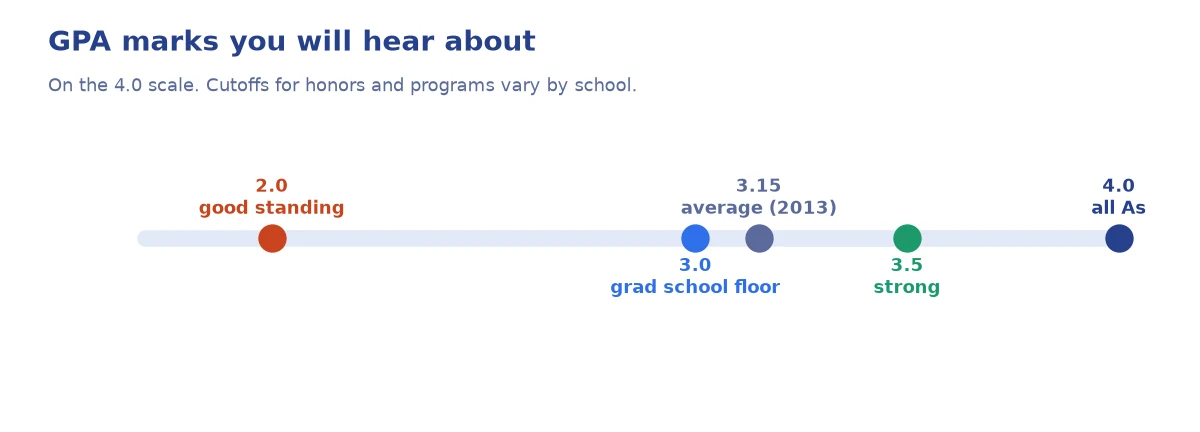
A good GPA in college depends on what you are aiming for: 2.0 is the usual line for good standing and graduation, about 3.0 is the common floor for graduate programs, and the average undergraduate sits near 3.15. This guide turns those numbers into goals you can plan for, with tables for how many credits it takes to move your GPA.

What is a good GPA in college for each goal?
There is no single good GPA in college, because the number only means something against a goal. These are the marks that schools and programs actually publish, with where each one comes from.
| Goal | GPA mark | Where the mark comes from |
|---|---|---|
| Stay in good standing and graduate | 2.0 | Policies at schools such as Emporia State and Stephen F. Austin; your own catalog is the rule |
| Average US undergraduate | About 3.15 | GradeInflation.com reports about 3.15 by 2013 at four-year schools in its database |
| Graduate school minimum | 3.0 (A = 4.0) | The Illinois Graduate College sets 3.0 over the last two years of undergraduate study as a minimum; programs can ask for more |
| Dean’s list or honors | Set by your college | Each school publishes its own cutoff and the term or credit rules that go with it |
A mark in this table is a floor, not a promise. A good GPA in college is the one that clears the line for your next step, and meeting a graduate minimum, for example, only makes you eligible to apply, while departments often admit students well above it.
What each GPA looks like in real grades
It helps to picture a GPA as a mix of grades. The table uses a 15 credit semester of five 3 credit courses on the common 4.0 plus/minus scale, where A- is 3.7 and B+ is 3.3, as the University of Maryland registrar publishes it.
| Target (nearest) | One way to get there in five courses | Semester GPA |
|---|---|---|
| 2.0 | C, C, C, C, C | 2.00 |
| 2.5 | B, B-, C+, C+, C | 2.46 |
| 3.0 | B, B, B, B, B | 3.00 |
| 3.3 | A, B+, B+, B, B | 3.32 |
| 3.5 | A, A, B+, B+, B | 3.52 |
| 3.7 | A, A-, A-, A-, B+ | 3.68 |
| 3.9 | A, A, A, A, A- | 3.94 |
Most targets can be reached in many ways, so use the pattern as a picture, not a recipe. A single C among four A grades still leaves a 3.60, which is why one weak course rarely decides a GPA by itself.
Is a 3.5 GPA good? What about a 3.0?
A 3.5 is good by almost any measure. It sits halfway between B+ and A-, and it is well above the 3.15 average, so it clears the usual graduate minimum. Whether it earns the dean’s list or Latin honors depends entirely on your school, since cutoffs differ and some schools use class rank instead.
A 3.0 is a B average. It is solid, it is above the 2.0 floor by a full letter grade, and it meets the common graduate minimum, but it sits slightly below the national average. If a program ranks applicants against each other, a 3.0 alone will not stand out, so grades in your major and in recent terms matter more.
The average college GPA and how yours compares
GradeInflation.com collects grade data from US colleges and reports that the average college GPA was about 3.15 by 2013, and that 45 percent of all A to F grades were As. It also finds private colleges about 0.2 points higher than public ones on average. Averages move over time and differ a lot between schools and majors, so compare yourself with your own program first.
Be careful with averages as a target. If most grades are As and Bs, the average sits near a B+ and a 3.0 can feel low even though it is a solid B. The more useful question is whether your GPA clears the line for the next step you want, which is why the goal table comes first.
How many credits does it take to reach a GPA goal?
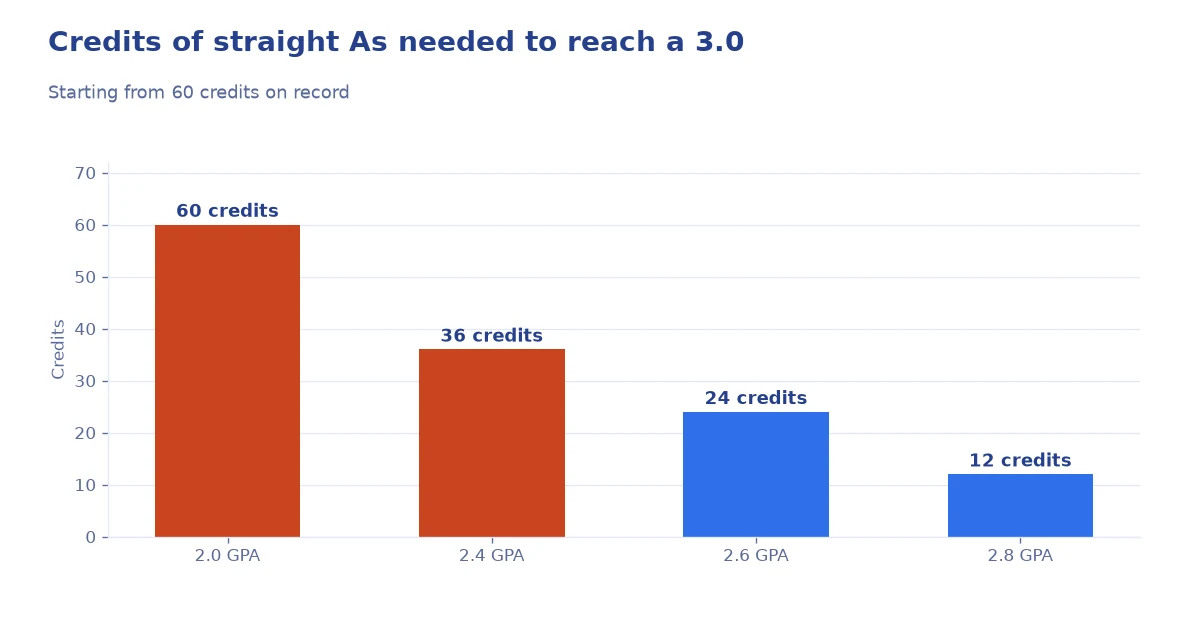
Cumulative GPA moves slowly once many credits are on record, so a goal is partly a question of how much time you have. The table shows how many more credits of straight As it takes, starting from 60 credits of work. The formula is credits needed = 60 × (goal − current) ÷ (4.0 − goal).
| Current GPA (60 credits) | To reach 2.5 | To reach 3.0 | To reach 3.5 |
|---|---|---|---|
| 2.00 | 20 credits | 60 credits | 180 credits |
| 2.40 | 4 credits | 36 credits | 132 credits |
| 2.60 | Already there | 24 credits | 108 credits |
| 2.80 | Already there | 12 credits | 84 credits |
| 3.00 | Already there | Already there | 60 credits |
| 3.20 | Already there | Already there | 36 credits |
Straight As is the extreme case. A more realistic plan is a steady average, and this second table shows the GPA you would need across the next 30 credits to reach 3.0 from several starting points.
| Credits already earned | Current GPA | GPA needed on the next 30 credits for 3.0 |
|---|---|---|
| 60 credits | 2.40 | Not reachable in 30 credits |
| 60 credits | 2.60 | 3.80 |
| 60 credits | 2.80 | 3.40 |
| 90 credits | 2.40 | Not reachable in 30 credits |
| 90 credits | 2.60 | Not reachable in 30 credits |
| 90 credits | 2.80 | 3.60 |
The target GPA planner in our college GPA calculator runs the same formula for your own numbers and shows the best and worst case.
What one letter grade step is worth
People often ask whether raising one grade is worth the effort. It depends on how many credits are on record, because the same improvement is spread across more credits as you go. This table shows the change in cumulative GPA from raising one 3 credit course by one full letter grade, such as C to B.
| Credits on record | One letter step (for example C to B) | One plus step (for example B to B+) |
|---|---|---|
| 30 | +0.10 | +0.03 |
| 60 | +0.05 | +0.02 |
| 90 | +0.03 | +0.01 |
| 120 | +0.03 | +0.01 |
Even a full letter step in one course moves a 90 credit GPA by only a few hundredths, so a plan that changes several courses, or one that targets high credit courses, does far more than a single heroic exam.
What admissions and employers see beyond the cumulative number
Many programs look at more than one GPA. The Illinois graduate minimum above is calculated from the last two years of undergraduate study, and your transcript also lists term GPAs, so a strong upward trend is visible. Some departments also look at the GPA in your major courses. If your cumulative number is below a goal, ask each program which GPA it uses before you decide it is out of reach.
What to do if your GPA falls short of your goal
Falling short of a goal is a planning problem, and these steps are in the order that usually saves the most time.
- Find out which GPA the goal uses: cumulative, last two years, or major only.
- Check whether your school replaces repeated grades. At the University of Cincinnati, for example, an approved replacement puts only the newest grade in the cumulative GPA, and replacements are capped at 18 semester credit hours (policy).
- Run the numbers with the planner so the target is a specific GPA on a specific number of credits.
- Put heavy credit courses first on your study plan, because a 4 credit grade moves the average more than a 1 credit grade.
- Plan the next two terms rather than the whole degree; short plans are easier to follow and still move a recent-terms GPA.
Free tools that help you plan your GPA
- College GPA calculator: semester, cumulative and target GPA in one place
- GPA calculator: high school, weighted and international scales
- Final grade calculator: the score you need on the final exam
- Weighted grade calculator: course grades from weighted categories
- Grade calculator: test and assignment percentages to letter grades
- Homework planner printable: plan study time around heavy credit courses
Related guides: Cumulative GPA explained (term, overall and major GPA, with a four-term example); GPA conversion chart (letter, percent and 4.0 scale lookups).
Sources
GradeInflation.com for average GPA data; Emporia State University and Stephen F. Austin State University for academic standing examples; University of Illinois Graduate College for a graduate admission minimum; University of Maryland Registrar for plus/minus grade points; University of Cincinnati Registrar for grade replacement. Policies change, so check your own catalog.
Frequently asked questions
8 quick answers
What is a good GPA in college?
A 3.0 or higher is a good GPA for most goals, and a 3.5 is strong. The minimum to stay in good standing and graduate is usually 2.0, and the average undergraduate is near 3.15, so “good” depends on whether you are aiming to graduate, win a scholarship or apply to graduate school.
Is a 3.5 GPA good in college?
Yes. A 3.5 is between an A- and a B+, above the average of about 3.15, and above the usual graduate admission floor of 3.0. Honors cutoffs differ by school, so check your own catalog.
What is a 3.0 GPA in college?
A 3.0 GPA is a B average on the standard 4.0 scale. It is above the 2.0 line for good standing and meets a common graduate minimum, though it sits a little below the national average.
What is a good GPA for graduate school?
Many graduate programs list 3.0 as a minimum, and some ask for more. Competitive departments often admit students well above the minimum, so look at the program’s own page and at which years of work it counts.
Is a 2.0 GPA bad?
A 2.0 is a C average. It usually keeps you in good standing and lets you graduate, but it leaves no margin, and it is below the 3.0 minimum that many graduate programs list. Raising it above 2.0 early gives you room if a hard course goes badly.
What is the average GPA in college?
GradeInflation.com reports about 3.15 for the average student by 2013 at four-year US colleges in its database. Private colleges averaged about 0.2 points higher than public ones, and the numbers vary by major.
How can I raise my GPA quickly?
Raise it where the credits are. Improve grades in high credit courses, use grade replacement if your school offers it, and run the numbers with a planner. One 3 credit D replaced with a B adds about 0.10 to a 60 credit GPA.
Does a cumulative GPA of 3.5 mean every term was 3.5?
No. It is a credit-weighted average, so a few terms above 3.5 can offset a lower one. A good guide to the arithmetic is our college GPA calculator.