A college GPA calculator turns your course credits and letter grades into a grade point average. Add each course, pick the grade, and the calculator gives your semester GPA, your cumulative GPA with any earlier credits, and the GPA you need next to reach a goal.
Quick answer: College GPA = total quality points ÷ total graded credits, where quality points are grade points × credits for each course. A 4 credit B+ (3.3) and a 3 credit A- (3.7) give 13.2 + 11.1 = 24.3 points over 7 credits, a 3.47 GPA.
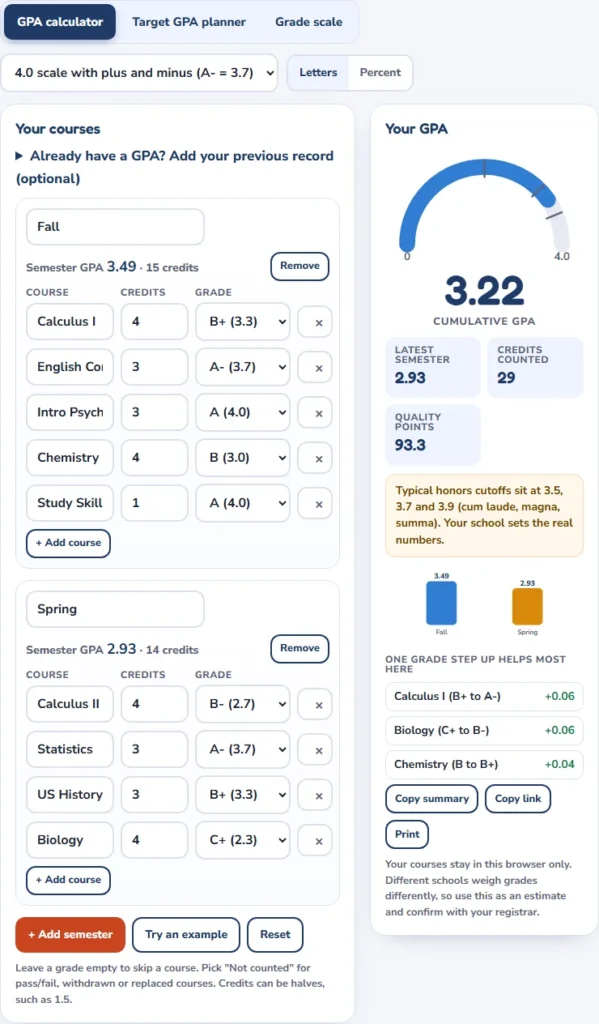
How to use the college GPA calculator
- Choose your grade scale at the top. The default is the common 4.0 scale with plus and minus grades; you can switch to letters only or to the 4.3 scale.
- Type each course, its credits and its grade. If your grades are percentages, switch to Percent and the calculator converts them with the usual US ranges.
- Open “Already have a GPA?” and add your current cumulative GPA and credits completed if you want a cumulative result that includes earlier terms.
- Press + Add semester for more terms. The gauge shows your cumulative GPA, the bars show each semester, and the list shows which courses a one grade step would help most.
- Use the Target GPA planner tab to see the average you need on future credits, or Copy summary and Print to save your result.
| Input | What to enter | Notes |
|---|---|---|
| Course name | Optional label | Helps you read the what-if list |
| Credits | Credit hours or units for the course | Halves are fine, such as 1.5; quarter-system credits can be entered as they appear on your transcript |
| Grade | Letter grade, or a percent in Percent mode | Pick “Not counted” for pass/fail, withdrawn or replaced courses |
| Previous GPA and credits | Your cumulative GPA and credits completed | Optional; used for the cumulative GPA and the planner |
The college GPA calculator keeps what you type in this browser only, so you can come back and update it next term. Use the full screen button above the calculator when you want more room on a phone.
How to calculate college GPA: formula and worked example
To calculate your college GPA, multiply each course’s grade points by its credits to get quality points, add the quality points, and divide by the total credits that count toward GPA. Courses graded pass/fail or withdrawn usually do not count.
| Course | Credits | Grade | Grade points | Quality points |
|---|---|---|---|---|
| Calculus I | 4 | B+ | 3.3 | 13.2 |
| English Composition | 3 | A- | 3.7 | 11.1 |
| Intro Psychology | 3 | A | 4.0 | 12.0 |
| Chemistry | 4 | B | 3.0 | 12.0 |
| Study Skills | 1 | A | 4.0 | 4.0 |
| Total | 15 | 52.3 |
The fall semester GPA is 52.3 ÷ 15 = 3.49. That is the whole method: the calculator repeats it for every course you add, so a heavy 4 credit class moves your GPA more than a 1 credit class.
Cumulative GPA calculator: combine semesters and earlier credits
A cumulative GPA calculator adds the quality points from every term and divides by every graded credit. You cannot average semester GPAs, because a 15 credit semester should count more than a 6 credit summer term.
Suppose you have a 3.10 cumulative GPA over 60 credits and then earn the 52.3 quality points above over 15 credits. Your new cumulative GPA is (3.10 × 60 + 52.3) ÷ (60 + 15) = 3.18.
| Record | Credits | GPA | Quality points |
|---|---|---|---|
| Before this term | 60 | 3.10 | 186.0 |
| This term | 15 | 3.49 | 52.3 |
| New cumulative | 75 | 3.18 | 238.3 |
Semester GPA calculator vs cumulative GPA
The semester GPA calculator part of the tool shows the GPA for one term, and the cumulative number covers everything on your record. Employers and programs usually ask for the cumulative GPA, while your dean’s list or probation status often depends on the semester GPA, so the calculator shows both.
College GPA scale: letter grades to grade points
Most US colleges use a 4.0 scale, but the details differ. These are the three versions the calculator supports. Your transcript or registrar page is the final word, so match the scale before you trust a result.
| Letter | 4.0 plus/minus | 4.0 letters only | 4.3 scale | Typical percent |
|---|---|---|---|---|
| A+ | 4.0 | – | 4.3 | 97 to 100 |
| A | 4.0 | 4.0 | 4.0 | 93 to 96 |
| A- | 3.7 | – | 3.7 | 90 to 92 |
| B+ | 3.3 | – | 3.3 | 87 to 89 |
| B | 3.0 | 3.0 | 3.0 | 83 to 86 |
| B- | 2.7 | – | 2.7 | 80 to 82 |
| C+ | 2.3 | – | 2.3 | 77 to 79 |
| C | 2.0 | 2.0 | 2.0 | 73 to 76 |
| C- | 1.7 | – | 1.7 | 70 to 72 |
| D+ | 1.3 | – | 1.3 | 67 to 69 |
| D | 1.0 | 1.0 | 1.0 | 63 to 66 |
| D- | 0.7 | – | 0.7 | 60 to 62 |
| F | 0.0 | 0.0 | 0.0 | below 60 |
The 4.0 GPA scale tops out at 4.0 even for an A+ at most schools, while the 4.3 scale gives an A+ 4.3 points. The percent ranges are the common US pattern; some instructors use 92 or 94 for an A, so use your syllabus when it differs.
GPA to percentage and percentage to GPA
There is no single official GPA to percentage formula, because each school sets its own cutoffs. A practical way is to match the letter grade: a 3.0 GPA is a B, which is usually 83 to 86 percent, and a 3.7 is an A-, usually 90 to 92 percent. Use Percent mode in the calculator to enter grades as numbers.
| GPA | Letter | Typical percent |
|---|---|---|
| 4.0 | A | 93 to 96 |
| 3.7 | A- | 90 to 92 |
| 3.3 | B+ | 87 to 89 |
| 3.0 | B | 83 to 86 |
| 2.7 | B- | 80 to 82 |
| 2.3 | C+ | 77 to 79 |
| 2.0 | C | 73 to 76 |
| 1.7 | C- | 70 to 72 |
| 1.3 | D+ | 67 to 69 |
| 1.0 | D | 63 to 66 |
| 0.7 | D- | 60 to 62 |
| 0.0 | F | below 60 |
For a quick percentage of a score before it becomes a grade, use the percentage calculator. For a weighted course grade, use the weighted grade calculator.
What GPA do I need? Target GPA planner
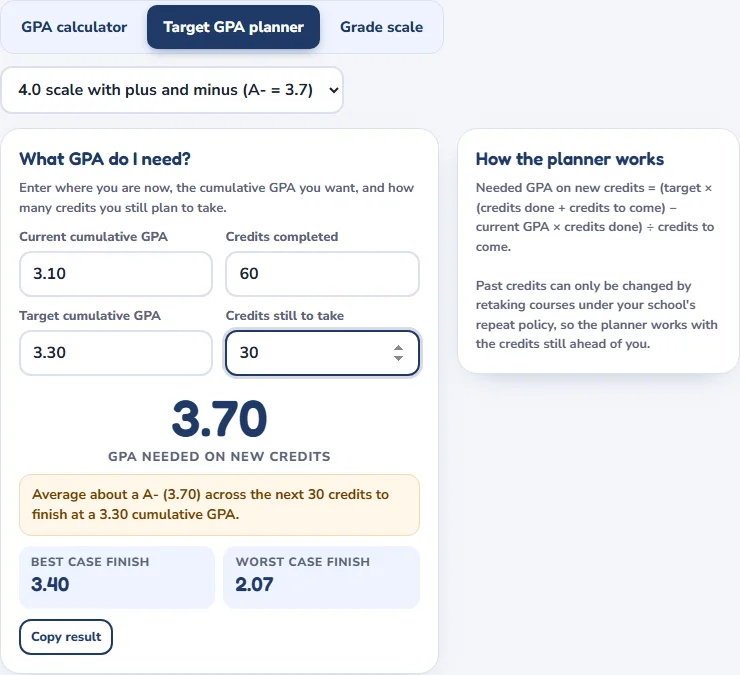
The planner answers the question “what GPA do I need” in one line: needed GPA = (target × (credits done + credits to come) − current GPA × credits done) ÷ credits to come. It also shows the best and worst finish, so you can see whether the goal is possible at all.
Here is the GPA you would need on future credits to move from a 3.10 over 60 credits to each target (4.0 scale):
| Target cumulative GPA | Next 15 credits | Next 30 credits | Next 45 credits | Next 60 credits |
|---|---|---|---|---|
| 3.20 | 3.60 | 3.40 | 3.33 | 3.30 |
| 3.30 | not reachable | 3.70 | 3.57 | 3.50 |
| 3.40 | not reachable | 4.00 | 3.80 | 3.70 |
| 3.50 | not reachable | not reachable | not reachable | 3.90 |
Raising a GPA is slow when many credits are already on the record: the more credits you have, the less each new semester moves the average. That also makes it hard for one bad term to wreck a long record.
How to raise your college GPA
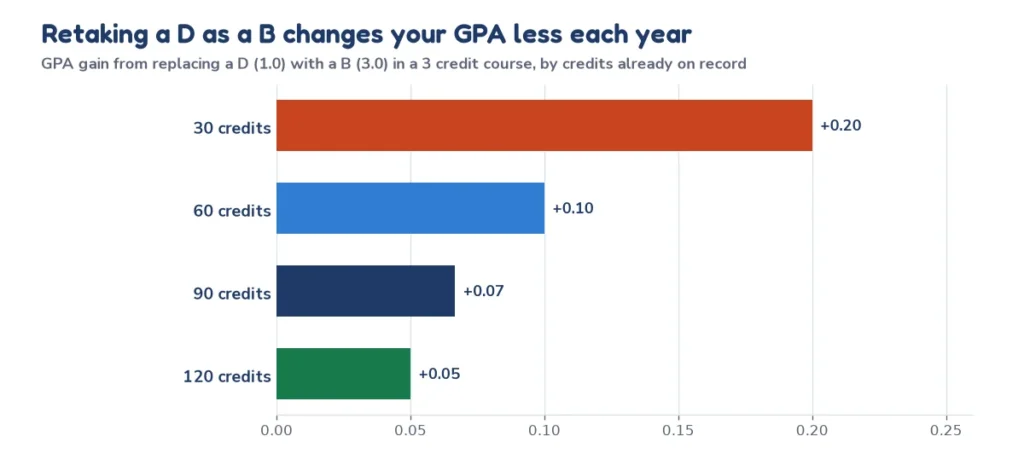
The fastest levers are credits and grades in the same place: improve the grade in a high credit course, repeat a low grade if your school replaces it, and avoid piling on credits in the same term as your hardest class. This table shows how much replacing a D (1.0) with a B (3.0) in a 3 credit course changes a cumulative GPA, assuming your school replaces the old grade:
| Credits on your record | GPA change from a D to a B in a 3 credit course |
|---|---|
| 30 | +0.20 |
| 60 | +0.10 |
| 90 | +0.07 |
| 120 | +0.05 |
Many schools average both attempts instead of replacing the first one, and some cap how many courses you can repeat. Ask your registrar before you retake anything, and mark the old attempt as “Not counted” in the calculator only if your school replaces it.
Is my GPA good? What a 3.0 and a 3.5 GPA mean
A 3.0 is a B average and is a common minimum for scholarships, honors programs and many graduate programs, while a 2.0 is the cutoff many schools use for good academic standing and graduation. A 3.5 sits between an A- and a B+ and often clears dean’s list and cum laude cutoffs, depending on the school.
For context, GradeInflation.com reports that the average undergraduate at a four-year US college had about a 3.15 GPA by 2013, using grade data from over 400 schools. Averages vary a lot between schools and majors, so compare your GPA to your own program, not only to a national number.
Dean’s list and Latin honors: the GPA behind cum laude
Latin honors are awarded at graduation, usually as cum laude, magna cum laude and summa cum laude. Many US schools use cutoffs near the numbers below, but others use class rank, a fixed percentage of the class or a higher GPA, so treat these as examples and read your school’s catalog. See Latin honors on Wikipedia for how the system varies by country.
| Honor | Commonly used GPA example | What decides it |
|---|---|---|
| Dean’s list (per semester) | About 3.5 | Semester GPA, often with a minimum number of credits |
| Cum laude | About 3.5 | Cumulative GPA, class rank or both |
| Magna cum laude | About 3.7 | Cumulative GPA, class rank or both |
| Summa cum laude | About 3.9 | Cumulative GPA, class rank or both |
Pass/fail, withdrawn, repeated and transfer credits
Courses taken pass/fail or withdrawn are normally left out of GPA, which is what the “Not counted” option does. Transfer credits often count toward your degree without counting in your GPA, so enter only the courses your own school grades. If you are on the quarter system, enter the credits shown on your transcript; as a rule of thumb one quarter credit is two thirds of a semester credit when you need to compare.
College GPA calculator for graduate and professional school
Application services recalculate your GPA using their own rules, so the number can differ from your transcript. LSAC computes a GPA for law school applications and AMCAS does the same for medical school. Use this calculator for your own planning, then check the service’s own rules before you apply.
Common college GPA mistakes
- Averaging semester GPAs instead of weighting by credits.
- Counting pass/fail or withdrawn courses as zero.
- Using a 4.3 or plus/minus scale when your school uses plain letters, or the other way round.
- Forgetting that some schools average repeated courses instead of replacing the first grade.
- Treating the honors cutoffs on a website as your school’s rule instead of reading the catalog.
When a college GPA calculator helps most
A college GPA calculator is most useful at four moments. Before registration, you can test how a heavy course load might affect your semester GPA. Midterm week is a good time to enter your current grades and see where you stand. After finals, the college GPA calculator confirms your cumulative GPA before the registrar posts it. And before applications for scholarships, internships or graduate school, the college GPA calculator shows how many credits of strong grades you need to cross a cutoff.
Because everything runs in your browser, you can try as many scenarios as you like. Change one grade, watch the cumulative GPA move, and use the what-if list to decide where extra study time pays off most. Treat the result as a planning estimate and your official transcript as the final record.
Typical semester results at a glance
It helps to know what a few common grade patterns produce before you open the college GPA calculator. Each row below assumes a 15 credit semester made of five 3 credit courses on the 4.0 plus/minus scale.
| Grade pattern | Quality points | Semester GPA |
|---|---|---|
| Five B grades | 45.0 | 3.00 |
| Three A grades and two B grades | 54.0 | 3.60 |
| Two A grades, two B+ grades and one B | 52.8 | 3.52 |
| Three B grades and two C grades | 39.0 | 2.60 |
| Four A- grades and one C+ | 51.3 | 3.42 |
Notice how a single weak grade costs less than people fear. One C+ among four A- grades still leaves a 3.42, which is why a college GPA calculator is more useful than worrying about one course. Enter your real courses to see your own number, then compare it with the target planner.
Frequently asked questions
9 quick answers
How do I calculate my college GPA?
Multiply each course’s grade points by its credits, add those quality points, and divide by the total graded credits. The calculator above does it as you type and shows each step.
How do I calculate my cumulative GPA?
Add your earlier quality points (GPA × credits) to the new quality points and divide by all credits. Add your current GPA and credits under “Already have a GPA?” and the calculator does this for you.
What is a good GPA in college?
A 3.0 or higher is a common benchmark for scholarships and many programs, and a 3.5 is often strong enough for dean’s list. What counts as good depends on your school, your major and your goals.
Is a 3.5 GPA good?
Yes, a 3.5 is between an A- and a B+ and is above the average of about 3.15 reported for four-year US colleges. It is usually enough for dean’s list and cum laude at many schools, but cutoffs vary.
What is a 3.0 GPA in percent?
A 3.0 GPA is a B, which is usually 83 to 86 percent. Some schools set the B range slightly differently, so check your syllabus.
How many credits should I take per semester?
Many bachelor’s degrees need 120 credits, so 15 credits a semester finishes in eight semesters, while 12 credits is usually the minimum for full-time status. Your degree plan and financial aid rules decide the right load for you.
Do pass/fail and withdrawn courses count in GPA?
Usually not. They affect credits earned but not GPA, which is why the calculator has a “Not counted” grade. Policies differ, so check your registrar.
How can I raise my GPA?
Use the what-if list and the planner: improve grades in high credit courses, repeat a low grade if your school replaces it, and remember that GPA moves slower as your credit total grows.
Is this calculator the same as my school’s GPA?
It uses the standard formula and common scales, so it should match for most schools. Schools with unusual scales, grade replacement or averaging rules may differ, so confirm with your registrar.
Related calculators and printables
- Good GPA in college: what counts as good for standing, honors and graduate school
- Cumulative GPA explained: term, overall and major GPA with a worked example
- GPA conversion chart: letter, percent and 4.0 scale lookups
- GPA calculator for high school, weighted and unweighted GPA and other countries
- Final grade calculator to find the score you need on a final exam
- Weighted grade calculator for course grades with weighted categories
- Grade calculator for the average of your assignments
- Percentage calculator for scores and percent grades
- Mean, median and mode calculator for class statistics
- Homework planner printable to plan study time around your credits
- All free calculators
Sources and further reading
- Grade point average on Wikipedia: definition and how GPA is calculated in different systems
- Academic grading in the United States on Wikipedia: letter grades and common percent ranges
- Latin honors on Wikipedia: how cum laude, magna and summa are used
- GradeInflation.com: average college GPA over time
Last reviewed: October 2026.