GPA conversion is a lookup, not a formula: convert each percent to a letter grade, then the letter to grade points, then weight by credits. This guide gives one chart that covers letter grade, percent and the main 4.0 scale variants, plus a worked example showing why converting an average percent can give a different GPA than converting course by course.
GPA conversion chart: letter grade, percent and grade points
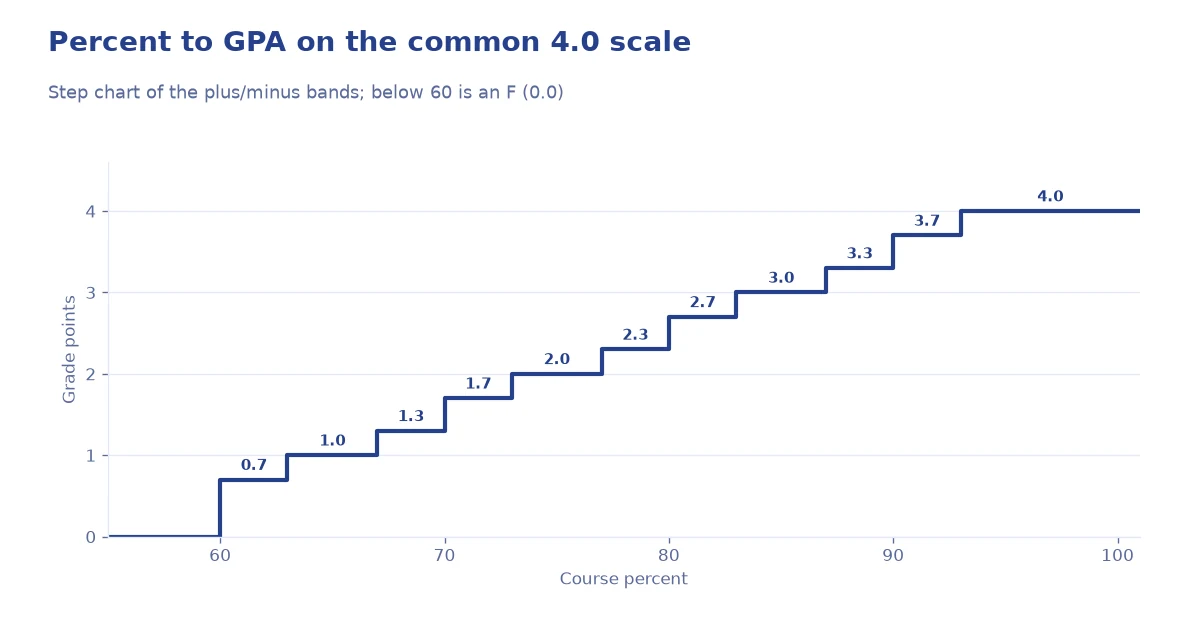
The percent ranges below are the common pattern in US schools, but instructors and departments set their own cutoffs, so treat them as a guide. The grade points in the 4.0 column are the plus/minus values published by the University of Maryland registrar, where A+ counts the same as A. The “thirds” column uses the one-third steps shown in the Illinois registrar example (B+ = 3.33).
| Letter grade | Common percent range | 4.0 scale (plus/minus) | 4.0 scale (thirds) | A+ counted as 4.33 |
|---|---|---|---|---|
| A+ | 97 to 100 | 4.0 | 4.00 | 4.33 |
| A | 93 to 96 | 4.0 | 4.00 | 4.00 |
| A- | 90 to 92 | 3.7 | 3.67 | 3.70 |
| B+ | 87 to 89 | 3.3 | 3.33 | 3.30 |
| B | 83 to 86 | 3.0 | 3.00 | 3.00 |
| B- | 80 to 82 | 2.7 | 2.67 | 2.70 |
| C+ | 77 to 79 | 2.3 | 2.33 | 2.30 |
| C | 73 to 76 | 2.0 | 2.00 | 2.00 |
| C- | 70 to 72 | 1.7 | 1.67 | 1.70 |
| D+ | 67 to 69 | 1.3 | 1.33 | 1.30 |
| D | 63 to 66 | 1.0 | 1.00 | 1.00 |
| D- | 60 to 62 | 0.7 | 0.67 | 0.70 |
| F | below 60 | 0.0 | 0.00 | 0.00 |
That last column matters only at schools that award more than 4.0 for an A+. Wikipedia notes that A+ is usually valued at 4.0, although 4.33 is used at some institutions, and that some schools add .25 or .3 instead of .33 for a plus.
Percentage to GPA: a lookup for every percent
Use this table when your course grade is a percentage. Find the percent, read the letter and the grade points, and multiply by credits as usual. It assumes the percent ranges in the chart above.
| Percent | Letter | GPA | Percent | Letter | GPA |
|---|---|---|---|---|---|
| 100% | A+ | 4.0 | 77% | C+ | 2.3 |
| 97% | A+ | 4.0 | 76% | C | 2.0 |
| 95% | A | 4.0 | 73% | C | 2.0 |
| 93% | A | 4.0 | 72% | C- | 1.7 |
| 92% | A- | 3.7 | 70% | C- | 1.7 |
| 90% | A- | 3.7 | 69% | D+ | 1.3 |
| 89% | B+ | 3.3 | 67% | D+ | 1.3 |
| 87% | B+ | 3.3 | 66% | D | 1.0 |
| 86% | B | 3.0 | 63% | D | 1.0 |
| 83% | B | 3.0 | 62% | D- | 0.7 |
| 82% | B- | 2.7 | 60% | D- | 0.7 |
| 80% | B- | 2.7 | 59% | F | 0.0 |
| 79% | C+ | 2.3 |
GPA to letter grade and to percent: what a GPA means in each system
Going backwards is less precise, because many percents map to one GPA. A GPA that falls between two letter grades is a mix. The table gives the nearest letter grade, the common range, and an estimated midpoint percent found by interpolating between the middle of each band. Use it as an estimate, not an official conversion.
| GPA | Nearest letter grade | Common percent range | Estimated percent |
|---|---|---|---|
| 2.0 | C | 73 to 76 | 74 |
| 2.5 | C+ / B- | 77 to 82 | 80 |
| 3.0 | B | 83 to 86 | 84 |
| 3.3 | B+ | 87 to 89 | 88 |
| 3.5 | B+ / A- | 87 to 92 | 90 |
| 3.7 | A- | 90 to 92 | 91 |
| 3.8 | A- / A | 90 to 96 | 92 |
| 3.9 | A- / A | 90 to 96 | 93 |
| 4.0 | A | 93 to 100 | 94 |
That is the logic behind answers such as 3.0 GPA to percentage (about 84, a B) and 3.5 GPA to percentage (about 89 to 90, between B+ and A-). If an admissions office or evaluator needs an exact figure, they will use their own conversion rules.
Why the same grades give a different GPA on a different scale
The scale matters more than people expect. Take one 16 credit semester and compute it under four common ways of valuing plus and minus grades.
The courses are: 4 credit B+, 3 credit A-, 3 credit A, 4 credit B and 2 credit A-.
| Scale | B+ is worth | A- is worth | Semester GPA |
|---|---|---|---|
| Plus/minus with tenths (3.3 / 3.7) | 3.3 | 3.7 | 3.48 |
| Plus/minus in thirds (3.33 / 3.67) | 3.33 | 3.67 | 3.48 |
| Plus/minus in quarters (3.25 / 3.75) | 3.25 | 3.75 | 3.48 |
| Letters only, no plus or minus | 3.0 | 4.0 | 3.50 |
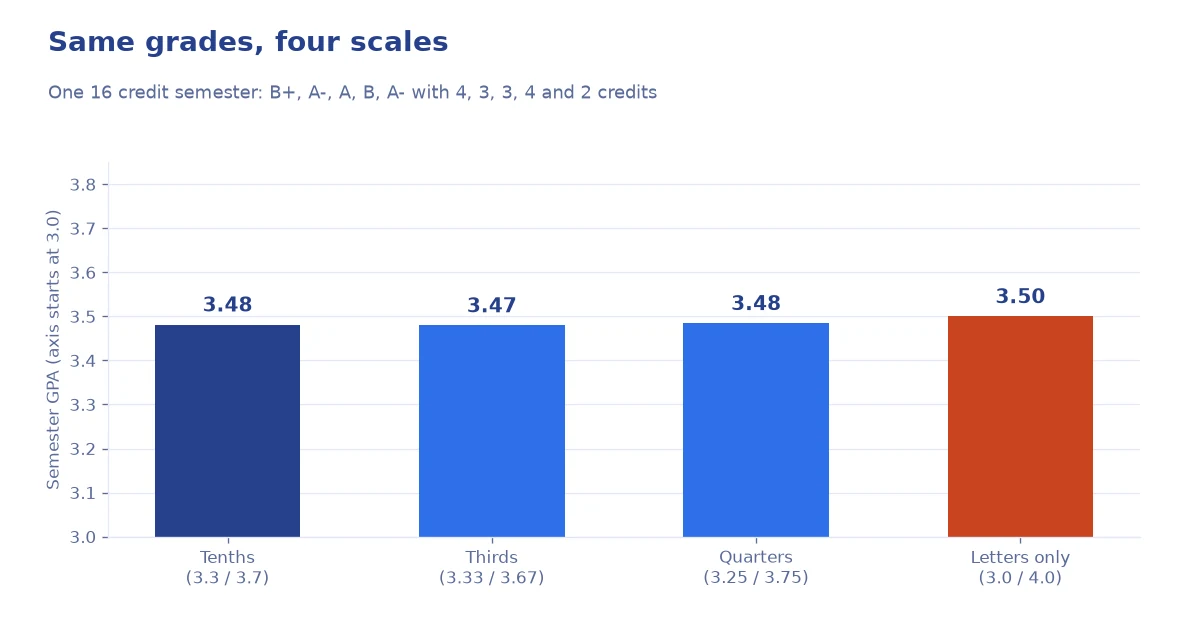
The spread is small here, but it can be enough to move a GPA across a cutoff such as 3.5. That is why you should use the scale printed in your own catalog, and why the college GPA calculator lets you switch between scales.
Do not convert an average percent: convert each course
If you have percent grades, converting each course before you average gives the right answer. Converting the average percent can land on a different letter and a different GPA. This example uses five courses.
| Course | Credits | Percent | Letter | Grade points | Quality points |
|---|---|---|---|---|---|
| Calculus | 4 | 94% | A | 4.0 | 16.0 |
| English | 3 | 88% | B+ | 3.3 | 9.9 |
| Chemistry | 4 | 81% | B- | 2.7 | 10.8 |
| History | 3 | 91% | A- | 3.7 | 11.1 |
| Spanish | 3 | 77% | C+ | 2.3 | 6.9 |
Course by course, the quality points are 54.7 over 17 credits, a GPA of 3.22. The credit-weighted average percent is 86.4, which is a B (3.0 points) if you convert it as one number. Course by course is closer to how your registrar does it, because each letter grade is awarded first.
How to do a GPA conversion by hand in four steps
- Write down every course with its credits and its percent or letter grade.
- Convert each percent to a letter using the ranges your school publishes, or use the lookup above.
- Convert each letter to grade points with your school’s scale, then multiply by the course credits.
- Add the quality points, divide by the total credits, and keep two decimals the way your school does.
A GPA conversion done this way takes about five minutes for a semester and is the same method your registrar uses. The result is only as good as the scale in step 3, which is why the table of four scales above is worth a look before you trust any GPA conversion you find online.
Restating your GPA for applications and evaluations
Scholarship offices, graduate programs and credential evaluators often restate your GPA using their own rules, so the number on their form can differ from your transcript. Some ask only for your cumulative average, some for the last two years, and some recalculate from raw grades. Before you spend time on a GPA conversion for an application, check which scale and which courses the form wants, and keep your course list and credits handy so you can recompute quickly if the rules change.
Do not round up. Some registrars, including Illinois and Georgia Tech, truncate to two decimals, so a 3.496 is a 3.49 on the transcript, and a form that asks for your transcript GPA expects that number, not a rounded 3.50. Run your exact figure first with the college GPA calculator, because 3.496 and 3.50 can fall on opposite sides of a cutoff.
When the 4.0 scale does not apply
Weighted GPAs add points for honors or Advanced Placement courses, and the extra points differ by school. Wikipedia lists examples where an A is worth 5 or 4.5 in AP courses, and other districts use their own tables. Outside the United States, scales such as the UK degree classes or Canadian percent grades are different systems again. Our GPA calculator covers weighted and international scales, and it is better than a generic chart for those cases.
Free tools for converting grades and GPA
- College GPA calculator: switch between 4.0, 4.3 and percent entry
- GPA calculator: weighted, unweighted and international scales
- Grade calculator: turn test scores into percent and letter grades
- Percentage calculator: percent of a score or change between two numbers
- Weighted grade calculator: a course grade from weighted categories
- Final grade calculator: what you need on the final exam
Related guides: Good GPA in college (what counts as good for standing, honors and graduate school); Cumulative GPA explained (term, overall and major GPA, with a four-term example).
Sources
University of Maryland Registrar: GPA Calculation for plus/minus values; University of Illinois Registrar for a one-third example and four types of GPA; Wikipedia: Academic grading in the United States for common percent ranges, plus/minus variants and weighted scales. Conversions are estimates; your own school’s published scale is the rule.
Frequently asked questions
7 quick answers
How do I convert percentage to GPA?
Convert the percent to a letter grade using your school’s ranges, then to grade points. On the common scale, 93 to 96 is an A (4.0), 90 to 92 an A- (3.7), 87 to 89 a B+ (3.3) and 83 to 86 a B (3.0). Do this per course, then weight by credits.
What is a 3.5 GPA as a percentage?
A 3.5 sits halfway between a B+ (87 to 89) and an A- (90 to 92), so it is roughly 89 to 90 percent. The exact figure depends on your school’s ranges.
What is a 3.0 GPA as a percentage?
A 3.0 is a B, which is usually 83 to 86 percent on the common US ranges.
What is the GPA to letter grade chart?
On the plus/minus scale, 4.0 is A, 3.7 is A-, 3.3 is B+, 3.0 is B, 2.7 is B-, 2.3 is C+, 2.0 is C, 1.7 is C-, 1.3 is D+, 1.0 is D and 0.0 is F. Some schools use thirds, so B+ is 3.33.
Is there an official GPA conversion formula?
There is no single official formula. Schools publish their own letter-to-points scales and percent ranges, and evaluators for international credentials follow their own methods. Use the chart in your catalog.
Why do two schools convert the same grades differently?
They value plus and minus grades differently (tenths, thirds, quarters or not at all) and may count A+ as 4.0 or more. Percent cutoffs also differ by instructor and department.
Can I convert a 4.0 GPA to a 4.3 GPA?
Only approximately. A 4.0 scale usually values A+ and A the same, while a 4.3 scale counts A+ higher, so the two agree for most grades below A+. Recalculate from your course grades for an exact figure.